Website profiles · Technology insights · Alternatives

the-fork.vercel.app

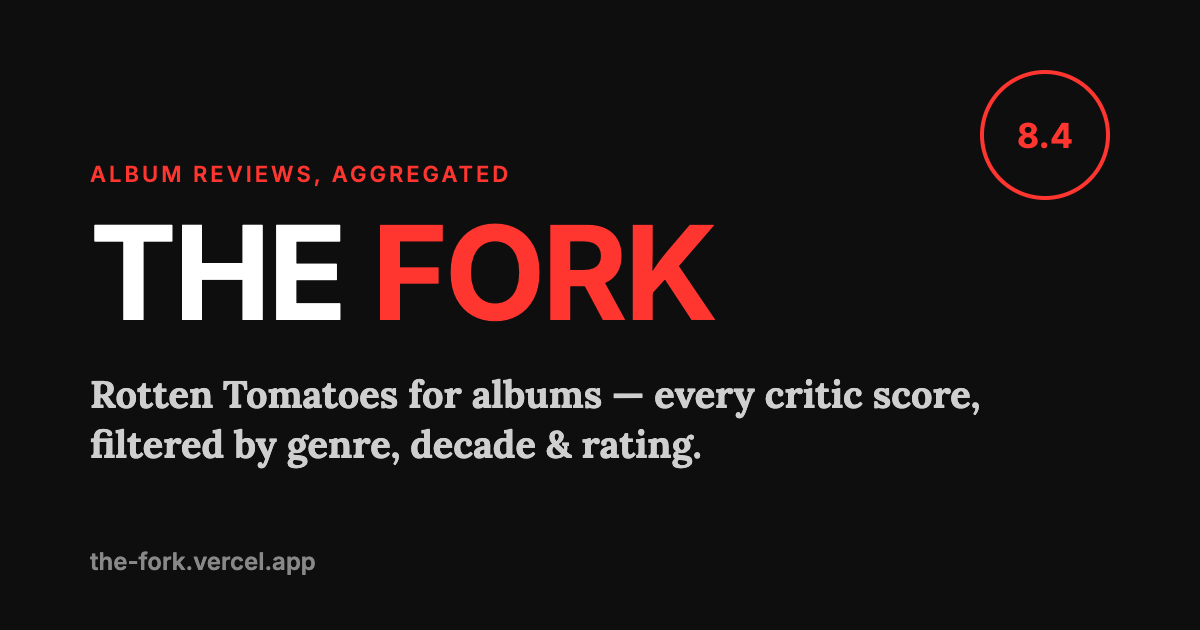
Rotten Tomatoes for albums — every critic review score aggregated and filterable by genre, decade, score, country and year.

No paid content found
Visit website
Profile views 11 Outbound visits 22 Normal
The Fork Full homepage screenshot

At a glance

Category
Music & Audio
Language
English
Paid-content signal
No paid content foundObserved
Registered
2020
Hosting
VercelInferred
HTTPS certificate trusted
PassedObserved
Last updated

Website review

This review may include AI-generated content and is not individually verified. Domain, certificate and other facts come from the observed data on this page.

What is The Fork?

The Fork is an album review aggregator — think of it as Rotten Tomatoes for music criticism. It collects critic scores for albums and lets you browse or filter them by genre, decade, score, country and release year.

The Fork

Who it suits

  • Music fans comparing reception. If you want to know whether an album was widely praised or savaged before you listen, an aggregated score is faster than reading five separate reviews.
  • Listeners exploring a genre or era. Filtering by decade, country or genre turns the site into a browsing tool rather than a lookup service — useful when you want a starting point for, say, 1990s Scandinavian releases.
  • People who prefer numbers to prose. A score lets you sort and scan quickly, though it flattens the reasoning behind each verdict.

What to weigh

Aggregators trade nuance for speed. A single number can't tell you why critics disagreed, and a mixed score sometimes reflects polarised reviews rather than lukewarm ones. Treat the score as a signal to investigate, not a verdict.

Next step: pick one album you already know well, look up its aggregate, and see whether the score matches your own experience. That calibration tells you how much to trust the site for records you don't know.

How does The Fork aggregate Pitchfork album review scores?

The Fork is built as a single aggregation layer for Pitchfork album reviews: it collects critic review scores into one browsable index, then lets you narrow that index by genre, decade, score, country and year. The visible page evidence is minimal — the site loads reviews progressively ("Loading reviews... Load more") — so the practical reading is that the catalogue is fetched in batches rather than shown all at once, and the filtering is what turns a long list into something usable.

In practice, that means you use The Fork less as a source of new criticism and more as a lookup and comparison tool.

What the aggregation is good for

  • Checking a score quickly. If you remember an album but not its Pitchfork number, the score filter and year or decade filters get you there faster than scrolling the publication itself.
  • Comparing across a period. Filtering by decade and genre is the strongest use case: it shows how Pitchfork's scoring tilted over time within a scene, which is hard to see from individual reviews.
  • Building listening lists. A score threshold plus a genre and country filter produces a shortlist you can take to a streaming service.

Trade-offs to expect

Aggregated scores lose context. A single number does not carry the review's argument, the writer's reservations, or the reissue-versus-new-release distinction. Treat any aggregated score as a pointer to the review, not a replacement for it.

Progressive loading also means very broad filters can be slow or incomplete on a first pass; narrow by decade or genre before scrolling.

A concrete workflow

Suppose you want to explore 1990s British electronic albums that scored well. Set decade to the 1990s, country to the UK, genre to electronic, then set a score floor. Skim the resulting list, note three or four titles, and read the actual Pitchfork reviews for those before committing listening time. For the original texts and scores in their native format, go to Pitchfork; for broader critical consensus and artist context, Metacritic and Album of the Year cover similar ground with different weighting.

Decision criterion

Use The Fork when you want to filter and compare Pitchfork scores at scale. Skip it when you want the reasoning behind a score — that still lives in the review itself.

Can I filter Pitchfork reviews by genre, decade, country, or year on The Fork?

Yes. The Fork is built around exactly that kind of filtering: it aggregates Pitchfork review scores and lets you narrow them by genre, decade, score, country and year, according to the site's own description. In practice, that means you can move from a broad browse of everything to a much tighter slice without leaving the page.

H3 What each filter is useful for

  • Genre — good for checking how a style was received over time, or for finding well-scored records in a niche you already follow.
  • Decade and year — useful for year-end catch-ups, "best of the 1990s" rabbit holes, or seeing whether a particular year was as strong as it felt at the time.
  • Country — helpful if you want to look beyond US and UK coverage and see how scenes elsewhere were reviewed.
  • Score — the most practical filter for triage: set a floor and you get a shortlist instead of a reading list.

H3 A concrete scenario

Suppose you want to find highly rated electronic albums from the 2010s by artists outside the US. Set genre to electronic, decade to 2010s, pick a country, and raise the score threshold. What would otherwise be hundreds of reviews becomes a manageable set you can actually listen through. The same approach works for a book club or a radio show: fix the genre and year, then sort by score to build a playlist.

H3 Trade-offs to keep in mind

Filtering by score is efficient but narrows your view toward consensus. Critics' highest scores cluster around well-known records, so a strict score floor will hide interesting mid-tier and divisive albums. If discovery matters more than validation, filter by genre and year, then browse the full spread rather than sorting to the top. Country filters also depend on how consistently a release's origin is recorded, so treat them as a rough guide rather than a precise map.

H3 Next step

Start with one filter that matches your goal — year for a retrospective, score for a shortlist, country for a scene survey — then add a second only if the list is still too long. If you want a second opinion on how a record was received elsewhere, cross-check with Metacritic or Album of the Year.

How do I find the highest or lowest rated albums on The Fork?

The Fork is built for exactly this task: it aggregates critic review scores for albums and lets you filter them by genre, decade, score, country and year. To surface the extremes, the practical move is to start from a filtered list and sort it by score rather than browsing album by album.

A workable routine

  1. Pick a scope first — a genre, decade or country. Unfiltered, "highest rated" tends to return a small set of canonised classics you have probably already heard.
  2. Sort the results by score, then read down from the top for the highest rated or up from the bottom for the lowest.
  3. Note that lists load in pages, so use "Load more" to extend past the first batch before you conclude you have seen the true top or bottom of a range.
  4. If a score filter is available, set a floor (for example, only highly scored albums) to skip the long middle, or a ceiling to isolate the weakest.

Choosing between highest and lowest

Goal What to filter What to expect
Find something to listen to Genre or decade, sorted high Familiar heavyweights; narrow the scope to surface less obvious picks
Understand critical consensus One artist or year, full score range A spread that shows where critics disagreed
Find genuine outliers Low sorting within a well-regarded genre Obscure or divisive records rather than simply bad ones

One caveat worth planning around

A low aggregate score often reflects a poorly received major release, not an undiscovered oddity, so low-score lists are more useful for context than for discovery. If you want the opposite — overlooked high scorers — filter to a narrow genre and a single year, then sort high; the smaller pool pushes genuinely strong but less famous records toward the top.

As a next step, pick one decade and one genre, sort by score, and load a couple of extra pages before deciding. If you want a second opinion on any album you find, Metacritic aggregates critic scores across music, film and television, and Album of the Year focuses specifically on album review aggregation.

Is The Fork affiliated with Pitchfork or does it use independent data?

The Fork is not Pitchfork. It describes itself as a separate aggregator — "Rotten Tomatoes for albums" — that gathers critic review scores and lets you filter them by genre, decade, score, country and year. Its name plays on Pitchfork's, but the aggregation model is closer to a review-metadata index than to a publication with its own editorial staff.

That distinction matters depending on what you need:

  • If you want Pitchfork's own verdicts, go to Pitchfork directly. The Fork is not a mirror of that one outlet's reviews.
  • If you want to compare how an album was received across many critics, an aggregator is the more useful starting point, because a single score is replaced by a spread.
  • If you want to cite a review, follow the aggregator's link back to the original publication and quote that, not the aggregate.

What the page itself shows: the only visible content is a loading state — "Loading reviews... Load more" — so the live index isn't described in the supplied page evidence. Treat the genre/decade/score/country filters as the site's stated offering rather than something verified here.

A practical test: pick one album you know well, find it on the site, and check whether the listed scores and linked reviews match what the original outlets published. If they do, it's functioning as an independent aggregator. If every score traces back to a single publication, it isn't.

For context on how this category of site usually works, review aggregators such as Metacritic and Rotten Tomatoes compile third-party critic scores rather than generating their own, and they attribute each score to its source. That's the model The Fork claims to follow.

How often is The Fork updated with new Pitchfork reviews?

The Fork does not state a fixed update schedule on its page. Its listing area shows a "Loading reviews…" state with a "Load more" control, which means reviews are fetched dynamically rather than published as a static, dated archive. In practice, that design suits near-continuous updating: the site can pull in new Pitchfork reviews as they appear instead of waiting for a weekly or monthly refresh.

H3 What this means for you

  • If you check the site on the day a review is published, you can reasonably expect it to show up quickly, but nothing on the page guarantees same-day coverage.
  • If a brand-new review is missing, it is more likely a lag in the data feed or matching than a deliberate editorial delay.
  • Historical reviews appear to be covered broadly, since the site offers filtering by genre, decade, score, country and year — useful for back-catalogue browsing rather than only new releases.

H3 A practical test Pick a review published by Pitchfork in the last 24–48 hours, then search The Fork for that artist and album. If it is already listed with a score, updates are effectively continuous. If not, check again the next day to gauge the typical delay before relying on the site for breaking coverage.

H3 Where it fits Use The Fork when you want aggregated critic scores you can filter by genre, decade, score, country or year — for example, building a shortlist of highly rated 1990s albums or comparing scores across countries. For release news and editorial context around a review, go to the source itself at Pitchfork. For broader film-and-TV-style aggregation habits, Rotten Tomatoes at Rotten Tomatoes shows the model this site borrows, while Metacritic is a useful cross-check when you want a weighted score alongside a simple average.

Related questions

More questions →
Can The Fork Filter Pitchfork Reviews by Country?

Yes. The Fork (the-fork.vercel.app) lists country as one of its filter dimensions, alongside genre, decade, score, and year. If you want to see which Pitchfork-reviewed albums are associated with a particular country or region, the country filter is the intended way to do it.

What the country filter does

The Fork aggregates Pitchfork review scores into a single browsable index — its own description frames it as "Rotten Tomatoes for albums," with every critic review score aggregated and filterable by genre, decade, score, country, and year.

In practice, that means:

  • Country is a first-class filter, not a search keyword. You select it the same way you select a genre or decade.
  • It narrows the album list, not the review text. You get the set of albums tied to that country, each with its aggregated Pitchfork score.
  • It combines with the other filters, so you can ask narrower questions rather than browsing one dimension at a time.

How to filter by country

  1. Open the-fork.vercel.app and let the review list load. The page shows a loading state ("Loading reviews...") before the index appears, so give it a moment on first visit.
  2. Find the filter controls for the index. Country sits alongside genre, decade, score, and year.
  3. Select the country you want. The album list updates to show only matching entries.
  4. Add more filters if you want a tighter result — for example, a country plus a decade, or a country plus a minimum score.
  5. Use Load more at the bottom of the list to page through additional results beyond the first batch.

The expected result is a shorter list of albums, each still carrying its aggregated Pitchfork score, restricted to the country you picked.

Useful combinations

Goal Filters to combine
Scene overview for one country Country only
A country's output in a specific era Country + decade
Strongly reviewed albums from one country Country + score threshold
A country's work within a genre Country + genre
A single year's releases from one country Country + year

Because the dimensions are independent, the same country can be cross-cut by genre, decade, score, or year without changing how the country filter itself behaves.

Things to keep in mind

  • Country reflects the album's associated origin, not the reviewer's location. Pitchfork reviews are written by critics, but the country dimension is about the music being indexed, so don't read it as "reviews written in country X."
  • Coverage depends on what Pitchfork reviewed. The Fork is an aggregator of Pitchfork scores, so a country with few Pitchfork-reviewed releases will show a thin list — that's a limit of the source, not the filter.
  • Filtering is browsing, not search. If you have a specific artist or album in mind, the country filter is the wrong entry point; it's built for exploring a region's catalog.
  • The list is paginated. A broad country selection can return more albums than fit on one screen, so use Load more rather than assuming the first page is everything.

If your question is "which albums from this country did Pitchfork review, and how did they score?", the country filter answers it directly. If your question is "what did Pitchfork say about this specific record?", you're better off going to Pitchfork itself.

What is The Fork (the-fork.vercel.app)?

The Fork is a fan-made web tool that aggregates Pitchfork album review scores into one filterable database. It works like Rotten Tomatoes for music criticism: instead of reading reviews one by one on Pitchfork, you can browse, sort, and filter every review score in a single interface. It is useful if you want to explore Pitchfork's review history by genre, decade, score, country, or year — for example, to find every album that scored above 8.0 in a given genre, or to see how a particular year's reviews were distributed. It is not an official Pitchfork product, and it does not host the review text itself; it organizes the scores.

What The Fork actually does

The site's own description frames it as "Rotten Tomatoes for albums — every critic review score aggregated and filterable by genre, decade, score, country and year." In practice, that means:

  • Aggregation: Pitchfork review scores are collected into one place rather than scattered across individual review pages.
  • Filtering: You can narrow the list by genre, decade, score range, country, and year.
  • Browsing: The interface loads reviews in a list, with a "Load more" control to page through results.

The page evidence shows the interface rendering "Loading reviews... Load more," which confirms the list is loaded progressively rather than all at once.

Who it is for

  • Casual listeners who want a quick sense of which Pitchfork-reviewed albums are considered strong in a genre or era.
  • Completionists and data-curious fans who want to slice Pitchfork's catalog by score or year.
  • Anyone comparing eras — for example, checking whether a given decade produced more high scores than another.

It is less useful if you want the actual review writing, context, or artist background — for that you still need Pitchfork itself.

How to use it

  1. Open the-fork.vercel.app in a browser.
  2. Wait for the review list to load (the page shows a loading state first).
  3. Apply filters — genre, decade, score, country, or year — to narrow the results.
  4. Use "Load more" to page through additional entries.
  5. Click through to a review if you want the original Pitchfork source.

Expected result: a filtered list of Pitchfork review scores matching your criteria, which you can scan quickly instead of visiting each review individually.

Things to keep in mind

  • Not official: The Fork is a third-party aggregator, so treat its data as a convenience layer, not the authoritative record. Verify anything important against Pitchfork directly.
  • Scores only: It aggregates scores, not full review text, so it won't replace reading the criticism.
  • Loading behavior: Because results load progressively, very broad filters may require several "Load more" clicks.
  • No pricing or login details are stated in the available page evidence, so don't assume the site is free, ad-free, or login-free without checking it yourself.

If your goal is fast, filterable access to Pitchfork's score history, The Fork is built for exactly that. If your goal is reading the reviews themselves, use it as an index and go to the source.

How to Filter Pitchfork Reviews on The Fork

The Fork (the-fork.vercel.app) is a review aggregator that collects Pitchfork album review scores in one place and lets you narrow them down by genre, decade, score, country, and year. To filter reviews, open the site, set one or more of those filters, and the list updates to show only matching albums; you then scroll and use "Load more" to page through additional results. This works well when you want to explore a specific era or genre rather than browse everything at once.

What The Fork Is

The Fork describes itself as "Rotten Tomatoes for albums" — a single page where every Pitchfork critic review score is aggregated and made filterable. Instead of searching Pitchfork directly and reading reviews one by one, you get a sortable, filterable index of scores.

The page loads reviews dynamically. On first visit you'll see a loading state ("Loading reviews...") before the list appears, and a "Load more" control at the bottom to pull in additional entries.

Available Filter Dimensions

Based on the site's own description, you can filter by:

Filter What it narrows down
Genre Albums in a specific musical style
Decade Releases grouped by decade (e.g., 1990s, 2000s)
Score Reviews within a score range or at a given rating
Country Albums by the artist's country
Year A specific release year

These dimensions can be combined, which is the main reason to use The Fork over reading Pitchfork directly — you can isolate, for example, high-scoring albums from a particular country in a particular decade.

How to Filter Reviews

  1. Open the site. Go to the-fork.vercel.app. Wait for the review list to finish loading — the page shows "Loading reviews..." until it's ready.
  2. Choose a filter. Select a value from any of the available filters (genre, decade, score, country, or year). The list should update to reflect your selection.
  3. Combine filters to narrow further. Add a second or third filter to shrink the result set. For example, pick a genre and a decade together to see only that style from that period.
  4. Browse the results. Scroll through the filtered list. Each entry represents an album with its aggregated critic score.
  5. Load more. When you reach the end of the visible results, use the "Load more" control to append additional matching reviews.

Expected result: a shorter, more relevant list of albums that match every filter you've set. If a combination returns nothing, loosen one filter (for example, widen the year or drop the country) until results appear.

When This Is Useful

  • Exploring a decade: Filter by decade to see how Pitchfork's scores clustered in a given era.
  • Exploring a genre: Filter by genre to find the highest- or lowest-rated albums in a style you care about.
  • Cross-referencing: Combine country and year to look at a specific scene or moment in music.
  • Score-based discovery: Use the score filter to surface only highly rated (or poorly rated) albums.

Common Snags

  • Empty results: Over-filtering is the usual cause. Remove one condition at a time.
  • List seems stuck: The page loads reviews asynchronously, so give it a moment after changing filters before assuming nothing happened.
  • Not seeing more entries: You need to trigger "Load more" — the initial view doesn't show the full dataset.

The Fork doesn't publish pricing or account requirements on the page, so treat it as a browsing tool and check the site itself for any current limitations.

Where does The Fork get its Pitchfork review scores?

The Fork (the-fork.vercel.app) draws its scores from Pitchfork's own album reviews. The site describes itself as "Rotten Tomatoes for albums" and states that it aggregates "every critic review score," filterable by genre, decade, score, country, and year. So the underlying ratings are Pitchfork's review scores, not a separate or independent scoring system.

What the site says about its data

The Fork's own description is the clearest statement of scope:

  • Source: Pitchfork album reviews
  • Coverage: "every critic review score" — i.e., it aims to include all of them, not a curated subset
  • Aggregation: scores are collected and displayed together in one browsable, filterable list
  • Filters: genre, decade, score, country, and year

The "Rotten Tomatoes for albums" framing is useful for understanding the model: Pitchfork supplies the individual review scores, and The Fork is the layer that gathers them into one place and makes them sortable.

How the data loads

The page evidence shows the interface rendering as "Loading reviews… Load more." That tells you two things about how the data reaches you:

  1. Reviews are fetched dynamically rather than baked into a single static page.
  2. Results are paginated — you see an initial batch, then pull in more with "Load more."

In practice, if the list looks empty or incomplete at first, it's likely still loading or waiting for you to request the next batch, not a sign that the dataset is missing.

What this means for using the scores

Because the scores originate from Pitchfork, The Fork is best understood as an index and filter tool rather than a new rating authority. If you want to know how a given album was received, the score you see traces back to Pitchfork's review. If you want to browse by genre, decade, score range, country, or year, that's the value The Fork adds on top.

One caveat worth keeping in mind: the site's description states the coverage goal ("every critic review score"), but the page itself only shows a loading state and a "Load more" control in the available evidence. Whether the collection is truly complete, and how current it is, isn't something the visible page content confirms — so treat the "every" claim as the site's stated intent rather than a verified count.

How Is The Fork Different From Browsing Pitchfork Directly?

The Fork (the-fork.vercel.app) is a review aggregator that presents Pitchfork scores as a filterable list, rather than as editorial articles. The practical difference is speed and comparison: on The Fork you scan and sort many scores at once; on Pitchfork you read one review at a time in its original context. If your goal is to find, compare, or filter scores across genres, decades, countries, or years, The Fork is built for that. If you want the full review text, artwork, and editorial framing, Pitchfork itself is the source.

What The Fork actually is

The Fork describes itself as "Rotten Tomatoes for albums — every critic review score aggregated and filterable by genre, decade, score, country and year." In other words, it takes Pitchfork review scores and turns them into a browsable, sortable dataset-style list.

That framing matters. Rotten Tomatoes doesn't replace reading a film review — it gives you a quick aggregate signal. The Fork plays the same role for Pitchfork album scores.

The core differences

Dimension The Fork Pitchfork directly
Primary unit A score in a filterable list A full review article
Browsing mode Scan, filter, sort many albums Read one review at a time
Comparison Compare scores across genre, decade, country, year Manual, one page at a time
Context Score-focused Full editorial text, framing, artwork
Best for Quick score comparison and discovery Understanding the critic's argument

Where The Fork wins

  • Filtering by multiple dimensions. Genre, decade, score range, country, and year can be combined — something Pitchfork's own site doesn't offer as a single view.
  • Fast comparison. If you want to see how a run of albums scored, or find highly rated records in a specific genre and era, a list view beats opening dozens of tabs.
  • Aggregate perspective. The "Rotten Tomatoes for albums" framing means you get a signal-first view rather than an article-first one.

Where Pitchfork wins

  • The actual review. The Fork aggregates scores; it doesn't reproduce the critic's writing, argument, or context.
  • Editorial framing. Pitchfork's Best New Music tags, feature writing, and news live on Pitchfork, not in an aggregator.
  • Original presentation. Artwork, layout, and the reading experience are Pitchfork's.

How to decide

Choose The Fork when you want to:

  • Find top-scored albums within a genre, decade, or country.
  • Compare scores across a set of records quickly.
  • Treat Pitchfork scores as data to filter rather than articles to read.

Choose Pitchfork directly when you want to:

  • Read the full review and the critic's reasoning.
  • Follow editorial curation like Best New Music.
  • Stay within the original publication's context.

A reasonable workflow is to use The Fork to shortlist, then go to Pitchfork for the reviews that matter to you.

One caveat

The Fork's page loads reviews dynamically ("Loading reviews... Load more"), so the visible list depends on scrolling or loading more entries. If a filter seems to return few results, load additional entries before concluding the dataset is thin.

Website Overview

An established domain and managed infrastructure suggest continuity of operations and may support dependable delivery, although neither guarantees service quality.

Domain and Registration

Registered in 2020, this domain has about 6 years of history. That suggests continuity, although ownership and purpose may have changed. Transfer-protection status is present, helping reduce the risk of unauthorized domain transfers. The registrar is Tucows Domains Inc, a widely used domain service provider. The domain uses the common .app extension, which is not an independent safety signal.

DNS and Email

Nameservers are provided by vercel-dns-3.com, indicating managed DNS hosting. CAA records restrict which certificate authorities are authorized to issue certificates. No CNAME was found; the observed records resolve directly to addresses. No MX record was found. A conventional explicit inbound-mail route is not configured. TXT records include verification markers for Google. Such markers may also remain after a service stops being used.

TLS and Certificates

The certificate uses an RSA 2048-bit public key, offering broad client compatibility. The server supplied a complete certificate chain. No organization name is present in the certificate; the available fields are consistent with domain validation. The certificate was issued within the Google Trust Services cloud or CDN ecosystem. The certificate's total validity is about 89 days, consistent with a short renewal cycle.

HTTP and Browser Security

The response lacks these common security headers: CSP, X-Content-Type-Options, Referrer-Policy, Permissions-Policy, clickjacking protection. CORS permits any origin to read this response. This is common for public resources; sensitive responses need narrower handling. No X-Powered-By header was found, reducing one common source of backend fingerprinting information. No obvious internal addresses or debug information were found in the headers. The Server header contains the custom value Vercel.

Technology Stack Analysis

The public page identifies Vercel without precise versions, leaving fewer clues for version-specific scanning.

Search and Social Sharing

No homepage canonical URL was detected. If duplicate URLs exist, consolidation may be less explicit. Twitter Card metadata is configured. The title has 33 characters, within a common display range. A meta description is present, with 123 characters. The observed directives allow indexing and link following.

Hosting and Email

DNSvercel-dns-3.com
HostingVercel
EmailUnknown
Approximate IP geolocation (inferred; a CDN or proxy may differ from the origin server) United States flagUnited States Inferred 216.198.79.195

Registration details

RDAP / WHOIS

RegistrarTucows Domains Inc
Registered2020-01-28
Expires2036-01-28
Domain statusclient transfer prohibited、client update prohibited
Nameserversns1.vercel-dns-3.com、ns2.vercel-dns-3.com、ns3.vercel-dns-3.com、ns4.vercel-dns-3.com
DNSSECunsigned

DNS records

DNS

TypeNameValueTTLPriority
Athe-fork.vercel.app216.198.79.195300—
Athe-fork.vercel.app64.29.17.195300—
NSvercel.appns1.vercel-dns-3.com75663—
NSvercel.appns2.vercel-dns-3.com75663—
NSvercel.appns3.vercel-dns-3.com75663—
NSvercel.appns4.vercel-dns-3.com75663—
TXTvercel.appgoogle-site-verification=ye33zD88WkvAKX2-F2WH7Fi-QkAzvvWaPJQneD6Vt802480—
TXTvercel.appv=spf1 -all2480—
CAAvercel.app0 issue "letsencrypt.org"3600—
CAAvercel.app0 issue "pki.goog"3600—
DMARC_dmarc.vercel.appv=DMARC1; p=reject; sp=reject; adkim=s; aspf=s;3600—

TLS and certificates

TLS / SSL

AssessmentNormal configuration
Supported protocolsTLSv1.2、TLSv1.3
Negotiated protocolTLSv1.3
Certificate subject*.vercel.app
IssuerGoogle Trust Services
Valid until2026-11-27T19:48 · Remaining when checked: 58 days
Verification detailsCertificate trust: Passed · Hostname match: Passed

HTTP response headers

HTTP

HeaderValue
content-typetext/html; charset=utf-8
cache-controlpublic, max-age=0, must-revalidate
serverVercel
strict-transport-securitymax-age=63072000; includeSubDomains; preload
access-control-allow-origin*

Identified technologies

Vercel

Pages, Search and Sharing

Meta descriptionRotten Tomatoes for albums — every critic review score aggregated and filterable by genre, decade, score, country and year.
Canonical URLNot detected
LanguageEnglish (default)
Twitter Cardsummary_large_image
All bots 1 allowed · 0 disallowed
  • Allow/

User reviews (0)

  • No reviews yet.