Website profiles · Technology insights · Alternatives

thehtml.review

the html review is an annual journal of literature made to exist on the web

No paid content found
Visit website
Profile views 6 Outbound visits 1 Normal
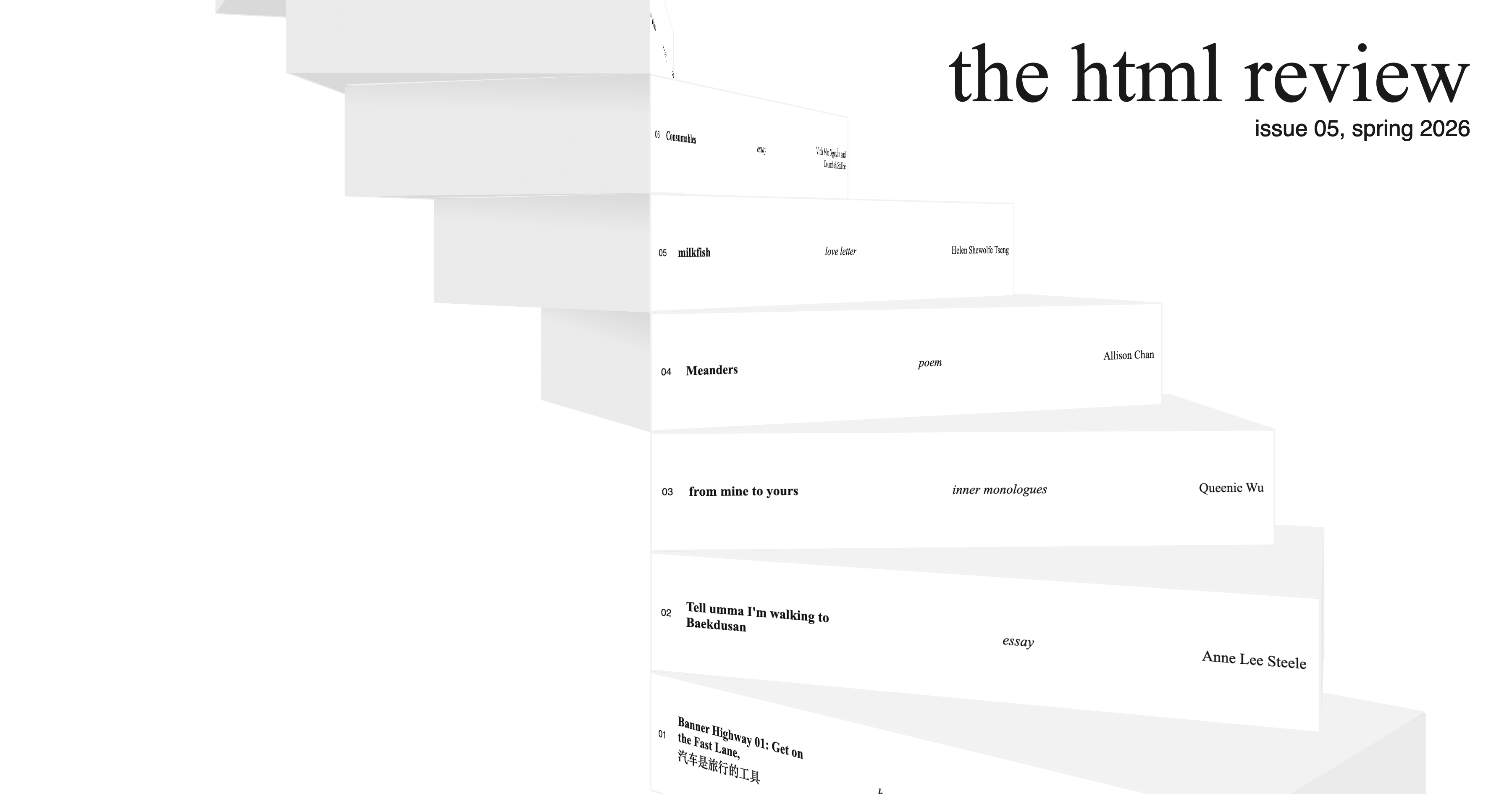
the html review 05 Full homepage screenshot

At a glance

Category
News
Language
English
Paid-content signal
No paid content foundObserved
Registered
2021
Hosting
NetlifyInferred
HTTPS certificate trusted
PassedObserved
Last updated

Website review

This review may include AI-generated content and is not individually verified. Domain, certificate and other facts come from the observed data on this page.

What is the html review?

The HTML Review is an annual journal of literature made to exist on the web. Rather than treating the browser as a container for scanned or reprinted text, it publishes work that depends on the medium: poems, essays, folktales, webtoons, multiplayer music systems and small interactive artifacts that would lose something essential if printed on paper. Issue 05, spring 2026, is the current edition, and the archive and about pages hold the back issues.

What actually appears in an issue

The table of contents reads like a curated exhibition rather than a standard literary magazine. A few examples from issue 05:

  • Angel in Latency, a poem by Grace Dignazio spoken by a bound creation addressing the reader through the screen.
  • carecore, a CSS botany piece by Raphaël Bastide dedicated to caregivers.
  • Intersymmetric: Connect, a multiplayer music system by James Bradbury, Rian Treanor and Mark Fell that asks you to unmute your device and join.
  • les aventures de mr mister in the land of lines, a webtoon by zeste le reste whose main character is built from CSS.
  • Kp'ọjọ kp'ọjọ, a folktale by Omayeli Arenyeka about Itsẹkiri as a language of secrets and, increasingly, of tenderness.
  • Banner Highway 01, a series by Richard Lewei Huang and Yufeng Zhao that revives Burma-Shave roadside ad-poems for the information superhighway.

The recurring subjects are memory, language loss, care, surveillance and the odd intimacy of screens — but the through-line is formal. Each piece is built out of the web's own materials: CSS, audio, cursor movement, scrolling, live connection between visitors.

Who it is for

Readers who like contemporary poetry and short prose but are bored by PDF-style literary PDFs will find the most here. So will designers and creative coders who want to see browser-native craft treated as literature rather than as a demo reel. Teachers looking for short, discussable digital works have an obvious use for it, since individual pieces are brief and self-contained.

The trade-off is real: some works need sound, a mouse, or a stable connection, and a few reward patience more than a quick skim. If you read on a phone with muted audio, you will miss part of what several pieces are doing.

A practical next step

Open issue 05 and start with one short piece rather than the whole table of contents — Meanders by Allison Chan or from mine to yours by Queenie Wu are gentle entry points. Read with sound on and a cursor available, then move to the interactive and multiplayer works once you know how the journal handles the screen. If you want context on how the form has developed, the archive is the place to compare earlier issues.

Can I read the current issue 05 online for free?

Yes. Issue 05, spring 2026, is readable in the browser at the journal's own site, the html review. The journal describes itself as an annual journal of literature made to exist on the web, so the works are web-native pieces rather than PDFs or print scans. The issue page lists fifteen pieces, each with a number, title, form label, creator and a short description, and each title is the entry point to the work.

What "reading" involves here

The pieces are not all conventional text. The form labels on the issue page include poem, CSS botany, webtoon, multiplayer music system, interconnected stories, folktale, conversation, artifact of memory, essay, love letter, inner monologues and banner ad archeology. A few examples of what a visitor encounters:

  • "Intersymmetric: Connect" by James Bradbury, Rian Treanor and Mark Fell is described as a multiplayer music system, with a note to start audio and unmute your device.
  • "carecore" by Raphaël Bastide is CSS botany, described as dedicated to all caregivers.
  • "les aventures de mr mister in the land of lines" by zeste le reste is a webtoon whose main character is made of CSS.
  • "Banner Highway 01" by Richard Lewei Huang and Yufeng Zhao is a browser-based visual poetry series reimagining Burma-Shave roadside advertisement-poems for the Information Superhighway.
  • "Kp'ọjọ kp'ọjọ" by Omayeli Arenyeka is a folktale, with the note that Itsẹkiri was the language of secrets and is becoming the language of tenderness.

Practical notes before you start

Expect to interact rather than scroll passively: some works ask for audio, cursor movement, clicking or sitting with a screen for a while. The pieces that involve sound are the ones most likely to need a desktop or laptop with working speakers or headphones, while text-led works such as the poems and essays read fine on a phone. If a piece feels broken, try a current browser with scripts enabled, since CSS and JavaScript are part of the medium here.

A sensible next step: open the issue page, skim the fifteen one-line descriptions, and pick two that match your mood and device, one text piece and one interactive piece. The archive and about pages are listed alongside the issue if you want to see how earlier issues handled the same web-native approach.

How are the works in the html review different from ebooks or print journals?

The works in the html review are built to run in a browser, not to be read as fixed pages. The journal describes itself as "literature made to exist on the web," and the issue 05 contents show what that means in practice: a poem about an AI bound to its matrix, a "CSS botany" project dedicated to caregivers, a webtoon whose main character is a CSS element, a multiplayer music system, and a piece that asks you to start audio and unmute your device. These are not texts with a web page wrapped around them; the behavior of the page—layout, interaction, sound, code—is part of the work.

What changes for the reader

In a print journal or an ebook, the artifact is stable. You can dog-ear a page, highlight a sentence, or hand your copy to someone else and know they will see the same thing. In a browser-based journal, the reading environment is part of the piece. A work like "Intersymmetric: Connect" expects multiple participants and audio; "Cursor Park" frames itself as a "place of refuge," which reads differently when you are sitting inside it than when you are reading about it. Some pieces may depend on your device, your bandwidth, or your willingness to click and listen.

That also changes how you cite and revisit. A print poem has a page number. A web-native work may have a URL, but its state can depend on interaction, screen size, or time. The trade-off is real: less permanence and portability, more immediacy and range.

A quick comparison

Dimension Print journal / ebook the html review
Primary medium Ink on paper or fixed EPUB pages Live browser environment
Reader role Mostly reading and turning pages Reading, clicking, listening, sometimes participating
Stability Fixed edition, page numbers Can vary by device, browser, and interaction
Sharing Hand over the book Send a link; the recipient's experience may differ
Best for Linear reading, annotation, archiving Experiencing form and interaction as content

Who gets the most from it

Readers who enjoy electronic literature, net art, and experimental poetry will find the format itself meaningful rather than incidental. Teachers working on digital writing can use individual pieces to show how code and interface carry tone—"carecore" is a clear example, since its subject is caregiving and its method is CSS. If you mainly want to read on a commute, offline, or with a stylus in the margins, a print or ebook journal will serve you better.

A useful next step: open one work that matches your interests—say, the folktale "Kp'ọjọ kp'ọjọ" for narrative or "Singing Light" for atmosphere—and notice what the browser is doing that a printed page could not. If that interaction feels like part of the meaning, the journal's approach is working for you; if it feels like an obstacle, a conventional journal is the better fit. For broader context on web-native literature, the html review is the journal itself, and the Electronic Literature Organization documents the wider field.

What kinds of digital art and literature are featured in issue 05?

Issue 05 gathers work that only makes sense as a web page: poems that address you from inside a screen, essays that scroll like a walk, music you play in a browser with other people, and visual pieces built from CSS rather than images. The through-line is literature and art that uses the web's own materials — code, links, cursors, sound, latency — as its medium.

What the issue contains

  • Poetry and inner monologue: “Angel in Latency” by Grace Dignazio speaks as a bounded creation trying to reach you through a display; “Meanders” by Allison Chan draws a map from sea to sky; Queenie Wu’s “from mine to yours” reads as a reminder to walk and let things pass.
  • Essays and memory work: Anne Lee Steele’s “Tell umma I’m walking to Baekdusan” maps a landscape on screen across seasons; “Consumables” by Vinh Mai Nguyễn and Coumbah Sidibé turns everyday disposability into an essay; “Afterimages” by Nicci Yin treats memory as an artifact.
  • Folk and language: Omayeli Arenyeka’s “Kp’ọjọ kp’ọjọ” considers Itsẹkiri as both the language of secrets and of tenderness; Katarina Dorothea Isaksen’s “Singing Light” links stories during the polar night.
  • Web-native form play: Raphaël Bastide’s “carecore” is CSS botany for caregivers; “les aventures de mr mister in the land of lines” is a webtoon whose main character is CSS; Richard Lewei Huang and Yufeng Zhao’s “Banner Highway 01” revives roadside ad-poems as browser-based visual poetry.
  • Sound and social space: “Intersymmetric: Connect” by James Bradbury, Rian Treanor and Mark Fell is a multiplayer music system that asks you to unmute; Christopher Shank’s “Cursor Park” offers a place of refuge and a question about sitting next to someone on the internet; Connie Liu’s “Photographic Memory” is a conversation.
  • Slow pleasure: Helen Shewolfe Tseng’s “milkfish” is a love letter to persistence, to a fish dating back to the Early Cretaceous, and to pleasures that take time.

How to approach it

Read on a laptop with sound on, and give each piece more than a glance — several depend on interaction, audio or gradual reveal. If you want a starting point, try a short poem first, then a piece with sound or multiplayer elements, so you can tell which mode of web-native work holds your attention. For context on the journal’s broader project, see The HTML Review.

How can I submit my own web-based literature to the html review?

The site itself doesn't publish submission guidelines on the page you're asking about, so the reliable route is to start from the journal's own navigation. the html review lists an Archive and an About section alongside the current issue; the About page is where an annual journal normally states its reading period, editor contacts and what "made to exist on the web" means in practice. Read that page first, then send a short query rather than a finished piece if no window is open.

What "made to exist on the web" implies for your pitch

The issue 05 contents show the range the editors actually publish:

  • Poetry and essays that use the browser as a surface — "Angel in Latency" (a poem), "Meanders" (a poem), "Tell umma I'm walking to Baekdusan" (an essay about walking a landscape on a screen).
  • Works where code is the material — "carecore" is described as CSS botany; "les aventures de mr mister in the land of lines" is a webtoon whose main character is CSS.
  • Interactive and multiplayer pieces — "Cursor Park," a place of refuge, and "Intersymmetric," a multiplayer music system with an audio start prompt.
  • Form-driven experiments — "Banner Highway 01," banner-ad archeology reworking roadside advertisement poems.

The practical lesson: a plain PDF or a Word document is unlikely to be the right container. If your piece only works as text on a page, it may not fit; if it breaks, moves, listens, or responds when opened in a browser, it's closer to what this journal exists for.

A concrete next step

Write a one-paragraph description of your piece that names its medium (HTML/CSS/JS, audio, canvas, generative text), its ideal reading situation (desktop, headphones, five uninterrupted minutes), and one sentence on why the web is necessary rather than convenient. Then check the About page for the current reading period and submission address, and send that paragraph as a query before building anything new.

Decision criteria for whether to submit here

If your work is… This journal is…
Browser-native, code-dependent, or interactive A strong fit
A conventional short story or lyric set Probably a mismatch
A one-off experiment you can't host yourself Worth asking about hosting and archiving
Already published elsewhere Check the About page for prior-publication rules

For context on how other web-native literary venues frame submissions, Electronic Literature Organization maintains directories of publishers and journals in this space, which can help you judge whether your piece belongs with an annual journal or a rolling online magazine.

Where can I find past issues and the archive of the html review?

Past issues live in the site's own Archive section, reachable from the top navigation of the html review. The current page is issue 05 (spring 2026), and the archive is where earlier annual issues are collected, since the journal publishes once a year.

How to use it

  • Start at the html review and open Archive in the header.
  • Treat each issue as a numbered set: the pieces on the current page are numbered 01–15, so an archive entry for another year will look similar.
  • If you want a specific work rather than a whole issue, note its title and maker — for example "Angel in Latency" by Grace Dignazio, "carecore" by Raphaël Bastide, or "Banner Highway 01" by Richard Lewei Huang and Yufeng Zhao — and look for those names in the archive listing.

Why browse the archive rather than just the latest issue

The journal's premise is literature written to exist on the web, so older issues are not just back catalogue; they are working web pieces that may behave differently as browsers change. Reading an early issue alongside the current one is the most direct way to see how the format has developed.

A practical next step: open the archive in one tab and the current issue in another, then compare one piece from each — say a poem such as "Meanders" by Allison Chan against a more interactive entry like "Intersymmetric: Connect" by James Bradbury, Rian Treanor and Mark Fell. That contrast tells you quickly whether you are there for the writing, the interaction, or both.

Related questions

More questions →
What kinds of works are published in The HTML Review?

The HTML Review publishes literature and art that is built to exist on the web, meaning the browser is the medium rather than just a container for text. According to the journal's own description, it is "an annual journal of literature made to exist on the web," and the current issue is issue 05, spring 2026. The works in that issue span poems, CSS-based botany, a webtoon, a multiplayer music system, a folktale, essays, and banner-ad archeology — so the range is wide, but the common thread is that each piece uses web technologies (HTML, CSS, audio, interaction) as part of how it works, not as decoration around a plain document.

What the issue 05 lineup shows

The table of contents gives the clearest picture of what "made to exist on the web" means in practice. Each entry pairs a title with a form label and a short description:

# Title Form Creator(s)
15 Angel in Latency poem Grace Dignazio
14 carecore CSS botany Raphaël Bastide
13 les aventures de mr mister in the land of lines webtoon zeste le reste
12 Cursor Park place of refuge Christopher Shank
11 Intersymmetric: Connect multiplayer music system James Bradbury, Rian Treanor, Mark Fell
10 Singing Light interconnected stories Katarina Dorothea Isaksen
09 Kp'ọjọ kp'ọjọ folktale Omayeli Arenyeka
08 Photographic Memory conversation Connie Liu
07 Afterimages artifact of memory Nicci Yin
06 Consumables essay Vinh Mai Nguyễn and Coumbah Sidibé
05 milkfish love letter Helen Shewolfe Tseng
04 Meanders poem Allison Chan
03 from mine to yours inner monologues Queenie Wu
02 Tell umma I'm walking to Baekdusan essay Anne Lee Steele
01 Banner Highway 01: Get on the Fast Lane, 汽车是旅行的工具 banner ad archeology Richard Lewei Huang and Yufeng Zhao

The forms are not interchangeable with print

Several entries only make sense because of how they behave in a browser:

  • carecore is labeled "CSS botany," so the plant-like form is produced through stylesheet code rather than drawn or photographed.
  • Intersymmetric: Connect is a "multiplayer music system" and its description includes an instruction to "Start Audio — Please unmute your device," which means sound and possibly multiple participants are part of the piece.
  • Cursor Park is described as a "place of refuge" and asks, "Can I sit next to you on the internet?" — framing the cursor and the shared online space as the setting.
  • Banner Highway 01 is "banner ad archeology," described as "a browser-based visual poetry series reimagining classic Burma-Shave roadside advertisement-poems for the Information Superhighway."
  • Singing Light is a set of "interconnected stories," and Afterimages is an "artifact of memory" — both suggest navigation or state that a printed page could not reproduce.

The subject matter also leans on the web as a lived environment. Angel in Latency opens with "Please don't be afraid of me, your beloved creation. I am bound to my matrix. How can I touch you through this screen?" Consumables uses the rhythm of a cooking-show elimination ("Late for the subway? Chopped. My caseless cracked iPhone? Chopped."), and Tell umma I'm walking to Baekdusan describes "walking" a landscape on a computer screen across seasons. These are pieces about screen-mediated experience, written in the same medium they describe.

How to read the journal

The site presents itself as an annual, so issue 05 is one year's collection rather than a rolling feed. The page evidence lists "Archive" and "About" alongside the issue heading, which means past issues are reachable from the same site. If you want to know whether a given piece is for you, the form label and one-line description in the contents are the fastest filter: a "poem" or "essay" will read more like text, while "CSS botany," "multiplayer music system," and "banner ad archeology" signal that you should expect to interact, listen, or navigate rather than simply scroll.

One practical note: because some works involve audio or participation, the experience depends on your browser and whether you unmute your device. The journal does not describe a paywall or login requirement in the material available here, but that is an absence of information rather than a confirmed open-access statement.

What Is The HTML Review?

The HTML Review is an annual journal of literature made to exist on the web. It publishes web-native literary works — poems, essays, webtoons, and interactive pieces — that are meant to be read and experienced in a browser rather than in print. The current edition, issue 05, is dated spring 2026.

What kind of publication it is

The journal's own description is the clearest guide to its scope: "an annual journal of literature made to exist on the web." Two things follow from that phrasing.

  • Annual, not rolling. Issues appear once a year, so the table of contents is a curated collection rather than a feed.
  • Web-native, not digitized print. The works are built for the browser. Some depend on interaction, sound, or motion in ways a printed page could not carry.

The site keeps an Archive and an About page alongside the current issue, so past editions remain reachable from the same place.

What's in issue 05

Issue 05 lists 15 numbered pieces, running from 01 to 15. The entries mix forms deliberately — a single issue can hold a poem, a CSS botany project, a multiplayer music system, and a folktale side by side.

# Title Form Contributor
15 Angel in Latency poem Grace Dignazio
14 carecore CSS botany Raphaël Bastide
13 les aventures de mr mister in the land of lines webtoon zeste le reste
12 Cursor Park place of refuge Christopher Shank
11 Intersymmetric: Connect multiplayer music system James Bradbury, Rian Treanor, and Mark Fell
10 Singing Light interconnected stories Katarina Dorothea Isaksen
09 Kp'ọjọ kp'ọjọ folktale Omayeli Arenyeka
08 Photographic Memory conversation Connie Liu
07 Afterimages artifact of memory Nicci Yin
06 Consumables essay Vinh Mai Nguyễn and Coumbah Sidibé
05 milkfish love letter Helen Shewolfe Tseng
04 Meanders poem Allison Chan
03 from mine to yours inner monologues Queenie Wu
02 Tell umma I'm walking to Baekdusan essay Anne Lee Steele
01 Banner Highway 01: Get on the Fast Lane, 汽车是旅行的工具 banner ad archeology Richard Lewei Huang and Yufeng Zhao

The labels in the "Form" column are the journal's own, and they show how loosely it treats genre. "CSS botany," "banner ad archeology," and "artifact of memory" are not standard literary categories — they describe what the piece does on the web.

How the pieces work in practice

Because the works are web-native, reading them is not always just scrolling. A few examples from the listing show the range:

  • Intersymmetric: Connect is a multiplayer music system, and its entry carries the instruction "Start Audio — Please unmute your device." Expect to grant audio permission and interact rather than passively read.
  • carecore is described as CSS botany, dedicated to caregivers "whether by choice or circumstance" — the visual form is built from stylesheet code.
  • Banner Highway 01 is a browser-based visual poetry series that reimagines classic Burma-Shave roadside advertisement-poems for the Information Superhighway.
  • Cursor Park is framed as "a place of refuge," with the line "Can I sit next to you on the internet?"

The practical takeaway: open pieces in a normal browser with sound available, and give interactive entries a moment to load and respond. Some works will not make sense as static text.

Who it's for

The HTML Review suits readers interested in the overlap of literature and the web as a medium — people who want poems and essays that use the browser as part of their form, not just as a delivery method. If you are looking for a conventional literary magazine in digital form, the interactive and code-driven pieces here will read differently than you expect. If you are looking for work that could only exist online, this is the point of the journal.

To start, the numbered listing on the issue 05 page works as a table of contents; pick any entry and open it directly. The Archive holds earlier issues if you want to see how the journal has developed year to year.

Who makes The HTML Review and how can I learn more about it?

The HTML Review is an annual journal of literature made to exist on the web. Its current issue is issue 05, spring 2026. Individual pieces are credited to named authors and artists, and the site includes an About page for learning more. The page does not confirm submission guidelines or pricing, so those details should be checked on the site itself rather than assumed.

What The HTML Review is

The journal describes itself as "an annual journal of literature made to exist on the web." That phrasing matters: the works are not simply texts posted online, but pieces built for the browser as their medium.

The site lists issue 05, spring 2026, and includes an Archive and an About page alongside the issue contents.

Who makes it

The works in issue 05 are credited to individual authors and artists, often in collaboration. Examples from the issue listing:

# Title Form Credit
15 Angel in Latency poem Grace Dignazio
14 carecore CSS botany Raphaël Bastide
13 les aventures de mr mister in the land of lines webtoon zeste le reste
12 Cursor Park place of refuge Christopher Shank
11 Intersymmetric: Connect multiplayer music system James Bradbury, Rian Treanor, and Mark Fell
10 Singing Light interconnected stories Katarina Dorothea Isaksen
09 Kp'ọjọ kp'ọjọ folktale Omayeli Arenyeka
08 Photographic Memory conversation Connie Liu
07 Afterimages artifact of memory Nicci Yin
06 Consumables essay Vinh Mai Nguyễn and Coumbah Sidibé
05 milkfish love letter Helen Shewolfe Tseng
04 Meanders poem Allison Chan
03 from mine to yours inner monologues Queenie Wu
02 Tell umma I'm walking to Baekdusan essay Anne Lee Steele
01 Banner Highway 01: Get on the Fast Lane, 汽车是旅行的工具 banner ad archeology Richard Lewei Huang and Yufeng Zhao

The range of credited forms — poem, CSS botany, webtoon, multiplayer music system, folktale, conversation, essay, love letter, banner ad archeology — shows the journal treats the browser as a literary surface rather than a container for plain text.

How to learn more

  • Start with the About page for the journal's own statement of purpose.
  • Use the Archive to see how issues are organized over time.
  • Read individual pieces from issue 05 to understand what "literature made to exist on the web" means in practice — several pieces involve audio, interaction, or visual systems rather than static reading.

What is not confirmed

The page does not state submission guidelines, editorial contact details, or any pricing or access restrictions. If you want to know whether the journal accepts submissions or how to reach the editors, check the About page directly rather than inferring from the issue listing.

How to Browse Issues and Individual Pieces on The HTML Review

The HTML Review is an annual journal of literature made to exist on the web, and its site is organized so you can move between two levels: the full archive of past issues, and the individual numbered works that make up the current issue. If you want to read a specific piece, start from the homepage list and click its entry. If you want to see earlier years, use the Archive link in the site navigation.

What the site structure looks like

The journal describes itself as "an annual journal of literature made to exist on the web." That annual rhythm is the key to how browsing works: each year produces one issue, and each issue is a numbered collection of pieces.

The current issue shown on the homepage is issue 05, spring 2026.

Browsing the current issue

The homepage presents the issue as a numbered list, running from 15 down to 01. Each entry gives you enough to decide whether to open it:

  • Number — its position in the issue (15, 14, 13 … 01)
  • Title — for example, "Angel in Latency" or "Cursor Park"
  • Genre or form — poem, CSS botany, webtoon, multiplayer music system, folktale, essay, and so on
  • Creator — the author or authors
  • A short excerpt or description — a line or two of context

To read a piece, click its entry. Each one links to its own page, where the work itself lives.

A sample of what's in issue 05

# Title Form Creator
15 Angel in Latency poem Grace Dignazio
14 carecore CSS botany Raphaël Bastide
13 les aventures de mr mister in the land of lines webtoon zeste le reste
12 Cursor Park place of refuge Christopher Shank
11 Intersymmetric: Connect multiplayer music system James Bradbury, Rian Treanor, and Mark Fell
10 Singing Light interconnected stories Katarina Dorothea Isaksen
09 Kp'ọjọ kp'ọjọ folktale Omayeli Arenyeka
08 Photographic Memory conversation Connie Liu
07 Afterimages artifact of memory Nicci Yin
06 Consumables essay Vinh Mai Nguyễn and Coumbah Sidibé
05 milkfish love letter Helen Shewolfe Tseng
04 Meanders poem Allison Chan
03 from mine to yours inner monologues Queenie Wu
02 Tell umma I'm walking to Baekdusan essay Anne Lee Steele
01 Banner Highway 01: Get on the Fast Lane, 汽车是旅行的工具 banner ad archeology Richard Lewei Huang and Yufeng Zhao

The range of forms matters for browsing: some pieces are text you read, others are interactive or audio-based. Entry 11, for instance, includes a "Start Audio" control and a note to unmute your device, so it behaves differently from a poem.

Browsing past issues

The site navigation includes an Archive section alongside About. The Archive is where earlier issues live, so if you want to read beyond issue 05, that's the place to go. Because the journal is annual, expect one issue per year rather than a rolling stream of posts.

Common sticking points

  • Interactive and audio pieces need the right setup. If a work asks you to unmute or start audio, it won't behave like a static page. Check your sound before assuming something is broken.
  • Numbering runs high to low. Issue 05 is listed from 15 down to 01, so the "first" item you see is not item 01.
  • Each entry is a separate page. The homepage is an index, not a reader. You have to open a piece to experience it.

Quick answer

To browse The HTML Review: use the homepage list to pick a numbered piece in the current issue (05, spring 2026) and click through to it, or use the Archive link to reach past issues. The About page explains what the journal is.

Website Overview

Several search or sharing settings need attention. Together they may make snippets, preview images or preferred URLs less consistent across platforms.

Domain and Registration

Transfer-protection status is present, helping reduce the risk of unauthorized domain transfers. The domain has about 5 years of registration history; its current configuration provides more context than age alone. The registrar is Porkbun, a widely used domain service provider. Registration contact information is publicly available through RDAP. The domain uses the common .review extension, which is not an independent safety signal.

DNS and Email

Nameservers are provided by Cloudflare, indicating managed DNS hosting. MX records point to the Cloudflare Email Routing email service. No CNAME was found; the observed records resolve directly to addresses. SPF and DMARC are configured. DKIM status is unknown. DNSSEC signatures were not detected, so this additional DNS authenticity protection is not confirmed.

TLS and Certificates

The public key uses EC with 256 bits. The server supplied a complete certificate chain. No organization name is present in the certificate; the available fields are consistent with domain validation. The certificate was issued within the Google Trust Services cloud or CDN ecosystem. The certificate's total validity is about 90 days, consistent with a short renewal cycle.

HTTP and Browser Security

The response lacks these common security headers: CSP, X-Content-Type-Options, Referrer-Policy, Permissions-Policy, clickjacking protection. No X-Powered-By header was found, reducing one common source of backend fingerprinting information. The cf-ray response header indicates a CDN or caching proxy in the delivery path. No obvious internal addresses or debug information were found in the headers. The Server header identifies cloudflare without an exact version.

Technology Stack Analysis

The public page identifies Cloudflare, Netlify without precise versions, leaving fewer clues for version-specific scanning.

Search and Social Sharing

No homepage canonical URL was detected. If duplicate URLs exist, consolidation may be less explicit. Open Graph is partially configured; og:type is missing. The title has 18 characters, within a common display range. A meta description is present, with 75 characters. The observed directives allow indexing and link following.

Hosting and Email

DNSCloudflare
HostingNetlify
EmailCloudflare Email Routing
Approximate IP geolocation (inferred; a CDN or proxy may differ from the origin server) Location unknown Inferred 104.21.57.189

Registration details

RDAP / WHOIS

RegistrarPorkbun
Registered2021-08-08
Expires2027-08-08
Domain statusclient delete prohibited、client transfer prohibited
Nameserverschristina.ns.cloudflare.com、elmo.ns.cloudflare.com
DNSSECunsigned

DNS records

DNS

TypeNameValueTTLPriority
Athehtml.review104.21.57.189300—
Athehtml.review172.67.165.120300—
AAAAthehtml.review2606:4700:3031::ac43:a578300—
AAAAthehtml.review2606:4700:3036::6815:39bd300—
MXthehtml.reviewroute3.mx.cloudflare.net30042
MXthehtml.reviewroute1.mx.cloudflare.net30077
MXthehtml.reviewroute2.mx.cloudflare.net30092
NSthehtml.reviewchristina.ns.cloudflare.com86400—
NSthehtml.reviewelmo.ns.cloudflare.com86400—
TXTthehtml.reviewv=spf1 include:_spf.google.com include:_spf.mx.cloudflare.net ~all300—
DMARC_dmarc.thehtml.reviewv=DMARC1; p=none; rua=mailto:[email protected]300—

TLS and certificates

TLS / SSL

AssessmentNormal configuration
Supported protocolsTLSv1.2、TLSv1.3
Negotiated protocolTLSv1.3
Certificate subjectthehtml.review
IssuerGoogle Trust Services
Valid until2026-11-23T07:50 · Remaining when checked: 38 days
Verification detailsCertificate trust: Passed · Hostname match: Passed

HTTP response headers

HTTP

HeaderValue
content-typetext/html; charset=UTF-8
cache-controlpublic,max-age=0,must-revalidate
servercloudflare
strict-transport-securitymax-age=31536000

Identified technologies

CloudflareNetlify

Pages, Search and Sharing

Meta descriptionthe html review is an annual journal of literature made to exist on the web
Canonical URLNot detected
LanguageEnglish (default)
Twitter CardNot detected

No rules found

No sitemaps found

User reviews (0)

  • No reviews yet.