Website profiles · Technology insights · Alternatives

tinystartups.com

Tiny Startups is a pay-what-you-want startup launch platform, startup directory, and Product Hunt alternative. The more you pay, the higher you rank, and every spot on the board earns a DR 71 do-follow backlink. The classic free weekly launchpad lives on at /launch.

No paid content found
Visit website
Profile views 10 Outbound visits 12 Normal
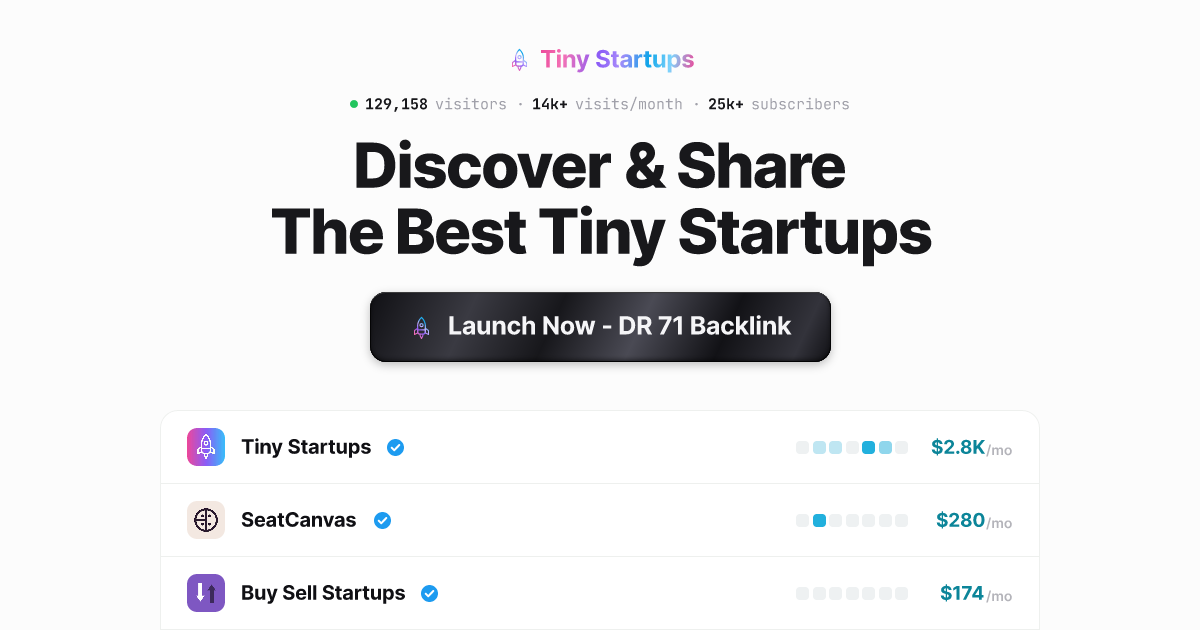
The #1 Startup Launch Platform & Product Hunt Alternative Full homepage screenshot

At a glance

Category
Artificial Intelligence
Language
English
Paid-content signal
No paid content foundObserved
Registered
2008
Hosting
CloudflareInferred
HTTPS certificate trusted
PassedObserved
Last updated

Website review

This review may include AI-generated content and is not individually verified. Domain, certificate and other facts come from the observed data on this page.

What is Tiny Startups?

Tiny Startups is a curated startup launch platform and directory — a Product Hunt alternative where makers list new products and visitors browse them. Listings are hand-picked by a human and updated daily, and the site also runs a newsletter and a free weekly launchpad at its /launch page.

The distinctive mechanic is that ranking is pay-what-you-want: the more you pay, the higher your spot on the board. Every spot on the board earns a DR 71 do-follow backlink, which is the main draw for founders who care about SEO as much as launch-day traffic. The site reports 129,158 visitors, roughly 14k+ visits per month, and 25k+ newsletter subscribers.

Who it suits

  • Indie makers and solo founders launching a small product who want a listing plus a backlink without a big marketing budget.
  • SEO-conscious founders who value a do-follow link from a domain with real traffic more than a one-day spike.
  • Browsers and early adopters looking for small, new tools across categories like design, productivity, AI, and marketing.

How it differs from a typical launch site

Aspect Tiny Startups Typical free launch board
Ranking Pay-what-you-want, higher payment ranks higher Usually votes or editorial pick
Listing cost Free to list; optional payment for position Free
Link value DR 71 do-follow backlink on every board spot Varies, often nofollow
Curation Human-picked, updated daily Often algorithmic or unfiltered

The trade-off is straightforward: paying buys visibility rather than earning it through votes, so a top slot reflects spend as much as merit. That may matter less if your goal is the backlink and a durable directory presence, and more if you want the credibility of an organically won ranking. The directory also shows self-reported revenue figures, which are useful signals but not verified numbers.

Next step: if you are launching, decide first what you want from it — a backlink and lasting listing, or a burst of launch-day attention. If it is the backlink, list for free and treat any payment as a separate visibility decision. If you are browsing, use the category and revenue filters to find small tools before they get crowded out. The free weekly launchpad at /launch is the lowest-commitment way to test how the audience responds.

How does the pay-what-you-want ranking system work?

The pay-what-you-want model on Tiny Startups ties your payment to your placement: the more you pay, the higher your startup ranks on the board. Every spot on the board also earns a DR 71 do-follow backlink, and a classic free weekly launchpad still exists at the /launch path.

What this means in practice

  • Payment sets position, not eligibility. You can launch for whatever you want to pay, but your rank reflects that amount. If visibility is the goal, treat payment as a bidding decision rather than a listing fee.
  • The backlink is the constant. Regardless of where you land on the board, the DR 71 do-follow link is the part with lasting SEO value, since it persists after the launch window.
  • The free route is separate. The weekly launchpad at /launch is the no-cost option, so you are not forced into paying to get listed at all.

Choosing between the two paths

Goal Better fit
Lasting domain authority from a do-follow link Either route, since the backlink applies to board spots
Maximum same-day visibility on the board Paying more to rank higher
Testing a launch with zero budget The free weekly launchpad at /launch
Reaching an existing audience The directory and newsletter, which the site reports at 25k+ subscribers

A concrete scenario

Suppose you are an indie maker launching a Mac productivity app. If your priority is a durable SEO signal, the backlink alone may justify a modest payment. If your priority is impressions during launch week, paying more to sit near the top of the board is the lever that matters. If you have no budget, submit to the free weekly launchpad and rely on the directory and newsletter for discovery.

Next step

Decide what you actually want from the launch — a link, a spike in traffic, or both — then pick the amount that matches. Check the board's current top slots before paying, since the value of a high position depends on how many other launches are competing that week. For broader launch options, compare with Product Hunt and BetaList.

What do I get for paying more on Tiny Startups?

Paying more on Tiny Startups buys you placement, not features. The site describes itself as pay-what-you-want, with the explicit rule that the more you pay, the higher you rank on the board, and every spot earns a DR 71 do-follow backlink. A separate free weekly launchpad still exists at the /launch path.

What the extra money changes

  • Ranking position — your listing moves up the board relative to other submissions. That is the core lever.
  • Visibility window — higher placement means more time in front of the site's stated traffic: 129,158 visitors, roughly 14k+ visits per month, and 25k+ newsletter subscribers.
  • Backlink — the DR 71 do-follow link is described as coming with every spot on the board, so treat it as a baseline rather than an upgrade.
  • Curation context — listings sit in a directory described as hand-picked by a human and updated daily, alongside categories like AI & ML, Design, Productivity, and Marketing.

What it does not change

There is no evidence of tiered features, analytics, or support levels tied to payment. You are bidding for attention, not unlocking a different product. The board also mixes in promoted placements from other advertisers, so paid ranking competes with paid advertising for the same eyeballs.

Who should pay

  • Founders chasing a launch-day spike — a short, concentrated push can work if your landing page converts cold traffic.
  • SEO-focused indie makers — if the do-follow link is your main goal, compare the cost against simply building links elsewhere, since the link comes with any board spot.
  • Pre-revenue projects — several listings on the board show "Pre-revenue" or "Revenue unknown," so paying for rank before you can convert visitors is the riskiest case.

A practical next step

Before paying, open the board and note where the free and low-payment listings actually sit after a week. If the top slots are consistently occupied by promoted advertisers rather than pay-what-you-want bidders, your money buys less than the ranking promise suggests, and the free weekly launchpad at /launch becomes the better first test. For a second opinion on launch timing, Hacker News and Indie Hackers both host founder discussions about whether paid launch placements pay back.

How does Tiny Startups compare to Product Hunt for launching a startup?

Tiny Startups positions itself as a Product Hunt alternative with a pay-what-you-want board: the more you pay, the higher you rank, and every listing earns a DR 71 do-follow backlink. A free weekly launchpad still runs at /launch. Product Hunt, by contrast, is a large, free, community-voted daily leaderboard where placement depends on upvotes and timing rather than payment.

The practical difference is what you're buying. On Tiny Startups you're buying visibility position and a backlink, with the trade-off that audience size is smaller and the ranking is explicitly paid. On Product Hunt you're buying access to a much larger, more competitive audience, with the trade-off that a paid boost isn't an option and most launches sink without a strong existing following.

H3 Where each tends to fit

  • Choose Tiny Startups if your goal is SEO and a durable do-follow link, or if you want a guaranteed slot rather than a lottery. The site reports 129k+ visitors, ~14k visits/month and 25k+ newsletter subscribers, so expect modest but real traffic.
  • Choose Product Hunt if you want a spike of broad attention, press pickup and social proof from a recognizable badge, and you have a community ready to upvote on day one.
  • Use both if the budget allows: Product Hunt for reach, Tiny Startups for the link and a second discovery surface.

H3 A concrete scenario

A solo founder shipping a Mac productivity app wants backlinks more than a traffic spike, because the product sells through search over months. Listing on Tiny Startups with a modest payment gets a fixed position and a DR 71 link; the same launch on Product Hunt might yield a bigger one-day bump but no lasting SEO asset. Conversely, a consumer app chasing a funding announcement benefits more from Product Hunt's volume.

H3 Decision criterion

Ask whether you need durable search visibility or a burst of attention. If it's the former, the paid-ranking, backlink-first model here is the better match; if it's the latter, a large free community board wins. You can also start free at Tiny Startups and upgrade only if the listing performs.

Can I list my startup for free and still get a backlink?

Yes — free listing and a backlink go together on Tiny Startups. The site describes itself as pay-what-you-want: you can submit at no cost, and every spot on the board is said to earn a DR 71 do-follow backlink. What payment changes is placement, not eligibility — the more you pay, the higher you rank. There is also a separate classic free weekly launchpad at /launch if you prefer the older format.

H3 Practical read

  • Cost of entry: nothing, if you accept a lower board position.
  • What you're buying with payment: visibility and rank, not access.
  • Link value: a DR 71 do-follow link is the main draw for SEO-minded founders; treat the DR figure as the site's own claim rather than a guarantee of ranking impact.
  • Curation: listings are described as hand-picked by a human and updated daily, so submission isn't automatic.

H3 When free is the right call If your goal is a durable backlink and a permanent directory entry, list free and skip the paid boost. If your goal is a launch-day spike — press-style attention, newsletter exposure to the stated 25k+ subscribers, or a slot near the top of the board — paying is the lever that moves you up.

A useful test: ask whether the traffic from a higher position converts better than the same money spent elsewhere. For a pre-revenue project, the free listing plus the backlink is usually the better trade. For a paid product with clear conversion, a top slot may pay for itself.

H3 What to prepare

  • A one-line pitch and a short description, since the board favours scannable entries.
  • A category match; the directory groups listings by tags such as Design, Marketing, Productivity, and AI & ML.
  • Founder attribution, as listings credit the maker's handle.
  • Honest revenue status if you want to appear in revenue-sorted views — self-reported figures are shown as such.

For comparison, other launch and directory options include Product Hunt for large-audience launch days and BetaList for early-stage pre-launch exposure.

How do I get my startup featured on the Tiny Startups homepage?

You get featured by submitting your startup to Tiny Startups, where placement is partly a pay-what-you-want ranking system: the more you pay, the higher you rank on the board. Every listed spot also earns a DR 71 do-follow backlink, and the site says listings are hand-picked by a human and updated daily. There is also a classic free weekly launchpad at the /launch path if you want the no-cost route.

What to expect

  • Paid ranking: Paying more moves you up the board rather than buying a fixed slot.
  • Editorial gate: A human reviews submissions, so a payment alone doesn't guarantee a specific position or acceptance.
  • Backlink value: The main practical draw for many founders is the DR 71 do-follow link, useful for SEO and domain authority.
  • Free option: The weekly launchpad at /launch is the free alternative if budget is tight.

A practical decision path

If your goal is a durable SEO backlink and some visibility, the paid board is the more direct route. If your goal is testing messaging and getting early feedback without spending, start with the free weekly launchpad, then consider paying for a higher board position once you have traction or a clearer pitch.

Prepare a tight one-line description, a clear category (the directory groups by Marketing, Design, Productivity, AI & ML and similar), and a working link before submitting — hand-picked directories tend to skip thin or unfinished listings.

Related questions

More questions →
What Is a Startup Directory and How Do You Get Listed?

A startup directory is a browsable, categorized index of companies and products where visitors discover new tools and founders. You get listed by submitting your startup through the directory's form, and you appear either immediately or after human review. Directories differ from launch platforms in one key way: a directory is a persistent catalog you stay in, while a launch platform is a time-boxed event where you compete for attention during a launch window. Tiny Startups, for example, runs both — a directory that stays live plus a weekly launchpad at /launch.

Directory vs. launch platform vs. Product Hunt alternative

These three terms get used interchangeably, but they describe different mechanics. Knowing which one you're dealing with tells you what you're actually buying: a permanent listing, a spike of attention, or both.

Type What it is Duration How visibility is decided
Startup directory Categorized index of startups, browsable by visitors Persistent Curation, recency, sorting, and sometimes payment
Launch platform Timed event where products launch together A launch window (often weekly) Votes, ranking, and launch-day traffic
Product Hunt alternative A platform positioned as a substitute for Product Hunt's launch model Varies Usually a mix of voting, curation, or paid placement

A directory is the better fit if you want a long-lived listing that keeps sending discovery traffic and links. A launch platform is the better fit if you want a concentrated burst of attention on one day. Many startups do both: launch once for the spike, then stay listed for the long tail.

Why a listing matters: discovery, backlinks, and audience

A directory listing does three jobs at once, and it's worth being clear about which one you actually need.

  • Discovery. People browse directories looking for tools in a category. If you're not listed, you don't exist in that channel. Tiny Startups describes itself as "hand picked by a human and updated daily," which means listings are curated rather than dumped in automatically.
  • Backlinks. A do-follow link from a directory passes SEO value. Tiny Startups states that every spot on the board earns a DR 71 do-follow backlink — that's a specific, checkable claim, and it's a common reason founders list even when they don't expect much direct traffic.
  • Newsletter and community exposure. Directories often have an audience attached. Tiny Startups reports 129,158 visitors, 14k+ visits/month, and 25k+ newsletter subscribers. Those numbers tell you the size of the audience your listing sits in front of.

If your goal is SEO, the backlink is the main prize. If your goal is users, the audience and category placement matter more. Decide which one you're optimizing for before you spend time on submissions.

How to get listed: the typical steps

The exact form differs by directory, but the process follows a consistent shape. Here's what to prepare and what to expect.

1. Prepare your listing assets

Before you open any submission form, have these ready:

  • A one-line description of what your product does, written for someone who has never heard of it
  • Your product URL
  • A logo and a screenshot or two
  • A category (e.g., Design, Productivity, AI & ML, Marketing — the categories Tiny Startups uses)
  • Founder attribution, since many directories credit the maker (Tiny Startups shows handles like @ratheejaisal next to listings)

2. Submit through the directory's form

You enter your product details, pick a category, and submit. The expected result is either an immediate listing or a pending review. Tiny Startups is explicitly human-curated, so expect a review step rather than instant publication.

3. Wait for review or ranking

Once submitted, one of three things happens: you're approved and listed, you're approved and ranked according to the directory's rules, or you're rejected or left unverified. On Tiny Startups, ranking is tied to payment — the site states "the more you pay, the higher you rank." That's a pay-what-you-want model, which means placement is a lever you control with money rather than votes.

4. Verify and maintain your listing

Some directories mark listings as unverified or show "Revenue unknown." You may be able to self-report revenue (Tiny Startups shows entries like "$2.7K all time — Self-reported"). Keeping your listing current — accurate description, working link, updated metrics — is what keeps it useful over time.

What actually drives visibility in a directory

Ranking and visibility aren't mysterious, but they're not uniform across directories either. The factors you'll encounter:

  • Payment. On pay-what-you-want directories, paying more moves you up. This is the most direct lever and the one most likely to be disclosed up front.
  • Curation. Human review means quality and fit matter. A hand-picked directory will reject or deprioritize listings that don't meet its bar.
  • Recency. Directories with "Newest" and "Top picks" views reward fresh listings with placement near the top of those feeds.
  • Sorting and filters. Visitors can sort by revenue (high to low, low to high) or browse by category. Your position depends on which view they're using, so a strong category fit can matter more than overall rank.
  • Verification status. Unverified listings and "Revenue unknown" labels are visible to visitors and can reduce trust.

The practical takeaway: if a directory ranks by payment, decide what placement is worth to you before you submit, not after.

Pitfalls to watch for

Directories are low-cost to join, which also means they're easy to over-invest in. Watch for these:

  • Paid placement that isn't disclosed. If ranking is pay-to-win, you should be able to find that out before paying. Tiny Startups states it plainly; not all directories do.
  • Unverified or self-reported revenue. A "Revenue unknown" or self-reported figure isn't audited. Treat revenue leaderboards as directional, not factual.
  • Dead or stale listings. Directories that aren't updated daily accumulate broken links and abandoned products, which drags down the value of being listed alongside them.
  • Backlink claims you can't verify. "DR 71 do-follow" is a specific claim — check the actual link on your live listing (do-follow vs. no-follow, and whether it's sitewide or page-level) rather than trusting the marketing copy.
  • Spreading too thin. Submitting to dozens of low-traffic directories costs time and produces little. A handful of directories with real audiences beats a long tail of empty ones.

How to choose which directories are worth your time

Use the same criteria for every directory you consider, and score them against your actual goal.

  1. Does it have a real audience? Look for disclosed traffic and subscriber numbers. Tiny Startups publishes 129,158 visitors, 14k+ visits/month, and 25k+ newsletter subscribers — numbers you can weigh against your own targets.
  2. Is the link do-follow and does it pass value? If SEO is your goal, this is the deciding factor.
  3. Is ranking transparent? You should know whether placement is decided by payment, curation, votes, or recency before you invest effort.
  4. Is it actively maintained? "Updated daily" and human curation are signals that the directory isn't a graveyard.
  5. Does it reach your category? A directory with a strong category for your product puts you in front of the right visitors; a general one may not.

If you want a persistent listing plus a launch moment, a platform that runs both — like Tiny Startups with its directory and its weekly launchpad at /launch — lets you do both without managing two separate profiles. If you only want the launch-day spike, a pure launch platform is the simpler choice.

How to Choose Where to Launch Your Startup: Product Hunt vs Pay-What-You-Want Launch Platforms

"Launching a startup" here means getting your product listed somewhere people browse for new tools — not incorporating a company. If your goal is a one-day traffic spike, a large community like Product Hunt fits. If your goal is a permanent, crawlable listing plus a backlink, a pay-what-you-want board like Tiny Startups fits better. If you just want to exist in a directory, free listings are enough. The right choice depends on which of those three outcomes you actually need.

The three channels, compared on the same dimensions

Dimension Product Hunt Pay-what-you-want board (Tiny Startups) Free directory
Cost Free to post You choose what to pay Free
How ranking works Community upvotes in a 24-hour window The more you pay, the higher you rank Usually no ranking, or a default sort
Listing lifespan Effectively one day of visibility Persistent board placement Persistent
SEO value Varies; not guaranteed Every spot earns a DR 71 do-follow backlink (per site) Often nofollow or no link
Audience Broad tech/early-adopter crowd Curated, "hand picked by a human and updated daily" Depends on the directory
Best for A launch-day spike and press-style attention A lasting listing, backlink, and slow discovery A low-effort presence

Tiny Startups describes itself as a "pay-what-you-want startup launch platform, startup directory, and Product Hunt alternative," with a classic free weekly launchpad still available at /launch. Its board is curated by a human and updated daily, and it reports 129,158 visitors, 14k+ visits/month, and 25k+ newsletter subscribers.

How pay-for-rank actually works

On a pay-what-you-want board, payment is a ranking lever, not a gate. The site states plainly: "The more you pay, the higher you rank." That means:

  • You are not buying a guaranteed audience. You are buying position on a board that visitors sort and scroll.
  • The board's traffic is the ceiling. With ~14k visits/month across the whole site, top placement is worth less raw traffic than a strong Product Hunt day.
  • The backlink is the durable asset. A DR 71 do-follow link persists after your launch week ends, which is the part that keeps working for SEO.

So the honest framing: pay for rank if you want visibility now; the backlink is what you keep either way.

Decide by your primary goal

Goal: a traffic spike and social proof. Go to Product Hunt first. It has the largest launch-day audience, and the upvote mechanic rewards a coordinated push. Treat it as a single event, not a channel.

Goal: an SEO backlink and a permanent listing. A pay-what-you-want board is the better fit. You control cost, you get a do-follow link, and your listing stays live. Pay enough to land near the top if you want same-week visibility; pay the minimum if you only want the link and listing.

Goal: just be findable. Use free directories and the free weekly launchpad. No cost, no ranking, minimal effort.

You can do all three — they don't conflict. The mistake is expecting any single one to deliver all three outcomes.

Common mistakes to avoid

  • Launching once and expecting lasting results. A launch-day spike decays in days. If you want ongoing discovery, you need a persistent listing (directory or board), not just a launch event.
  • Paying for rank without a landing page ready. Traffic that arrives at a broken or unclear page is wasted. Have a working page, a clear one-line pitch, and a way to capture interest before you pay for placement.
  • Assuming a backlink is free SEO. One do-follow link helps; it doesn't rank you. Pair it with content and other links.
  • Ignoring the audience fit. A curated board of "tiny startups" and indie makers surfaces different products than a broad tech community. Check what's already listed before you pay.

A practical sequence

  1. Define your one goal: spike, backlink, or presence.
  2. Prepare the landing page and pitch first.
  3. Launch on Product Hunt for the spike (if that's your goal).
  4. List on a pay-what-you-want board for the persistent listing and backlink — pay according to how much same-week visibility you want.
  5. Add free directory listings for baseline findability.
  6. Verify your listing is live and the link is do-follow before considering the launch done.
What Is a Startup Launch Platform and How Do You Launch on One?

A startup launch platform is a site where founders list a new product to get it in front of an audience of early adopters, makers, and potential customers. You submit your product, it appears in a directory or a time-limited launch board, and in exchange you get visibility, a listing that can rank in search, and often a backlink to your site. Tiny Startups is one example: it describes itself as a curated startup launch platform and directory, a Product Hunt alternative, and it runs on a pay-what-you-want model where paying more moves you higher on the board. This article explains how these platforms work, how they differ from Product Hunt, and how to decide whether launching on one is worth your time.

What you actually get from a launch platform

The value breaks into four things, and it's worth being honest about which ones matter for your product:

  • Visibility to a browsing audience. Your product sits alongside others in a feed or directory that people scroll. Tiny Startups reports 129,158 visitors, 14k+ visits/month, and 25k+ newsletter subscribers, so the audience is real but modest compared to a major platform.
  • A persistent directory listing. Unlike a one-day launch that disappears, a directory entry keeps existing and can be found later through search or internal browsing.
  • A backlink. Tiny Startups states that every spot on the board earns a DR 71 do-follow backlink. For SEO purposes, a do-follow link from a domain with that authority is the concrete, measurable asset.
  • Early users and feedback. The audience is largely indie makers and founders, so expect peers and curious builders more than a mass consumer wave.

If your goal is a backlink and a durable listing, a directory-style platform fits. If your goal is a single spike of consumer traffic, a large launch day matters more.

How it differs from Product Hunt

Both are launch platforms, but the mechanics and incentives differ. Here's the comparison on the dimensions that affect your decision:

Dimension Tiny Startups Product Hunt (general)
Ranking model Pay-what-you-want; the more you pay, the higher you rank Community upvotes drive daily ranking
Cost to list Free to list; paying raises your position Free to submit
Listing lifetime Directory entry persists; classic free weekly launchpad at /launch Primarily a daily cycle
Backlink DR 71 do-follow on every board spot Varies; not guaranteed
Curation Hand-picked by a human, updated daily Community and moderator driven
Audience Indie makers, founders, small products Broad tech and early-adopter audience

The key structural difference is the ranking mechanism. On Product Hunt, position comes from votes you have to earn. On Tiny Startups, position is something you can buy, which means a founder with budget can guarantee placement near the top without campaigning for support. That's a trade-off: less gamification, more predictability, but also a ranking that reflects payment rather than merit.

How to prepare and submit a launch

The steps are similar across directory-style platforms. Using Tiny Startups as the reference:

  1. Prepare your assets. You need a product name, a one-line description, a URL, and a visual (logo or screenshot). The listings shown on the site pair each product with a short tagline and a category such as Design, Productivity, AI & ML, or Marketing.
  2. Write the tagline for a scanning reader. Look at how existing entries read: "Beautiful web analytics for founders you'll actually want to open" or "89 original animated SVG icons for React." Short, concrete, benefit-first. Avoid jargon.
  3. Pick the right category. Categories on the board include Design, Productivity, AI & ML, and Marketing. A wrong category buries you next to irrelevant products.
  4. Decide what to pay. This is the platform's core lever. Free gets you listed; paying moves you up. Decide your budget before you submit, because the amount directly determines your position.
  5. Submit and verify your listing. After submission, check that your entry renders correctly, your link works, and your backlink is live and do-follow.
  6. Use the free weekly launchpad if you want the classic experience. Tiny Startups notes the classic free weekly launchpad lives on at /launch, which is the option if you don't want to pay for placement.

Expected result: a live directory entry, a position determined by what you paid, and a do-follow backlink from a DR 71 domain.

How ranking, promotion, and backlinks actually work

Understanding the mechanism tells you whether paying is worth it.

  • Ranking is pay-driven. "The more you pay, the higher you rank" is the stated model. There's no vote threshold to clear, so your position is a function of budget, not popularity. If you want guaranteed top placement without rallying supporters, this is the appeal.
  • Promotion is separate from listing. The board also shows promoted placements, such as a banner offering to "get your startup featured on 500+ media outlets in 48 hours." That's a distinct service from your directory spot, so don't confuse the two when budgeting.
  • The backlink is the durable asset. A DR 71 do-follow link persists as long as your listing does. For SEO, this is often the most defensible reason to list, independent of how much traffic the launch day brings.
  • Revenue and verification labels are self-reported. Listings show tags like "Pre-revenue," "Revenue unknown," "Not yet verified," or a self-reported figure such as "$2.7K all time." Treat these as founder-supplied, not audited.

Common pitfalls and how to judge whether it's worth it

  • Paying for rank without a reason. If your only goal is a backlink, the free listing may already deliver it. Pay only if top-of-board visibility serves a specific goal, like a coordinated launch push.
  • Expecting a consumer flood. The audience skews toward indie makers and founders. Plan for peer discovery and feedback, not mass signups.
  • Skipping the tagline. A vague one-liner gets scrolled past regardless of your paid position. The copy does the conversion work; the payment only buys attention.
  • Forgetting to verify the backlink. After launch, confirm the link is live, do-follow, and points to the right page. A listing that doesn't link correctly delivers none of the SEO value.
  • Ignoring the free option. If budget is tight, the free weekly launchpad at /launch is the lower-risk entry point.

How to decide: if you want a persistent, high-authority do-follow backlink and a listing in a curated directory, a platform like Tiny Startups fits, and the free tier covers the basics. If you also want guaranteed top placement for a launch moment and have budget, the pay-what-you-want ranking gives you that control. If your goal is a large one-day consumer spike, a vote-driven platform with a bigger mainstream audience is the better fit.

Product Hunt Alternatives: How to Choose a Launch Platform and Get Your Startup Listed

Product Hunt is not the only place to launch. The main alternatives fall into four types: free weekly launchpads, pay-what-you-want ranking boards, curated directories, and niche communities. Which one fits depends on what you want out of launch day — maximum eyeballs, a do-follow backlink, a permanent directory listing, or feedback from other makers. Tiny Startups, for example, is a pay-what-you-want launch platform and directory where paying more moves you higher on the board, every spot earns a DR 71 do-follow backlink, and a classic free weekly launchpad still runs at /launch. That combination — paid ranking plus a free tier plus a backlink — is one specific model, not the default. Below is how to compare the models and run a launch across several at once.

The four types of Product Hunt alternatives

Type Cost model How ranking works Main payoff Watch out for
Free weekly launchpad Free Time-based; everyone launches in the same weekly window Broad same-day attention, community feedback Crowded; your listing ages out fast
Pay-what-you-want board You choose the amount Pay more, rank higher Position on the board + backlink Ranking is bought, not earned — spend only if placement matters to you
Curated directory Free or paid listing Human review, often "hand picked" Long-term presence, discovery, SEO value Acceptance isn't guaranteed; review can take time
Niche community Free Engagement-driven (upvotes, comments) Targeted audience, useful feedback Small reach outside the niche

Tiny Startups sits across the first two and part of the third: it describes itself as a curated startup launch platform and directory, hand picked by a human and updated daily, with a pay-what-you-want model where the more you pay the higher you rank, and a free weekly launchpad at /launch. Its page also states every spot on the board earns a DR 71 do-follow backlink. Treat those as the platform's own claims about its model, and verify the current terms on the site before you pay.

Match the platform to your goal

  • Maximum same-day visibility → a free weekly launchpad. You compete on the day, not on budget.
  • A specific board position and a backlink → a pay-what-you-want board. You decide the price; the trade-off is that placement reflects payment.
  • Long-term discovery and SEO → a curated directory. Listings persist and can keep sending referral traffic after launch week.
  • Feedback from people who build similar things → a niche community of indie makers or founders.

If you want more than one of these, you don't have to pick. A single launch cycle can cover a free launchpad, a paid board, and a directory submission.

Prepare your launch assets once

Most platforms ask for roughly the same inputs, so build them before you submit:

  1. Tagline — one line, under ~60 characters, saying what it does and for whom.
  2. Short description — 2–3 sentences: the problem, what you built, who it's for.
  3. Screenshots or a short demo — 3–5 images, or a 30–60 second clip. Check each platform's image dimensions.
  4. Founder profile — name, handle, and a one-line bio. Some directories, like Tiny Startups, surface founder profiles alongside products.
  5. Links — your site, and any social or demo links you want shown.
  6. Category — pick the closest fit (e.g., Design, Productivity, AI & ML, Marketing). Directories often group listings this way.

Reusing one asset set across platforms saves time and keeps your positioning consistent.

Submit to several platforms in one cycle

  1. List your targets — one free launchpad, one paid board, one or two directories, one niche community.
  2. Submit to the free launchpad first so your launch day is set.
  3. Submit to directories — these are reviewed by a human and may take days, so start early.
  4. Decide your pay-what-you-want amount on any paid board, based on how much a higher position is worth to you.
  5. Post to the niche community and reply to comments; engagement is what drives visibility there.
  6. Track results — see the verification section below.

Verify what actually worked

After launch week, check three numbers per platform:

  • Referral traffic — in your analytics, filter sessions by each platform's domain.
  • Signups or conversions — did those sessions convert, or just bounce?
  • Backlink status — confirm the link exists and is do-follow (a quick check with any backlink tool). For Tiny Startups, the stated value is a DR 71 do-follow backlink per board spot; confirm it's live on your listing.

Compare platforms on the same metrics so you can tell which one earned its place in your next launch.

Common problems and what to do

Listing rejected or still unverified. Curated directories review submissions by hand, so rejection or delay is normal. Re-read the submission guidelines, tighten your tagline and description, and resubmit. Some listings show an "unverified" or "not yet verified" state until the platform confirms details — that's a status, not a failure.

Low ranking despite paying. On a pay-what-you-want board, position depends on how much you pay relative to others, not just that you paid. If placement matters, check the current board before deciding your amount. If it doesn't, the free launchpad may serve you just as well.

Little traffic from a directory. Directories are built for long-term discovery, not launch-day spikes. A listing that sends a trickle of qualified visitors for months can still be worth it — judge it on conversions over time, not day-one traffic.

No backlink showing up. Give it time to be indexed, then re-check. If it's still missing, confirm the listing is live and the link points to the page you intended.

Quick decision guide

  • Want attention today, no budget → free weekly launchpad.
  • Want a board position and a backlink, and will pay → pay-what-you-want board.
  • Want lasting discovery and SEO → curated directory.
  • Want feedback from builders → niche community.
  • Want all of the above → run them in one cycle and let the referral and conversion numbers tell you where to focus next time.
What Is Pay What You Want Pricing and How Does It Work?

Pay what you want (PWYW) is a pricing model where the buyer chooses the price, including zero, unless the seller sets a minimum. It works best when the product is cheap to deliver, the buyer already trusts you, and the price itself is part of the marketing. It tends to fail when the value is unclear or when there is no suggested price to anchor the decision. On Tiny Startups, a startup launch platform and Product Hunt alternative, PWYW is tied to placement: the site states that the more you pay, the higher you rank, and every spot on the board earns a DR 71 do-follow backlink.

How PWYW differs from fixed, tiered, and freemium pricing

Model Who sets the price Buyer's choice Typical use
Fixed Seller Pay or don't Commodity products, clear value
Tiered Seller Pick a tier Software with feature levels
Freemium Seller Free tier or paid upgrade Products with network effects
PWYW Buyer (within any floor) Pay any amount, often including zero Launches, indie products, goodwill plays

The key difference is who holds the pricing decision. In fixed and tiered models, the seller sets an anchor and the buyer accepts or rejects it. In PWYW, the buyer sets the anchor, which is why a suggested price matters so much.

How buyers decide what to pay

Most buyers do not calculate your costs. They respond to a few signals:

  • Anchors. A suggested price, a "most people pay" note, or a visible average payment gives them a reference point. Without one, many default to zero.
  • Fairness and reciprocity. If the product solved a real problem or the creator is visible and likable, buyers often pay above zero to support the work.
  • Social proof. Seeing that others paid, or that a launch is gaining traction, increases willingness to pay.
  • Perceived value vs. effort. A tool that saves hours can justify a higher payment than a novelty item, even when both are PWYW.

Common PWYW variations

  • Pure PWYW. No minimum, no suggestion. Highest friction for revenue, lowest friction for adoption.
  • Suggested price. A recommended amount is shown, but buyers can pay less or nothing.
  • Minimum price floor. A lowest acceptable amount, which converts PWYW into "pay at least X."
  • Pay-more-to-rank. Payment buys a better position rather than the product itself. Tiny Startups uses this: paying more moves a listing higher on the board, and every spot still earns a DR 71 do-follow backlink.
  • Pay-what-you-want with a bundle. The buyer names a price for a package, often with a charity split.

When PWYW works and when it fails

Works well when:

  • You want launch buzz and maximum signups more than immediate revenue.
  • The product is digital, with near-zero marginal cost per buyer.
  • You have an audience that already trusts you.
  • The price itself is a story worth sharing.

Fails when:

  • The value is unclear, so buyers have no reason to pay above zero.
  • There is no anchor, no minimum, and no social proof.
  • Your costs per buyer are high, so free riders are expensive.
  • Buyers expect free because the category is already free.

How to set up a PWYW offer

  1. Pick the goal. Decide whether you are optimizing for signups, revenue, or ranking. Tiny Startups optimizes for ranking: the more you pay, the higher you rank.
  2. Set an anchor. Add a suggested price or a visible average. This is the single biggest lever on average payment.
  3. Add a floor if needed. A minimum price protects against pure free-riding, at the cost of some goodwill.
  4. Make the trade-off explicit. If payment buys placement, say so. Tiny Startups states the pay-more-to-rank mechanic directly, and notes that every spot on the board earns a DR 71 do-follow backlink.
  5. Verify the outcome. After launch, confirm the listing is live and the backlink is present, since that is the deliverable you paid for.

How to measure success

  • Conversion rate. Share of visitors who complete a payment, including zero.
  • Average payment. Total revenue divided by number of buyers.
  • Share paying above zero. The clearest signal that your anchor and value story work.
  • Repeat buyers. Whether people come back and pay again.
  • Secondary value. For launch platforms, the backlink and ranking may matter more than the payment itself. Tiny Startups reports 129,158 visitors, 14k+ visits/month, and 25k+ newsletter subscribers, which is the kind of audience a launch is buying access to.

A concrete example

A solo developer launches a Mac screenshot tool on a PWYW launch platform. They set a suggested price of $20 and a floor of $0. Most visitors pay nothing, a few pay $5, and a handful pay $20 or more. The real return is not the payments but the DR 71 do-follow backlink and the ranking boost from paying above the minimum, which improves the listing's visibility on the board. The developer measures success by backlink presence and referral traffic, not by average payment.

If your goal is a backlink and visibility rather than direct revenue, PWYW tied to ranking can make sense. If your goal is predictable revenue, a fixed or tiered price with a clear anchor will usually outperform it.

Website Overview

An established domain and managed infrastructure suggest continuity of operations and may support dependable delivery, although neither guarantees service quality. Several search or sharing settings need attention. Together they may make snippets, preview images or preferred URLs less consistent across platforms.

Domain and Registration

Registered in 2008, this domain has about 17 years of history. That suggests continuity, although ownership and purpose may have changed. Transfer-protection status is present, helping reduce the risk of unauthorized domain transfers. The registrar is GoDaddy.com, LLC, a widely used domain service provider. The domain uses the common .com extension, which is not an independent safety signal.

DNS and Email

The observed email authentication setup is incomplete: DMARC is missing. Nameservers are provided by Cloudflare, indicating managed DNS hosting. MX records point to the Google Workspace email service. No CNAME was found; the observed records resolve directly to addresses. TXT records include verification markers for Google. Such markers may also remain after a service stops being used.

TLS and Certificates

The public key uses EC with 256 bits. The server supplied a complete certificate chain. No organization name is present in the certificate; the available fields are consistent with domain validation. The certificate was issued within the Google Trust Services cloud or CDN ecosystem. The certificate's total validity is about 90 days, consistent with a short renewal cycle.

HTTP and Browser Security

No X-Powered-By header was found, reducing one common source of backend fingerprinting information. All six checked browser-security headers are present. Their effectiveness still depends on the policy values and application behavior. The cf-ray response header indicates a CDN or caching proxy in the delivery path. No obvious internal addresses or debug information were found in the headers. The Server header identifies cloudflare without an exact version.

Technology Stack Analysis

The public page identifies WordPress, Next.js, Cloudflare without precise versions, leaving fewer clues for version-specific scanning.

Search and Social Sharing

The meta description has 266 characters and may be shortened in search results. Open Graph is partially configured; og:type is missing. Twitter Card metadata is configured. JSON-LD includes Organization data, helping describe the organization as an entity. The title has 57 characters, within a common display range.

Hosting and Email

DNSCloudflare
HostingCloudflare
EmailGoogle Workspace
Approximate IP geolocation (inferred; a CDN or proxy may differ from the origin server) Location unknown Inferred 104.21.24.246

Registration details

RDAP / WHOIS

RegistrarGoDaddy.com, LLC
Registered2008-11-09
Expires2026-11-09
Domain statusclient delete prohibited、client renew prohibited、client transfer prohibited、client update prohibited
Nameserversdale.ns.cloudflare.com、harleigh.ns.cloudflare.com
DNSSECunsigned

DNS records

DNS

TypeNameValueTTLPriority
Awww.tinystartups.com104.21.24.246300—
Awww.tinystartups.com172.67.221.58300—
AAAAwww.tinystartups.com2606:4700:3033::6815:18f6300—
AAAAwww.tinystartups.com2606:4700:3035::ac43:dd3a300—
MXtinystartups.comaspmx.l.google.com3001
MXtinystartups.comalt1.aspmx.l.google.com3005
MXtinystartups.comalt2.aspmx.l.google.com3005
MXtinystartups.comalt3.aspmx.l.google.com30010
MXtinystartups.comalt4.aspmx.l.google.com30010
NStinystartups.comdale.ns.cloudflare.com86400—
NStinystartups.comharleigh.ns.cloudflare.com86400—
TXTtinystartups.comgoogle-site-verification=C_EUJIwmWEmmf_IQoMmS-lEczFAeeq-YwwphwuMkh-8300—
TXTtinystartups.comgoogle-site-verification=e4WTYZ-wgZ5r2N4DMtekb6SjB82-sRncCMyOMaZX_Jw300—
TXTtinystartups.comv=spf1 include:dc-aa8e722993._spfm.tinystartups.com ~all300—

TLS and certificates

TLS / SSL

AssessmentNormal configuration
Supported protocolsTLSv1.2、TLSv1.3
Negotiated protocolTLSv1.3
Certificate subjecttinystartups.com
IssuerGoogle Trust Services
Valid until2026-11-16T13:47 · Remaining when checked: 47 days
Verification detailsCertificate trust: Passed · Hostname match: Passed

HTTP response headers

HTTP

HeaderValue
content-typetext/html; charset=utf-8
cache-controls-maxage=60, stale-while-revalidate
servercloudflare
strict-transport-securitymax-age=31536000; includeSubDomains
content-security-policydefault-src 'self'; script-src 'self' 'unsafe-inline' 'unsafe-eval' https://api.pirsch.io https://www.clarity.ms https://*.clarity.ms https://clicks.page; style-src 'self' 'unsafe-inline'; img-src 'self' https: data: blob:; frame-src 'self'; font-src 'self' data:; connect-src 'self' https:; media-src 'self'; worker-src 'self' blob:; frame-ancestors 'none'; base-uri 'self'; form-action 'self'
x-frame-optionsDENY
x-content-type-optionsnosniff
referrer-policystrict-origin-when-cross-origin
permissions-policycamera=(), microphone=(), geolocation=(), interest-cohort=()
set-cookieRedacted

Identified technologies

WordPressNext.jsCloudflare

Pages, Search and Sharing

Meta descriptionTiny Startups is a pay-what-you-want startup launch platform, startup directory, and Product Hunt alternative. The more you pay, the higher you rank, and every spot on the board earns a DR 71 do-follow backlink. The classic free weekly launchpad lives on at /launch.
Canonical URLhttps://www.tinystartups.com
LanguageEnglish (default)
Twitter Cardsummary_large_image
All bots 1 allowed · 3 disallowed
  • Allow/
  • Disallow/api/
  • Disallow/admin/
  • Disallow/api/auth/
gptbot 1 allowed · 0 disallowed
  • Allow/
chatgpt-user 1 allowed · 0 disallowed
  • Allow/
claudebot 1 allowed · 0 disallowed
  • Allow/
claude-web 1 allowed · 0 disallowed
  • Allow/
anthropic-ai 1 allowed · 0 disallowed
  • Allow/
perplexitybot 1 allowed · 0 disallowed
  • Allow/
googlebot 1 allowed · 0 disallowed
  • Allow/
google-extended 1 allowed · 0 disallowed
  • Allow/
bingbot 1 allowed · 0 disallowed
  • Allow/
cohere-ai 1 allowed · 0 disallowed
  • Allow/
meta-externalagent 1 allowed · 0 disallowed
  • Allow/
youbot 1 allowed · 0 disallowed
  • Allow/
applebot 1 allowed · 0 disallowed
  • Allow/
applebot-extended 1 allowed · 0 disallowed
  • Allow/
duckassistbot 1 allowed · 0 disallowed
  • Allow/

User reviews (0)

  • No reviews yet.