
 简体中文
简体中文 English
Website review
This review may include AI-generated content and is not individually verified. Domain, certificate and other facts come from the observed data on this page.
What is UFG?
UFG is a creator platform and multi-channel network for gaming and entertainment video creators. Its pitch is straightforward: you keep making content, and UFG supplies the business side — brand deals, distribution, channel management and payments. The site describes itself as "the creator platform designed to turn your creativity into revenue," with published figures of $270M paid to creators, 1.4B+ monthly views and 400+ YouTube Play Buttons across its roster.
What it actually offers creators
- Brand deals — connecting channels with premium brands for sponsored work.
- Facebook distribution — pushing the same content to Facebook to reach new audiences and monetize there, with a partner manager attached.
- Partner manager — a named contact for channel development advice.
- Open contracts — no lock-in, and the stated ability to leave at any time.
- Payment tools — advance funding (the site says up to 10x monthly income, with creators keeping their copyrights), multiple withdrawal options, and access to MC Pay for money management.
- Account safety — 2FA, KYC checks and copyright protection to block unauthorized reuploads.
- Merchandise-style partnerships — for example, a tie-up with AceZone where creators share a personal link or code and earn on headset sales.
Who it suits, and who it doesn't
UFG makes most sense if you already have a working channel and want help converting views into revenue — particularly if you're interested in Facebook as a second platform, or you want advances rather than waiting on monthly payouts. It's less relevant if you're pre-audience: nothing here replaces the work of building a viewership, and a partner manager can't manufacture one.
The trade-off is the usual network one. You gain infrastructure, brand access and faster cash flow; in exchange, you give up a share of revenue and some direct control over your deals. The "no lock-in" contract term matters here — it lowers the cost of trying it, because you can leave if the revenue share doesn't beat what you'd earn independently.
A practical next step
Before applying, do two things. First, check whether your audience actually overlaps with gaming/entertainment brand budgets — that's where UFG's partner network is strongest. Second, compare the revenue share against your current earnings, including any existing sponsorships you'd have to route through them. If you're already monetizing well on your own, the deciding question is whether their brand pipeline and advance funding beat the cut they take.
You can also look at how other networks position themselves, such as Fullscreen or Machinima, to see whether UFG's terms fit your situation.
How do I get paid by UFG?
UFG pays creators through its creator platform, and the page describes several distinct earning and payout routes rather than a single method.
Earning routes described on the page
- Brand deals — UFG connects creators with premium brands to increase revenue.
- Facebook distribution — it expands audience reach and monetizes new platforms, with UFG saying it covers "every step of your FB journey."
- Affiliate-style partner offers — the AceZone partnership lets creators share a personal link or code and earn each time their community buys AceZone products.
- MC Pay — UFG's payment and money-management system, which the page presents as the core payout experience.
Payout mechanics mentioned
- Advance funding: money before you earn it, described as up to 10x your monthly income while you keep your copyrights.
- Multiple withdrawal options: the page says "many ways to withdraw" and "get paid today," but it does not list the specific methods.
Practical next step If you are weighing UFG, treat the payment terms as the deciding factor. Before signing anything, ask a partner manager directly: which withdrawal methods are supported in your country, what the advance funding actually costs (it is an advance, not a bonus), and how revenue splits work across brand deals versus Facebook distribution. The page emphasizes an "open contract" with "fair terms, no lock-in, leave anytime," so confirm that in writing.
UFG cites scale that may matter to creators comparing networks: $270M paid to creators, 1.4B+ monthly views, 340M+ subscribers, 400+ YouTube Play Buttons, and 13 years serving creators. For a second opinion on network terms generally, creator communities such as Reddit can be useful, but verify any specific claim against UFG's own contract.
What is the AceZone partnership and how can I earn from it?
The AceZone partnership is a referral-style revenue stream UFG has set up with AceZone, a gaming headset brand. According to UFG's page, creators share a personal link or code with their audience and earn each time someone from that community buys AceZone products.
H3 How the earning works
- UFG provides the link or code to you as a UFG creator.
- You share it with your viewers, followers or Discord community.
- When someone shops AceZone products through your link or code, you earn on that sale.
- It sits alongside UFG's other creator income routes, such as brand deals and Facebook distribution, rather than replacing them.
H3 Who it suits This fits gaming and tech-adjacent creators whose audience already buys peripherals, or who can talk about gear credibly in videos, streams or community posts. If your viewers are not in the market for headsets, the link will likely sit unused — referral income depends on audience intent, not just reach.
H3 Practical trade-offs
- Low effort, variable return: no production work is required, but earnings scale with how often your audience actually buys.
- Trust matters: recommending gear you have not used or would not wear can cost credibility faster than the commission is worth.
- Disclosure: paid or incentivised links should be clearly flagged to your audience, which is standard practice across platforms.
As a next step, check your UFG dashboard or creator support for the current AceZone terms, commission structure and approved promotional formats before you post the link. If you want a broader view of how UFG positions creator monetisation, see UFG.
Do I have to sign a long-term contract to join UFG?
No. The UFG page describes an "open contract" with "fair terms, no lock-in, leave anytime," so joining is not presented as a long-term commitment.
That matters if you are testing whether a network is worth it. A creator who already posts regularly can join, try the brand-deal and Facebook-distribution services, and leave if the fit is wrong — rather than being tied down while the channel changes direction. The trade-off is that open terms usually mean less guaranteed support or revenue than a locked-in deal might offer, so weigh flexibility against stability.
If you are comparing options, check the exit terms in writing before you sign anything, and ask what happens to pending payments and brand deals if you leave. You can review the current terms at UFG.
What is advance funding and how much can I get?
Advance funding is a way to get paid before your earnings actually arrive. UFG describes it as receiving money upfront against future income, so instead of waiting for a platform payout cycle to complete, you take an advance now and it is later reconciled against what you earn.
What the page says about the amount
- UFG states creators can receive "up to 10x your monthly income" as an advance.
- UFG says you retain your copyrights when taking an advance.
- UFG lists "many ways to withdraw" and "get paid today" alongside advance funding, suggesting the advance is tied into its payment system, MC Pay, rather than being a separate loan product.
What that means in practice
The "up to 10x" figure is a ceiling, not a guarantee. In creator-finance arrangements, the multiple you're actually offered usually depends on how predictable your income is, how long you've been earning, and which revenue sources back the advance. A channel with steady, verified monthly revenue is a very different risk profile from one with spiky or brand-deal-dependent income, so expect the real number to be assessed case by case.
Who this suits
- Creators with an established, trackable monthly income who want cash for a specific purpose: equipment, an editor, a production run, or bridging a gap between earning and payout.
- Creators who want liquidity without giving up ownership of their content, which is the trade-off UFG highlights.
Who should be cautious
- Anyone whose income is irregular or new. A large multiple against unstable income is harder to repay through future earnings.
- Anyone who doesn't want future payouts reduced. An advance is not a bonus; it is money moved earlier, so plan for the offset.
A practical next step
Before requesting anything, work out two numbers: your average monthly net earnings over the last several months, and the smallest advance that solves your actual problem. Then ask UFG directly what multiple your channel qualifies for, what the repayment or offset schedule looks like, and whether there are fees. If the advance is reconciled against future earnings, confirm whether it's recovered from all revenue streams or only specific ones, since that affects how much you keep month to month.
For context on how other creator platforms handle payments and monetization, you can compare notes with YouTube and Patreon, though their payout models differ from an advance against future income.
How does UFG help me grow on Facebook and get brand deals?
UFG addresses Facebook growth and brand deals as two connected services: it handles distribution and monetization on Facebook while also pitching you to brands for sponsored work.
Facebook distribution UFG says it will "expand your audience and monetize new platforms" and that it covers "every step of your FB journey." In practice, that means you keep producing the videos while UFG manages the publishing and monetization side on Facebook rather than you running it as a separate channel by hand. This suits creators who already have a YouTube audience and want Facebook treated as an additional revenue surface instead of a second full-time job.
Brand deals UFG's brand-deal service is described as partnering with "premium brands to increase your revenue." The pitch is that UFG brings the brand relationships and negotiates, so you are not cold-emailing sponsors yourself. The page also lists 80+ partners with over 1M subscribers, which is the kind of scale that makes a network attractive to brands in the first place.
The AceZone example UFG has partnered with AceZone, a gaming headset brand, and offers creators a personal link or code to share with their community, earning on each purchase. This is an affiliate-style deal rather than a flat sponsorship fee — useful if your audience already buys gaming gear, less useful if it does not.
What to weigh
- Contract terms: UFG advertises an "open contract" with "fair terms, no lock-in, leave anytime," which matters because network deals often involve revenue splits and exclusivity. Ask what percentage UFG takes and whether Facebook content is exclusive to them.
- Fit with your niche: a headset brand deal works for gaming channels; a beauty or finance channel would need a different partner match.
- Your own leverage: if you already close brand deals directly, a network's main value is access and admin relief, not reach.
Next step: before signing, ask UFG for the revenue split, the length of any exclusivity, and a list of brands they have placed creators with in your specific category. Compare that against what you could negotiate alone — for reference on how networks typically structure these arrangements, see YouTube's own creator resources on channel monetization and brand deals.
 Cloudflare
 Google Workspace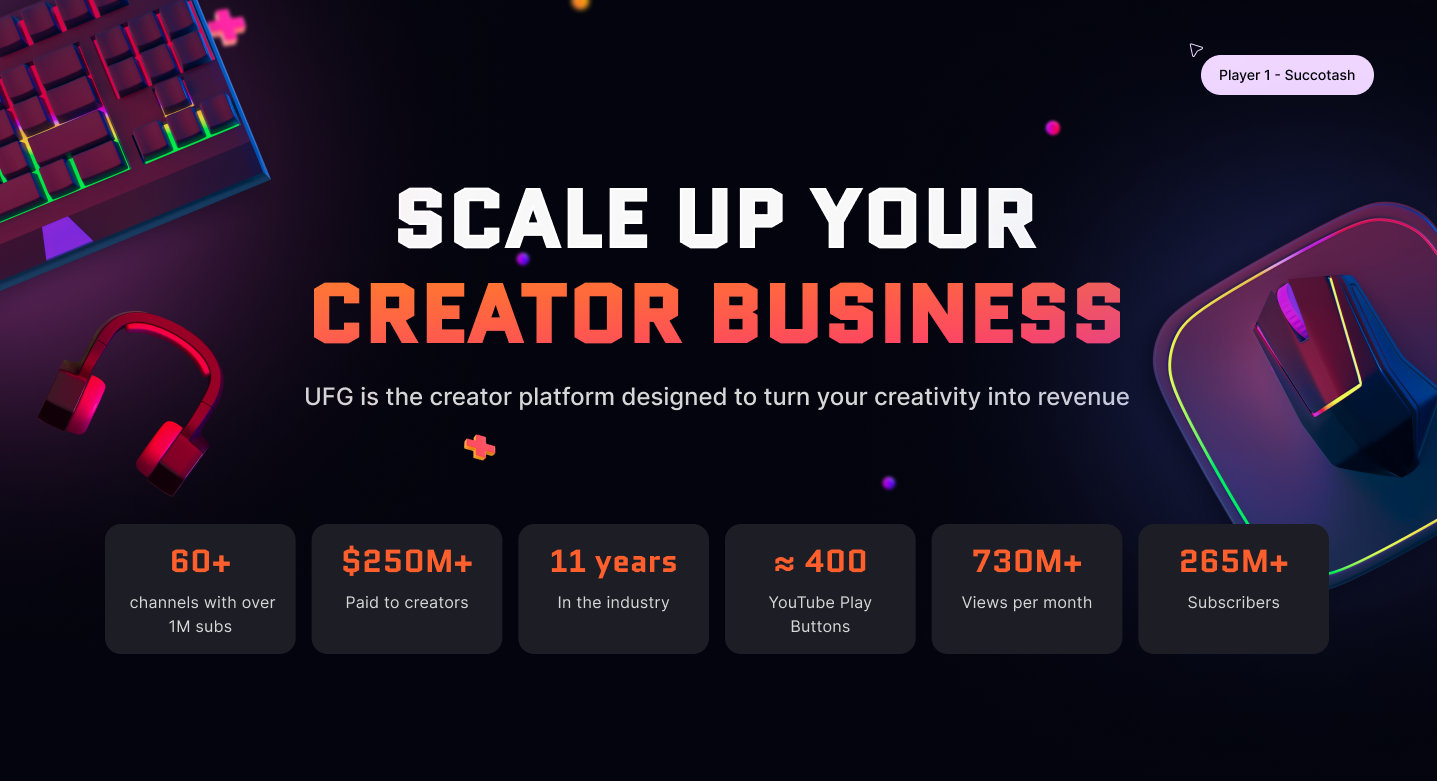

User reviews (0)