Website profiles · Technology insights · Alternatives

vocova.app Paid content Multilingual

Categories: Video & Film

Instantly transcribe audio and video to text in 100+ languages. Import from YouTube, Google Drive, Dropbox and 1,000+ platforms. Export to PDF, DOCX, SRT. Free to start.

Visit website

Updated: 2026-10-03 18:38 Language: English (default) Access: Normal

Profile views 1 Outbound visits 0
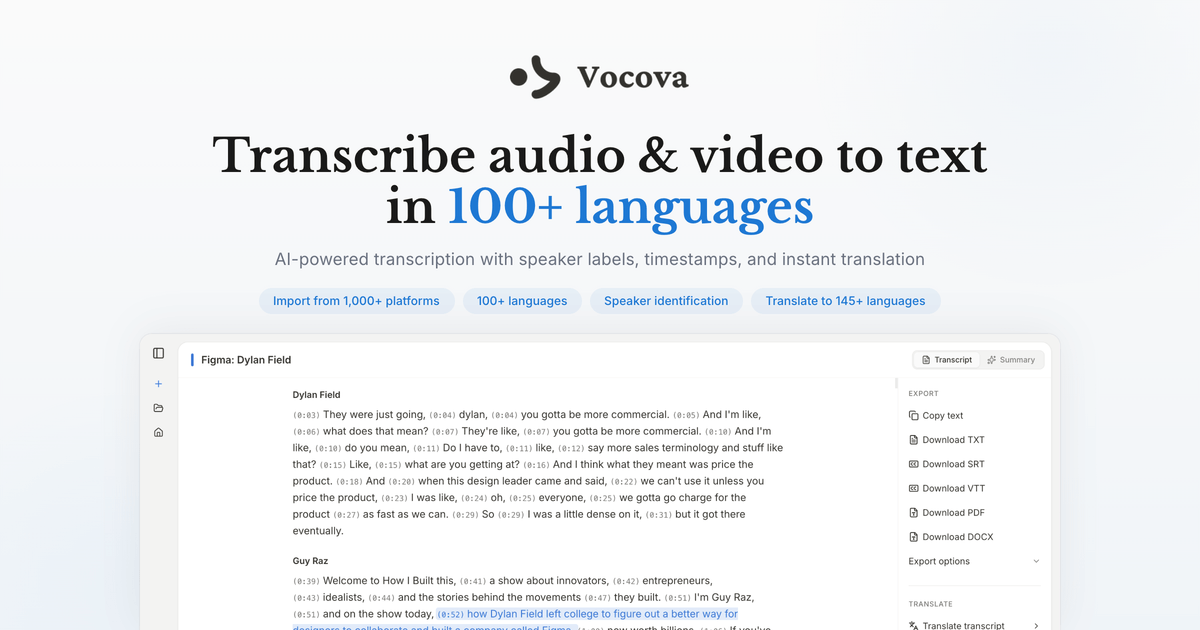
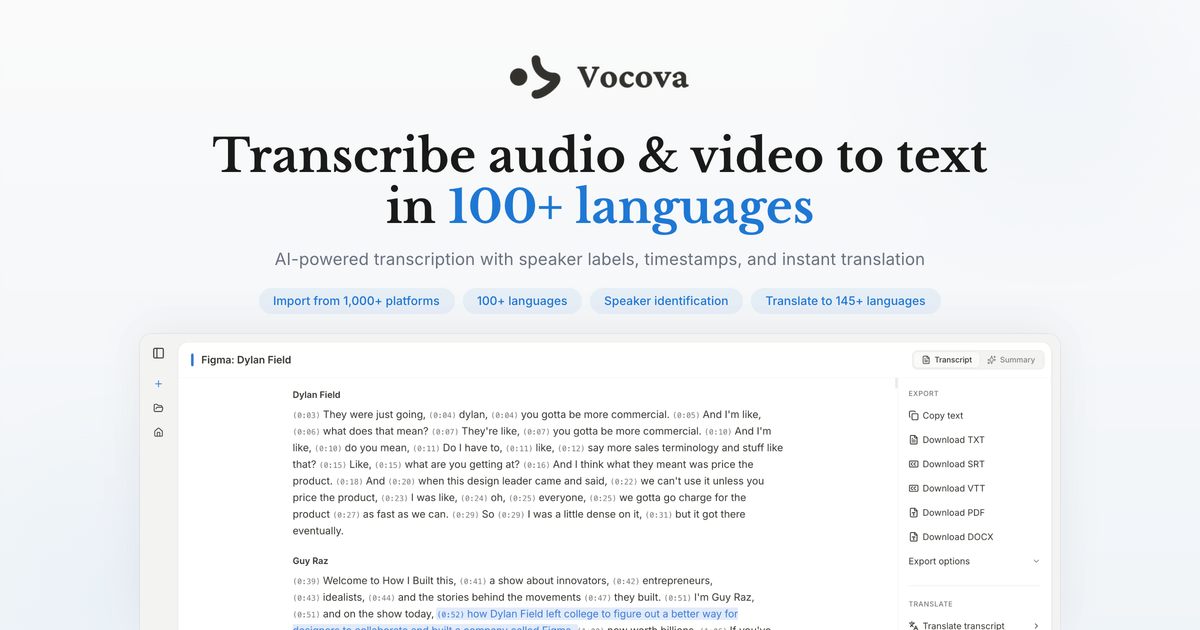
Vocova Full homepage screenshot
Editorial Review

Website Review

What is Vocova?

Vocova is a web-based AI transcription tool that converts audio and video into text. According to its site, it supports 100+ languages with automatic language detection, identifies different speakers, adds timestamps, and can translate transcripts into 140+ languages. It also generates an AI summary of each transcript.

What you can feed it

  • Upload a file: MP4, WebM, MKV, MOV, AVI, MP3, WAV, FLAC, M4A and many other audio/video formats, up to 500MB per the page.
  • Paste a link: the page says it works with 1,000+ platforms, including YouTube, and can extract audio automatically.
  • Connect cloud storage: Google Drive or Dropbox.
  • Record in the browser.

What you get out

Transcripts with speaker labels and word-level timestamps, editable inline (text, speakers, timestamps), then exportable as PDF, DOCX, SRT, VTT, TXT or CSV. SRT/VTT matter if you plan to use the text as subtitles; DOCX/PDF suit written deliverables; CSV is handy if you want to process the transcript in a spreadsheet.

Who it tends to fit

  • Journalists and researchers transcribing interviews who need speaker separation.
  • Podcasters and video editors who want subtitle files rather than retyping dialogue.
  • Teams turning meetings or webinars into readable notes and summaries.
  • Anyone working across languages who needs a transcript plus a translation.

Trade-offs to weigh

Speaker labels and timestamps are only as good as the audio, so overlapping speech, heavy accents or noisy recordings still need a manual pass. Translation and summaries are convenience layers, not substitutes for a human check on anything published or legally sensitive. The page says you can start free and sign in to save, but check the pricing page for limits on file size, minutes or exports before committing.

A practical next step: take one real file you already need transcribed — ideally a multi-speaker recording in your main working language — run it through, and judge the raw transcript before editing. If speaker turns and timestamps come out clean enough that you only fix names and jargon, it fits your workflow; if you spend as long correcting as typing, look elsewhere.

How do I transcribe a YouTube video or other online link with Vocova?

Paste the link into Vocova's "Paste link" box on the transcription screen, and it extracts the audio and transcribes it automatically. No download or file conversion is needed on your side: Vocova states it works with YouTube and 1,000+ other platforms, plus Google Drive and Dropbox.

The short version

  1. Open Vocova and choose the link option rather than uploading a file.
  2. Paste the video or audio URL.
  3. Let the AI run: it detects the language automatically (100+ supported) and produces a transcript with speaker labels and timestamps.
  4. Review the text, then export as PDF, DOCX, SRT, VTT, TXT or CSV — or translate it into one of 140+ languages.

What you get back

Vocova's own example shows the format for a two-person conversation: each line is tagged with a speaker name and a timestamp, so a transcript looks like "Sarah 0:01 — So how did the product launch go last week?" rather than one undifferentiated block of text. That matters if your goal is meeting minutes, interview quotes or subtitles, because SRT and VTT exports need timestamps to work at all.

Practical scenario

Suppose you want a blog post from a 40-minute conference talk. Paste the URL, let Vocova transcribe, skim the AI-generated summary for the main points, fix names and jargon in the editor, then export DOCX for writing or SRT if you also want captions. If the talk is in another language, translate the transcript instead of re-recording it.

Trade-offs to weigh

  • Link import depends on the source staying publicly reachable; private or login-only videos are better handled by uploading the file or connecting a cloud drive.
  • Speaker labels and timestamps are the reason to use this over a plain speech-to-text tool, but any tool's speaker detection can merge similar voices — budget a few minutes to correct them.
  • Uploads are listed up to 500MB, so long recordings may be easier to paste as a link than to upload.
  • Export format should drive your choice: SRT/VTT for video editors, DOCX/PDF for documents, CSV if you want to process the transcript in a spreadsheet.

Next step

Test it with one short public video first and check how well the timestamps and speaker labels hold up for your accent and audio quality. If you need a second opinion on accuracy, compare against another transcription service such as Otter.ai or Descript, and check Vocova's own pricing page before committing to longer projects.

Does Vocova identify different speakers and add timestamps automatically?

Yes. Vocova's page states that its AI transcription generates transcripts with automatic speaker identification and precise word-level timestamps, and the sample excerpt shows labels like "Sarah 0:01" and "James 0:05" alongside the dialogue. Timestamps and speaker names can also be edited inline before export, so you can correct a misattributed line or adjust a cue point without re-running the file.

H3 Practical implications

  • Speaker labels are useful for interviews, panel recordings, research sessions, and meeting minutes where you need to know who said what.
  • Timestamps matter for subtitle work (SRT/VTT), locating quotes in long recordings, and cross-referencing a transcript against the original audio.
  • Editing after the fact is the important trade-off: automatic diarization is rarely perfect with overlapping speech, similar voices, or heavy background noise, so plan on a review pass rather than treating the output as final.

H3 Example scenario A researcher records a 45-minute group interview, uploads the file, and gets a timestamped, speaker-labeled transcript. They skim the AI summary to find the relevant section, jump to that timestamp in the audio to verify a quote, then fix any swapped speaker labels before exporting to DOCX for coding.

H3 Decision criterion If your work depends on accurate attribution — legal, journalistic, academic, or accessibility subtitling — test Vocova on a short clip with your actual recording conditions (multiple speakers, accents, crosstalk) and check how many labels you have to correct. If you mainly need clean text and a summary, the automatic labels are a bonus rather than a requirement. For comparison, dedicated transcription and captioning tools such as Otter.ai and Descript also offer speaker detection and timestamps, so the deciding factor is usually language coverage, export formats, and how much manual cleanup each one demands on your audio.

What export formats can I use for my Vocova transcript?

Vocova lists six export formats for a finished transcript: PDF, DOCX, SRT, VTT, TXT, and CSV. You choose the format at the export step, after reviewing and editing the text, speaker labels, and timestamps inline.

Which format fits which job

Format Best for Trade-off
PDF Sharing a read-only copy with a client, manager or legal file Hard to edit or re-import later
DOCX Reports, meeting minutes and anything a colleague will rewrite Not understood by video players
SRT Uploading subtitles to most video platforms and editors Plain styling only
VTT Web players and HTML5 video captions Less widely accepted than SRT in older tools
TXT Pasting into notes, chat or a CMS Loses speaker and timing structure
CSV Spreadsheets, coding analysis, or importing rows into a database Not readable as a document

A practical way to decide

Ask what happens to the transcript next. If a person reads it, pick PDF or DOCX. If a player displays it, pick SRT or VTT. If software processes it, pick CSV or TXT. When you need both, export twice — the transcript is already there, so the second file costs you nothing but a click.

Reader scenario: a podcast producer records a 45-minute interview, corrects speaker names in the editor, exports SRT for the video version and DOCX for the show-notes writer. Two exports, two audiences, one transcript.

For limits on file size, duration or format availability on your plan, check the pricing page: Vocova.

Can Vocova translate my transcript into another language?

Yes. Vocova's page states that transcripts can be translated into 140+ languages, separate from the 100+ languages it can transcribe. So you can record or upload in one language and produce a translated transcript in another.

H3 How it fits into a typical workflow

  1. Upload a file, paste a link, record in the browser, or connect Google Drive or Dropbox.
  2. Let the AI produce a transcript with speaker labels and timestamps.
  3. Review and edit the text, speakers, and timestamps inline.
  4. Translate the transcript, then export as PDF, DOCX, SRT, VTT, TXT, or CSV.

H3 Practical example A project lead records a 45-minute English meeting, gets a speaker-labelled transcript, translates it into Spanish for a Madrid team, and exports the Spanish version as DOCX while keeping the original SRT for subtitles.

H3 Decision criteria

  • If you need translated subtitles, check that the translated export keeps timestamps intact before you rely on it.
  • If accuracy matters legally or medically, have a human reviewer check names, numbers, and technical terms after translation.
  • If you only need a rough gist, the AI summary may be enough without a full translation.

Next step: open Vocova, try a short clip in your source language, and confirm the translated output format before committing a long recording.

How much does Vocova cost and is there a free option?

Vocova is free to start, and its paid pricing is listed on a separate pricing page rather than on the homepage. The site states that you can try transcription for free, but you need to sign in to save your work. It does not publish specific plan prices or free-tier limits in the homepage content provided, so check the official Vocova pricing page for current numbers before committing.

What the free option appears to cover

Based on the site's own wording, the free path is a trial rather than a permanent free plan:

  • Upload an audio or video file, or paste a link, and start transcribing without paying upfront.
  • Signing in is required to save transcripts.
  • The service accepts files up to 500MB and many common formats (MP3, WAV, MP4, M4A, and others), plus imports from Google Drive and Dropbox.

What is not stated on the homepage: how many free minutes you get, whether exports like PDF, DOCX, or SRT are locked behind payment, and whether watermarks or time limits apply. Treat those as unknowns until you see the pricing page.

How to decide

If you only need an occasional short recording, start with the free trial and test one real file end to end — including the export format you actually need. If you need regular transcription, speaker labels, or translation into one of the 140+ supported languages, compare the paid tiers against your monthly volume.

A practical check: transcribe a representative file first, then look at the pricing page to see which tier covers that volume. That tells you the real cost faster than reading feature lists.

For context, other transcription tools with published free tiers include Otter.ai and Descript, which can help you benchmark what "free" usually means in this category.

Related questions

More questions →
What to Look for in a Video Platform Beyond Hosting and Sharing

If you're evaluating a video platform for a small business or marketing team, hosting and sharing are just the entry point. The features that actually determine whether a platform fits your workflow fall into four areas: privacy and playback control, collaboration and review tools, marketing and analytics capabilities, and practical limits like storage and mobile support. Most general-purpose tools (cloud storage, social networks, free hosts) cover hosting well but leave gaps in the other three. This guide walks through what each area means in practice, so you can map features to your own situation instead of comparing endless checklists.

Start by separating three jobs: hosting, editing, and marketing

Video platforms tend to bundle three distinct functions, and confusion usually comes from mixing them up:

  • Hosting — storing a file, generating a player, delivering it reliably to viewers. This is the baseline.
  • Editing — trimming, assembling, adding captions or branding. Some platforms include basic editors; others expect you to edit elsewhere and upload the result.
  • Marketing and business features — privacy controls, lead capture, calls to action, analytics, team review workflows. These are what separate a "video host" from a "video platform."

A useful exercise: write down your last five video tasks (a product demo, a client pitch, a social clip, an internal training, a landing page embed). For each one, note which of the three jobs it required. If most of your tasks stop at hosting, a lighter tool may be enough. If several involve review cycles, gated access, or measuring viewer behavior, a fuller platform earns its cost.

Privacy and playback control: the business-vs-social divide

On social platforms, everything is public by default and wrapped in ads and recommendations. For business use, that's often the opposite of what you want. Look for:

  • Granular privacy settings — can you restrict a video to specific people, a password, a domain, or an embed location? Can you make it unlisted but still embeddable?
  • Ad-free playback — your product demo shouldn't end with a competitor's ad or an unrelated recommendation.
  • Customizable embeds — control over player color, logo, and whether related videos appear. This matters when the video sits on your own site and represents your brand.
  • Domain-level restrictions — the ability to limit playback to your own website prevents your content from being re-embedded elsewhere.

If your videos are purely promotional and public, these controls matter less. If you share client work, internal training, or pre-release material, they become the deciding factor.

Collaboration and review: the most common gap

This is where general-purpose tools most often fall short. A shared drive lets people comment on a file, but it doesn't give you a structured review process. A dedicated platform typically offers:

  • Timestamped comments — feedback attached to a specific moment in the video, so "the logo looks off" points to an exact frame.
  • Versioning — uploading a new cut while keeping the old one, so reviewers can see what changed.
  • Approval status — a clear "approved" or "needs changes" state rather than a scattered email thread.
  • Role-based access — reviewers who can comment but not download or reshare.

When this becomes relevant: as soon as more than two people need to sign off on a video, or when you're producing videos on a recurring schedule. For a solo operator publishing once a month, a simple comment thread may be sufficient.

Analytics and lead capture: beyond view counts

A raw view count tells you almost nothing actionable. Business-oriented platforms go further:

Feature What it tells you When it matters
Watch time / engagement graph Where viewers drop off Improving content or editing
Viewer identity Who watched (when gated) Sales follow-up, internal training
Lead capture forms Email collected before or during playback Demand generation
Calls to action Click-through to a page or booking link Converting viewers
Embed/domain reports Where your video is being watched Tracking campaign performance

If your goal is brand awareness, basic view counts may be fine. If you're using video to generate leads or train staff, the deeper metrics are the reason to choose a platform over a free host.

Practical limits that affect daily use

Feature lists rarely mention the constraints that cause friction later. Check these before committing:

  • Storage and bandwidth limits — how much you can upload, and whether high viewership triggers overage fees.
  • Upload size and length caps — relevant if you work with long recordings or high-resolution footage.
  • Mobile app support — can you upload, review, and respond to comments from a phone? For teams that shoot on mobile, this is a real workflow factor.
  • Export and portability — can you download your originals and embed codes if you leave? Lock-in is a hidden cost.
  • Integrations — does it connect to the tools you already use (your website builder, CRM, or project tracker)?

Deciding between a full platform and a lighter tool

Use these rough conditions as a starting point:

A lighter tool (free host, cloud storage, social platform) is likely enough if:

  • You publish occasionally and mostly to public channels.
  • One person handles video end to end.
  • You don't need gated access or viewer-level analytics.

A dedicated platform is worth evaluating if:

  • Multiple people review or approve videos.
  • You need privacy controls, ad-free playback, or branded embeds.
  • You're using video for lead generation, training, or client delivery.
  • You publish frequently enough that manual workarounds cost more than a subscription.

Pricing and plan details change often, so check the platform's current plans page directly rather than relying on secondhand comparisons. The right approach is to list your actual requirements first, then match them against what each option offers — not the other way around.

How to Convert Video to Text: Files, Links, and Export Formats

To turn a video into text, you either upload a local video file or paste a video link into a transcription tool, let the AI generate a transcript with timestamps and speaker labels, then export it in the format your next step requires. Vocova supports both routes: it accepts video files up to 500MB in formats including .mp4, .webm, .mkv, .mov, .avi, .flv, .mts, .m4v, and .mxf, and it can pull audio from links on YouTube and 1,000+ other platforms, plus Google Drive and Dropbox. Transcription works across 100+ languages with automatic detection, and exports include PDF, DOCX, SRT, VTT, TXT, and CSV. The right choice between file and link depends on whether you already have the video locally and whether you need to keep the original file.

Upload a file vs. paste a link

Both methods produce the same kind of transcript, but they fit different situations.

Situation Better method Why
Video is on your device Upload file No dependency on a platform or URL
Video lives on YouTube or another host Paste link Audio is extracted automatically, no download needed
Video is in Google Drive or Dropbox Connect the cloud drive Avoids downloading and re-uploading large files
You need to keep the original file Upload file You control the source copy
Video is long or high-resolution Paste link or cloud import Skips a large local upload

Vocova's upload limit is 500MB per file, so a long or high-bitrate video may exceed it as a file but work fine as a link, since only the audio needs processing. If a link fails to extract audio — common with private, region-locked, or login-gated videos — downloading the file and uploading it is the fallback.

Step-by-step: from video to editable text

  1. Add your source. Upload a video file, paste a supported URL, or connect Google Drive or Dropbox. You can also record in the browser. The tool accepts MP4, WAV, M4A, and other common audio/video formats.
  2. Let the AI transcribe. The speech recognition model generates a transcript with automatic speaker identification and word-level timestamps. Language detection is automatic across 100+ languages.
  3. Review and edit. Check the transcript inline — you can edit text, speaker labels, and timestamps directly. This is where you fix misheard names, jargon, or overlapping speech.
  4. Translate if needed. Transcripts can be translated into 140+ languages, separate from the transcription language.
  5. Export. Choose the format that matches your next task (see below).

The expected result after step 2 is a timestamped, speaker-labeled transcript plus an AI-generated summary. Steps 3–5 are where you turn that draft into something usable.

Choosing an export format

The format should follow what you'll do with the text, not personal preference.

  • SRT or VTT — subtitles and captions. Use these if the text will be re-attached to video as timed captions. They preserve timestamps.
  • PDF or DOCX — documents, reports, or sharing with people who won't edit the file. DOCX if further editing is expected.
  • TXT — plain text for pasting into notes, CMS fields, or scripts where formatting doesn't matter.
  • CSV — structured data. Use this if you need to sort, filter, or process segments (for example, per-speaker or per-timestamp analysis) in a spreadsheet.

If you're unsure, export SRT for anything video-related and DOCX for anything document-related; you can always re-export later.

Getting accurate results

Accuracy depends mostly on the source audio, not the tool.

  • Check the detected language. Auto-detection is convenient but can misfire on short clips, heavy accents, or mixed-language speech. If the transcript comes out wrong, verify the language setting before assuming the audio is bad.
  • Speaker labels need review. Automatic speaker identification separates voices, but similar voices or crosstalk can merge or split speakers. Fix labels during the edit step.
  • Audio quality dominates. Background noise, music, overlapping speech, and low volume are the main causes of errors. A clean recording transcribes far better than a noisy one, regardless of format.
  • Timestamps are word-level. This helps when aligning captions, but you may still need to nudge segment boundaries for readability.

Common failure points and fixes

  • File too large — the 500MB upload limit is the usual cause. Use a link, a cloud import, or compress/extract the audio first.
  • Unsupported format — check the accepted list (.mp4, .webm, .mkv, .mov, .avi, .flv, .mts, .m4v, and common audio formats). Convert if needed.
  • Link won't extract audio — private, login-gated, or restricted videos often fail. Download and upload the file instead.
  • Poor transcription quality — usually a source-audio problem. Improve the recording or isolate the audio track before retrying.
  • Wrong language output — override auto-detection manually and re-run.

Vocova is free to start; signing in is required to save transcripts, and pricing details are on its pricing page. For one-off conversions, the free start is enough to test whether the file-or-link route and export formats fit your workflow before committing.

PDF Invoices in Legal Billing: What to Include and When to Use Them

A PDF invoice in legal billing is a fixed-format document that presents the fees and costs owed on a matter in a layout that looks the same on every device. It is the digital equivalent of a printed bill: readable, portable, and easy to attach to an email or upload to a client portal. Its main limitation is that it is not machine-readable in the way a LEDES file is, so a client's e-billing system cannot automatically ingest it. PDF works best for flat-fee matters, small or one-off engagements, and clients who do not run an automated billing platform.

What "PDF" means in a legal billing context

When a billing tool offers to send an invoice "in PDF," it is generating a rendered document rather than a structured data file. The distinction matters:

  • PDF is a presentation format. A human reads it. Line items, totals, and matter details appear as text and tables on a page.
  • LEDES (Legal Electronic Data Exchange Standard) is a structured, delimited text format. An e-billing system parses it, validates it against outside counsel guidelines, and routes it for review.
  • Email delivery is a transport method, not a format. You can email a PDF, email a LEDES file, or email a link to an online invoice.

These three are often confused because a single invoice can combine them: a LEDES file delivered by email, or a PDF attached to an email. The format is what the client's systems can read; the delivery method is how it arrives.

When a PDF invoice is the right choice

PDF is usually appropriate when the client does not require electronic submission through a billing platform. Common scenarios:

  • Flat-fee and fixed-price matters. When the invoice is one or two lines, a structured file adds no value.
  • Small businesses and individuals. Clients without an accounts payable system can open a PDF and pay from it.
  • Retainers and replenishment requests. A simple statement of the retainer balance is easy to read as a PDF.
  • Pro bono or courtesy bills. Where no formal e-billing review applies.
  • Backup documentation. Even when a LEDES file is submitted, a PDF is often attached for the reviewer's convenience.

If the client has outside counsel guidelines requiring LEDES submission, a PDF alone will typically be rejected or returned for manual entry. Check the client's billing requirements before choosing the format.

PDF versus LEDES versus emailed invoice: a quick comparison

Factor PDF LEDES Email (as delivery)
Machine-readable No Yes N/A
Accepted by e-billing platforms Rarely Yes Depends on attachment
Setup effort Low Higher (mapping fields) Low
Best for Flat fees, small clients, backup Corporate and insurer clients Any format
Risk Manual re-entry by client Format rejection if fields are wrong Lost or filtered messages

Core elements of a compliant legal PDF invoice

A PDF invoice should stand on its own. If a client's AP department picks it up with no context, it should still answer who, what, when, and how much.

Firm and client identification

  • Firm name, address, and contact details
  • Tax or VAT identification number where applicable
  • Client name and billing contact
  • Invoice number and invoice date
  • Client matter number or reference

Matter and timekeeper detail

  • Matter name and description
  • For each timekeeper: name, initials, and billing rate
  • Time entries with date, narrative description, and time recorded in tenths of an hour
  • Clear separation of fee earners if rates differ

Fees, expenses, and totals

  • Fees subtotal
  • Disbursements and expenses, itemized with dates
  • Taxes applied
  • Prior payments, credits, or trust retainer applied
  • Total amount due and currency

Payment terms

  • Due date and payment window
  • Accepted payment methods
  • Remittance details or a payment link
  • Late-payment terms if the engagement letter specifies them

A useful test: hand the PDF to someone who has never seen the matter and ask them to confirm the amount due and the period covered. If they hesitate, the invoice is missing something.

Practical limitations to plan around

PDF invoices shift work to the recipient. Someone at the client has to read the document and key the data into their system, which introduces delay and transcription errors. PDFs also cannot be validated against billing guidelines automatically, so a reviewer may reject a line item that a LEDES rule would have caught before submission.

Two habits reduce the friction:

  1. Send a consistent template. Clients learn where to find the total, the matter number, and the payment terms.
  2. Keep a LEDES version in reserve. If a client later adopts an e-billing platform, you can convert rather than rebuild.

Choosing between PDF, LEDES, and email delivery

Work from the client's requirements backward:

  • Does the client mandate LEDES submission? If yes, PDF is a supplement, not a substitute.
  • Is the matter flat-fee or very small? PDF is usually sufficient.
  • Does the client have no billing system? PDF delivered by email or portal is the simplest path.
  • Is the invoice complex with many timekeepers and expenses? A structured format reduces disputes, even if the client accepts PDF.

When in doubt, ask the client's billing contact which format they prefer and whether a PDF attachment is acceptable alongside any required file. That one question prevents most rejected invoices.

Easy Legal Billing supports sending or scheduling invoices in LEDES, email, or PDF formats, which lets you match the format to each client's requirements rather than forcing one approach across every matter.

Speech to Text: How It Works and What to Look For

Speech to text converts spoken audio into written words by combining an acoustic model (which maps sound to speech units) with a language model (which predicts likely word sequences). The practical result depends less on the concept than on where recognition runs, how well the models handle your language and accent, and whether the tool fits the apps you actually type in. Superwhisper, for example, is an AI dictation app for macOS, Windows, iOS, and Android that offers offline and cloud recognition, 100+ languages, and custom AI modes, and states SOC 2 Type II certification and HIPAA compliance.

How speech-to-text turns audio into text

The pipeline is consistent across most tools:

  1. Capture — a microphone turns sound pressure into a digital audio stream.
  2. Preprocessing — the tool filters noise, normalizes volume, and splits audio into short frames.
  3. Acoustic modeling — each frame is mapped to phonemes or sub-word units.
  4. Language modeling — those units are assembled into the most probable word sequence given context.
  5. Formatting — punctuation, capitalization, and sometimes paragraph breaks are added.
  6. Delivery — text is inserted into the active field or returned as a transcript.

The acoustic model answers "what sounds were said"; the language model answers "what words were probably meant." Errors usually come from one of the two: an unclear acoustic signal (noise, distance, accent) or a context the language model predicts poorly (names, jargon, code).

Offline vs. cloud recognition

Dimension Offline / on-device Cloud
Where audio goes Stays on the device Sent to a remote server
Latency Low, no network round trip Depends on connection
Accuracy on hard audio Limited by device compute Often higher with larger models
Works without internet Yes No
Privacy exposure Audio never leaves the device Audio leaves the device

Choose offline when you dictate sensitive content, work without reliable internet, or want the lowest latency. Choose cloud when you need maximum accuracy on noisy audio, long recordings, or less common languages. Some tools, including Superwhisper, offer both and let you switch per situation.

Why accuracy varies

Accuracy is not a single number. It shifts with:

  • Language and dialect — a model trained heavily on one language degrades on another; regional accents within the same language also matter.
  • Microphone quality and distance — a headset mic a few centimeters from your mouth produces far cleaner input than a laptop mic across the room.
  • Background noise — steady noise (fans, traffic) is easier to filter than intermittent speech from other people.
  • Domain vocabulary — product names, acronyms, and code identifiers are rare in training data and are frequent error sources.
  • Speaking style — clear, steady pacing with explicit punctuation cues ("comma," "new line") beats fast, run-on speech.

If accuracy is poor, change one variable at a time: move closer to the mic, reduce noise, slow down, or switch recognition mode.

What to check before choosing a tool

  • Language support — confirm your language and dialect are covered, not just the total count.
  • App compatibility — verify it dictates into the specific apps you use. Superwhisper states it works in Slack, Gmail, and "any other site or app," with a demo flow of selecting an app, pressing ⌥ + space, and dictating.
  • Offline availability — if you need on-device recognition, check it is offered on your platform, not only on one OS.
  • Privacy and compliance — look for concrete certifications rather than vague claims. Superwhisper states SOC 2 Type II certification and HIPAA compliance.
  • Custom modes — modes that reformat output for a specific context (email vs. code vs. notes) reduce manual cleanup.
  • Platform coverage — Superwhisper lists macOS, Windows, iOS, and Android; confirm your devices are included.
  • Pricing model — the site links to a "Get Pro" checkout and a billing management page, indicating a paid tier exists. Check current plan details on the site rather than assuming what is free.

Common failure points and workarounds

Punctuation and formatting. Automatic punctuation can misplace commas or skip sentence breaks. Fix: speak punctuation explicitly, or use a custom mode that applies a formatting style.

Dictating into specific apps. Some fields reject synthetic input or behave differently in rich-text editors. Fix: test in your target app first; if insertion fails, dictate into a plain text field and paste.

Code and identifiers. Spoken symbols ("underscore," "open paren") and camelCase names are error-prone. Fix: use a voice-coding mode if available, or dictate identifiers letter by letter.

Switching languages mid-sentence. Mixed-language speech often forces the model to pick one language. Fix: set the correct language per session, or use a tool that supports multilingual input.

Long dictation drift. Accuracy can degrade over long sessions as context accumulates. Fix: pause at natural boundaries and start fresh segments.

A practical way to decide

Start with the constraint that matters most to you:

  • Privacy or offline need → prioritize on-device recognition and check certifications.
  • Maximum accuracy on messy audio → prioritize cloud recognition and test with your own recordings.
  • Specific app workflow → test dictation directly in that app before committing.
  • Multiple devices → confirm the platforms you use are supported.

Then run a short trial with your real conditions: your mic, your noise environment, your language, and your apps. A tool that scores well in a demo can still fail on your specific vocabulary — the only reliable test is dictating the content you actually produce.

How Does AI Audio Transcription Work and What Affects Its Accuracy?

AI audio transcription converts speech into text by combining signal processing with machine learning models trained on huge amounts of paired audio and text. In practice, the pipeline runs through several stages: audio preprocessing, acoustic and language modeling, punctuation and formatting, and—if enabled—speaker diarization and summarization. Accuracy is not a single fixed number; it depends on recording quality, accents, background noise, overlapping speech, vocabulary, and how well the chosen language is supported. This article explains each stage and the practical factors that move accuracy up or down, so you can judge when automated transcription is enough and when human review still matters.

The core pipeline: from sound wave to readable text

1. Audio preprocessing

Before any speech recognition happens, the file is normalized and cleaned up. Typical steps include:

  • Resampling to a consistent sample rate (commonly 16 kHz for speech models).
  • Channel handling: mono conversion or selecting the dominant channel when stereo tracks differ.
  • Noise reduction and gain normalization to bring quiet speakers up and steady loud peaks.
  • Voice activity detection (VAD) to find where speech actually occurs and skip silence.

Good preprocessing improves everything downstream. A clean, consistent input gives the model less to compensate for.

2. Speech recognition (acoustic + language modeling)

Modern systems use neural networks—often transformer-based—that map short audio frames to probable words or subword units. Two components work together:

  • The acoustic model estimates which sounds were spoken.
  • The language model estimates which word sequences are plausible in the target language.

The decoder combines both to produce the most likely transcript. This is why context matters: a model that "knows" a phrase is common will favor it over a phonetically similar but unlikely alternative.

3. Punctuation, casing, and formatting

Raw recognition output is a stream of words. A separate step adds:

  • Sentence boundaries and punctuation.
  • Capitalization of proper nouns and sentence starts.
  • Number, date, and currency formatting.

These are learned from text data, so they follow the conventions of the training material rather than any single style guide.

4. Speaker diarization

Diarization answers "who spoke when." The system extracts voice characteristics (embeddings) from each speech segment, clusters similar segments, and assigns labels like Speaker 1, Speaker 2. It works best when speakers sound distinct and don't talk over each other. Overlapping speech and similar voices are the main failure modes.

5. Summaries and derived outputs

Once a transcript exists, summarization models condense it into key points, action items, or topics. Because summaries are generated from the transcript, any transcription error can propagate into the summary. Speaker labels also let a summary attribute statements to the right person—if diarization was accurate.

What actually affects accuracy

Accuracy varies widely by conditions. The table below summarizes the main factors and their typical effect.

Factor Why it matters Practical impact
Audio quality / bitrate Low bitrate or clipping destroys phonetic detail Major
Background noise Music, traffic, chatter mask speech Major
Microphone distance Far-field audio is reverberant and quiet Major
Accents and dialects Training data may underrepresent them Moderate to major
Overlapping speech Models struggle to separate simultaneous voices Major for diarization
Speaking rate Very fast speech blurs word boundaries Moderate
Domain vocabulary Jargon, names, acronyms are rare in training data Moderate to major
Language coverage Less-resourced languages have weaker models Major
Audio length / consistency Mixed conditions within one file Moderate

Language coverage and multilingual models

A system advertising "54+ languages" does not mean equal quality in all of them. High-resource languages (English, Spanish, French, German) usually have more training data and better accuracy. Lower-resource languages may show more errors, especially with specialized terms. Multilingual models can handle code-switching—mixing languages in one conversation—but results depend on how much mixed-language data the model saw. If your content is in a less common language, test a sample before committing.

Domain-specific vocabulary

Names, product terms, medical or legal jargon, and acronyms are frequent error sources because they're rare in general training text. Many tools let you supply a custom vocabulary or keyword list to bias the decoder. This is one of the highest-leverage fixes you can apply.

Practical steps to improve your results

  1. Record well. Use a close microphone, a quiet room, and a consistent setup. This single step often matters more than any setting.
  2. Use one speaker per channel when possible; it makes diarization trivial and more reliable.
  3. Add a custom vocabulary for names, brands, and technical terms.
  4. Choose the correct language explicitly rather than relying on auto-detection, especially for short clips.
  5. Review the transcript against the audio for high-stakes content.
  6. Check speaker labels if attribution matters; correct them before generating summaries.

A simple quality-check template

For any important recording, run this quick pass:

  • [ ] Does the transcript match the audio in the first two minutes?
  • [ ] Are proper nouns and numbers correct?
  • [ ] Are speaker labels consistent and correctly assigned?
  • [ ] Do punctuation and paragraph breaks aid readability?
  • [ ] Does the summary reflect the actual discussion, not just keywords?

When human review is still needed

Automated transcription is fast and increasingly accurate, but certain situations call for a human pass:

  • Legal, medical, or financial records where a single word changes meaning.
  • Heavily accented or overlapping speech in noisy environments.
  • Highly technical content with dense jargon.
  • Anything published under your name where errors carry reputational cost.

A common workflow is machine transcription first, then targeted human editing—this captures most of the speed benefit while controlling risk.

Choosing a tool: what to compare

When evaluating transcription software, compare on the dimensions that match your use case:

  • Language support for your specific languages, not just the headline count.
  • Speaker detection quality if you need attributed transcripts.
  • Custom vocabulary support.
  • Export formats (SRT, VTT, DOCX, JSON) for your downstream tools.
  • Summarization if you want derived outputs.
  • Pricing model—check the vendor's current pricing page, since plans and rates change.

Sonix, for example, positions itself around transcription in 54+ languages with AI summaries and speaker detection, and offers a free trial without a credit card. Verify current features and pricing directly on its site, as these details evolve.

Bottom line

AI transcription works by cleaning audio, recognizing speech with acoustic and language models, then adding punctuation, speaker labels, and summaries. Accuracy is driven less by the model alone and more by your recording conditions, language, vocabulary, and whether speakers overlap. Improve the input, supply domain terms, and reserve human review for high-stakes content—and you'll get reliable results from automated transcription in most everyday cases.

Website Overview

An active inbound-mail setup with incomplete authentication may leave the domain more open to impersonation. Provider hosting alone does not close that gap.

Domain and Registration

The domain was registered less than a year ago and has limited historical evidence to assess. Transfer-protection status is present, helping reduce the risk of unauthorized domain transfers. The registrar is CloudFlare, Inc., a widely used domain service provider. The domain uses the common .app extension, which is not an independent safety signal.

DNS and Email

The observed email authentication setup is incomplete: DMARC is missing. Nameservers are provided by Cloudflare, indicating managed DNS hosting. MX records point to the Lark Mail email service. No CNAME was found; the observed records resolve directly to addresses. TXT records include verification markers for Google. Such markers may also remain after a service stops being used.

TLS and Certificates

The public key uses EC with 256 bits. The server supplied a complete certificate chain. No organization name is present in the certificate; the available fields are consistent with domain validation. The certificate was issued within the Google Trust Services cloud or CDN ecosystem. The certificate's total validity is about 90 days, consistent with a short renewal cycle.

HTTP and Browser Security

X-Powered-By exposes backend information: Next.js. The response lacks these common security headers: CSP. The cf-ray response header indicates a CDN or caching proxy in the delivery path. No obvious internal addresses or debug information were found in the headers. The Server header identifies cloudflare without an exact version.

Technology Stack Analysis

The public page identifies Next.js, Google Analytics, Cloudflare without precise versions, leaving fewer clues for version-specific scanning.

Search and Social Sharing

The meta description has 169 characters and may be shortened in search results. Twitter Card metadata is configured. JSON-LD includes Organization data, helping describe the organization as an entity. The page declares 10 language or regional alternatives using hreflang. The title has 59 characters, within a common display range.

Hosting and Email

DNSCloudflare
HostingCloudflare
EmailLark Mail
Location Location unknown 104.21.69.117

User reviews (0)

  • No reviews yet.

Pages, Search and Sharing

Meta descriptionInstantly transcribe audio and video to text in 100+ languages. Import from YouTube, Google Drive, Dropbox and 1,000+ platforms. Export to PDF, DOCX, SRT. Free to start.
Canonical URLhttps://vocova.app
LanguageEnglish (default) · Multilingual
Twitter Cardsummary_large_image
All bots 1 allowed · 4 disallowed
  • Allow/
  • Disallow/api/
  • Disallow/auth/
  • Disallow/home
  • Disallow/admin/
gptbot 1 allowed · 4 disallowed
  • Allow/
  • Disallow/api/
  • Disallow/auth/
  • Disallow/home
  • Disallow/admin/
chatgpt-user 1 allowed · 4 disallowed
  • Allow/
  • Disallow/api/
  • Disallow/auth/
  • Disallow/home
  • Disallow/admin/
claudebot 1 allowed · 4 disallowed
  • Allow/
  • Disallow/api/
  • Disallow/auth/
  • Disallow/home
  • Disallow/admin/
claude-web 1 allowed · 4 disallowed
  • Allow/
  • Disallow/api/
  • Disallow/auth/
  • Disallow/home
  • Disallow/admin/
claude-user 1 allowed · 4 disallowed
  • Allow/
  • Disallow/api/
  • Disallow/auth/
  • Disallow/home
  • Disallow/admin/
anthropic-ai 1 allowed · 4 disallowed
  • Allow/
  • Disallow/api/
  • Disallow/auth/
  • Disallow/home
  • Disallow/admin/
perplexitybot 1 allowed · 4 disallowed
  • Allow/
  • Disallow/api/
  • Disallow/auth/
  • Disallow/home
  • Disallow/admin/
perplexity-user 1 allowed · 4 disallowed
  • Allow/
  • Disallow/api/
  • Disallow/auth/
  • Disallow/home
  • Disallow/admin/
google-extended 1 allowed · 4 disallowed
  • Allow/
  • Disallow/api/
  • Disallow/auth/
  • Disallow/home
  • Disallow/admin/
googleother 1 allowed · 4 disallowed
  • Allow/
  • Disallow/api/
  • Disallow/auth/
  • Disallow/home
  • Disallow/admin/
googleother-image 1 allowed · 4 disallowed
  • Allow/
  • Disallow/api/
  • Disallow/auth/
  • Disallow/home
  • Disallow/admin/
googleother-video 1 allowed · 4 disallowed
  • Allow/
  • Disallow/api/
  • Disallow/auth/
  • Disallow/home
  • Disallow/admin/
ccbot 1 allowed · 4 disallowed
  • Allow/
  • Disallow/api/
  • Disallow/auth/
  • Disallow/home
  • Disallow/admin/
applebot-extended 1 allowed · 4 disallowed
  • Allow/
  • Disallow/api/
  • Disallow/auth/
  • Disallow/home
  • Disallow/admin/
meta-externalagent 1 allowed · 4 disallowed
  • Allow/
  • Disallow/api/
  • Disallow/auth/
  • Disallow/home
  • Disallow/admin/
amazonbot 1 allowed · 4 disallowed
  • Allow/
  • Disallow/api/
  • Disallow/auth/
  • Disallow/home
  • Disallow/admin/
bytespider 1 allowed · 4 disallowed
  • Allow/
  • Disallow/api/
  • Disallow/auth/
  • Disallow/home
  • Disallow/admin/
youbot 1 allowed · 4 disallowed
  • Allow/
  • Disallow/api/
  • Disallow/auth/
  • Disallow/home
  • Disallow/admin/

Registration details RDAP / WHOIS

RegistrarCloudFlare, Inc.
Registered2026-01-26
Expires2027-01-26
Domain statusclient transfer prohibited
Nameserversitzel.ns.cloudflare.com、walt.ns.cloudflare.com
DNSSECunsigned

DNS records

TypeNameValueTTLPriority
Avocova.app104.21.69.117300—
Avocova.app172.67.207.254300—
AAAAvocova.app2606:4700:3033::6815:4575300—
AAAAvocova.app2606:4700:3037::ac43:cffe300—
MXvocova.appmx1.larksuite.com6001
MXvocova.appmx2.larksuite.com6005
MXvocova.appmx3.larksuite.com60010
NSvocova.appitzel.ns.cloudflare.com86400—
NSvocova.appwalt.ns.cloudflare.com86400—
TXTvocova.appgoogle-site-verification=EXqJDFuR8OLHOIrxitDlc_Fv7F1u0LnjZFcuAG_XulU600—
TXTvocova.appv=spf1 +include:spf.onlarksuite.com -all600—
TXTvocova.appverification-code-site-App_lark=bIDdA12lbq93QycuUYaa600—

TLS and certificates

AssessmentNormal configuration
Supported protocolsTLSv1.2、TLSv1.3
Negotiated protocolTLSv1.3
Certificate subjectvocova.app
IssuerGoogle Trust Services
Valid until2026-12-18T13:31 · Remaining when checked: 75 days
Verification detailsCertificate trust: Passed · Hostname match: Passed

HTTP response headers

HeaderValue
content-typetext/html; charset=utf-8
cache-controlprivate, no-cache, no-store, max-age=0, must-revalidate
servercloudflare
strict-transport-securitymax-age=63072000; includeSubDomains; preload
x-frame-optionsDENY
x-content-type-optionsnosniff
referrer-policystrict-origin-when-cross-origin
permissions-policycamera=(), microphone=(self), geolocation=()

Identified technologies

Next.jsGoogle AnalyticsCloudflare