
 简体中文
 English

Website review
This review may include AI-generated content and is not individually verified. Domain, certificate and other facts come from the observed data on this page.
What is The Yesterweb?
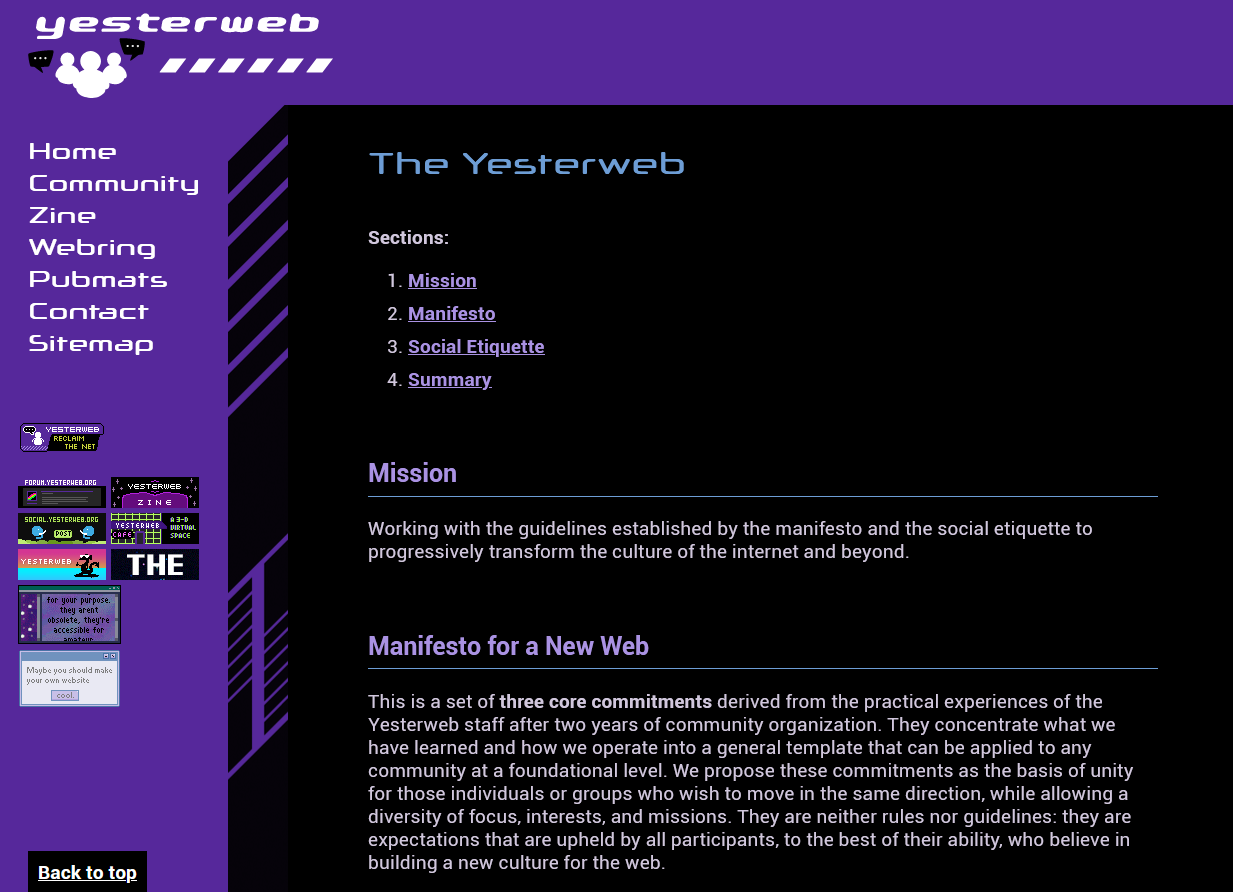
The Yesterweb is a community project about changing internet culture rather than a product or service. Its page presents a mission, a "Manifesto for a New Web" and a set of social etiquette expectations, framed as a template other communities can adopt. The manifesto is described as three core commitments drawn from the organizers' practical experience after two years of community work — explicitly expectations upheld by participants, not rules or guidelines.
What it covers
- Social responsibility and partisanship: A community should recognize that not all beliefs can coexist in one space; diversity of opinion is respected up to bounds that exclude oppressive intentions such as discrimination by age, sex, gender, class, race or ethnicity, religion, or disability. When conflict appears, the stated approach is to investigate whether harm was intentional or ignorant, and to side with the oppressed.
- Collective well-being and personal growth: Sustainable selflessness and social effort are treated as necessary for a healthy community, with emphasis on listening, empathy, dialogue and resolving conflict rather than winning debate. The page also warns against defining a community only in opposition to something.
- Social etiquette: A separate section sets expectations for how participants treat one another, complementing the manifesto.
Who it is for
It suits people running or joining small online communities — forums, chat servers, zine circles, indie web groups — who want a stated basis for moderation and culture-building, and individuals interested in the "reclaiming the internet" idea of a less commercial, more human web.
Trade-offs to weigh
The approach is deliberately partisan: it prioritizes protecting marginalized members over neutral "both sides" moderation. That can make spaces safer and clearer about boundaries, but it demands active moderation, judgment in ambiguous cases, and willingness to enforce values — more work than a hands-off policy. Readers should treat the manifesto as a starting point to adapt, not a plug-in ruleset.
A practical next step: read the manifesto and etiquette sections alongside your own community's conflict history, then draft two or three concrete expectations you could actually uphold. Related reading on independent, non-commercial web culture includes Neocities.
How can I apply the Manifesto for a New Web to my own online community?
Treat the manifesto as a set of operating expectations rather than a rulebook. The Yesterweb frames its three commitments as "the basis of unity" for groups heading in a similar direction, while leaving room for different focuses and missions. That framing is the key to applying it: adopt the commitments as shared principles, then work out concrete practices that fit your community's size, purpose and moderation capacity.
Translate each commitment into practice
Social responsibility and partisanship. Decide in advance that some conduct is out of bounds — the manifesto names discrimination based on age, sex, gender, class, nation/race/ethnicity, religion or disability. Write a short statement of what your community will not host, and give moderators a clear path for ambiguous cases: talk to the people involved to distinguish malice from ignorance, then respond with education or removal as appropriate. The harder part is the stated willingness to "take the side of the oppressed at any cost," which may mean losing members who hold antagonistic views. Discuss that trade-off openly before a conflict forces the decision.
Collective well-being and personal growth. Build habits that make listening and empathy normal: slower reply norms in sensitive threads, facilitators for disputes, and a stated preference for dialogue over debate. The manifesto also warns against defining the community purely by what it opposes. Give newcomers a positive reason to join — a shared project, a craft, a place to learn — not just a list of things you reject.
Sustainability. The manifesto asks for "sustainable amounts of selflessness and sacrifice," which is a caution as much as an aspiration. Volunteer moderators burn out when expectations are unlimited. Set realistic response times, rotate duties, and treat moderator rest as part of community health.
A concrete starting scenario
Suppose you run a small forum for hobbyist writers. You could post the three commitments as a pinned charter, add one sentence to your rules explaining how reports are handled, and hold a monthly thread where members propose improvements to the culture. When a dispute arises, a moderator opens a private conversation with each side before any public action.
| If your community is… | Start with… | Watch for… |
|---|---|---|
| Small and informal | A pinned charter and one moderator norm for handling reports | Drift when the charter is never referenced |
| Growing quickly | Written escalation steps and a rotating moderation roster | Volunteers absorbing all conflict alone |
| Built around a shared interest | Framing the charter around what you build together | Defining yourselves mainly against rival spaces |
A decision criterion
Before adopting the manifesto, ask whether your group is willing to enforce the partisanship commitment when it costs members. If not, adopt the well-being and sustainability commitments first and be honest that the boundary commitment is aspirational. For background on the wider movement, see The Yesterweb.
What does the social etiquette section expect from me when I participate in a Yesterweb space?
The social etiquette section is best read as a participation standard rather than a rulebook: it expects you to help keep the space safe and humane, not just to avoid breaking rules. The page frames the manifesto's three commitments as expectations "upheld by all participants, to the best of their ability," and the etiquette section sits alongside them as the practical layer for how people treat each other.
What it asks of you in practice
- Take a side against harm. The manifesto's first commitment says diversity of opinion is respected only up to the bounds of oppressive intentions, such as discrimination based on age, sex, gender, class, nation, race or ethnicity, religion or disability. When conflict appears, the expectation is to understand the situation and side with the oppressed.
- Distinguish malice from ignorance. Where it is unclear whether harm was intentional, the page calls for investigation through dialogue. Ignorance is treated as something education can resolve, so the expected response is inquiry before judgment.
- Contribute consistent social effort. The second commitment asks for sustainable selflessness and sacrifice, ideally from everyone, because maintaining a culture is ongoing work rather than a one-time act.
- Listen and empathise before debating. Communication should train listening and empathy, striving for unity and dialogue rather than division and debate, and approaching conflict with the intention of resolution.
- Build toward something, not just against something. Communities should not define goals purely in opposition to something else.
A concrete scenario
Suppose a newcomer posts a joke that reads as demeaning to a religious group. A member who has absorbed this etiquette would not simply delete it or pile on. They would ask whether the poster understood the impact, explain the harm, and, if the poster doubles down, treat that as a deliberate choice rather than an accident. The point is to protect the targeted people first and educate second.
Decision criterion
Before posting in a Yesterweb-affiliated space, ask two questions: does this comment treat anyone's safety as negotiable, and am I engaging to resolve or to win? If either answer is uncomfortable, revise before sending. For the fuller context, read the manifesto and mission on The Yesterweb.
How does the Yesterweb handle conflicts between members with opposing beliefs?
The Yesterweb treats opposing beliefs as something a community must actively manage, not something it can avoid by trying to include everyone. Its manifesto, drawn from two years of running the community, frames this as a commitment to "social responsibility and partisanship": diversity of opinion is respected up to a boundary, and beliefs that express oppressive intent—discrimination by age, sex, gender, class, nation, race or ethnicity, religion, or disability—fall outside that boundary.
What happens when a conflict appears
- The community takes a side. When antagonistic beliefs clash with the stated bounds, the expectation is to understand the situation and side with the oppressed "at any cost," rather than staying neutral.
- Intent is investigated first. If it is unclear whether harm was deliberate or accidental, the manifesto calls for dialogue to establish whether it was malice or ignorance. Ignorance is treated as something education can resolve; malice is not.
- Resolution is the goal, not victory. The companion commitment to collective well-being asks members to listen and empathize, and to approach conflict "with the intention of resolution" rather than division and debate.
The trade-off to weigh
This is a partisan model, and it is explicit about that. It gives a community a clear basis for decisions and protects members from having to share space with people who would harm them, but it also means some people will not be accommodated, and moderators carry the burden of judging where a belief crosses the line. For someone deciding whether to join or build a similar space, the practical question is whether they accept that boundary-setting role being exercised by others on their behalf—and whether the group has the patience for the dialogue step before judgment.
A useful next step is to read the manifesto's third commitment and the social etiquette section together, since the etiquette is where abstract principles become day-to-day expectations for how members actually speak to each other.
What does 'reclaiming the internet' mean in practice for an individual user?
"Reclaiming the internet" on The Yesterweb is framed as a cultural project rather than a technical one: individuals rebuild a healthier web culture by changing how they participate, not by switching to a particular tool. The site's manifesto treats this as commitments people uphold "to the best of their ability," which means the practical answer is a set of habits.
What it looks like for one person
- Practice social responsibility. The manifesto asks participants to recognize that no single space can accommodate everyone, and to take the side of people facing discrimination when conflicts arise. In daily use, that means choosing communities with clear boundaries and speaking up when harm occurs, while distinguishing malice from ignorance through dialogue.
- Invest in collective well-being. The site calls for "sustainable amounts of selflessness," patient listening and approaching conflict with the intention of resolution. Concretely: prefer dialogue over debate, and avoid building a presence purely in opposition to something.
- Contribute rather than only consume. The mission describes transforming internet culture "progressively," which implies small, repeated acts — writing, linking, moderating, welcoming newcomers — rather than a one-time migration.
A realistic scenario
Someone frustrated with algorithmic feeds could start by keeping one small, human-scale space where they post and reply deliberately, and by applying the manifesto's conflict guidance when disagreements appear there. That is a cultural commitment, not a platform choice; the site does not prescribe specific software.
Decision criterion
If you want a checklist of features or a migration guide, this framing will disappoint. If you want a set of behavioral expectations you can adopt in whatever space you already use, the manifesto and social etiquette sections are the place to start — read both, then pick one commitment to practice for a month before adding another.
How can I get involved with or contribute to the Yesterweb community?
The Yesterweb frames involvement as adopting a shared set of expectations rather than joining a formal membership program. Its page describes the project as "working with the guidelines established by the manifesto and the social etiquette to progressively transform the culture of the internet and beyond." So the most direct way to contribute is to practice that culture in whatever online spaces you already inhabit, and to organize with others who share the same direction.
What the site asks of participants
The manifesto is presented as three core commitments, drawn from the staff's two years of community organizing. They are described as expectations upheld by all participants "to the best of their ability," not rules or guidelines:
- Social responsibility and partisanship. The community recognizes it cannot accommodate everyone in one space, and draws bounds around oppressive intentions such as discrimination by age, sex, gender, class, nation/race/ethnicity, religion, or disability. When conflict appears, the stated approach is to investigate whether harm was intentional or accidental through dialogue, then take the side of the oppressed.
- Collective well-being and personal growth. This calls for sustainable selflessness and consistent social effort, listening and empathizing, and approaching conflict with the intention of resolution rather than division or debate. The page also cautions against building community goals purely out of opposition to something.
- A shared direction with diverse focuses. The commitments are proposed as a "basis of unity" that still allows "a diversity of focus, interests, and missions"—so contributing can mean applying them to your own niche project, not only to Yesterweb-run spaces.
The page also lists a "Social Etiquette" section alongside Mission and Manifesto, which is the practical companion to the commitments above; read it before participating in any discussion space tied to the project.
A concrete next step
If you run a small forum, Discord, or personal site, treat the manifesto as a template: write down your own version of these commitments, state explicitly what behavior is out of bounds, and describe how you will handle ambiguous harm (dialogue first, then a decision). Then link it publicly so newcomers know what they are joining. That is the kind of contribution the page's framing invites—applying the template "to any community at a foundational level"—and it gives you something concrete to compare notes on with others moving in the same direction.
For background on the wider movement of independent, personal-web projects this belongs to, see Neocities and IndieWeb.
User reviews (0)