

 Visit website
 Updated: 2026-10-03 15:58
 Language: English (default)
 Access: Normal
 Profile views 8
  Outbound visits 0
 Website Review
What is Zakon Group LLC?
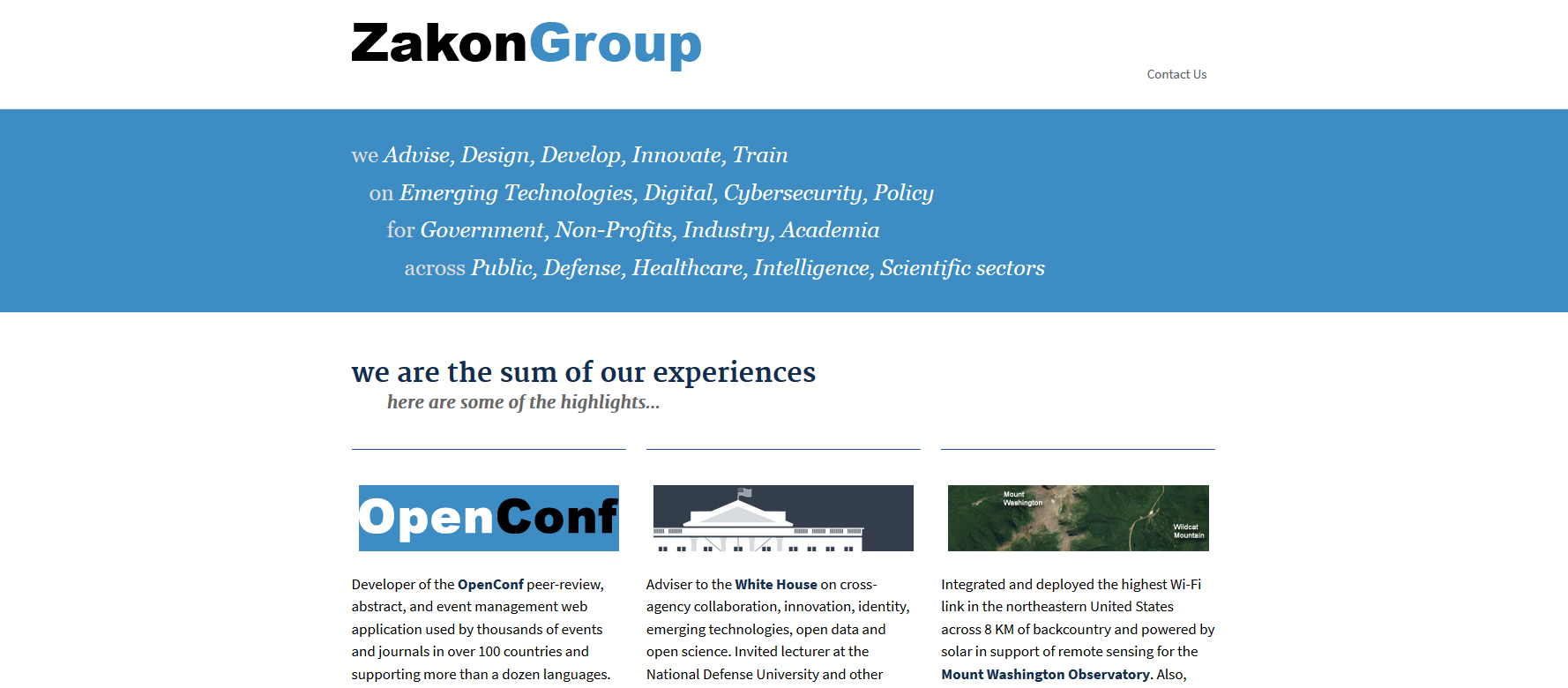
Zakon Group LLC is a consultancy that provides technology strategy, development, and integration services. Its stated focus spans digital, cybersecurity, emerging technologies, and policy work for government, non-profits, industry, and academia, with sector experience listed across public, defense, healthcare, intelligence, and scientific fields. In practice, it looks like a small, senior-led firm that advises and builds rather than a product company with a single flagship platform — although it does also develop and operate software, notably the OpenConf peer-review and event management application.
What the firm says it does
The site describes an "Advise, Design, Develop, Innovate, Train" model. Concrete examples from its own highlights include:
- Developing OpenConf, a peer-review, abstract, and event management web application used by events and journals in many countries and languages, offered both as licensed client-installed software and as cloud/SaaS.
- Advising the White House on cross-agency collaboration, innovation, identity, emerging technologies, open data, and open science.
- Serving as an innovation expert at the U.S. Department of the Treasury on governance, critical infrastructure, cybersecurity, fintech, and blockchain/distributed ledger.
- Building bilingual web-based information infrastructures for U.S. Department of Defense collaboration with Korean and Japanese defense forces.
- Developing a volunteer management system and map-based plant monitoring application for the Appalachian Mountain Club.
- Designing, hosting, and managing public, intranet, and extranet sites for the Clean Air Task Force, including an interactive map of diesel soot health impacts.
- Training FBI and Treasury procurement teams on product strategy and visioning for agile digital acquisition.
- Developing an early web-based machine translation service, first prototyped for the United Nations and later deployed on U.S. intelligence networks.
- Leading design and deployment of a multi-national OSINT information-sharing network among intelligence components of seven countries.
- Deploying a solar-powered Wi-Fi link across 8 km of backcountry for the Mount Washington Observatory's remote sensing, plus hosting and managing the observatory's website.
Who it tends to suit
This kind of consultancy fits organizations that need cross-disciplinary help at the intersection of policy, security, and software — for example, a public-sector program office that must stand up a collaboration platform under strict compliance, or a scientific nonprofit that needs a mapping or data-collection tool built and hosted. It is less obviously aimed at buyers seeking a shrink-wrapped commercial product with published tiers and self-serve onboarding, since the described work is largely bespoke advisory and integration.
How to decide whether it is the right fit
Use the firm's own case examples as the test. If your problem resembles advising on cross-agency data sharing, deploying secure collaboration infrastructure, building a niche web application, or training acquisition teams, the demonstrated pattern matches. If you need a large systems integrator with broad bench depth or a pure SaaS vendor, the fit is weaker.
A practical next step: pick two or three of the highlights above that overlap with your project, and ask directly how the team would approach your specific constraints — hosting environment, security review, languages, and long-term maintenance. For comparison, you can also review adjacent public-interest technology consultancies such as 18F or Code for America, and check the OpenConf product page for the software side of the business.
What types of organizations can benefit from Zakon Group's consulting services?
Zakon Group is best suited to organizations that need senior technical strategy and hands-on delivery in complex, regulated or research-driven environments. Its stated focus spans public, defense, healthcare, intelligence and scientific sectors, so the strongest fit is an institution with a problem that mixes policy, security, data and custom software rather than a routine marketing site or simple app build.
Likely beneficiaries
- Government and public-sector agencies: Strategy, digital services, cybersecurity, identity, open data and cross-agency collaboration. The site cites advisory work with the White House and an innovation role at the U.S. Department of the Treasury, which suggests experience navigating public-sector governance and critical infrastructure.
- Defense and intelligence organizations: Secure information sharing, multilingual systems and collaboration across national boundaries. Examples include a web-based machine translation service deployed on U.S. intelligence networks and an OSINT sharing network among seven countries.
- Healthcare and scientific institutions: Research infrastructure, remote sensing, peer review and event management. OpenConf, its peer-review and event management application, is used by thousands of events and journals in over 100 countries, according to the site.
- Nonprofits and environmental groups: Web platforms, volunteer systems and public-facing data tools. The site describes work for the Appalachian Mountain Club and the Clean Air Task Force, including an interactive map of diesel soot health impacts.
- Universities and academic bodies: Training, emerging-technology lectures and research workflow tools. The company says it has lectured at the National Defense University on topics from cybersecurity to AI and machine learning.
- Industry teams with high-stakes integration needs: Organizations that need emerging technology, cloud, cybersecurity or policy expertise rather than a single-purpose vendor.
A practical way to decide
Choose Zakon Group when your project requires both strategic advice and delivery, involves sensitive data or multiple stakeholders, and would benefit from experience in government, defense, healthcare, intelligence or science. If you need a low-cost, high-volume consumer product or a narrow commodity service, its profile is likely more specialized than you need.
A useful next step is to map your project against one of its documented areas — for example, peer-review and event management, secure multilingual information sharing, remote sensing infrastructure or public-facing environmental data — and ask whether your organization needs that combination of policy, security and custom development. If it does, the fit is strong; if only one element is needed, a narrower specialist may be more efficient.
How does Zakon Group support government agencies with technology strategy and development?
Zakon Group supports government agencies through a mix of advisory work and hands-on build-and-integrate services. Its stated focus is advising, designing, developing, innovating and training in emerging technologies, digital, cybersecurity and policy, and it lists public, defense, healthcare, intelligence and scientific organizations among the sectors it serves.
What that looks like in practice, based on the site's highlights
- Policy and strategy advising: Work as an adviser to the White House on cross-agency collaboration, innovation, identity, emerging technologies, open data and open science.
- Department-level innovation leadership: Serving as an innovation expert at the U.S. Department of the Treasury, facilitating work on governance, critical infrastructure, cybersecurity, fintech, blockchain and distributed ledger.
- Custom systems development: A volunteer management system and map-based plant monitoring application for the Appalachian Mountain Club, built within a legacy hosting environment.
- Web infrastructure for public-interest organizations: Designing, developing, hosting and managing the Clean Air Task Force's public, intranet and extranet sites, including an interactive map of diesel soot health impacts.
- Cross-border and multilingual systems: Bilingual web-based information infrastructures for U.S. Department of Defense collaboration with Korean and Japanese defense counterparts; a web-based machine translation service first prototyped for the United Nations and later deployed on U.S. intelligence networks in 10 languages.
- Multi-national information sharing: Leading design and deployment of an OSINT sharing network among intelligence components of seven countries, plus technical liaison work for a U.S. Intelligence Community delegation.
- Training and acquisition support: Training cross-functional procurement teams from the FBI and the Treasury on product strategy and visioning for agile digital acquisition.
- Field engineering in austere conditions: Integrating and deploying a solar-powered Wi-Fi link spanning 8 km of backcountry for the Mount Washington Observatory's remote sensing, and running the observatory's website.
- A productized platform: OpenConf, a peer-review, abstract and event management web application used by thousands of events and journals in over 100 countries and more than a dozen languages, available as licensed client-installed software or cloud/SaaS.
How to decide whether this fits your agency
Match the engagement type to your need:
| Your need | Relevant pattern from the site |
|---|---|
| Policy, governance or cross-agency coordination | White House and Treasury advisory roles |
| A custom application or legacy-environment build | Appalachian Mountain Club tools; DoD bilingual infrastructures |
| Public-facing web presence with hosting and operations | Clean Air Task Force sites |
| Multilingual or cross-border collaboration systems | UN prototype, 10-language intelligence deployment, seven-country OSINT network |
| Workforce upskilling on agile acquisition | FBI and Treasury procurement training |
| Peer review or event management out of the box | OpenConf, licensed or cloud |
A practical next step: identify which of these patterns matches your requirement, then ask for a reference in that specific domain — the site's highlights are strongest evidence for advisory, multilingual systems and public-interest web work, so a comparable case is the fastest way to judge fit. For peer-review or conference workflows specifically, you can compare the OpenConf option directly at Zakon Group LLC.
What is OpenConf and how can it be used for managing peer-review and events?
OpenConf is a web application for peer review, abstract submission and event management, developed by Zakon Group LLC. According to the company, it is used by thousands of events and journals in more than 100 countries, supports over a dozen languages, and is offered both as licensed software for client installation and as a cloud/SaaS service Zakon Group LLC. That dual delivery model is the main practical distinction: licensed installation suits organizations that must keep submission data on their own infrastructure or integrate deeply with internal systems, while the hosted option shifts patching, uptime and scaling to the vendor.
What it does
The core workflow covers the path a conference or journal typically needs: call for papers or abstracts, online submission, reviewer assignment, scoring and discussion, decision notifications, and camera-ready or final material collection. Because the same system spans abstract and event management, organizers can often run the whole cycle without stitching together a submission tool, a spreadsheet and a separate registration or scheduling product.
Who it fits
- Academic societies and journal editors handling recurring review cycles.
- Conference chairs who need multiple tracks, reviewer bidding and conflict-of-interest handling.
- Research groups and institutes with modest budgets that still need multilingual submission forms.
- IT or security-conscious organizations that prefer self-hosting.
A realistic scenario
A program chair for a mid-sized conference opens submissions in three languages, assigns each paper to two or three reviewers with conflicts screened out, runs a rebuttal round, then releases accept/reject notices and collects final PDFs. Most of that is configuration and committee coordination rather than custom development, which is where the value sits compared with building on generic survey or form tools.
Trade-offs to weigh
Self-hosting gives control and data residency but puts upgrades, backups and security on your team. The SaaS route is faster to launch, though you accept the vendor's release schedule and data location. Feature depth also matters: confirm that the specific review model you use — double-blind, open, or a journal-style multi-round process — is supported natively rather than through workarounds.
Next step
Before committing, list your must-have review model, languages, integration points (single sign-on, DOI or indexing workflows) and hosting constraints, then ask the vendor to demonstrate those exact steps in a live instance using a sample of your own past submissions.
What cybersecurity and emerging technology training does Zakon Group offer?
Zakon Group offers training tied to emerging technology and cybersecurity topics, but it does not present a public catalog of standard courses. Its page highlights training as one of several services — alongside advising, designing, developing and innovating — for government, nonprofits, industry and academia. The clearest named training evidence is that its principal has been an invited lecturer at the National Defense University and other venues on subjects ranging from cybersecurity and blockchain to artificial intelligence and machine learning. It also trained cross-functional procurement teams from the FBI and the U.S. Department of the Treasury on product strategy and visioning for agile digital acquisition.
That pattern suggests bespoke, expert-led sessions rather than open-enrollment certification programs. A realistic use case: a public-sector program office needs its acquisition, security and engineering staff to share a working vocabulary around AI risk, distributed ledger or identity before a new project starts. Zakon's background in cross-agency collaboration, critical infrastructure, fintech and open data is relevant to that kind of briefing. If you need a vendor-neutral certification path with fixed syllabi, a dedicated training provider is likely a better fit; if you need tailored instruction connected to a specific mission or technology decision, a consultancy like this is more appropriate.
To move forward, ask for a short syllabus, sample module, instructor bio and whether sessions are in-person, virtual or workshop-style, plus how they handle classified or sensitive environments. For comparison, established training bodies such as SANS Institute and ISC2 publish structured cybersecurity curricula, while NIST provides free frameworks and guidance that can anchor a custom curriculum.
How has Zakon Group contributed to intelligence and defense information sharing networks?
Zakon Group's intelligence and defense work centers on building and connecting information-sharing systems for government and allied partners, not on selling a commercial platform. According to the company's own site, its founder served as technical liaison for a U.S. Intelligence Community delegation and led the design and deployment of a multinational OSINT (open-source intelligence) information-sharing network among the intelligence components of seven countries. The same background includes developing the first web-based machine translation service — first a prototype for the United Nations, later deployed on U.S. Intelligence networks and supporting 10 languages — plus bilingual web-based information infrastructures for U.S. Department of Defense collaboration with Korean and Japanese defense forces.
What this pattern means in practice
These examples point to a specific niche: cross-organization and cross-border systems where the hard problems are governance, identity, data exchange and language, rather than a single agency's internal tooling. The site also lists advisory work to the White House on cross-agency collaboration, identity, emerging technologies, open data and open science, and an innovation role at the U.S. Department of the Treasury covering governance, critical infrastructure, cybersecurity, fintech and distributed ledger. Those are policy-and-architecture assignments that typically sit upstream of any deployed network.
A concrete reader scenario
If you lead a program office that must share sensitive but unclassified information with coalition partners, the relevant question is not "can they build a portal" but "can they negotiate data-sharing rules, identity federation and multilingual handling across agencies that do not share a common stack." The evidence above suggests that is the kind of engagement Zakon Group takes on. For comparison, large systems integrators such as Leidos and Booz Allen Hamilton field much larger delivery organizations for enterprise-scale defense programs, while Zakon Group's profile reads closer to a small, senior consultancy for architecture, standards and pilot-to-production work.
How to decide
- Choose this type of consultancy when the core risk is cross-agency or multinational coordination, identity, policy alignment or language support.
- Choose a large integrator when you need sustained headcount, cleared staff at scale and long-term operations and maintenance.
- Ask any candidate for references on a network that spanned more than two organizations, and for the governance model that made it work — that is where these projects usually fail.
Next step: request a short architecture briefing and one anonymized case study of a multi-party sharing network, then check whether their approach matches your data-classification and identity constraints.
 Hosting and Email
 Amazon Route 53
 Hosting
 Zoho Mail
 Location
 Ashburn, Virginia, United States
 Pages, Search and Sharing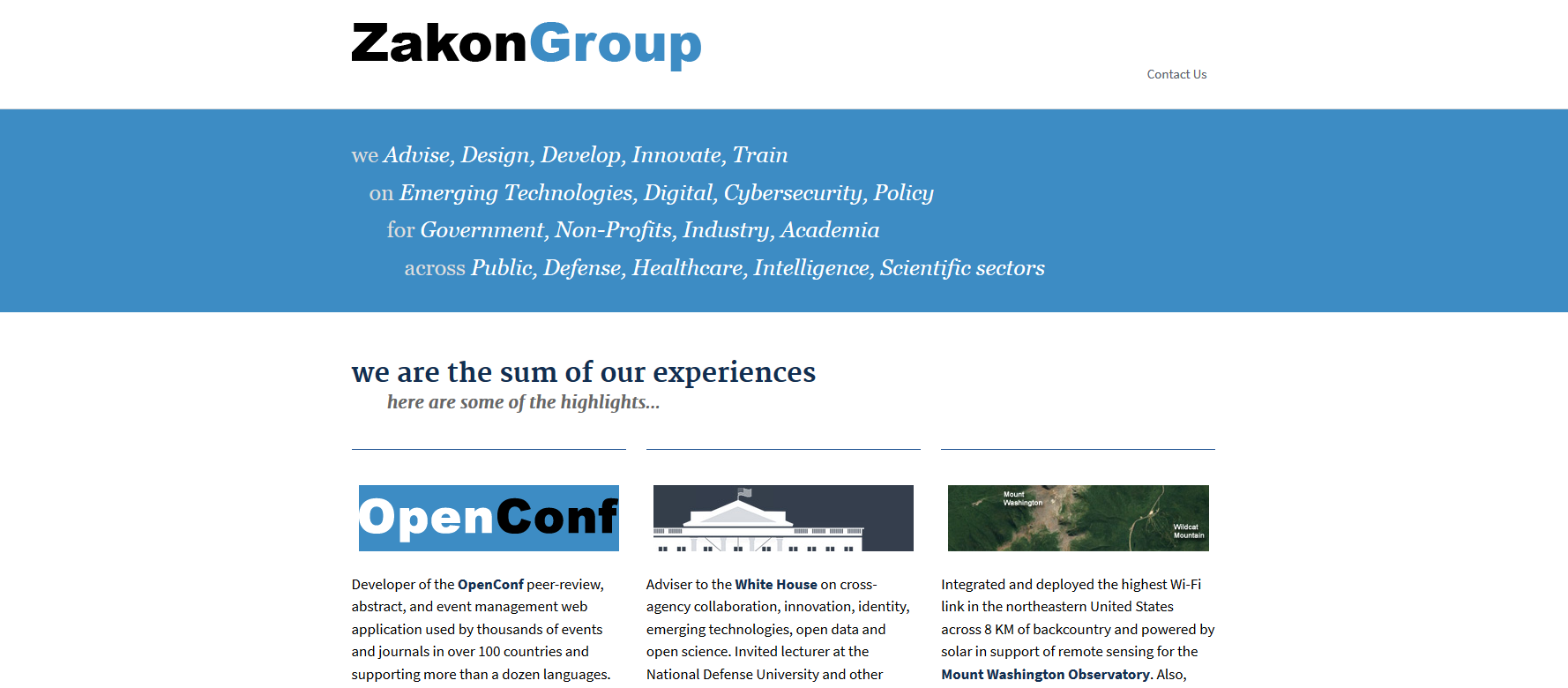


 ia_archiver

 Registration details

 Identified technologies
User reviews (0)