Website profiles · Technology insights · Alternatives

aspra.app

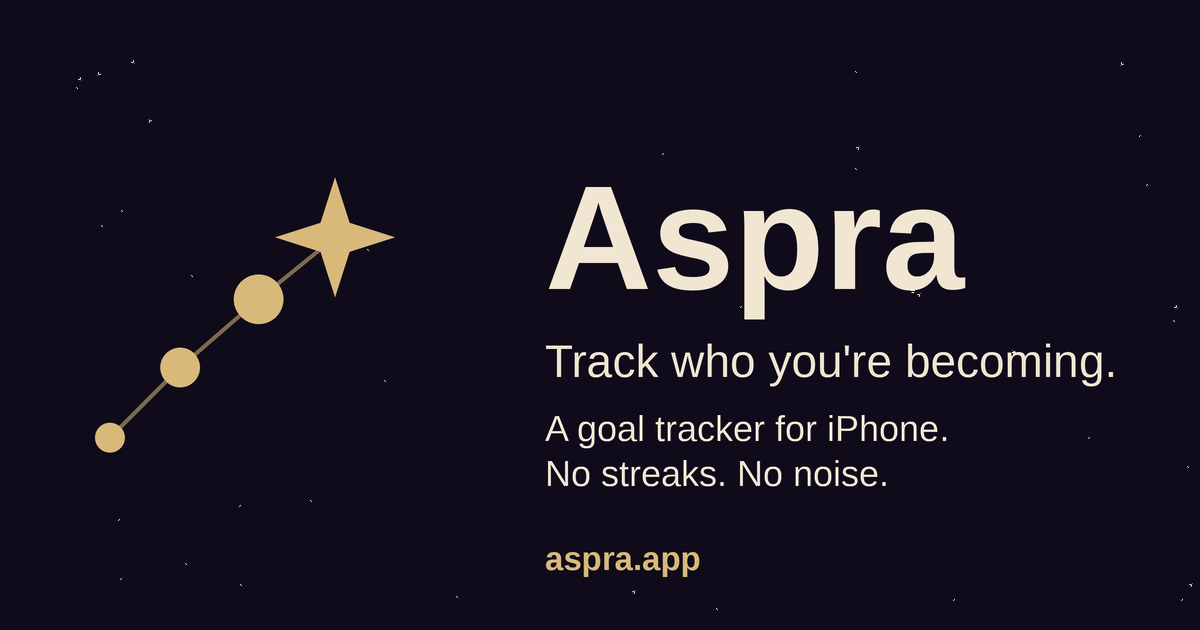
A Kaizen-inspired habit and goal tracker for iPhone. Small daily actions that scale with you. No streaks, no gamification. Solo, or with one accountability partner.

No paid content found Multilingual
Visit website
Profile views 2 Outbound visits 0 Normal
Aspra Full homepage screenshot

At a glance

Category
Other
Language
English
Paid-content signal
No paid content foundObserved
Registered
2026
Hosting
CloudflareInferred
HTTPS certificate trusted
PassedObserved
Last updated

Website review

This review may include AI-generated content and is not individually verified. Domain, certificate and other facts come from the observed data on this page.

What is Aspra?

Aspra is an iPhone habit and goal tracker built around small, steady progress rather than streaks. Instead of gamified rewards, it shows consistency as a rate over a recent window, so a missed day lowers that rate slightly instead of resetting your progress. It is designed for solo use or for exactly two people: you and one accountability partner.

How it works in practice

  • Plan from your own words: During onboarding, Aspra drafts a plan based on what you write, with month-by-month milestones and daily actions.
  • Weekly readback: Each Sunday, the app reflects your week back to you.
  • No streak pressure: There are no streaks, XP, badges, or leaderboards.
  • Two-person accountability: In Lone Wolf mode you use it alone. In Partner mode, you and one other person each keep your own goals and share only the goals, actions, and journal entries you choose. There is no social feed and no group larger than two.

Who it suits

This fits someone who keeps restarting the same goal and wants a quieter system that tolerates an off day. It also suits a pair—partners, friends, or couples—who want mutual visibility without a broader social layer. If you prefer competitive leaderboards or streak-driven motivation, a different style of tracker will likely feel more natural.

Practical next step

If you want to try it, start with the 3-day free trial and use onboarding to describe one goal you have restarted before. Then check whether the generated daily actions feel small enough to do on a low-energy day. For a broader comparison of streak-free approaches, see Aspra.

How does Aspra differ from streak-based habit trackers like Habitica?

Aspra is built around consistency rates rather than streaks, so a missed day nudges a percentage down instead of resetting a chain to zero. It also deliberately strips out the game layer: no XP, badges, leaderboards or social feed. Habitica, by contrast, is a gamified tracker where habits and tasks feed an avatar, party and reward economy — the motivation comes from playing the game as much as from the habit itself.

Where the philosophies split

Aspra Habitica-style trackers
Missed day Lowers a consistency rate over a recent window Breaks a streak or costs in-game health/currency
Motivation source Quiet evidence of showing up Points, levels, pets, quests, parties
Social layer Exactly one accountability partner, or solo Guilds, parties, public challenges
Plan structure Long-term goal broken into monthly milestones and daily actions, reviewed each Sunday Task lists you maintain yourself
Platform iPhone Broad, including web and Android

Which fits whom

Pick Aspra if streaks have backfired for you — if losing a 40-day chain once made you abandon the habit entirely — or if you want one person who notices whether you showed up, rather than a group. The two-person cap is a feature, not a limitation: it keeps the accountability specific and the sharing selective, since each person chooses which goals, actions and journal entries to expose.

Pick a gamified tracker if you genuinely enjoy the game mechanics and they sustain you rather than distract you, or if you want a shared quest structure with a larger group.

A practical test

Run one habit in both styles for two weeks. Note what happens on the day you miss. If the gamified version makes you want to restart immediately and the rate-based version just makes you want to log tomorrow, that tells you which system matches how you actually behave.

For background on the goal-writing and weekly-reporting element Aspra leans on, the widely cited study by Dr. Gail Matthews at Dominican University found that participants who wrote down goals and sent weekly progress updates to a friend reached them at roughly twice the rate of those who told no one. Aspra's one-partner mode is a direct application of that finding.

If you want to compare against the gamified approach directly, Habitica's own site is Habitica, and for habit-building method generally, James Clear covers the non-streak view in depth.

How does the accountability partner feature work in Aspra?

Aspra’s partner feature is deliberately narrow: it pairs you with exactly one other person, and each of you keeps your own goals. You share only the goals, actions, and journal entries you choose to make visible, so your partner can see that you showed up, and you can see the same from them. There is no social feed and no group larger than two.

The practical effect is that accountability becomes a private, low-pressure signal rather than a performance. Because Aspra does not use streaks, a missed day lowers a consistency rate over a recent window instead of resetting progress to zero. Your partner sees that rate and the shared activity, not a public failure. For someone who finds streak-based apps stressful or who wants a spouse, sibling, or close friend to be the only witness, that design is the main draw; for anyone who wants a team, community challenges, or visible competition, it will feel too limited.

A concrete way to use it

  • Each person picks one goal they keep restarting and shares it with the other.
  • You both share the daily actions that support those goals, so “showing up” is specific rather than vague.
  • You leave private journals private and share only what helps the other person support you.
  • The weekly read-back gives both of you a natural moment to compare consistency rates and adjust the plan.

The evidence page cites Dr. Gail Matthews’ study of 267 adults, in which people who wrote down goals and sent weekly progress to a friend reached them at roughly twice the rate of those who told no one. That is general research, not a guarantee for Aspra specifically, but it explains the weekly rhythm the app is built around.

If you are deciding whether the partner tier is worth it, ask two questions: do you already have one person you would genuinely update each week, and would you rather have quiet evidence than a public scoreboard? If yes to both, the two-person setup is the point. If you would need a larger group to stay motivated, Aspra’s cap of two is a real limitation. The partner joins free, so the cost difference is mainly about whether you want that shared layer at all.

What does Aspra's pricing look like, and is there a free trial?

Aspra uses a simple subscription model with a 3-day free trial, and the price depends on whether you use it alone or with a partner. You subscribe inside the iPhone app.

Pricing at a glance

Plan Who it covers Annual Weekly
Lone Wolf (solo) One person $29.99/year $1.99/week
Partner Two people, with one partner joining free $49.99/year $2.99/week

What the trial means in practice

The 3-day free trial gives you a short window to test the core loop: turning a goal into daily actions and seeing whether the no-streak consistency rate fits how you think about progress. Three days is enough to check the onboarding and daily check-in, but not really enough to judge the month-by-month plan growth, since that unfolds over weeks.

Which plan makes sense

  • Choose Lone Wolf if you want a private tracker and don't need anyone else involved. It's the cheaper option and matches Aspra's solo mode.
  • Choose Partner if accountability is the main reason you're here. The second person joins free, so the higher price covers both of you. If you're splitting it, the per-person cost ends up close to the solo rate.

One decision criterion: the Partner plan only pays off if you actually have someone willing to share goals, actions, and journals with you. Aspra caps sharing at exactly two people, so if you don't have that person lined up, Lone Wolf is the straightforward choice.

Next step

Download Aspra from the App Store and start the 3-day trial with one real goal you keep restarting. Decide on solo versus partner before the trial ends, since that choice determines which subscription you'll pick.

How does Aspra turn a long-term goal into a daily plan during onboarding?

During onboarding, Aspra asks you a few questions in your own words and drafts a plan from those answers. The plan is structured top-down: your future self at the top, then month-by-month milestones, then daily actions that match the goal you entered. So instead of picking from preset habit templates, you describe the goal and Aspra proposes the intermediate steps and the small daily actions that ladder up to it. The plan is meant to grow month by month as you stay consistent, rather than being fixed at signup.

What the onboarding flow looks like in practice

  1. You answer a short set of prompts about the goal you keep restarting.
  2. Aspra generates a draft plan: milestones spread across months, with daily actions attached.
  3. You work from the daily actions; each Sunday the app reads your week back to you so you can see what actually happened.
  4. The plan scales with your real capacity over time — the Kaizen idea of small, steady steps rather than a fixed target you either hit or miss.

Why this matters for the daily plan

The design choice that follows from this is the absence of streaks, XP, badges and leaderboards. Missing a day lowers a consistency rate over a recent window rather than resetting progress. If you have abandoned habit trackers before because one missed day made the whole thing feel ruined, that mechanic is the relevant difference: the daily plan stays intact and the feedback is a rate, not a break.

Solo or with one partner

You can use Aspra alone in Lone Wolf mode, or pair with exactly one accountability partner. Each person keeps their own goals and shares only the goals, actions and journal entries they choose; the partner sees that you showed up, and vice versa. The app is capped at two people — no social feed, no larger groups.

A concrete scenario

Suppose the goal you keep restarting is "get fit enough to hike a long trail next summer." Onboarding turns that into milestones by month and a handful of daily actions sized to what you can actually do now. Your partner's role is narrow and specific: they see whether you showed up today. The research cited on the page — Dr. Gail Matthews' study of 267 adults at Dominican University, where participants who wrote down goals and sent weekly progress to a friend reached them at roughly twice the rate of those who told no one — is the rationale for that one-partner cap rather than a broad social layer.

Next step

If you want to judge whether the generated plan is any good, the useful test is the first Sunday read-back: does the week summary reflect actions you could realistically repeat, and does the monthly milestone still look like a step toward the goal you typed in? If yes, the onboarding did its job. If the daily actions feel generic or oversized, that's the signal to revise your inputs rather than push through.

For comparison, streak-based trackers such as Habitica reward consecutive completion, which is the model Aspra explicitly avoids.

Can I use Aspra solo without a partner?

Yes. Aspra can be used entirely on your own in a mode it calls Lone Wolf. The partner feature is optional, not a requirement for using the app.

What solo use looks like

In solo mode, you get the same core experience: you turn a long-term goal into daily actions, and the plan grows month by month as you stay consistent. The accountability partner is a separate layer you add only if you want it.

Solo mode is likely the better fit if:

  • You want to work on goals privately.
  • You don't have someone you'd want to share progress with.
  • You'd rather not coordinate with another person's schedule.

Partner mode makes sense if you want someone to see that you showed up, and to see the same from them. Aspra caps this at exactly two people — no feeds, no groups.

The trade-off

The main difference is external accountability. Aspra's own framing cites research by Dr. Gail Matthews at Dominican University, in which adults who wrote down goals and sent weekly progress to a friend reached them at roughly twice the rate of those who told no one. That's an argument for pairing up, but it's a general finding about accountability, not a guarantee about your results. If you already have structure — a coach, a training group, a colleague — you may not need a second person inside the app.

One thing to check before subscribing

Because solo and partner plans are priced separately, confirm you're selecting the Lone Wolf plan rather than the Partner plan when you subscribe. If you start solo and later want a partner, you'd be moving to a different plan tier rather than adding a free seat to your existing one.

If you want to compare approaches before committing, Aspra sits alongside streak-free habit trackers generally, and you can read more on its guides for habit tracking without streaks.

Related questions

More questions →
How Does Aspra Track Habits Without Streaks or Gamification?

Aspra replaces streak counting with a consistency rate measured over a recent window. There are no streaks, XP, badges, or leaderboards in the app. When you miss a day, that rate drops slightly rather than resetting your progress to zero. This applies to anyone using Aspra on iPhone, whether in Lone Wolf (solo) mode or with one accountability partner.

What replaces the streak

Most habit trackers push you with a counter that grows each day and breaks the moment you skip one. Aspra removes that mechanism entirely and shows your follow-through as a rate instead.

  • Consistency rate over a recent window — your recent behavior is summarized as a percentage-style rate, not a running total that can be wiped out.
  • A missed day lowers the rate a little — the cost of one off day is small and proportional, not a full reset.
  • No XP, badges, or leaderboards — there is nothing to grind and no ranking against other people.
  • Quiet evidence — the app frames the rate as evidence of who you are becoming, rather than a score to defend.

The practical difference: with a streak, one missed day can erase months of visible progress and often triggers quitting. With a rate, the same missed day is absorbed into the average, so the plan continues.

How the plan grows instead of resetting

Aspra is built on the Kaizen idea: small, steady steps that scale with your real capacity. The plan is designed to expand as you stay consistent, rather than to punish inconsistency.

During onboarding, Aspra drafts a plan from your own words, with milestones month by month and daily actions to match. Each Sunday, your week is read back to you. Because growth is tied to sustained consistency rather than an unbroken chain, a single missed day does not interrupt the month-by-month expansion of the plan.

Solo or with one partner

Aspra works in two configurations, and neither one adds gamification:

Mode Who is involved What is shared
Lone Wolf You only Nothing shared
Partner You and exactly one accountability partner Only the goals, actions, and journal you choose to share

In Partner mode, each person keeps their own goals. Your partner sees that you showed up, and you see the same from them. Aspra is capped at two people — there is no social feed and no group larger than two. The app cites a study of 267 adults in which the group that wrote down goals and sent weekly progress to a friend reached them at twice the rate of the group that told no one (Dr. Gail Matthews, Dominican University).

Pricing and availability

Aspra is on the App Store for iPhone and starts with a 3-day free trial. Subscriptions are purchased inside the app:

  • Lone Wolf (solo): $29.99 a year, or $1.99 a week billed weekly
  • Partner (two people, one partner joins free): $49.99 a year, or $2.99 a week billed weekly

Who this approach fits

Choose Aspra if a broken streak has caused you to abandon a habit before, or if competition and point systems feel like noise rather than motivation. The consistency rate suits people who want to see an honest recent picture of their behavior and keep going after an off day.

Look elsewhere if you specifically want streak counters, achievement badges, or a social feed with a larger group — Aspra deliberately excludes all of these, and its partner feature is limited to exactly two people.

What Is Aspra? A Kaizen-Style Habit and Goal Tracker for iPhone

Aspra is a habit and goal tracker for iPhone that turns a long-term goal into a small set of daily actions, then grows the plan month by month as you stay consistent. It's built for people who keep restarting the same goal and want a plan they can actually see — from a picture of their future self at the top down to what they do today. You can use it alone (Lone Wolf mode) or pair with exactly one accountability partner. It's a fit if streak resets and gamified rewards have been demotivating for you; it's less of a fit if you want leaderboards, badges, or a social feed.

The core idea: Kaizen, not streaks

Aspra is built on the Kaizen principle: small, steady steps that scale with your real capacity. Instead of a streak that resets the moment you miss a day, Aspra tracks consistency as a rate over a recent window. A missed day lowers that rate a little rather than erasing your progress.

That single design choice changes how the app feels day to day:

  • No streaks. Missing a day doesn't wipe out a number you've been protecting.
  • No XP, badges, or leaderboards. There's no gamification layer to game.
  • Consistency as a rate. Progress is shown as quiet evidence of who you're becoming, measured over a recent window rather than a perfect chain.

If you've used streak-based trackers and found the reset mechanic stressful or all-or-nothing, this is the main reason to look at Aspra.

How the plan gets built

Aspra doesn't start with a blank checklist. During onboarding, it drafts a plan from your own words — your goal, described in your own terms — and structures it into milestones month by month with daily actions to match.

The structure runs top-down:

  1. Your future self — the long-term goal at the top.
  2. Monthly milestones — the goal broken into stages.
  3. Daily actions — a few concrete things to do today.

Each Sunday, your week is read back to you. That weekly review is where you see whether your consistency rate is holding, and the plan is meant to grow month by month as you stay consistent — scaling with your capacity rather than assuming a fixed pace.

Solo or with one partner

Aspra supports two modes:

Mode Who's involved What's shared
Lone Wolf Just you Your own goals, actions, and journal
Partner You and exactly one other person Only the goals, actions, and journal you each choose to share

In Partner mode, one partner joins free. Each person keeps their own goals. Your partner sees that you showed up, and you see the same from them — no more than that. Aspra is capped at two people: there's no social feed and no group larger than two.

The app cites a study of 267 adults (Dr. Gail Matthews, Dominican University) in which the group that wrote down their goals and sent weekly progress to a friend reached them at twice the rate of the group that told no one. That's the rationale behind the one-partner design — a single accountability relationship rather than a crowd.

Pricing

Aspra starts with a 3-day free trial. Subscriptions are purchased inside the app:

  • Lone Wolf (solo): $29.99 per year, or $1.99 per week billed weekly.
  • Partner (two people, one partner joins free): $49.99 per year, or $2.99 per week billed weekly.

Who it's for

Aspra is a reasonable choice if:

  • You're on iPhone and want a tracker that lives on your phone.
  • You have one recurring goal you keep restarting and want it broken into daily actions.
  • Streak counters and gamified rewards have backfired for you.
  • You want accountability from one specific person, not a community.

It's probably not what you want if you're looking for a social habit network, group challenges, points and levels, or an Android app — the product is described as an iPhone app on the App Store.

FAQ

Does Aspra use streaks?

No. There are no streaks, XP, badges, or leaderboards. Consistency is shown as a rate over a recent window, and a missed day lowers that rate slightly instead of resetting your progress.

Can I use Aspra alone?

Yes. Lone Wolf mode is solo use. If you want accountability, Partner mode pairs you with exactly one other person, and that partner joins free.

How many people can share goals in Aspra?

Two — you and one partner. There's no social feed and no group larger than two.

How does the plan adapt over time?

It starts from your own words during onboarding, with monthly milestones and matching daily actions, and is designed to grow month by month as you stay consistent. Each Sunday your week is read back to you.

Is there a free version?

Aspra starts with a 3-day free trial, after which a subscription is required. Pricing is $29.99/year or $1.99/week for Lone Wolf, and $49.99/year or $2.99/week for Partner.

How Aspra Turns Your Goals Into a Daily Plan

Aspra builds your plan from your own words during onboarding, then structures it top-down: your future self at the top, month-by-month milestones in the middle, and the specific daily actions at the bottom. Each Sunday, the app reads your week back to you. The plan is designed to grow month by month as you stay consistent, rather than resetting when you miss a day. This applies to anyone using Aspra on iPhone, whether in Lone Wolf (solo) mode or with one accountability partner.

The starting point: a few answers, not a blank template

During onboarding, Aspra asks you a small set of questions and drafts a plan from your own words. You are not picking from preset habit categories or choosing a template — the raw material is what you say about the goal you keep restarting.

The output of this step is a visible plan rather than a single habit to check off. The page describes the structure as running "from your future self at the top down to what you do today," which means three layers:

  • Future self — the long-term goal stated in your terms
  • Milestones — month-by-month markers between now and that goal
  • Daily actions — the few things you actually do today

If you have restarted the same goal several times, that goal is the intended input. Aspra is built around taking one such goal and drawing it into a plan you can see.

What the plan actually contains

Layer What it holds Time horizon
Future self The goal as you described it Long-term
Milestones Month-by-month progress markers Monthly
Daily actions A few actions matched to each stage Daily

The daily layer is deliberately small. Aspra is described as turning a long-term goal into "a few daily actions" — not a full schedule. The Kaizen idea behind it is small, steady steps that scale with your real capacity.

How the plan grows over time

The plan is not fixed at onboarding. Aspra grows it month by month as you stay consistent, so the daily actions scale with what you have actually shown you can sustain rather than with an ambitious first draft.

This is also where the no-streak design matters. There are no streaks, XP, badges, or leaderboards. A missed day lowers a consistency rate a little instead of erasing your progress. Consistency is shown as a rate over a recent window — described on the page as "quiet evidence of who you are becoming." Practically, this means one missed day does not wipe out the plan's history or force you back to the start.

The weekly read-back

Every Sunday, your week is read back to you. This is the review loop that closes the cycle between the daily actions and the monthly milestones: you see what you actually did over the past week, which informs how the plan continues to grow.

If you use Partner mode, this loop has a second reader. You pair with exactly one accountability partner — Aspra is capped at two people, with no social feed and no group larger than two. Each of you keeps your own goals and shares only the goals, actions, and journal you choose to share. Your partner sees that you showed up, and you see the same from them.

The page cites a study of 267 adults (Dr. Gail Matthews, Dominican University) in which the group that wrote down their goals and sent weekly progress to a friend reached them at twice the rate of the group that told no one. That is the mechanism Partner mode is built around — a weekly progress signal to one other person.

What you need to get started

  • An iPhone — Aspra is on the App Store for iPhone
  • A goal you keep restarting, stated in your own words
  • Optionally, one person to pair with as an accountability partner

Pricing, per the site: Aspra starts with a 3-day free trial. Lone Wolf (solo) is $29.99 a year, or $1.99 a week billed weekly. Partner (two people, one partner joins free) is $49.99 a year, or $2.99 a week billed weekly. Subscriptions are handled inside the app.

Common points of confusion

"No streaks" does not mean "no tracking." Aspra still records whether you showed up — it expresses that as a consistency rate over a recent window instead of a streak counter that resets to zero.

The plan is not generated once and frozen. Onboarding drafts it, but the month-by-month growth is part of the design, tied to staying consistent.

Partner mode is not a social feature. It is exactly two people. There is no feed, no group, and no leaderboard, and sharing is limited to the goals, actions, and journal you each choose to share.

What Does Aspra Cost? Lone Wolf vs Partner Plans Explained

Aspra starts with a 3-day free trial, then costs $29.99/year (or $1.99/week) for Lone Wolf (solo) or $49.99/year (or $2.99/week) for Partner, where one partner joins free. You subscribe inside the app, and Aspra runs on iPhone via the App Store. If you only track your own habits, Lone Wolf is the cheaper fit; if you want one accountability partner sharing selected goals and actions, Partner is the plan that unlocks that.

Aspra Pricing at a Glance

Plan Who it's for Annual price Weekly price Notes
Lone Wolf One person, solo tracking $29.99/year $1.99/week billed weekly No partner features
Partner Two people (you + one partner) $49.99/year $2.99/week billed weekly One partner joins free

Both plans begin with a 3-day free trial. Subscriptions are purchased inside the app, so billing runs through your Apple ID.

Lone Wolf: solo use

Choose Lone Wolf if you want Aspra's core loop without a second person: turning a long-term goal into a few daily actions, with the plan growing month by month as you stay consistent. There are no streaks, XP, badges, or leaderboards — a missed day lowers a consistency rate slightly rather than resetting progress. This is the Kaizen approach: small, steady steps that scale with your real capacity.

Partner: two people, one partner free

Choose Partner if accountability is the part you keep missing. Aspra caps sharing at exactly two people — no social feed, no groups larger than two. Each person keeps their own goals and shares only the goals, actions, and journal entries they choose. Your partner sees that you showed up, and you see the same from them.

The pricing reflects that structure: $49.99/year covers both people, with the second seat free. If you'd otherwise pay for two separate habit apps, that's the comparison worth making.

How to Start and Verify What You're Paying

  1. Download Aspra from the App Store on your iPhone.
  2. Open the app and go through onboarding — Aspra drafts a plan from your own words, with month-by-month milestones and matching daily actions.
  3. Start the 3-day free trial when prompted.
  4. Before the trial ends, open the subscription screen in the app and confirm which plan and billing period you're selecting (annual vs. weekly).
  5. Check your Apple ID subscription settings to verify the renewal price and date.

Expected result: you're on the plan you intended, at the price shown above, with renewal visible in your Apple account.

Choosing Between Annual and Weekly

  • Annual ($29.99 Lone Wolf / $49.99 Partner) suits you if you expect to use Aspra past a few months — the weekly rate is roughly $103/year for Lone Wolf and $155/year for Partner if paid weekly all year.
  • Weekly ($1.99 / $2.99) suits a short trial run of the paid experience, or if you want to stop after a few weeks without committing to a year.

The weekly option is billed weekly, so it's a recurring charge, not a one-time purchase.

Common Questions Before Subscribing

Is there a free version? The site describes a 3-day free trial, not a permanent free tier. Plan on subscribing after the trial if you continue.

Can I add a second person on Lone Wolf? No — partner sharing is the Partner plan's feature, and Aspra is capped at two people total.

Do both people pay? No. On Partner, one partner joins free; the $49.99/year (or $2.99/week) covers the pair.

Where do I manage or cancel? Since you subscribe inside the app, manage the subscription through your Apple ID settings on iPhone.

Does Aspra work on Android or web? The site lists Aspra on the App Store for iPhone, so plan around iOS.

A Quick Decision Rule

  • Tracking alone, want the lowest price → Lone Wolf, $29.99/year.
  • Want one accountability partner and shared selected goals → Partner, $49.99/year with the second seat free.
  • Unsure after the 3-day trial → start weekly ($1.99 or $2.99), then switch to annual once you know it sticks.
How the Accountability Partner Mode Works in Aspra

Aspra's partner mode pairs you with exactly one other person. You each keep your own goals, and you each decide which goals, actions, and journal entries to share. Your partner sees that you showed up; you see the same from them. There is no social feed and no group larger than two. If you'd rather not involve anyone, the same app runs in Lone Wolf mode solo.

What "one partner" actually means

The cap is structural, not a setting. Aspra is built for one-to-one accountability, so you can't add a third person, create a group, or browse other users. That removes the usual social-app dynamics — no followers, no public profiles, no leaderboard to compare against.

The practical effect: the only person who sees your progress is someone you chose, and the only progress you see is theirs.

What gets shared, and what stays private

Sharing is selective rather than automatic. According to Aspra, you share "the goals, actions, and journal you choose to share" — meaning the default is your own private set, and you open up specific items to your partner.

Item Shared by default? Who controls it
Your goals No — only what you choose You
Daily actions No — only what you choose You
Journal entries No — only what you choose You
Whether you showed up Yes, for shared items You, via what you share

So the partner's view isn't a full mirror of your account. It's a view of the commitments you've opted into. If you want to keep a goal entirely to yourself, you can.

What the partner sees day to day

The core signal is presence: your partner sees that you showed up, and you see the same from them. This is deliberately quieter than a streak counter or a points total.

Two design choices shape what that feels like:

  • No streaks. Missing a day doesn't reset anything. It lowers a consistency rate slightly, measured over a recent window. So a partner checking in sees a rate trending up or down, not a number that collapses to zero.
  • No gamification. No XP, badges, or leaderboards. There's nothing to win against your partner, which keeps the relationship from turning into a competition.

Each Sunday, your week is read back to you — a summary of how the week went, which is also the natural moment to compare notes with your partner.

Why one partner instead of a group

Aspra cites a study of 267 adults (Dr. Gail Matthews, Dominican University) in which the group that wrote down goals and sent weekly progress to a friend reached them at twice the rate of the group that told no one. The one-partner limit follows from that finding: the mechanism is a specific person expecting to hear from you, not an audience.

If your goal is a shared one — a couple working on the same thing, for instance — the Partner plan covers two people, and the second person joins free.

Setting it up

  1. Install Aspra on iPhone and complete onboarding, where the app drafts a plan from your own words with month-by-month milestones and matching daily actions.
  2. Choose Partner mode rather than Lone Wolf.
  3. Invite your one partner; they join on the Partner plan at no extra cost.
  4. Decide which goals, actions, and journal entries to share with them.
  5. Check in weekly — the Sunday read-back is the built-in moment to review and adjust.

Cost and limits to weigh

Aspra starts with a 3-day free trial. Lone Wolf (solo) is $29.99 a year or $1.99 a week billed weekly. Partner (two people, one partner joins free) is $49.99 a year or $2.99 a week billed weekly. Subscriptions are handled inside the app.

Choose partner mode if you want one specific person to notice whether you showed up, and you're comfortable with them seeing only the commitments you select. Stay in Lone Wolf mode if you'd rather not involve anyone, or if the person you'd pick isn't someone you want seeing even a partial view of your goals. And if you need a group, a feed, or public accountability, Aspra's two-person cap means it isn't the right tool.

Website Overview

Several search or sharing settings need attention. Together they may make snippets, preview images or preferred URLs less consistent across platforms.

Domain and Registration

The domain was registered less than a year ago and has limited historical evidence to assess. Transfer-protection status is present, helping reduce the risk of unauthorized domain transfers. The registrar is CloudFlare, Inc., a widely used domain service provider. The domain uses the common .app extension, which is not an independent safety signal.

DNS and Email

Nameservers are provided by Cloudflare, indicating managed DNS hosting. MX records point to the Google Workspace email service. No CNAME was found; the observed records resolve directly to addresses. SPF and DMARC are configured. DKIM status is unknown. TXT records include verification markers for Google. Such markers may also remain after a service stops being used.

TLS and Certificates

The public key uses EC with 256 bits. The server supplied a complete certificate chain. No organization name is present in the certificate; the available fields are consistent with domain validation. The certificate was issued within the Google Trust Services cloud or CDN ecosystem. The certificate's total validity is about 90 days, consistent with a short renewal cycle.

HTTP and Browser Security

The response lacks these common security headers: HSTS, CSP, Permissions-Policy, clickjacking protection. CORS permits any origin to read this response. This is common for public resources; sensitive responses need narrower handling. No X-Powered-By header was found, reducing one common source of backend fingerprinting information. The cf-ray response header indicates a CDN or caching proxy in the delivery path. No obvious internal addresses or debug information were found in the headers.

Technology Stack Analysis

The public page identifies React, Cloudflare without precise versions, leaving fewer clues for version-specific scanning.

Search and Social Sharing

The title has 72 characters and may be truncated in search results. The meta description has 164 characters and may be shortened in search results. Twitter Card metadata is configured. JSON-LD includes Organization data, helping describe the organization as an entity. The page declares 11 language or regional alternatives using hreflang.

Hosting and Email

DNSCloudflare
HostingCloudflare
EmailGoogle Workspace
Approximate IP geolocation (inferred; a CDN or proxy may differ from the origin server) Location unknown Inferred 104.21.8.134

Registration details

RDAP / WHOIS

RegistrarCloudFlare, Inc.
Registered2026-05-30
Expires2027-05-30
Domain statusclient transfer prohibited
Nameserversjoel.ns.cloudflare.com、mimi.ns.cloudflare.com
DNSSECunsigned

DNS records

DNS

TypeNameValueTTLPriority
Aaspra.app104.21.8.134300—
Aaspra.app172.67.188.119300—
AAAAaspra.app2606:4700:3034::6815:886300—
AAAAaspra.app2606:4700:3037::ac43:bc77300—
MXaspra.appsmtp.google.com3001
NSaspra.appjoel.ns.cloudflare.com86400—
NSaspra.appmimi.ns.cloudflare.com86400—
TXTaspra.appgoogle-site-verification=jzDfGJxsXMumrnBH5rSfMfRjJ8lp0iKl_eUjvMCMGkE300—
TXTaspra.appgoogle-site-verification=ux-JpsREwx6gROkkXbAxDm5G6N4gQ6UuS3zzh1r_rVY300—
TXTaspra.appv=spf1 include:_spf.google.com ~all300—
DMARC_dmarc.aspra.appv=DMARC1; p=none; rua=mailto:[email protected]; fo=1300—

TLS and certificates

TLS / SSL

AssessmentNormal configuration
Supported protocolsTLSv1.2、TLSv1.3
Negotiated protocolTLSv1.3
Certificate subjectaspra.app
IssuerGoogle Trust Services
Valid until2026-11-28T11:15 · Remaining when checked: 50 days
Verification detailsCertificate trust: Passed · Hostname match: Passed

HTTP response headers

HTTP

HeaderValue
content-typetext/html; charset=utf-8
cache-controlpublic, max-age=0, must-revalidate
servercloudflare
x-content-type-optionsnosniff
referrer-policystrict-origin-when-cross-origin
access-control-allow-origin*

Identified technologies

ReactCloudflare

Pages, Search and Sharing

Meta descriptionA Kaizen-inspired habit and goal tracker for iPhone. Small daily actions that scale with you. No streaks, no gamification. Solo, or with one accountability partner.
Canonical URLhttps://aspra.app/
LanguageEnglish (default) · Multilingual
Twitter Cardsummary_large_image
All bots 1 allowed · 0 disallowed
  • Allow/

Recent Updates

  • Website images
  • Screenshots
  • Network details
  • Website Technologies
  • Pages and Search Information

User reviews (0)

  • No reviews yet.