Website profiles · Technology insights · Alternatives

autismdelaware.org

Our vision is that all people with autism will have opportunities to learn, grow, and live full lives as included and valued members of their communities.

No paid content found
Visit website
Profile views 8 Outbound visits 1 Normal
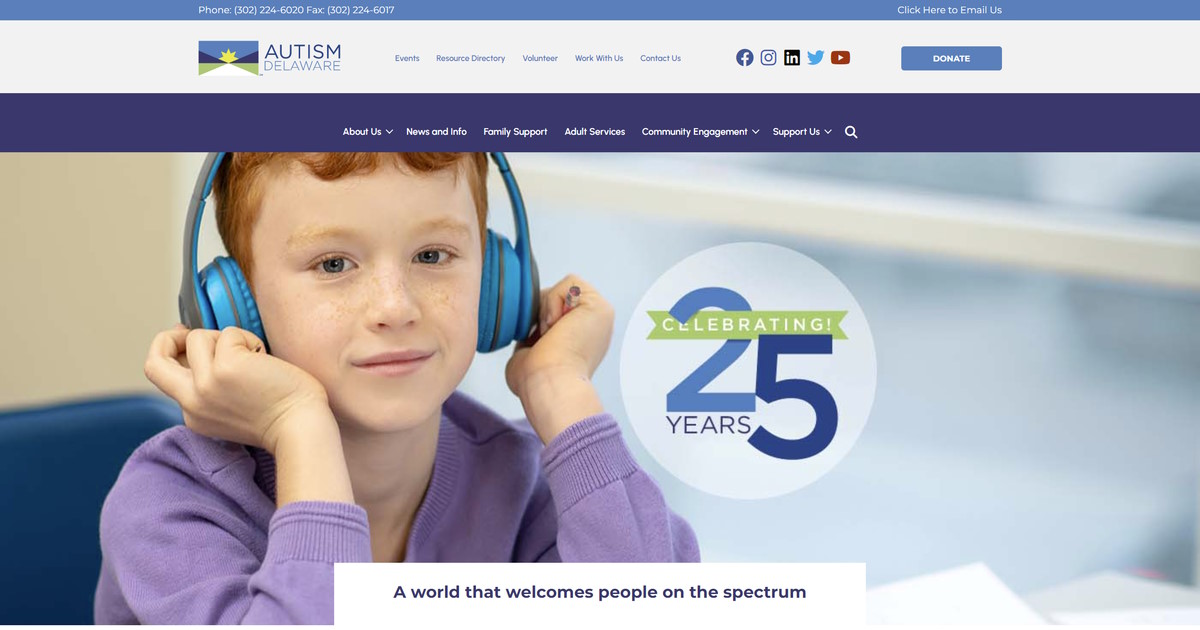
Autism Delaware Full homepage screenshot

At a glance

Category
Health & Medical
Language
English
Paid-content signal
No paid content foundObserved
Registered
2010
Hosting
FastlyInferred
HTTPS certificate trusted
PassedObserved
Last updated

Website review

This review may include AI-generated content and is not individually verified. Domain, certificate and other facts come from the observed data on this page.

What is Autism Delaware?

Autism Delaware is a nonprofit organization focused on supporting autistic people and their families across the state of Delaware. Its stated vision is that all people with autism will have opportunities to learn, grow, and live full lives as included and valued members of their communities.

Who it serves

The site speaks to autistic individuals, parents, caregivers, educators and others who want local information and connection. Because it is organized around one state, it is likely most useful to people who live in or have ties to Delaware and need services, community or guidance close to home.

What it typically offers

  • Information about autism and available support in Delaware
  • Ways for families to connect with others facing similar situations
  • Updates on events, programs and advocacy
  • A route to subscribe for news and announcements

Trade-offs

A state-focused organization can provide more relevant local knowledge than a large national group, but its resources may not apply to people outside Delaware. The site is primarily an information and community hub, so visitors looking for clinical diagnosis or direct medical care would usually need to look elsewhere. For Delaware families, it is a practical starting point for orientation and connection.

What services does Autism Delaware provide for individuals and families?

Autism Delaware is a statewide nonprofit focused on supporting people with autism and their families in Delaware. Its services generally fall into a few broad areas.

Family and individual support

The organization provides information and referral, helping families navigate diagnoses, school services and adult supports. It may also offer family support programs, community events and connections to local resources.

Advocacy and public policy

Autism Delaware advocates for policies and services that affect autistic people and their families, aiming to improve access to education, employment and community inclusion.

Community and lifespan services

Programs typically span the lifespan, from early childhood through adulthood. These may include social and recreational opportunities, employment-related support and efforts to build inclusive communities.

Who it serves

  • Families seeking guidance after a new diagnosis
  • Autistic adults looking for community and support
  • Caregivers and professionals needing local information

Trade-offs

As a regional nonprofit, its services are concentrated in Delaware, so families elsewhere may find limited direct help. Some programs may have eligibility requirements, waiting lists or event-based availability.

For official details, see Autism Delaware. National organizations such as Autism Speaks also publish broader resources, though they are not Delaware-specific.

How can I get support or resources from Autism Delaware?

Autism Delaware is a statewide nonprofit focused on helping people and families affected by autism. Its stated vision is that autistic people have opportunities to learn, grow, and live full lives as included members of their communities.

Common ways to connect

  • Start with the website. It typically outlines programs, events and ways to get in touch, so it is the main entry point.
  • Ask about family support. Organizations like this usually offer information and referral, parent or caregiver guidance, and help navigating local services.
  • Look for lifespan services. Support may cover early childhood, school-age years, transition to adulthood, employment and adult life.
  • Check events and community groups. Social, recreational or peer gatherings are often listed, alongside trainings and workshops.
  • Consider membership or updates. A subscription option suggests newsletters or alerts about programs and advocacy.

Who it suits

Families new to a diagnosis often need orientation and referrals, while autistic adults may look for social or employment-related programs. Educators and professionals may use it for local training and community connections.

Trade-offs

A state-focused nonprofit can offer practical, locally relevant knowledge and peer understanding, but its reach depends on staff, volunteers and funding. It is not a medical provider, so diagnosis and clinical care usually come from health professionals. Response times and service availability may vary by region, so contacting the organization directly is the most reliable next step.

Does Autism Delaware offer programs for children and adults with autism?

Autism Delaware is a statewide nonprofit serving people with autism and their families in Delaware. Its stated vision is that people with autism have opportunities to learn, grow and live full lives as included, valued community members. That framing suggests supports across the lifespan rather than a single age group.

Likely program areas

  • Children and families: information and referral, parent support, and guidance for navigating school-based services are typical offerings from autism organizations of this kind.
  • Adults: adult services, community inclusion, employment-related supports and social or recreational opportunities are commonly part of a lifespan approach.
  • Advocacy and community education: public policy work and awareness efforts usually accompany direct family services.

Who it suits

Families newly diagnosed, parents seeking peer support, and autistic adults looking for local connection may find the organization useful. Because services are Delaware-specific, it is most relevant to residents of that state; people elsewhere would need a comparable regional organization.

Trade-offs

A single statewide nonprofit can offer local knowledge and personal contact, but capacity may be limited and some programs may have waitlists or eligibility criteria. Details such as specific program names, ages served and any fees are not confirmed by the information available here, so checking the website directly is advisable.

For related national perspectives, see Autism Speaks and Autism Society of America.

How can I donate or volunteer to support Autism Delaware's mission?

Autism Delaware is a statewide nonprofit focused on helping people and families affected by autism through support, information and community inclusion. Its site is aimed at Delaware residents, family members, educators and local businesses that want to get involved.

Ways to help

  • Donate: Look for a "Donate" or "Give" section on the site. Nonprofits of this kind typically accept one-time gifts, recurring monthly contributions, and tribute or memorial gifts. Some also list workplace giving, employer matching, vehicle donation or planned giving.
  • Volunteer: Check a "Get Involved," "Volunteer" or "Events" page. Typical roles include helping at walks, fundraisers, family events, support groups or office and outreach tasks.
  • Events and membership: Walks, runs, galas and community days often combine fundraising with volunteer needs. A newsletter or "subscribe" option, suggested by the site's keywords, is a common way to hear about these first.

What to confirm

Before committing, verify current donation methods, whether gifts are tax-deductible, volunteer age requirements, background checks, time commitments and training. Availability varies by program and season.

For context on autism organizations, you can compare Autism Delaware with national groups such as Autism Speaks or Autism Society of America, though local needs and services differ.

What events or community activities does Autism Delaware organize?

Autism Delaware organizes events and community activities aimed at connecting people with autism and their families with support, learning and social opportunities. Its stated vision—that people with autism have chances to learn, grow and live full lives as included community members—shapes the kinds of gatherings it typically promotes.

Common activity types may include:

  • Family and community events such as walks, picnics or awareness gatherings that bring families together and reduce isolation.
  • Support groups and networking for parents, caregivers and autistic adults, often offered regionally across Delaware.
  • Educational workshops or presentations on topics like advocacy, services, transitions or daily living skills.
  • Social and recreational programs for children, teens or adults, designed around shared interests and peer connection.
  • Fundraising and awareness campaigns, which often double as community meet-ups.

These activities suit families seeking local peer support, autistic individuals looking for social contact, and professionals or volunteers wanting to get involved. Because schedules and formats change, checking the organization's own calendar is the most reliable way to find current offerings. Some events may require registration or a subscription to updates, but details are not specified here. For broader context, national organizations such as Autism Speaks also list events, though local groups like Autism Delaware typically focus specifically on Delaware communities.

Related questions

More questions →
Autism Support and Resources in Delaware: What Families Need to Know

Autism Delaware (autismdelaware.org) is a statewide nonprofit whose stated vision is that all people with autism will have opportunities to learn, grow, and live full lives as included and valued members of their communities. It functions as a family-facing hub for information, support, and referrals rather than as a diagnostic or clinical provider. If you are a Delaware family trying to figure out where to start, the practical path usually runs through three separate systems — a nonprofit like Autism Delaware for navigation and family support, state programs for early intervention and disability services, and schools and healthcare providers for evaluations and therapies. This guide explains what each part does and how to move between them.

What Autism Delaware actually provides

Autism Delaware is best understood as a connection point, not a one-stop service agency. Based on its own description, its role centers on helping people and families affected by autism access opportunities to learn, grow, and live full lives in their communities.

In practice, that means families typically turn to it for:

  • Information and referrals — pointing you toward the right agency, program, or provider for your situation
  • Family support — connecting parents and caregivers with others in similar circumstances
  • Community inclusion — programs and advocacy aimed at participation in community life
  • Statewide reach — it describes itself as serving Delaware broadly, not a single county or city

What it is not: a clinic that diagnoses autism, a school district, or the state agency that determines eligibility for funded disability services. Those are separate systems, and knowing the difference saves time.

The three systems you will actually navigate

Most confusion for Delaware families comes from mixing up who does what. Keep them separate:

System Typical role Who runs it
Nonprofit (e.g., Autism Delaware) Information, family support, referrals, community programs Private nonprofit
State programs Early intervention, disability eligibility, funded services Delaware state agencies
Schools and healthcare providers Evaluations, IEPs, therapies, medical care Districts, clinics, hospitals

A referral from one system does not automatically trigger another. You generally have to make contact with each separately.

Step-by-step: getting from concern to services

1. Start with a concern and get it documented

Whether the concern comes from a pediatrician, a preschool teacher, or your own observation, the first useful step is to get it written down. Ask your child's doctor for a referral or a note. This becomes the paper trail that other systems ask for.

2. Contact Autism Delaware for orientation

Use the organization as your map. Explain your situation — age of the person, what you have already tried, what you need — and ask specifically which agency or program handles it. This is the step that prevents months of calling the wrong office.

3. Pursue an evaluation through the appropriate channel

  • Young children: early intervention or your school district, depending on age
  • School-age children: the school district, which can evaluate for special education eligibility
  • Adults: healthcare providers and, for services, state disability programs

An evaluation is the gate to almost everything else. Without it, most funded services will not proceed.

4. Apply for state-funded services if eligible

State disability programs typically have their own application, documentation requirements, and waitlists. Ask Autism Delaware or the referring agency which program fits your age group, then apply directly.

5. Build the therapy and support plan

Once eligibility is established, therapies and supports are arranged through a mix of school-based services, insurance-covered providers, and state-funded programs. These are separate approvals, so confirm each one individually.

6. Verify each step

After any application or referral, confirm in writing:

  • That your submission was received
  • What the next action is and who owns it
  • The expected timeline

Do not assume silence means progress.

Common sticking points

  • Waiting for an evaluation. Evaluations can take time. While waiting, you can still request information and referrals, join family support networks, and ask the school district about interim supports.
  • Eligibility denied. A denial is usually about documentation or the specific program's criteria, not about whether your concern is real. Ask for the reason in writing and what would change the decision.
  • Confusing the nonprofit with the state. Autism Delaware can guide you, but it does not decide eligibility or fund services. Expect to file applications with the agency itself.
  • Assuming one approval covers all. School services, insurance-covered therapy, and state programs are approved separately.

How to decide where to start

  • If you are newly concerned and don't know the system: start with Autism Delaware for orientation, then pursue an evaluation.
  • If you already have a diagnosis and need funded services: go directly to the relevant state program, using Autism Delaware for referral if the path is unclear.
  • If the issue is school-related: contact your school district about evaluation and special education eligibility.
  • If the person is an adult: focus on state disability programs and adult service providers, with Autism Delaware as a referral source.

What to have ready before you contact anyone

  • Age of the person and current diagnosis status
  • Any prior evaluations or reports
  • A short written summary of your main concern
  • Your questions, ranked by priority

This preparation is what turns a general inquiry into a specific, actionable referral.

For current program names, contact details, and event information, go directly to autismdelaware.org, since specific offerings and schedules change over time.

Website Overview

An established domain and managed infrastructure suggest continuity of operations and may support dependable delivery, although neither guarantees service quality.

Domain and Registration

Registered in 2010, this domain has about 16 years of history. That suggests continuity, although ownership and purpose may have changed. Transfer-protection status is present, helping reduce the risk of unauthorized domain transfers. The registrar is GoDaddy.com, LLC, a widely used domain service provider. The domain uses the common .org extension, which is not an independent safety signal.

DNS and Email

Nameservers are provided by Cloudflare, indicating managed DNS hosting. MX records point to the Microsoft 365 email service. No CNAME was found; the observed records resolve directly to addresses. SPF and DMARC are configured. DKIM status is unknown. TXT records include verification markers for Microsoft. Such markers may also remain after a service stops being used.

TLS and Certificates

The public key uses EC with 256 bits. The server supplied a complete certificate chain. No organization name is present in the certificate; the available fields are consistent with domain validation. The certificate was issued within the Google Trust Services cloud or CDN ecosystem. The certificate's total validity is about 90 days, consistent with a short renewal cycle.

HTTP and Browser Security

The response lacks these common security headers: HSTS, CSP, Permissions-Policy, clickjacking protection. No X-Powered-By header was found, reducing one common source of backend fingerprinting information. The cf-ray, x-cache, x-served-by response header indicates a CDN or caching proxy in the delivery path. No obvious internal addresses or debug information were found in the headers. The Server header identifies cloudflare without an exact version.

Technology Stack Analysis

The public page identifies WordPress, jQuery, Cloudflare, Fastly without precise versions, leaving fewer clues for version-specific scanning.

Search and Social Sharing

Open Graph is partially configured; og:title, og:description, og:type is missing. The title has 64 characters, within a common display range. A meta description is present, with 154 characters. No Generator meta tag is publicly exposed. A viewport declaration is present, providing a basis for mobile layout.

Hosting and Email

DNSCloudflare
HostingFastly
EmailMicrosoft 365
Approximate IP geolocation (inferred; a CDN or proxy may differ from the origin server) Location unknown Inferred 104.21.27.192

Registration details

RDAP / WHOIS

RegistrarGoDaddy.com, LLC
Registered2010-07-18
Expires2027-07-18
Domain statusclient delete prohibited、client renew prohibited、client transfer prohibited、client update prohibited
Nameserversjasmine.ns.cloudflare.com、kurt.ns.cloudflare.com
DNSSECunsigned

DNS records

DNS

TypeNameValueTTLPriority
Awww.autismdelaware.org104.21.27.192300—
Awww.autismdelaware.org172.67.143.120300—
AAAAwww.autismdelaware.org2606:4700:3033::ac43:8f78300—
AAAAwww.autismdelaware.org2606:4700:3037::6815:1bc0300—
MXautismdelaware.orgautismdelaware-org.mail.protection.outlook.com36000
NSautismdelaware.orgjasmine.ns.cloudflare.com86400—
NSautismdelaware.orgkurt.ns.cloudflare.com86400—
TXTautismdelaware.orgMS=ms722733293600—
TXTautismdelaware.orgv=spf1 include:spf.protection.outlook.com include:spf.us.exclaimer.net include:salsalabs.org -all3600—
DMARC_dmarc.autismdelaware.orgv=DMARC1; p=none;3600—

TLS and certificates

TLS / SSL

AssessmentNormal configuration
Supported protocolsTLSv1.2、TLSv1.3
Negotiated protocolTLSv1.3
Certificate subjectautismdelaware.org
IssuerGoogle Trust Services
Valid until2026-12-19T05:23 · Remaining when checked: 88 days
Verification detailsCertificate trust: Passed · Hostname match: Passed

HTTP response headers

HTTP

HeaderValue
content-typetext/html; charset=UTF-8
servercloudflare
x-content-type-optionsnosniff
referrer-policyno-referrer-when-downgrade

Identified technologies

WordPressjQueryCloudflareFastly

Pages, Search and Sharing

Meta descriptionOur vision is that all people with autism will have opportunities to learn, grow, and live full lives as included and valued members of their communities.
Canonical URLhttps://www.autismdelaware.org/
LanguageEnglish (default)
Twitter CardNot detected
All bots 2 allowed · 3 disallowed
  • Allow/*.css
  • Allow/*.js
  • Disallow/calendar/action*
  • Disallow/events/action*
  • Disallow/*?
  • IntervalCrawl delay 3 seconds

Recent Updates

  • Website profile

User reviews (0)

  • No reviews yet.