
 简体中文
简体中文 English
Website review
This review may include AI-generated content and is not individually verified. Domain, certificate and other facts come from the observed data on this page.
What is UneeQ?
UneeQ is a platform for practicing difficult workplace conversations with AI-driven digital humans. Rather than reading scripts or sitting through slides, teams rehearse realistic scenarios — sales calls, customer service escalations, leadership conversations — against lifelike avatars that respond in the moment. The company positions this as "immersive training": the idea that soft skills are built by repetition under pressure, not by instruction.
Its main product, the Immersive Training Platform, simulates conversational scenarios across several common uses:
- Sales roleplay — reps rehearse tough prospect personas from discovery through closing.
- Customer service — staff practice difficult or emotional conversations in a safe space.
- Leadership — managers work through the awkward, high-stakes talks that define good leadership.
- Education — learners prepare for real-world career interactions.
A personal AI coach called AI Buddy sits alongside the training platform. The underlying technology includes digital human animation and behavior (branded Synanim), LLM orchestration that acts as the digital human's "AI brain," and integrations for deployment in kiosks, websites and event experiences. UneeQ also runs XD Studios, a creative agency for building digital human ambassadors, and publishes resources on responsible AI design.
Who it's for and how it differs
The fit is enterprise learning-and-development teams, sales enablement groups and customer experience organizations that need scalable, repeatable practice. The trade-off is the familiar one for simulation tools: realistic AI roleplay gives people a low-risk place to fail, but it works best when paired with human coaching and debriefing — the simulation creates the reps, not the judgment about what went wrong.
If you're evaluating it, a useful first step is to pick your single most expensive recurring conversation (for example, a renewal negotiation or a churn-risk call), ask for that exact scenario in a demo, and judge whether the digital human's responses feel close enough to the real thing to be worth rehearsing. UneeQ offers a free trial and demo booking for that purpose. For context on the broader category, see UneeQ.
How does UneeQ's AI roleplay help sales teams practice difficult prospect conversations?
UneeQ's AI roleplay gives sales reps a place to rehearse high-stakes prospect conversations — discovery calls, objection handling, closing — against lifelike digital humans before they face real buyers. The pitch is blunt: easy conversations don't need practice, so the platform targets the awkward, sweaty-palm kind.
What the practice actually looks like
According to the site, the Immersive Training Platform can simulate virtually any conversational scenario, and sales roleplay is one of its most popular uses. Reps practice "toughest prospect personas" from discovery through closing, rehearsing the calls that would otherwise cost pipeline. The digital humans are built on UneeQ's animation and behavior engine (Synanim) with LLM orchestration behind them, and the company says its AI Buddy acts as a personal coach for each rep. UneeQ also cites 95% training effectiveness and 3x higher engagement, though those are vendor-reported figures — treat them as marketing claims, not independently verified outcomes.
Where it fits and where it doesn't
| Situation | AI roleplay suits it | Why |
|---|---|---|
| New reps ramping up | Strong fit | Low-risk repetition before live calls |
| Practicing objection handling | Strong fit | Scenarios can be run repeatedly on demand |
| Standard product pitches | Moderate fit | Useful, but real differentiation is in the hard moments |
| Complex, relationship-driven enterprise deals | Weaker fit | Nuance and history are hard to simulate convincingly |
The trade-off is realism versus safety. A digital human never gets annoyed, never goes off-script in genuinely unpredictable ways, and never carries the relationship history a real prospect does. That makes it excellent for building fluency and confidence, but it can't fully replace live coaching or shadowing experienced reps.
A practical next step
Pick the single conversation your team loses most often — say, the pricing objection at the end of a demo — and run it as a short pilot with a handful of reps. Compare their confidence and performance on live calls before and after. If you want to see how the simulations feel first, UneeQ offers a free trial and demo option on UneeQ. For broader context on AI roleplay tools, UneeQ is the vendor here; other platforms exist, but evaluate them on scenario realism and coaching feedback rather than demo polish.
Can UneeQ's Immersive Training Platform be used for customer service training?
Yes. UneeQ's Immersive Training Platform is explicitly positioned for customer service training, alongside sales, leadership and education use cases. The page lists "Customer Service Training — Practice difficult conversations in a safe space" as one of its core applications, and the platform is built around simulating any conversational scenario with lifelike digital humans.
What that means in practice
- Safe rehearsal before live contact. A new support agent can run a heated escalation, a refund refusal or a confused-customer call with an AI roleplay partner rather than a real customer. Mistakes stay internal.
- Repeatable scenarios. Because the counterpart is a digital human, the same difficult call can be replayed with different responses, so trainees get volume and variety without burning colleague time.
- Soft-skill focus. The framing is soft skills and behaviour change, not script memorisation — useful for tone, de-escalation and empathy, which are the parts of service work that are hardest to teach from a slide deck.
- Scale across a distributed team. The pitch is enterprise-oriented, so it suits contact centres with many agents who all need the same practice, and it can be deployed as kiosks or integrated into existing systems.
Trade-offs to weigh
| Consideration | Why it matters for service teams |
|---|---|
| AI roleplay vs. human roleplay | Consistent, always available and low-embarrassment; may miss the unpredictability of a genuinely angry person |
| Behaviour change claims | The page cites training-effectiveness and engagement figures, but you should pilot with your own agents and measure against your QA scores |
| Scenario design effort | The value depends on how well your real call types are turned into simulations — that's your work, not the tool's |
| Fit with existing stack | Integration and deployment options exist; check them against your LMS and telephony setup |
Next step: pick your three highest-cost service conversations — for example, billing disputes, outage apologies and cancellation attempts — and ask for a demo built around one of them. Judge it on whether a trainee's behaviour in the simulation visibly improves in a live call, not on how lifelike the avatar looks.
UneeQ is at UneeQ. For general context on designing service-training scenarios, most learning teams pair this kind of simulation with live call coaching rather than replacing it.
What types of leadership and education training scenarios can UneeQ simulate?
UneeQ's Immersive Training Platform is built around AI roleplay with digital humans, and its leadership and education scenarios are framed as conversation practice rather than content delivery. The platform is designed to simulate "any conversational scenario," so the leadership and education pages describe categories of practice rather than a fixed curriculum.
Leadership training
- Practicing difficult one-to-one conversations — the kind described as awkward, high-stakes, or emotionally charged.
- Rehearsing feedback, coaching and performance discussions before they happen with a real employee.
- Letting managers build soft skills through repetition, since the platform's premise is that hard conversations need practice, not easy ones.
Education training
- Preparing people for real-world careers, i.e. using simulated conversations to rehearse workplace interactions learners will meet after study.
- Broader immersive learning use, positioned as a way to make training more effective and engaging than passive methods.
What the scenarios have in common
| Dimension | Leadership | Education |
|---|---|---|
| Core activity | AI roleplay with a lifelike digital human | AI roleplay with a lifelike digital human |
| Main audience | Managers and leaders | Learners preparing for careers |
| Intended outcome | Better handling of hard, in-person conversations | Readiness for real-world professional situations |
The trade-off is that this is conversation-simulation software, not a learning management system: it excels when the skill you want to build lives in dialogue and is hard to practise safely with real people. It is less suited to training that is primarily procedural, technical or knowledge-based.
A useful next step: list the two or three conversations your managers or students most often get wrong, then check whether each can be reduced to a roleplay with a defined counterpart and goal. If it can, it is a candidate scenario; if it cannot, look elsewhere in your training stack.
UneeQ also publishes supporting material such as a guide on immersive learning, and its site lists enterprise case studies including Pearson and Deutsche Telekom, which may help you judge fit for your sector.
How does UneeQ's digital human technology improve training effectiveness and engagement?
UneeQ's approach is to let people rehearse high-stakes conversations with lifelike digital humans before facing the real thing, on the premise that awkward, sweaty-palm conversations are exactly the ones worth practicing. The homepage claims 95% training effectiveness and 3x higher engagement, and describes an Immersive Training Platform that can simulate "any conversational scenario," with an AI Buddy positioned as a personal AI coach for every rep.
The mechanism behind the engagement claim is roleplay with a face and voice rather than a text prompt. Practicing a difficult conversation with a responsive digital human is closer to the real interaction than reading a script or clicking through a module, so learners stay in the moment instead of treating it as a quiz. The effectiveness claim is best read as the vendor's own headline figure; the more useful question for a buyer is which behaviors changed and how that was measured.
Where it fits by team
- Sales: rehearsing tough prospect personas from discovery through closing, so reps stop practicing on live pipeline.
- Customer service: repeating difficult customer conversations in a safe space before handling them for real.
- Leadership: giving managers a low-risk way to try hard feedback and people conversations.
- Education: preparing learners for real-world career interactions.
The common thread is conversations that are costly to get wrong the first time.
Practical trade-offs
Simulation is strong for building fluency in delivery, phrasing and staying composed under pressure. It is weaker for anything that depends on real consequences, deep relationship history or nuanced judgment about a specific person. A realistic digital human can also feel uncanny to some learners, which is worth testing with a small group before rolling out broadly.
A useful next step
Pick your single most expensive recurring conversation, run a small pilot with that scenario, and judge it on observed behavior change in real calls rather than on satisfaction scores. UneeQ offers a free trial and a demo path, so you can compare a simulated version against your current roleplay method directly. For general background on conversational AI in learning, UneeQ is the product source, and the broader category is covered by eLearning Industry.
Is there a free trial available to try UneeQ's AI roleplay platform?
Yes. UneeQ signals a free trial on its site: the navigation and header include a “Free trial” call to action alongside “Get a demo” and “Log in.” The same page also offers a “Launch simulation” option and a “Watch overview” link, so you can sample the AI roleplay experience before committing.
Practical next step: Start with the free trial or launch a simulation, then book a demo if you need help mapping scenarios to your team’s workflows. The platform is built around practicing high-stakes conversations—sales roleplay, customer service, leadership, and education training—so a useful trial test is to run one realistic scenario your team actually faces, such as a difficult renewal call or an upset-customer escalation, and judge whether the digital human’s responses feel natural enough to change behavior.
Decision criterion: A free trial is most valuable if it lets you test the specific conversation types you care about, not just a generic demo. If your priority is enterprise-wide deployment, ask about integrations, deployment options, and how AI Buddy coaching fits into the Immersive Training Platform during the trial.
For context, UneeQ is the vendor behind UneeQ.
 Cloudflare
 Google Workspace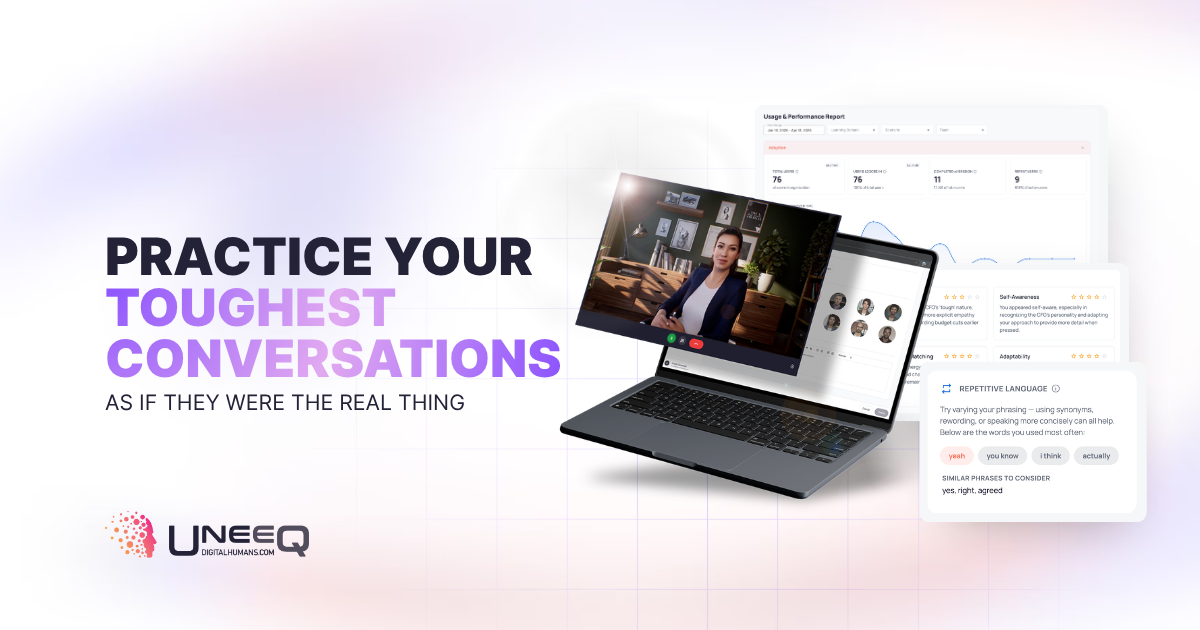

User reviews (0)