
 flixier.com
 Paid content
 Multilingual
Categories: Video & Film
Edit video in your browser: cut, caption in 130+ languages, export 4K rendered in the cloud. Or let Eva make the first cut, or the whole video.
 Visit website
 Updated: 2026-09-23 15:16
Language: English (default)
Updated: 2026-09-23 15:16
Language: English (default)
 Access: Normal
 Profile views 1
 Outbound visits 0
Related questions
More questions →How Music Video Editing Shapes a Song's Chart and Promotional Run
Music video editing is not just a creative afterthought—it is a release strategy. The cut you publish, how long it runs, how it is paced, and which versions you distribute across platforms all influence how a song is promoted, how playlists and programmers treat it, and whether the video supports or complicates a chart run. For artists, managers, and labels, understanding the difference between creative editing and chart-rule compliance is essential before the first frame goes live.
Why the Edit Is a Business Decision
A song can exist without a video, but once a video is attached, it becomes part of the song's commercial identity. Editors and directors shape that identity through:
- Length – a full narrative video may run four to six minutes, while a platform-friendly cut may be trimmed to match the song's radio edit.
- Pacing – faster cuts suit short-form clips and social teasers; slower, sustained shots suit lyric videos and performance pieces.
- Versioning – the same song may need a clean version, an explicit version, a vertical cut, and a shortened edit for different outlets.
Each of these choices affects where the video can be placed, how it is promoted, and how it interacts with the song's chart eligibility.
The Main Edit Types and When to Use Them
Radio Edit
A shortened, often lyrically cleaned version timed to fit radio formatting. Use it when the song is being serviced to radio and you want the video to mirror what programmers are playing. If the video runs significantly longer than the radio edit, some promotional partners will use the shorter cut instead, which can split audience attention.
Lyric Video
A lower-cost, text-driven edit that can be released quickly, often before or alongside the official video. It is useful for maintaining momentum in the first days of a release, when fans want something to watch immediately. Lyric videos are also easier to update or replace if a lyric correction is needed.
Performance Cut
Focuses on the artist performing, often in a single setting or with minimal narrative. This is the most flexible format for promotional use because it can be trimmed, looped, or reformatted for vertical platforms without losing coherence.
Narrative Cut
A story-driven edit, usually the "official" video. It carries the most editorial weight but is also the hardest to shorten without losing meaning. If a narrative video is the primary release, plan a separate shorter cut for platforms that favor brevity.
Vertical / Short-Form Cut
A re-edited version framed for vertical screens, often using the hook or chorus. This is not simply a cropped version of the horizontal video—good vertical edits re-time cuts to the platform's pacing and place the most recognizable moment early.
How Edit Choices Interact With Promotion and Charts
Chart rules vary by territory and by chart, and they change over time. The safe approach is to treat the following as general principles rather than fixed rules:
- Version strategy matters. Releasing multiple edits of the same song can help promotion, but it can also complicate how streams and sales are counted if the versions are treated as separate releases. Check the current rules of the specific chart you care about before splitting a release.
- Timing matters. A video released before or at the same time as the song can concentrate attention. A video released weeks later can extend a song's promotional life but may miss the initial chart window.
- Platform fit matters. A video that is poorly formatted for a major platform will get less promotional support, which can indirectly affect the song's visibility.
None of this guarantees a chart position. Editing supports a release; it does not replace audience demand.
A Practical Version Plan
Before editing begins, decide which versions you actually need. A workable starting point:
- Official video – the primary creative cut, full length.
- Radio edit video – matches the radio edit length and lyrics.
- Lyric video – fast turnaround, released early if needed.
- Vertical cut – 15–60 seconds, hook-first, for short-form platforms.
- Clean version – if the song has explicit content and you want broader placement.
For each version, note the intended platform, the target length, and the release date. This prevents last-minute re-edits that delay a rollout.
Common Mistakes to Avoid
- Assuming one cut works everywhere. A four-minute narrative video rarely performs well as a short-form clip without re-editing.
- Ignoring chart-rule details. If you plan to release multiple versions, confirm how they will be counted before release day.
- Letting the edit drift from the audio. If the video uses a different mix or edit than the released audio, make sure that is intentional and documented.
- Releasing the lyric video too late. Its main value is speed; if it arrives after the official video, it adds little.
What to Watch For in Industry Coverage
Industry news outlets track release strategies, version rollouts, and chart-rule changes. When reading coverage of a music video release, pay attention to:
- Whether the video is described as an official video, lyric video, or visualizer.
- Whether multiple versions were released and in what order.
- Whether the coverage mentions chart performance, and if so, which chart and which tracking period.
These details tell you more about the strategy than the video's creative style alone.
Bottom Line
Music video editing is a promotional tool with real consequences for how a song is positioned. Decide your version plan before you shoot, match each cut to its platform, and verify chart-rule details for your territory before splitting a release. Creative editing and release strategy are not opposites—the best rollouts treat them as the same job.
What to Look for in a Video Platform Beyond Hosting and Sharing
If you're evaluating a video platform for a small business or marketing team, hosting and sharing are just the entry point. The features that actually determine whether a platform fits your workflow fall into four areas: privacy and playback control, collaboration and review tools, marketing and analytics capabilities, and practical limits like storage and mobile support. Most general-purpose tools (cloud storage, social networks, free hosts) cover hosting well but leave gaps in the other three. This guide walks through what each area means in practice, so you can map features to your own situation instead of comparing endless checklists.
Start by separating three jobs: hosting, editing, and marketing
Video platforms tend to bundle three distinct functions, and confusion usually comes from mixing them up:
- Hosting — storing a file, generating a player, delivering it reliably to viewers. This is the baseline.
- Editing — trimming, assembling, adding captions or branding. Some platforms include basic editors; others expect you to edit elsewhere and upload the result.
- Marketing and business features — privacy controls, lead capture, calls to action, analytics, team review workflows. These are what separate a "video host" from a "video platform."
A useful exercise: write down your last five video tasks (a product demo, a client pitch, a social clip, an internal training, a landing page embed). For each one, note which of the three jobs it required. If most of your tasks stop at hosting, a lighter tool may be enough. If several involve review cycles, gated access, or measuring viewer behavior, a fuller platform earns its cost.
Privacy and playback control: the business-vs-social divide
On social platforms, everything is public by default and wrapped in ads and recommendations. For business use, that's often the opposite of what you want. Look for:
- Granular privacy settings — can you restrict a video to specific people, a password, a domain, or an embed location? Can you make it unlisted but still embeddable?
- Ad-free playback — your product demo shouldn't end with a competitor's ad or an unrelated recommendation.
- Customizable embeds — control over player color, logo, and whether related videos appear. This matters when the video sits on your own site and represents your brand.
- Domain-level restrictions — the ability to limit playback to your own website prevents your content from being re-embedded elsewhere.
If your videos are purely promotional and public, these controls matter less. If you share client work, internal training, or pre-release material, they become the deciding factor.
Collaboration and review: the most common gap
This is where general-purpose tools most often fall short. A shared drive lets people comment on a file, but it doesn't give you a structured review process. A dedicated platform typically offers:
- Timestamped comments — feedback attached to a specific moment in the video, so "the logo looks off" points to an exact frame.
- Versioning — uploading a new cut while keeping the old one, so reviewers can see what changed.
- Approval status — a clear "approved" or "needs changes" state rather than a scattered email thread.
- Role-based access — reviewers who can comment but not download or reshare.
When this becomes relevant: as soon as more than two people need to sign off on a video, or when you're producing videos on a recurring schedule. For a solo operator publishing once a month, a simple comment thread may be sufficient.
Analytics and lead capture: beyond view counts
A raw view count tells you almost nothing actionable. Business-oriented platforms go further:
| Feature | What it tells you | When it matters |
|---|---|---|
| Watch time / engagement graph | Where viewers drop off | Improving content or editing |
| Viewer identity | Who watched (when gated) | Sales follow-up, internal training |
| Lead capture forms | Email collected before or during playback | Demand generation |
| Calls to action | Click-through to a page or booking link | Converting viewers |
| Embed/domain reports | Where your video is being watched | Tracking campaign performance |
If your goal is brand awareness, basic view counts may be fine. If you're using video to generate leads or train staff, the deeper metrics are the reason to choose a platform over a free host.
Practical limits that affect daily use
Feature lists rarely mention the constraints that cause friction later. Check these before committing:
- Storage and bandwidth limits — how much you can upload, and whether high viewership triggers overage fees.
- Upload size and length caps — relevant if you work with long recordings or high-resolution footage.
- Mobile app support — can you upload, review, and respond to comments from a phone? For teams that shoot on mobile, this is a real workflow factor.
- Export and portability — can you download your originals and embed codes if you leave? Lock-in is a hidden cost.
- Integrations — does it connect to the tools you already use (your website builder, CRM, or project tracker)?
Deciding between a full platform and a lighter tool
Use these rough conditions as a starting point:
A lighter tool (free host, cloud storage, social platform) is likely enough if:
- You publish occasionally and mostly to public channels.
- One person handles video end to end.
- You don't need gated access or viewer-level analytics.
A dedicated platform is worth evaluating if:
- Multiple people review or approve videos.
- You need privacy controls, ad-free playback, or branded embeds.
- You're using video for lead generation, training, or client delivery.
- You publish frequently enough that manual workarounds cost more than a subscription.
Pricing and plan details change often, so check the platform's current plans page directly rather than relying on secondhand comparisons. The right approach is to list your actual requirements first, then match them against what each option offers — not the other way around.
How Do Enterprise Teams Adopt Specialist AI Agents Without Disrupting Existing Workflows?
Enterprise teams can adopt specialist AI agents without disruption by starting with one narrow, high-volume workflow, running it as a bounded pilot with human review, measuring against a baseline, and only then expanding. The key is to treat agents as new team members with defined scopes rather than as a replacement for existing tools or a sweeping platform migration. This article explains what specialist agents are, where they fit across common team functions, and a phased approach you can follow.
What Makes an Agent "Specialist" Rather Than General-Purpose
A general-purpose assistant responds to open-ended prompts across many topics. A specialist agent is scoped to one job: it has a defined goal, a limited set of tools and data sources, and a clear definition of "done."
That scoping matters for enterprise teams for three practical reasons:
- Predictability. A narrow agent produces more consistent outputs, which makes it easier to review and trust.
- Permission control. You can grant access only to the systems that specific task needs, rather than broad data access.
- Measurable value. When an agent owns one workflow, you can compare its output against a manual baseline.
A useful rule of thumb: if you cannot describe the agent's job in one sentence with a clear input and output, it is still too broad to deploy safely.
Mapping Team Functions to Agent Use Cases
Most enterprise teams have a handful of repetitive, rules-plus-judgment tasks that are good first candidates. The table below shows typical starting points.
| Team | Candidate agent task | Why it fits |
|---|---|---|
| Sales | Research and enrich inbound leads before handoff | High volume, structured output, easy to verify |
| Customer success | Draft responses to common account questions | Repetitive, benefits from consistency |
| Marketing | Repurpose long-form content into channel variants | Clear brief, reviewable drafts |
| HR | Screen and summarize applications against criteria | High volume, needs audit trail |
| Operations | Triage and route incoming requests | Rule-based with clear routing logic |
Notice that none of these replace a person's judgment. They compress the repetitive portion so the human spends time on exceptions and decisions.
A Phased Adoption Approach: Pilot, Measure, Expand
Phase 1: Pick one workflow and define success
Choose a task that is high-volume, low-risk, and currently a bottleneck. Write down:
- The current process, step by step
- The baseline metric (time per task, volume per week, error rate)
- What "good output" looks like, with two or three examples
- Who reviews the agent's work
Phase 2: Run a bounded pilot
Keep the agent inside the existing workflow rather than beside it. For example, the agent drafts; the human sends. Set a review gate so nothing leaves the team unreviewed. Run for a fixed period, such as four to six weeks, with a small group.
Phase 3: Measure against the baseline
Compare the same metrics you recorded in Phase 1. Look for time saved, consistency gained, and — importantly — where the agent failed. Failures tell you whether the scope was right.
Phase 4: Expand deliberately
Only widen scope after the pilot shows a clear, repeatable gain. Expand in one of two directions: more volume of the same task, or an adjacent task with the same data and review pattern. Avoid expanding into a new function and a new data source at the same time.
Handling Workflow Integration Concerns
Data access
Give each agent the minimum access its task requires. Prefer read access plus a single write action over broad permissions. Document which systems it touches so security and IT can review.
Handoffs
Define exactly where the agent stops and a human begins. A simple handoff rule works well: the agent completes the task and flags anything outside its defined scope for a person. Ambiguous handoffs are the most common source of friction.
Human oversight
Decide the review level up front:
- Full review for anything customer-facing or high-stakes
- Spot check for internal, low-risk outputs
- Exception-only review once the agent has a track record
Start stricter than you think you need, then relax as evidence accumulates.
How Roles and Responsibilities Shift
Adopting agents rarely removes roles; it redistributes effort. Expect these shifts:
- Reviewers become editors. People spend less time producing first drafts and more time improving and approving them.
- Process owners become agent owners. Someone needs to maintain the agent's instructions, examples, and scope as the business changes.
- New quality checks appear. Teams need a lightweight way to catch drift — for example, a weekly sample review.
Be explicit about who owns the agent after launch. An unowned agent degrades quietly.
Practical Criteria for Choosing Where to Start
Score candidate workflows against these questions:
- Volume: Does it happen often enough to matter?
- Risk: What is the cost of a wrong output, and can a human catch it?
- Structure: Is the input and output reasonably consistent?
- Baseline: Can you measure the current state today?
- Ownership: Is there a person who will own the agent after launch?
A workflow that scores well on all five is a strong first pilot. A high-volume task with no clear owner is a poor start, no matter how repetitive it is.
A Simple Pilot Template
You can copy this structure to scope your first agent:
- Task: [one sentence]
- Current baseline: [time/volume/error rate]
- Agent scope: [what it does, what it does not do]
- Data access: [systems, read/write]
- Handoff rule: [when it escalates to a human]
- Review level: [full / spot / exception]
- Owner: [name]
- Pilot length: [weeks]
- Success metric: [target]
Bottom Line
Disruption comes from adopting too much at once, not from agents themselves. Start with one scoped task, keep humans in the loop, measure against a real baseline, and expand only when the evidence supports it. Platforms built around specialist agents — such as Relevance AI, which offers agents for sales, customer success, marketing, and HR — are designed for exactly this kind of task-by-task rollout, so you can add capability without rebuilding your team's existing processes.
Website Overview
An established domain and managed infrastructure suggest continuity of operations and may support dependable delivery, although neither guarantees service quality. Page metadata, canonical configuration and social previews work together to provide more consistent search and sharing presentation.
Domain and Registration
Registered in 2018, this domain has about 8 years of history. That suggests continuity, although ownership and purpose may have changed. Transfer-protection status is present, helping reduce the risk of unauthorized domain transfers. The domain uses the common .com extension, which is not an independent safety signal.
DNS and Email
Nameservers are provided by Cloudflare, indicating managed DNS hosting. MX records point to the Google Workspace email service. CAA records restrict which certificate authorities are authorized to issue certificates. No CNAME was found; the observed records resolve directly to addresses. SPF and DMARC are configured. DKIM status is unknown.
TLS and Certificates
The public key uses EC with 256 bits. The server supplied a complete certificate chain. No organization name is present in the certificate; the available fields are consistent with domain validation. The certificate was issued within the Google Trust Services cloud or CDN ecosystem. The certificate's total validity is about 90 days, consistent with a short renewal cycle.
HTTP and Browser Security
X-Powered-By exposes backend information: Next.js. CORS permits any origin to read this response. This is common for public resources; sensitive responses need narrower handling. All six checked browser-security headers are present. Their effectiveness still depends on the policy values and application behavior. The cf-ray response header indicates a CDN or caching proxy in the delivery path. No obvious internal addresses or debug information were found in the headers.
Technology Stack Analysis
The public page identifies Next.js, Cloudflare without precise versions, leaving fewer clues for version-specific scanning.
Search and Social Sharing
Twitter Card metadata is configured. JSON-LD includes Organization data, helping describe the organization as an entity. The page declares 9 language or regional alternatives using hreflang. The title has 49 characters, within a common display range. A meta description is present, with 143 characters.
 Hosting and Email
 Cloudflare
 Hosting
 Google Workspace
 Location
 unknown
104.20.18.1
Location
Location unknown
104.20.18.1
 Pages, Search and Sharing
| Meta description | Edit video in your browser: cut, caption in 130+ languages, export 4K rendered in the cloud. Or let Eva make the first cut, or the whole video. |
|---|---|
| Canonical URL | https://flixier.com |
| Language | English (default) · Multilingual |
| Twitter Card | summary_large_image |
Social Sharing Preview
12 fieldsSharing metadata
| og:url | https://flixier.com |
|---|---|
| og:type | website |
| og:image | https://dp0rksi384o97.cloudfront.net/media/8562/conversions/home-page-desktop-webp.webp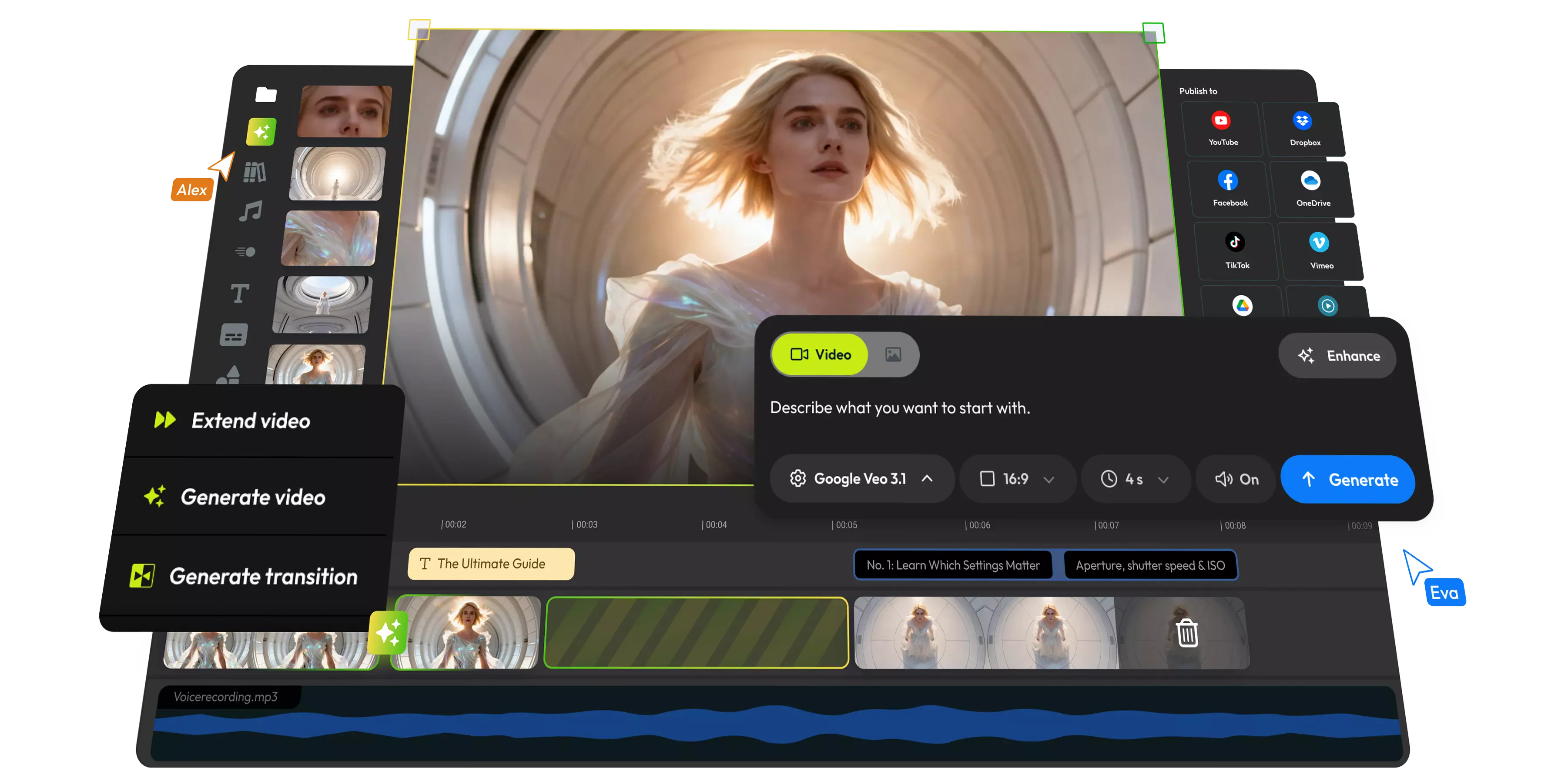 |
| og:title | Flixier: Free Online Video Editor With AI Editing |
| og:site_name | Flixier |
| og:description | Edit video in your browser: cut, caption in 130+ languages, export 4K rendered in the cloud. Or let Eva make the first cut, or the whole video. |
| twitter:card | summary_large_image |
| twitter:site | @flixier_pro |
| twitter:image | https://dp0rksi384o97.cloudfront.net/media/8562/conversions/home-page-desktop-webp.webp |
| twitter:title | Flixier: Free Online Video Editor With AI Editing |
| twitter:creator | @flixier_pro |
| twitter:description | Edit video in your browser: cut, caption in 130+ languages, export 4K rendered in the cloud. Or let Eva make the first cut, or the whole video. |
robots.txt (opens in a new tab)
22 rulesAll bots 0 allowed · 12 disallowed

 All bots

/api//[locale]//cache-api/*?fx_source=*?fx_medium=*?fx_campaign=*?ref=*?cache=*?utm_medium=*?utm_source=*?utm_campaign=*?fpr=
oai-searchbot 1 allowed · 0 disallowed

/
chatgpt-user 1 allowed · 0 disallowed
/
claudebot 1 allowed · 0 disallowed
/
gptbot 1 allowed · 0 disallowed
/
perplexitybot 1 allowed · 0 disallowed
/
bytespider 1 allowed · 0 disallowed
/
google-extended 1 allowed · 0 disallowed
/
applebot-extended 1 allowed · 0 disallowed
/
cohere-ai 1 allowed · 0 disallowed
/
meta-externalagent 1 allowed · 0 disallowed
/
No matching rules.
Sitemaps
1 Registration details RDAP / WHOIS
| Registrar | Amazon Registrar, Inc. |
|---|---|
| Registered | 2018-08-27 |
| Expires | 2027-08-27 |
| Domain status | client transfer prohibited |
| Nameservers | dora.ns.cloudflare.com、jeff.ns.cloudflare.com |
| DNSSEC | unsigned |
 DNS records
| Type | Name | Value | TTL | Priority |
|---|---|---|---|---|
| A | flixier.com | 104.20.18.1 | 300 | — |
| A | flixier.com | 172.66.154.108 | 300 | — |
| AAAA | flixier.com | 2606:4700:10::6814:1201 | 300 | — |
| AAAA | flixier.com | 2606:4700:10::ac42:9a6c | 300 | — |
| MX | flixier.com | aspmx.l.google.com | 300 | 1 |
| MX | flixier.com | alt1.aspmx.l.google.com | 300 | 5 |
| MX | flixier.com | alt2.aspmx.l.google.com | 300 | 5 |
| MX | flixier.com | alt3.aspmx.l.google.com | 300 | 10 |
| MX | flixier.com | alt4.aspmx.l.google.com | 300 | 10 |
| NS | flixier.com | dora.ns.cloudflare.com | 86400 | — |
| NS | flixier.com | jeff.ns.cloudflare.com | 86400 | — |
| TXT | flixier.com | ahrefs-site-verification_e6f8887b0c0451ee689318f6665f51ffc026a2ecb9301ad7a935b5613370a7cb | 300 | — |
| TXT | flixier.com | google-site-verification=0a_csmvo5t3Ha5C9Tlsntt5wUEaSjPQ884yFhMz9CD4 | 300 | — |
| TXT | flixier.com | openai-domain-verification=dv-CO4X21a9RBfvYtVgl6Jt7o2h | 300 | — |
| TXT | flixier.com | v=spf1 include:amazonses.com include:_spf.google.com include:mailgun.org include:242712109.spf07.hubspotemail.net ~all | 300 | — |
| CAA | flixier.com | 0 issue "amazon.com" | 300 | — |
| CAA | flixier.com | 0 issue "comodoca.com" | 300 | — |
| CAA | flixier.com | 0 issue "digicert.com; cansignhttpexchanges=yes" | 300 | — |
| CAA | flixier.com | 0 issue "letsencrypt.org" | 300 | — |
| CAA | flixier.com | 0 issue "pki.goog; cansignhttpexchanges=yes" | 300 | — |
| CAA | flixier.com | 0 issue "ssl.com" | 300 | — |
| CAA | flixier.com | 0 issuewild "comodoca.com" | 300 | — |
| CAA | flixier.com | 0 issuewild "digicert.com; cansignhttpexchanges=yes" | 300 | — |
| CAA | flixier.com | 0 issuewild "letsencrypt.org" | 300 | — |
| CAA | flixier.com | 0 issuewild "pki.goog; cansignhttpexchanges=yes" | 300 | — |
| CAA | flixier.com | 0 issuewild "ssl.com" | 300 | — |
| DMARC | _dmarc.flixier.com | v=DMARC1;p=reject;sp=reject;adkim=r;aspf=r;rua=mailto:[email protected] | 300 | — |
 TLS and certificates
| Assessment | Normal configuration |
|---|---|
| Supported protocols | TLSv1.2、TLSv1.3 |
| Negotiated protocol | TLSv1.3 |
| Certificate subject | flixier.com |
| Issuer | Google Trust Services |
| Valid until | 2026-11-27T18:04 · Remaining when checked: 65 days |
| Verification details | Certificate trust: Passed · Hostname match: Passed |
 HTTP response headers
| Header | Value |
|---|---|
| content-type | text/html; charset=utf-8 |
| cache-control | private, no-cache, no-store, max-age=0, must-revalidate |
| server | cloudflare |
| strict-transport-security | max-age=63072000; includeSubDomains; preload |
| content-security-policy | default-src * data: blob: 'unsafe-inline' 'unsafe-eval' |
| x-frame-options | SAMEORIGIN |
| x-content-type-options | nosniff |
| referrer-policy | strict-origin-when-cross-origin |
| permissions-policy | camera=(self "https://editor.flixier.com"), microphone=(self "https://editor.flixier.com"), display-capture=(self "https://editor.flixier.com"), fullscreen=(self "https://editor.flixier.com"), autoplay=(self "https://editor.flixier.com") |
| access-control-allow-origin | * |
| set-cookie | Redacted |
 Identified technologies
Recent Updates
- Website images
- Screenshots
- Website Technologies
- Pages and Search Information
User reviews (0)