
 franckgoddio.org
 Paid content
 Multilingual
Categories: History & Archives
Meet Franck Goddio and his team of the European Institute for Underwater Archaeology and follow their search for sunken cities and civilizations.
 Visit website
 Updated: 2026-09-27 00:27
Language: English (default)
Updated: 2026-09-27 00:27
Language: English (default)
 Access: Normal
 Profile views 8
 Outbound visits 1
Related questions
More questions →Scuba Diving: What It Is and How to Get Started
Scuba diving lets you breathe underwater using a tank of compressed air, so you can explore reefs, wrecks, and marine life for extended periods rather than holding your breath. Getting started usually means one of two paths: a supervised "try dive" with no certification required, or a full entry-level certification course that qualifies you to dive independently with a buddy. The right choice depends on whether you want a one-time experience or a lifelong activity. This guide covers what's involved, how certification works, and how to pick a dive center — using a Tenerife operator, Amarilla Divers, as a concrete example of how these programs are typically structured.
What scuba diving actually involves
Scuba stands for Self-Contained Underwater Breathing Apparatus. Unlike snorkeling, you carry your own air supply, which lets you stay under longer and go deeper.
The core equipment:
- Mask and fins — for vision and propulsion
- Regulator — the mouthpiece assembly that delivers air from the tank at ambient pressure
- Buoyancy compensator (BCD) — an inflatable vest that lets you control whether you float, sink, or hover
- Cylinder (tank) — holds compressed air
- Wetsuit or drysuit — thermal protection; water conducts heat away from your body far faster than air
- Weights and a dive computer or gauges — for descent control and tracking depth, time, and air
Most of this is provided by the dive center on courses and guided dives, so you don't need to buy gear to start.
Beginner options: try dive vs. certification
There are two common entry points, and they serve different goals.
PADI Discover Scuba Diving (try dive)
A supervised introduction, typically a short briefing plus a shallow-water session with an instructor. No certification results, and you can't dive independently afterward. It's the right choice if you're unsure whether you'll enjoy it or you only have a day to spare.
PADI Open Water Diver (entry certification)
The standard entry-level certification. According to Amarilla Divers, the Open Water course is "recognised world wide and will allow you to dive to 18 Meters after certification." It typically combines knowledge development, confined-water skills practice, and open-water dives. Once certified, you can dive with a buddy without an instructor present, and the certification is generally accepted internationally.
How to decide: choose the try dive if you want a low-commitment sample; choose Open Water if you intend to dive again, travel to dive destinations, or continue to advanced training.
The typical path from first dive to certification
While exact sequencing varies by operator, the general progression looks like this:
- Enquiry and booking — contact the center, confirm course dates, and ask what's included (gear, materials, certification fee).
- Medical screening — complete a health questionnaire. Certain conditions (heart, lung, ear, or seizure-related) may require a physician's sign-off before you can dive.
- Knowledge development — study the theory, now often via eLearning before you arrive.
- Confined-water training — practice core skills (regulator recovery, mask clearing, buoyancy control) in a pool or shallow, calm water.
- Open-water dives — apply those skills in the sea or a lake, usually four dives for Open Water.
- Certification — on successful completion, you receive your certification card, often issued digitally.
Verification: ask the center to confirm in writing what the course fee covers and what depth and conditions you'll be certified for. After certification, you can verify your status through the certifying agency's system.
How to choose a dive center
The center you train with affects both your safety and your experience. Use the same criteria to compare any operator:
| What to check | Why it matters |
|---|---|
| Agency affiliation | PADI, SSI, CMAS, and others are all legitimate; confirm the center is an authorized resort or center for the agency it advertises |
| Instructor qualifications | Ask about instructor ratings and student-to-instructor ratios |
| Group sizes | Smaller groups mean more individual attention, especially for beginners |
| Equipment condition | Well-maintained regulators and BCDs are a basic safety signal |
| Site access | Shore vs. boat diving, and how many sites are available |
| Reviews and reputation | Look for patterns across multiple reviews, not a single glowing one |
| Logistics | Pickup, location, and language of instruction |
As an example of how one operator presents itself: Amarilla Divers describes itself as a "multi AWARD winning Dive Resort" in Los Abrigos, in the south of Tenerife, and states it offers free collection from Golf Del Sur, Costa Del Silencio, Los Cristianos, Las Americas, and Adeje. It lists PADI courses from Discover Scuba Diving up to professional levels, says it has "over 50 scuba dive sites," and notes it has a PADI Master Instructor and PADI MSDT Instructor on staff. It also offers Divemaster internships for those going professional. These are the operator's own claims — treat them as a starting point for your own verification, not as independent endorsement.
A customer review quoted on the site (Hobarts, March 2017) describes the center as "very friendly & experienced" and names a dive guide as "the best dive guide I have had." Reviews like this are useful for gauging tone and consistency, but check recent reviews across platforms before booking.
Safety and health considerations
Diving is generally safe when done within training limits, but a few points are non-negotiable:
- Never dive with a cold, congestion, or ear problems. Equalizing pressure is difficult when you're congested, and forcing it can cause injury.
- Complete the medical questionnaire honestly. If a condition is flagged, get the required physician clearance before diving.
- Follow your certification depth limits. Open Water is typically 18 meters; deeper diving requires further training.
- Ascend slowly and never hold your breath on ascent — expanding air needs to escape.
- Dive within your training and comfort level, and don't let a guide or buddy pressure you past it.
- Check your insurance. Standard travel insurance often excludes diving; confirm coverage or buy dive-specific insurance.
Continuing after certification
Once certified, the common next steps are PADI Advanced Open Water (which extends your depth limit and introduces specialties like navigation and deep diving), Rescue Diver, and specialty courses. For those who want to work in the industry, the Divemaster level is the first professional rating — Amarilla Divers, for instance, lists Divemaster internships among its offerings, which typically combine training with assisting instructors.
Quick decision guide
- Just want to try it once? Book a Discover Scuba Diving session.
- Plan to dive on future trips? Go straight to Open Water certification.
- Already certified and want more depth or skills? Look at Advanced Open Water or specialties.
- Want to work in diving? Research Divemaster internships and confirm what's included (training, dives, duration, and any costs).
Whichever path you choose, confirm the details in writing with the center before you commit, and prioritize a center that answers your safety questions clearly.
Website Overview
An established domain and managed infrastructure suggest continuity of operations and may support dependable delivery, although neither guarantees service quality. Page metadata, canonical configuration and social previews work together to provide more consistent search and sharing presentation.
Domain and Registration
Registered in 2000, this domain has about 26 years of history. That suggests continuity, although ownership and purpose may have changed. The domain uses the common .org extension, which is not an independent safety signal.
DNS and Email
The observed email authentication setup is incomplete: DMARC is missing. Nameservers are provided by GoDaddy, indicating managed DNS hosting. MX records point to the franckgoddio.org email service. No CNAME was found; the observed records resolve directly to addresses. DNSSEC signatures were not detected, so this additional DNS authenticity protection is not confirmed.
TLS and Certificates
The public key uses EC with 256 bits. The server supplied a complete certificate chain. No organization name is present in the certificate; the available fields are consistent with domain validation. The certificate was issued by Let's Encrypt, commonly associated with automated certificate services. The certificate's total validity is about 89 days, consistent with a short renewal cycle.
HTTP and Browser Security
The response lacks these common security headers: HSTS, CSP, Referrer-Policy, Permissions-Policy, clickjacking protection. No X-Powered-By header was found, reducing one common source of backend fingerprinting information. No obvious internal addresses or debug information were found in the headers. The Server header identifies nginx without an exact version. No explicit CDN or WAF marker was found in the response headers.
Technology Stack Analysis
The public page identifies Google Analytics, nginx without precise versions, leaving fewer clues for version-specific scanning.
Search and Social Sharing
Twitter Card metadata is configured. The page declares 3 language or regional alternatives using hreflang. The title has 23 characters, within a common display range. A meta description is present, with 145 characters. The observed directives allow indexing and link following.
 Hosting and Email
 GoDaddy
 Hosting
 Amazon.com, Inc.
 Location
 Frankfurt am Main, Hesse, Germany
 Pages, Search and Sharing
| Meta description | Meet Franck Goddio and his team of the European Institute for Underwater Archaeology and follow their search for sunken cities and civilizations. |
|---|---|
| Canonical URL | https://www.franckgoddio.org/ |
| Language | English (default) · Multilingual |
| Twitter Card | summary_large_image |
Social Sharing Preview
14 fields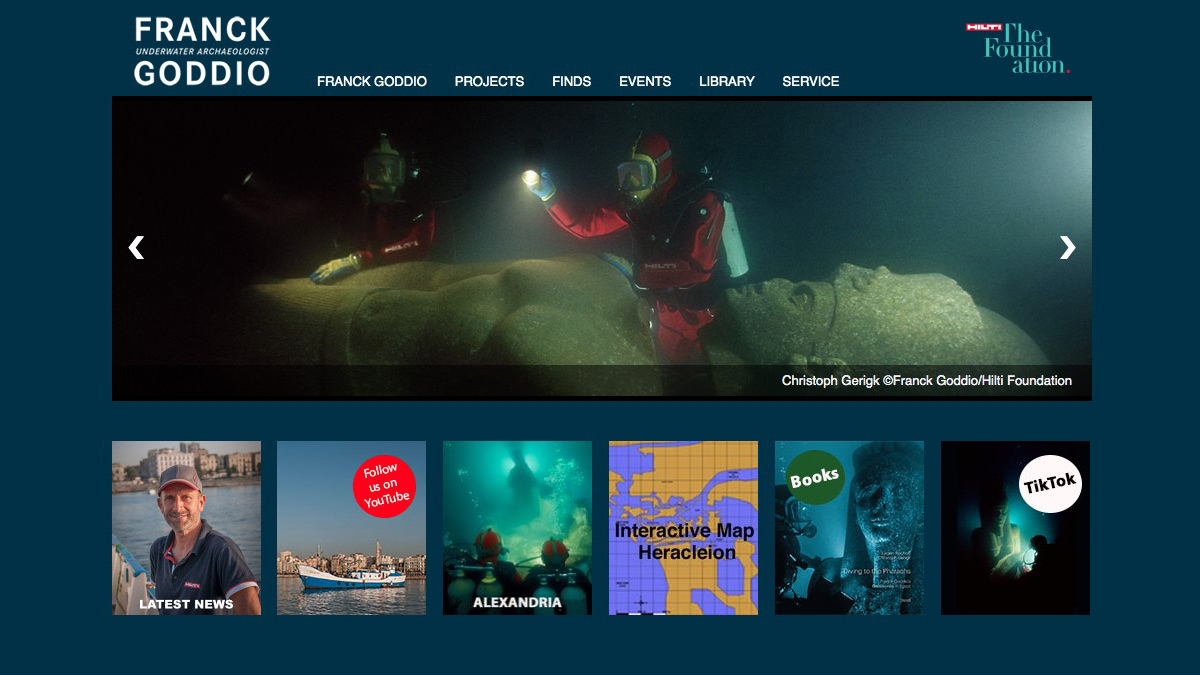

Sharing metadata
| og:url | https://www.franckgoddio.org/ |
|---|---|
| og:type | website |
| og:image | https://www.franckgoddio.org/fileadmin/_processed_/d/b/csm_01_Hera-CG-035_373aa8da94.jpg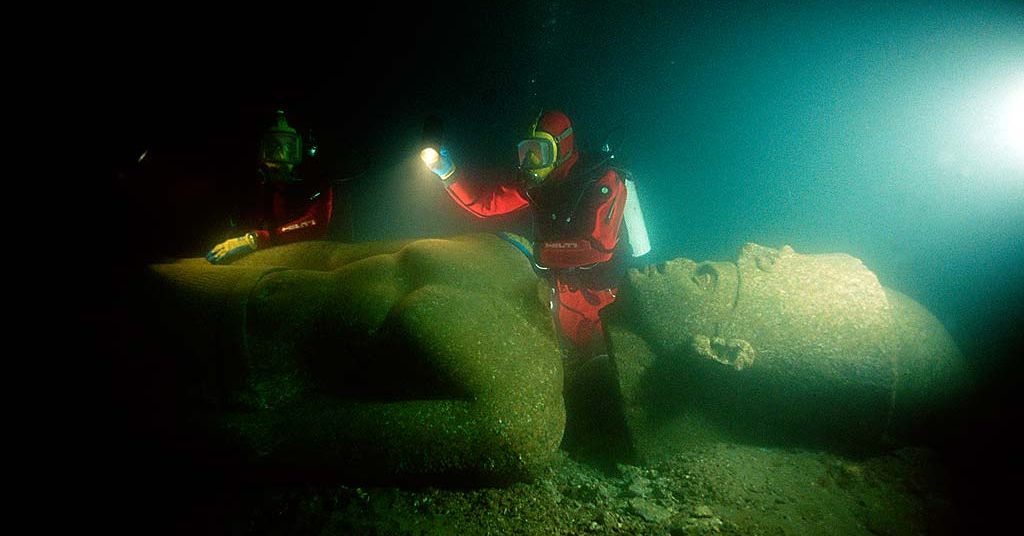 |
| og:title | Homepage |
| og:locale | en_US |
| og:image:url | https://www.franckgoddio.org/fileadmin/_processed_/d/b/csm_01_Hera-CG-035_373aa8da94.jpg |
| og:site_name | Franck Goddio - Underwater Archaeologist |
| og:description | Underwater archaeological excavations by the European Institute for Underwater Archaeology (IEASM), directed by Franck Goddio in the sunken cities of Thonis-Heracleion, Canopus and the eastern port of Alexandria off the coast of Egypt as well as of sunken ships worldwide. |
| og:image:width | 1024 |
| og:image:height | 536 |
| twitter:card | summary_large_image |
| twitter:image | https://www.franckgoddio.org/typo3conf/ext/goddio_base/Resources/Public/Images/franck-goddio-org.jpg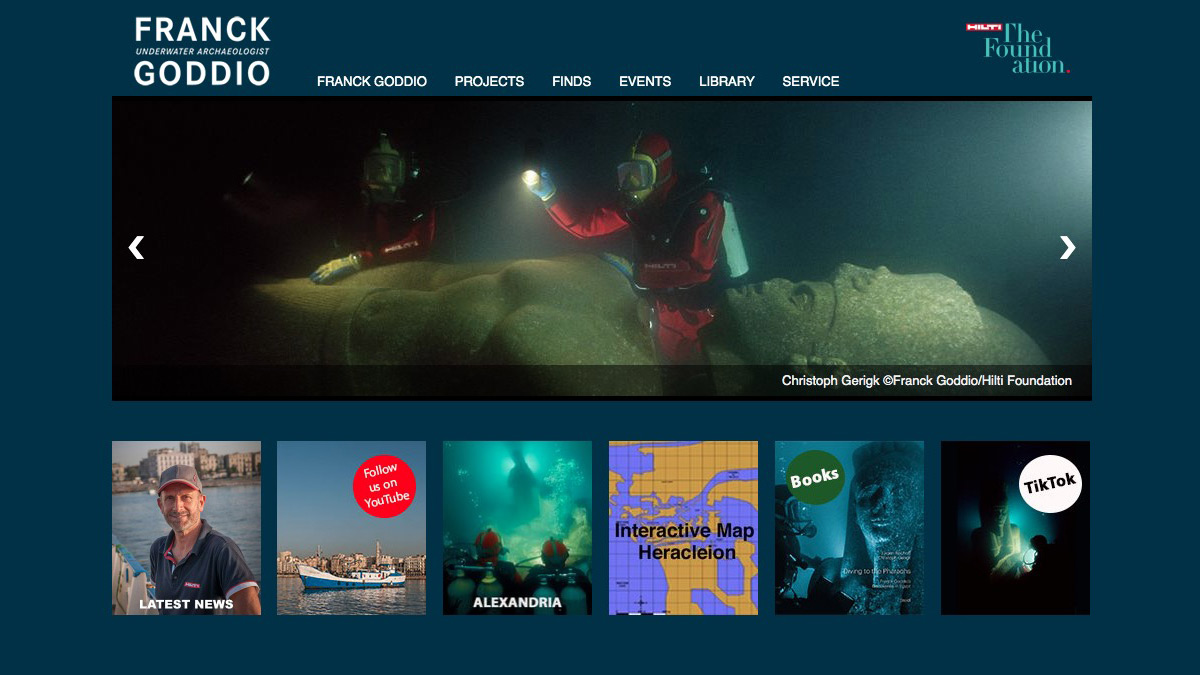 |
| twitter:title | Homepage |
| twitter:description | Underwater archaeological excavations by the European Institute for Underwater Archaeology (IEASM), directed by Franck Goddio in the sunken cities of Thonis-Heracleion, Canopus and the eastern port... |
robots.txt (opens in a new tab)
6 rulesAll bots 2 allowed · 4 disallowed

 All bots

//typo3conf/ext/goddio_base/Resources/Public/
/typo3//typo3conf//typo3_src//typo3temp/
No matching rules.
Sitemaps
1 Registration details RDAP / WHOIS
| Registrar | Mesh Digital Limited |
|---|---|
| Registered | 2000-03-08 |
| Expires | 2027-03-08 |
| Domain status | active |
| Nameservers | ns57.domaincontrol.com、ns58.domaincontrol.com |
| DNSSEC | unsigned |
 DNS records
 TLS and certificates
| Assessment | Normal configuration |
|---|---|
| Supported protocols | TLSv1.2、TLSv1.3 |
| Negotiated protocol | TLSv1.3 |
| Certificate subject | franckgoddio.org |
| Issuer | Let's Encrypt |
| Valid until | 2026-12-04T20:53 · Remaining when checked: 68 days |
| Verification details | Certificate trust: Passed · Hostname match: Passed |
 HTTP response headers
| Header | Value |
|---|---|
| content-type | text/html; charset=utf-8 |
| content-language | en |
| cache-control | max-age=0 |
| server | nginx |
| x-content-type-options | nosniff |
 Identified technologies
User reviews (0)