
 简体中文
简体中文 English
Website review
This review may include AI-generated content and is not individually verified. Domain, certificate and other facts come from the observed data on this page.
What is AirCare?
AirCare is a mobile app for checking air quality and pollen levels, positioned as a simple, intuitive way to know what you're breathing. Based on its own description, it tracks air pollution and pollen data and is offered as a free download.
What it does
- Shows air quality and pollen information for your location.
- Aims for an easy, at-a-glance experience rather than dense environmental data.
- Publishes a blog, including practical topics such as air quality monitoring in schools.
Who it's for
- People with allergies or asthma who want a quick daily pollen and pollution check before heading out.
- Parents, runners, cyclists and commuters deciding whether to exercise outdoors or keep windows open.
- Schools and workplaces interested in indoor and outdoor air quality, which the site addresses through a business solutions section.
Practical next step If you're deciding whether to install it, check two things first: whether it covers your city or region, and whether its pollen breakdown matches the species you react to. A useful test is to compare its reading on a high-pollen day against how you actually feel outdoors.
For broader context on pollution and pollen forecasts, official sources such as AirNow (US) or Met Office (UK) can serve as a cross-check.
How does AirCare track pollen and air pollution?
AirCare tracks pollen and air pollution by pulling air-quality data into a simple mobile app, so you can see what's in the air where you are without digging through scientific charts. The app is positioned around a single idea — "know what you breathe" — with air quality and pollen as the two main things it surfaces. It's aimed at everyday users rather than specialists: people with allergies or asthma, parents, runners and cyclists, or anyone deciding whether to open the windows or take a longer route.
What it covers
- Air pollution: the app presents air quality readings for your location in a simplified form, so the headline number and its meaning are the point rather than raw sensor data.
- Pollen: pollen is tracked alongside pollution as a separate concern, which matters because the two have different sources, seasons and health effects. A high-pollution day and a high-pollen day can call for different responses.
- Presentation: the emphasis is on being intuitive and quick to read — useful when you're checking before a commute or a run rather than studying a dashboard.
Who gets the most out of it
If you have hay fever, the pollen layer is the practical one: check before a morning run or before spending an afternoon outdoors. If you have a respiratory condition or live in a city with variable air quality, the pollution reading helps you time errands, exercise or ventilation. If you're a parent or teacher, both matter for outdoor play and classroom windows — the site's own blog discusses air quality monitoring in schools, which reflects that audience.
How to judge whether it fits you
The deciding factors are coverage where you actually live and how often the data refreshes. Air-quality and pollen data are usually aggregated from monitoring networks and models, so a location far from sensors may show estimates rather than direct measurements. Before relying on it:
- Check that your city or region appears and that readings look plausible against what you experience.
- Compare a few days of readings with how you actually feel, especially during pollen season.
- Decide whether you need the simplified view or more granular pollutant breakdowns — if it's the latter, a specialist source may suit you better.
For a broader or more technical view, official monitoring services such as AirNow publish pollutant-by-pollutant data, and The Weather Channel includes pollen and air-quality information alongside forecasts. AirCare's value is convenience and clarity rather than depth, so treat it as a daily check rather than a clinical or regulatory reference.
Is AirCare free to download and use?
Based on the information provided, AirCare is described as free to download, and the app's own description invites users to "Download AirCare for free." The page evidence does not mention any subscription, in-app purchase, or paid tier, so there is no indication of a paid version.
H3 What to check yourself
- Open the app store listing for your platform and look at the "In-App Purchases" section; it will show whether any paid upgrades exist.
- Check whether the free version limits features such as pollen forecasts, multiple saved locations, or ad removal.
- If you need air quality data for a school, workplace, or other organization, note that the site has a separate "Business Solutions" section, which may involve commercial terms rather than free consumer use.
H3 Practical takeaway For a typical individual checking daily air quality or pollen, the free download is likely enough to start. The main trade-off is between zero cost and possible limits on advanced features or ads. If you rely on the data for institutional decisions, treat the business offering as a separate arrangement and confirm terms directly with the provider.
Next step: install the app, use it for a week in your usual locations, and see whether the free feature set covers what you actually need before considering any paid option.
How accurate is AirCare's air quality data?
AirCare presents its data as "air quality data you can trust," and the app's pitch is simplicity: check current pollution and pollen levels without wading through technical dashboards. Accuracy, though, depends less on the app itself and more on the monitoring stations feeding it.
What determines the accuracy
Most consumer air quality apps, AirCare included, aggregate official government monitoring networks and combine them with models to estimate conditions between stations. That means:
- Near an official monitor: readings track the local station closely and are reliable for that spot.
- Between monitors: values are interpolated or modeled, so they can miss street-level differences such as a busy road, a park, or a valley where pollution pools.
- Pollen: counts come from a smaller number of stations and vary more by microclimate, so treat them as a general regional signal rather than a precise local measurement.
Practical use
For a daily decision like whether to run outside, walk to school with a child, or open windows, AirCare-style readings are usually good enough to spot a bad-air day. For a health condition such as asthma, or for choosing where to live, cross-check the nearest official monitor and local forecasts. The site's blog, including a piece on monitoring in schools, suggests it is aimed at everyday awareness and institutional use rather than regulatory-grade measurement.
A quick comparison
| Situation | How much to trust the reading |
|---|---|
| You are near a government monitor | High for that location |
| You are several kilometres away | Moderate; expect local variation |
| Checking pollen for a specific garden | Low; use as a regional guide |
| Deciding whether to exercise outdoors today | Generally sufficient |
Next step
Open AirCare, note the distance to the nearest monitoring station shown for your area, and compare that reading with your national or regional air quality service on the same day. If the two broadly agree, the app is a convenient front end; if they diverge sharply, trust the official monitor for health decisions.
Can AirCare be used for air quality monitoring in schools?
Yes. AirCare is designed as a mobile air quality and pollen app, and its own blog covers “Air Quality Monitoring in Schools,” so it is positioned for school-related use. The practical value for a school is not a single reading but a repeatable routine: check local air pollution and pollen levels before outdoor activities, recess, sports practice or ventilation decisions, and share a common reference point with staff and families.
H3 What a school can realistically do with it
- Daily planning: Staff or administrators check the app in the morning to decide whether outdoor PE, recess or field trips need adjustment on high-pollution or high-pollen days.
- Symptom context: Teachers and school nurses can note when rising pollen or pollution overlaps with student allergy or asthma complaints, rather than treating each case in isolation.
- Awareness and communication: The app can support parent notices or classroom discussions about air quality, using the same simple interface across phones.
- Ventilation timing: On days when outdoor air is poor, schools can lean toward filtered indoor air; on cleaner days, natural ventilation is easier to justify.
H3 Limits to keep in mind
AirCare reports air quality and pollen data, not indoor CO₂, ventilation rates or room-level particulate levels. It cannot tell you whether a specific classroom is stuffy or whether a filter is working. For building-level decisions, schools generally pair an app like this with indoor sensors or a professional monitoring service. Also, app readings depend on the nearest monitoring station or data source, so a school in a large city may get a useful area estimate rather than an exact campus measurement.
H3 A sensible next step
Start with a two-week trial: one staff member checks AirCare each morning and records the day’s outdoor activity decisions, then compare those notes with nurse visits or complaints. If the pattern is useful, formalize it into a simple daily checklist. For official guidance on protecting students, the U.S. Environmental Protection Agency’s indoor air quality resources for schools at EPA are a practical companion, and the World Health Organization at WHO publishes air quality guidelines that help interpret what the numbers mean.
What business solutions does AirCare offer for organizations?
AirCare’s business offering is aimed at organizations that need air-quality or pollen information for planning, operations, or communication rather than just personal daily checks. The site presents “Business Solutions” as a distinct section alongside its consumer app, reviews, and blog, which suggests a separate track for companies and institutions instead of only an individual mobile download.
What the business track appears to cover
Based on the available page information, the business side is best understood as a way to bring AirCare’s air-quality and pollen data into an organization’s own workflows. The consumer app focuses on helping people know what they breathe; the business solutions section implies extending that same general capability to teams, locations, or customer-facing services.
Concrete uses could include:
- Workplace and facility planning: checking local air quality or pollen levels before scheduling outdoor work, events, or ventilation adjustments.
- Schools and campuses: the blog excerpt specifically discusses air-quality monitoring in schools, which points to education as a relevant audience.
- Health and wellness services: giving staff or clients a simple reference for pollution and pollen exposure.
- Travel, fitness, or outdoor-focused businesses: incorporating air-quality context into daily recommendations or customer communications.
- Media and apps: using AirCare data as a source for displays, alerts, or environmental reporting.
Who it suits
The business solutions are likely most useful to organizations that already make decisions based on local environmental conditions, or that want to offer that information to employees, customers, or users without building their own monitoring and data pipeline. A school administrator, for example, might use it to decide whether outdoor recess or sports are appropriate on a high-pollen or high-pollution day. A company with multiple offices could use it to compare conditions across locations.
It is less obviously aimed at organizations that need regulatory-grade compliance monitoring, custom hardware installation, or detailed industrial emissions analysis. The available information describes an app and data service, not a full environmental engineering platform.
How to decide whether it fits
Start by defining what your organization actually needs:
| Need | Likely fit with AirCare business solutions |
|---|---|
| Simple air-quality and pollen reference for staff or customers | Strong fit |
| Location-based environmental information in an app or service | Likely fit |
| School or workplace daily planning | Likely fit |
| Regulatory reporting or certified monitoring | Not indicated |
| Hardware sensors or on-site installation | Not indicated |
The practical next step is to visit the Business Solutions section on AirCare and compare its stated use cases with your organization’s location count, audience, and whether you need a public-facing display or an internal planning tool. If your main need is a simple, trusted environmental signal rather than certified compliance data, AirCare’s business track is worth evaluating.
 Cloudflare
 Google Workspace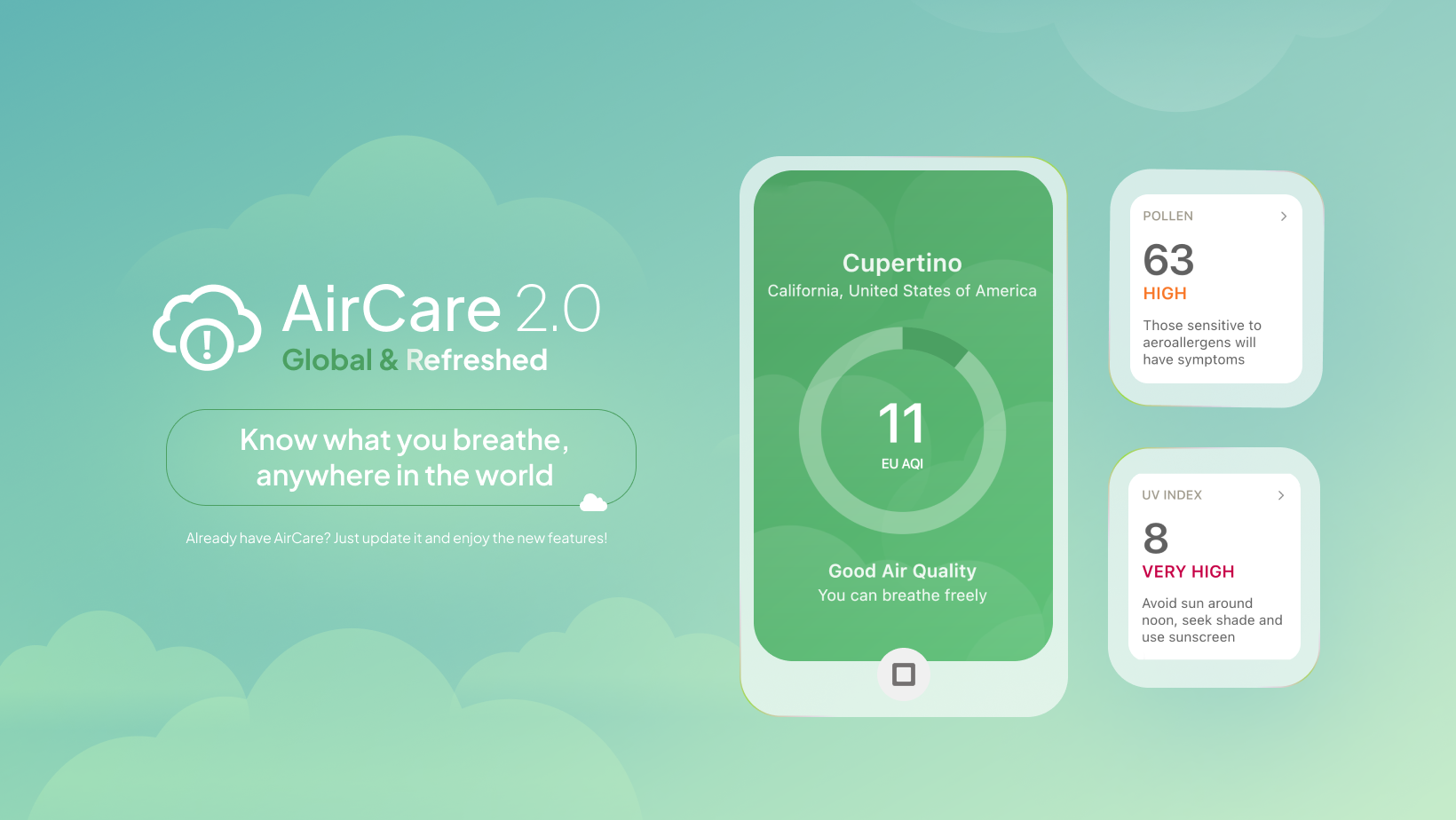

User reviews (0)