Website profiles · Technology insights · Alternatives

hdc.net

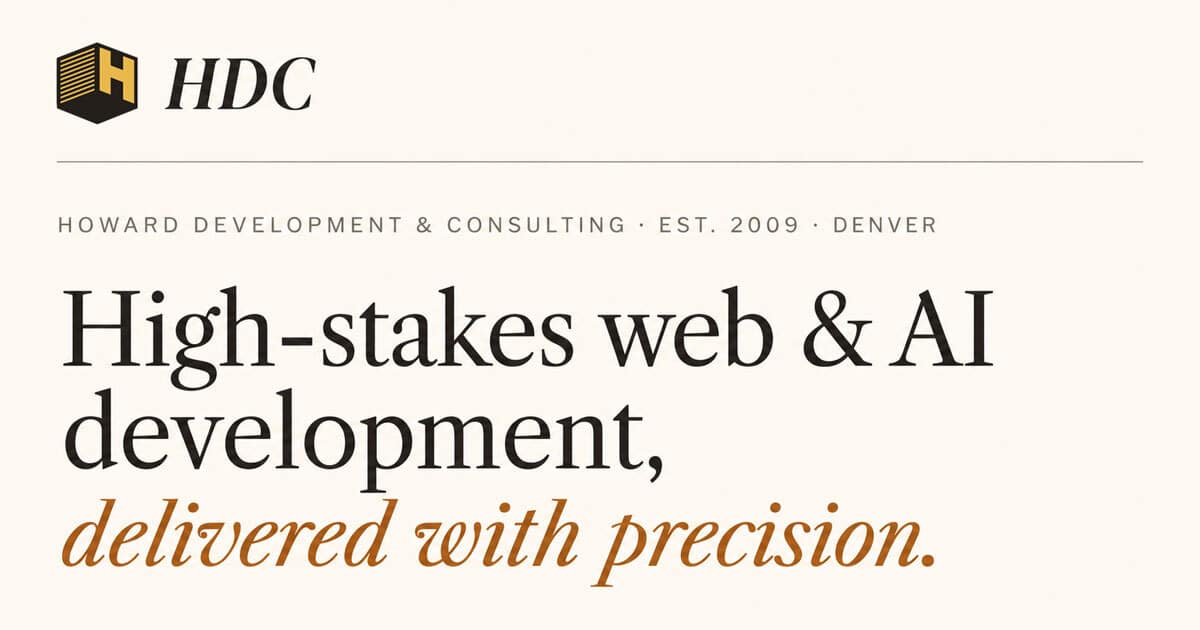
Howard Development & Consulting builds advanced AI workflows and website solutions for the world's most demanding organizations. U.S.-based team, transparent fixed-fee pricing. Est. 2009, Denver.

No paid content found
Visit website
Profile views 4 Outbound visits 1 Normal
HDC Full homepage screenshot

At a glance

Category
Artificial Intelligence
Language
English
Paid-content signal
No paid content foundObserved
Registered
1997
Hosting
CloudflareInferred
HTTPS certificate trusted
PassedObserved
Last updated
Unknown

Website review

This review may include AI-generated content and is not individually verified. Domain, certificate and other facts come from the observed data on this page.

What is HDC?

HDC is Howard Development & Consulting, a Denver-based studio founded in 2009 that builds custom web platforms and AI systems for large organizations. Its stated focus is "high-stakes" work — projects where missed deadlines or off-spec code carry real consequences for launches, budgets and stakeholders. The team is U.S.-based and works on fixed-fee pricing, which the site presents as a way to plan budgets without open-ended billing.

What it actually does

The page splits the work into two practices:

  • AI solutions — custom agents and workflows, private or air-gapped systems, systems and API integration, and knowledge-base assistants.
  • Web development — enterprise WordPress and Shopify builds, Laravel, Vue.js and React applications, accessibility and performance audits, and legacy rescue or modernization.

The through-line is that both practices are held to the same delivery standard, rather than one being a side offering.

Who it is for

The named client roster — Harvard Law School, MIT Media Lab, Marriott International, The World Bank, ESPN The Magazine, the U.S. Holocaust Memorial Museum, the Department of Defense and others — signals the target audience: institutions and enterprises with procurement processes, compliance concerns and low tolerance for rework. The site also mentions entrepreneurs, but the emphasis is clearly on organizations where failure is expensive.

One point of note: the founder's Understrap WordPress theme framework is cited as powering 100,000+ sites, which is a useful credibility marker if your project touches WordPress — it suggests deep familiarity with the ecosystem rather than occasional use.

How to decide if it fits

If you are choosing a partner for a sensitive AI deployment, the practical question is whether they can work inside your constraints — private infrastructure, data-handling rules, existing APIs. The page claims air-gapped and private systems as a capability, so that is worth testing directly in a first conversation.

For a web rebuild or rescue, the fixed-fee model matters most when scope is already well defined. If your requirements are still shifting, ask how change requests are handled before signing.

A sensible next step: book the complimentary consultation the site offers, and bring one concrete problem — a legacy platform you need modernized, or an AI workflow you want piloted — so you can judge their approach on a real case rather than a capabilities list.

How does HDC's fixed-fee pricing work for web and AI projects?

HDC describes its pricing as transparent and fixed-fee, so the practical model is a defined project scope agreed up front, with one price for delivering that scope rather than an open-ended hourly meter. For a client, that shifts cost risk to the developer: if the work takes longer than expected, the fee does not move, which makes budgeting and internal approval easier. The trade-off is that scope has to be pinned down carefully before the fee is set, and changes after that point are typically handled as separate work.

What fixed-fee tends to fit well

  • Clearly bounded builds — an enterprise WordPress or Shopify site, a Laravel/Vue/React application, or a defined AI agent or knowledge-base assistant with known inputs and outputs.
  • Organizations that need predictable spend — a department with a fixed budget line, or a stakeholder group that must approve a number before work starts.
  • Procurement and compliance reviews — a single contract value is simpler to justify than an estimate that drifts.

Where it needs more care

  • Exploratory AI work — model behavior, data quality and integration quirks often only become clear during the build. If your requirements are still hypotheses, expect the scope conversation to be iterative, or ask how unknowns are handled.
  • Legacy rescue and modernization — the true state of an old codebase is sometimes only visible once work begins, so discovery matters more than the headline fee.
  • Ongoing change — fixed-fee suits a launch, less so a product that evolves every month. Ask whether there is a separate arrangement for maintenance and iteration.

How to evaluate a fixed-fee proposal

  1. Read the scope document, not the price. The fee is only meaningful next to what is explicitly included: pages, integrations, user roles, accessibility and performance targets, content migration, QA and launch support.
  2. Ask what counts as a change. A clear change-request process protects both sides.
  3. Check the assumptions. Who supplies content, brand assets, API access and stakeholder feedback — and by when? Client-side delays are the most common cause of friction on fixed-fee projects.
  4. Match the discipline to the risk. A marketing site and a private, compliance-sensitive AI system carry very different failure costs, so the depth of discovery should differ too.

A useful next step is to write a one-page brief listing your must-haves, your nice-to-haves and your hard deadline, then ask for a fixed-fee quote against that brief. The gaps between your brief and their scope document are where surprises live. For context on the studio's background and portfolio, see HDC.

What types of AI solutions does HDC build for enterprises?

HDC builds two broad categories of AI work for enterprises and entrepreneurs: custom agents and workflows tailored to a specific operation, and private or air-gapped AI systems for organizations that cannot send data to outside services. Around those, the page lists systems and API integration and knowledge-base assistants.

What that means in practice

  • Custom agents and workflows suit teams with a repeatable process — intake, review, reporting, triage — where an agent can take over steps and hand off to a person at defined checkpoints.
  • Private, air-gapped systems are for regulated or sensitive environments: legal, defense, finance, health, or any team whose data cannot leave controlled infrastructure. This is the option to weigh when data residency or compliance rules rule out public model APIs.
  • Systems and API integration is the plumbing that makes AI useful rather than a demo — connecting models to internal tools, databases, and existing software so outputs land where work already happens.
  • Knowledge-base assistants are internal question-answering over your own documents and policies, aimed at reducing the time staff spend hunting for answers.

Choosing between them

If your situation is… The relevant offering is…
A repeatable internal process with clear steps Custom agents and workflows
Data that must not leave your environment Private, air-gapped AI systems
AI that has to act inside existing software Systems and API integration
Staff repeatedly asking the same questions of documents Knowledge-base assistants

A practical next step is to write down one workflow you would hand over first, then note where its data lives and who signs off on outputs. Those two answers usually decide whether you need a private deployment or a standard integrated one, and they give any consultancy — HDC included — enough to scope the work concretely. The page also points to a complimentary consultation as the entry point, which is the right moment to test whether their fixed-fee, U.S.-based model fits your timeline and procurement process.

For context on the wider market, enterprise buyers often compare specialist shops like HDC against larger integrators such as Accenture or platform vendors such as OpenAI and Anthropic when deciding whether to build, buy, or partner.

Can HDC handle both a new web platform and a legacy system modernization?

Yes. HDC presents itself as a single partner for both new builds and legacy work, with web development and AI as parallel disciplines. The site lists enterprise WordPress and Shopify builds, Laravel/Vue/React applications, accessibility and performance audits, and “legacy rescue & modernization” among its web services. On the AI side, it describes custom agents and workflows, private or air-gapped systems, systems and API integration, and knowledge-base assistants. The claim is that both tracks are held to one standard of delivery.

What that means in practice

If you are planning a new platform while an older system still runs the business, the useful question is not “can one vendor do both?” but “can the same team sequence them without stalling either?” A realistic split looks like this:

  • New platform work: greenfield architecture, design systems, integrations, content migration, launch support.
  • Legacy modernization: audit, stabilization, incremental refactoring or replatforming, accessibility and performance fixes, and a migration path that keeps existing users working.
  • AI workflows: agents or private systems that connect to your data and APIs — often the piece that makes a modernized platform more useful.

Decision criteria

  • Evidence of comparable stakes: HDC cites work for Harvard Law School, MIT Media Lab, Marriott International, The World Bank, ESPN, and the U.S. Department of Defense, plus Understrap, a WordPress theme framework used across many sites. That mix suggests experience with both public-facing platforms and institutional constraints.
  • Delivery model: the site emphasizes a U.S.-based team, fixed-fee pricing, and hitting deadlines. Fixed fees are easier to plan around, but they work best when scope is well defined before work starts — especially across two parallel tracks.
  • AI-specific risk: private, air-gapped systems and API integration are listed, which matters if your legacy environment has compliance or data-residency limits. Ask how those systems are isolated and who owns the model and data.
  • Modernization approach: “legacy rescue” can mean anything from patching a failing site to a full replatform. Ask for a phased plan with rollback points, not a single cutover date.

A practical next step is to bring one document to the first conversation: a short inventory of the legacy system’s critical paths, the new platform’s must-have launch scope, and any AI use case you want to pilot. That lets you test whether HDC scopes the two efforts as one program or as disconnected projects. For general market context on modernization and platform choices, see WordPress.org and Shopify.

What makes HDC suitable for high-stakes projects at large organizations?

HDC positions itself around one core claim: it handles web and AI work where failure is expensive. Its suitability for large organizations rests less on any single technology and more on how it structures risk, communication and accountability.

What the site actually promises

Three commitments recur across the page:

  • A narrow focus on high-stakes work. The stated client list — Harvard Law School, MIT Media Lab, The World Bank, Marriott International, JFK Airport, the U.S. Holocaust Memorial Museum and the Department of Defense — is used to argue that the team is accustomed to exacting review processes and unforgiving launch dates.
  • A U.S.-based team with fixed-fee pricing. For a large organization, this matters mainly for procurement and planning: a fixed fee caps budget exposure, and a domestic team simplifies time-zone coordination and contracting. The trade-off is that fixed-fee scoping demands a well-defined brief up front; late-breaking scope changes are where this model usually strains.
  • Two disciplines under one roof. Custom AI agents, private or air-gapped systems, API integration and knowledge-base assistants sit alongside enterprise WordPress and Shopify builds, Laravel/Vue/React applications, accessibility audits and legacy modernization.

That combination is the more distinctive part. Many agencies do one side well; HDC's pitch is that an AI workflow and the platform it lives on get built by the same team, avoiding the handoff gaps that cause integration failures.

Where the AI claim earns its weight

"Private, air-gapped AI systems" and "custom agents" are the phrases most relevant to regulated or security-conscious buyers. For a hospital network, bank or government body, the decisive question is rarely model quality — it is whether sensitive data stays inside approved boundaries and whether outputs can be audited. HDC's stated focus on private deployments and systems integration speaks directly to that concern.

The site also notes that Ron Howard teaches AI development publicly. That is a credibility signal rather than a capability guarantee, but it suggests the AI practice is led by someone who engages with the field beyond client delivery.

A concrete way to test the fit

Suppose you lead digital at a mid-size enterprise and need an internal knowledge assistant that queries confidential policy documents, plus a refreshed customer portal. HDC's profile suggests it would scope both together, deploy the assistant privately, and integrate it with the existing stack.

Before committing, ask for:

  1. A reference from a comparable regulated or institutional client, ideally one where the AI component was the hard part.
  2. A written scope that defines what "fixed fee" excludes, so change requests are predictable.
  3. Evidence of how private or air-gapped deployments were secured and tested in a past engagement.

If your project is exploratory, fast-moving or likely to shift direction monthly, a fixed-fee, deadline-driven partner may feel rigid. If it is high-visibility, security-sensitive and must ship on a date you have already announced, HDC's stated model is aimed squarely at that situation.

How does HDC's U.S.-based team ensure communication and deadlines?

HDC's answer rests on three stated commitments: a U.S.-based team, "flawless communication," and hitting "every deadline." The page presents these as a single promise rather than a documented process, so treat them as positioning claims to verify in a scoping call, not as a service-level guarantee.

What the page actually commits to

  • A U.S.-based team — framed as the reason communication stays clean and deadlines hold.
  • Fixed-fee pricing, described as transparent — the stated purpose is planning certainty, so budget surprises don't derail a launch.
  • Senior-level stakes — the portfolio named on the page (Harvard Law School, The World Bank, Marriott International, MIT Media Lab, the Department of Defense, among others) is used to argue the team is used to exacting review cycles.

Why the combination is meant to reduce risk

The page's own framing of failure is concrete: missed deadlines break stakeholder trust and affect launches and budgets, and code that misses spec ripples across teams. On the AI side it adds data exposure, unreliable outputs and unmet ROI expectations. A domestic team with fixed fees is the proposed antidote — fewer time-zone handoffs and no change-order ambiguity.

How to test the claims before signing

  1. Ask for the communication contract. Who is your named point of contact, what are the response windows, and which channel is used for urgent items?
  2. Ask how a deadline is defined. Is it a launch date, a staging handoff, or a milestone? Get the acceptance criteria in writing.
  3. Ask what happens when scope shifts. Fixed-fee pricing is only comforting if the change process is written down.
  4. Ask for a reference in your sector. A museum, a bank and a sports event have different review rhythms.
  5. For AI work, ask where data lives. The page mentions private, air-gapped systems and knowledge-base assistants; confirm which applies to you.

Who this fits, and who it doesn't

This suits an organization with a fixed launch window, an internal stakeholder group and a low tolerance for rework — the kind of buyer who values a single accountable partner over the lowest bid. It fits less well if you want to staff a project with your own engineers, or if you're testing a small experimental idea where a fixed-fee engagement is more structure than you need.

A practical first step is the complimentary consultation the page offers: bring your deadline, your acceptance criteria and one example of a past project that slipped, and ask how they would have handled it. If you're still comparing firms, Clutch publishes verified client reviews, and Upwork shows how smaller fixed-scope web and AI work is typically priced.

Related questions

More questions →
What Is HDC (hdc.net)? Services, Clients, and Who It's For

HDC is Howard Development & Consulting, a Denver-based development firm founded in 2009 that builds advanced AI workflows and website solutions for organizations where the margin for error is slim. If you're evaluating a partner for a high-stakes AI or web project — and you care about U.S.-based communication, fixed-fee pricing, and a portfolio of large institutions — HDC is positioned for exactly that kind of work. If you need a low-cost, quick-turnaround vendor, the fit is weaker.

What HDC does

The company describes two disciplines held to one standard:

AI solutions

  • Custom AI agents and workflows
  • Private, air-gapped AI systems
  • Systems and API integration
  • Knowledge-base assistants

These are aimed at enterprises and entrepreneurs who need AI tailored to their own operations rather than an off-the-shelf tool.

Web development

  • Enterprise WordPress and Shopify
  • Laravel, Vue.js, and React applications
  • Accessibility and performance audits
  • Legacy rescue and modernization

The site frames these as "complex, high-stakes web platforms — built to spec, delivered on deadline."

Who HDC works with

HDC lists past and current work for organizations including Harvard Law School, The World Bank, Marriott International, X Games, JFK Airport, ESPN The Magazine, MIT Media Lab, the Big Ten Fan Fest, the U.S. Holocaust Memorial Museum, Planet Hollywood, and the Department of Defense.

It also maintains Understrap, a widely used WordPress theme framework that the site says powers 100,000+ sites, including work connected to Facebook, Intel, the Oscars, and the Olympic Games.

That client mix is the clearest signal of fit: institutions with strict requirements, review processes, and little tolerance for missed deadlines or code that doesn't meet spec.

How HDC positions itself

Three claims run through the site:

Claim What it means for a buyer
U.S.-based team Direct communication, same-time-zone collaboration
Transparent, fixed-fee pricing Budget predictability before work starts
Deadline reliability Launches, stakeholders, and budgets aren't put at risk

The site also notes that founder Rob Howard teaches others to build with AI — useful context if you want to gauge the team's depth in that area before committing.

Who it's for — and who it isn't

A good fit if you:

  • Are an enterprise, institution, or funded entrepreneur with a high-stakes web or AI initiative
  • Need a partner rather than a task-taker, with clear communication and firm deadlines
  • Want fixed-fee pricing so the project is easy to plan
  • Need private or air-gapped AI systems, or a complex platform built to spec

Probably not a fit if you:

  • Want the cheapest available option
  • Have a small, simple site with no compliance or reliability requirements
  • Prefer to manage development entirely in-house without an outside partner

How to start

The site offers a complimentary consultation as the entry point — "Book a Free Consultation" appears as the primary call to action. That's the practical first step: describe your project, confirm scope and fit, and get pricing terms before any commitment. Since HDC emphasizes fixed-fee pricing, the consultation is where you'd expect those numbers to be defined.

How HDC Prices Projects and What Its Engagement Process Looks Like

HDC (hdc.net) states that it uses transparent, fixed-fee pricing and that the first step in working with the firm is booking a complimentary consultation. Those are the two concrete commercial facts the site provides. It does not publish rate cards, project minimums, or a detailed phase-by-phase process, so anyone evaluating HDC should treat the free consultation as the point where scope, price, and timeline actually get defined.

What the site says about pricing

HDC describes its pricing model in one line: "Transparent, fixed-fee pricing that makes it easy to plan your project." That tells you the commercial shape of the engagement rather than a number:

  • Fixed fee, not hourly. The stated intent is budget predictability — you agree on a price for a defined scope instead of absorbing open-ended time-and-materials billing.
  • Transparency as a positioning claim. HDC presents this as a differentiator for buyers who need to plan spend internally.
  • No published figures. The site gives no rates, ranges, or minimum engagement sizes. Any specific number would have to come from the consultation.

For a buyer, the practical implication is that fixed-fee pricing shifts the burden of scope definition to the front of the project. A fixed price is only as reliable as the specification behind it, which is why the consultation matters more here than it would with an hourly vendor.

What the site says about the engagement process

The site does not lay out numbered phases. What it does establish:

  1. Entry point: a free consultation. The call to action is "Book your complimentary consultation" / "Book a Free Consultation." This is the only step the site names explicitly.
  2. Two service tracks. Work falls into either AI solutions (custom agents and workflows, private or air-gapped AI systems, systems and API integration, knowledge-base assistants) or web development (enterprise WordPress and Shopify, Laravel/Vue.js/React applications, accessibility and performance audits, legacy rescue and modernization).
  3. One delivery standard across both. HDC frames the two disciplines as held to "one standard" — the same rigor whether the deliverable is a full-stack platform or an intelligent agent.
  4. A U.S.-based team. The site emphasizes a U.S.-based team delivering "flawless communication" and hitting deadlines, which is relevant if time-zone overlap and direct communication are part of your selection criteria.

What to prepare for the consultation

Because pricing is fixed-fee and scope-driven, the consultation is where you should expect to supply the inputs that determine price. Useful things to have ready:

  • A written scope or feature list, even a rough one
  • Which track the work falls under (AI, web, or both)
  • Hard deadlines or launch dates
  • Any compliance, data-residency, or air-gap requirements — HDC explicitly offers private, air-gapped AI systems, so this is a legitimate thing to raise
  • Your internal budget range, so the fixed-fee proposal can be shaped against it

Who this model fits

The fixed-fee-plus-consultation structure tends to suit organizations that can specify what they want before work begins and that value budget certainty over flexibility to change direction mid-project. HDC's own framing targets exactly that profile: "high-stakes" initiatives at large organizations, where "missed deadlines break trust" and "code that doesn't meet spec creates problems that ripple across teams."

It fits less well if your requirements are still genuinely undefined and likely to shift — a fixed fee usually comes with a change-order process, and heavy mid-project scope changes erode the predictability that is the model's main selling point.

What the site does not tell you

To avoid over-reading the marketing copy, note what is absent:

  • No price ranges, hourly equivalents, or minimum project sizes
  • No named process phases, discovery fees, or payment schedule
  • No contract terms, retainer structure, or post-launch support pricing

If any of those are decision-critical, they are questions for the consultation rather than things you can determine from the site.

Bottom line

HDC's commercial model, as described on its own site, is fixed-fee pricing with a free consultation as the starting point, delivered by a U.S.-based team across two service lines — AI solutions and web development. Whether it is a good fit depends on how completely you can define scope up front and how much you value budget predictability versus flexibility. The consultation is where the actual number and timeline get set, so come to it with a scope, a deadline, and a budget range.

What Experience and Clients Does HDC Have?

HDC (Howard Development & Consulting, hdc.net) has been operating since 2009 out of Denver, Colorado, and its track record centers on two things: a long list of large institutional clients and a widely used open-source contribution. If you're evaluating whether the firm is credible for a high-stakes web or AI project, the strongest evidence is the client roster — Harvard Law School, The World Bank, Marriott International, ESPN The Magazine, MIT Media Lab, the U.S. Holocaust Memorial Museum, JFK Airport, the Department of Defense, and others — plus Understrap, a WordPress theme framework the firm built that powers 100,000+ sites.

The client list, grouped by sector

HDC's own site organizes its portfolio around recognizable institutions rather than anonymous case studies. Grouping them makes the pattern clearer:

Sector Clients named
Education & research Harvard Law School, MIT Media Lab, Big Ten Fan Fest
Finance & international institutions The World Bank
Hospitality & entertainment Marriott International, Planet Hollywood, X Games, ESPN The Magazine
Government & public institutions Department of Defense, JFK Airport, U.S. Holocaust Memorial Museum
Nonprofit & community Boys & Girls Clubs

The through-line HDC draws is that these are organizations "where the margin for error is slim and expectations are exacting." That framing matters if your own project carries similar constraints — fixed launch dates, multiple stakeholders, or compliance-sensitive content.

Understrap: the open-source credential

Beyond client work, HDC built Understrap, described as one of the world's most widely used WordPress theme frameworks. It powers 100,000+ sites, with HDC naming Facebook, Intel, the Oscars, and the Olympic Games among them.

For a buyer, this is a different kind of signal than a client logo. A theme framework at that scale implies the team has maintained public code used by a large developer community — relevant if your project involves WordPress at enterprise scale, legacy modernization, or accessibility and performance work.

What the experience is actually experience in

The client list only tells you who trusted HDC. The service pages tell you what they were trusted with:

  • AI solutions — custom agents and workflows, private and air-gapped AI systems, systems and API integration, and knowledge-base assistants, aimed at enterprises and entrepreneurs.
  • Web development — enterprise WordPress and Shopify, Laravel/Vue.js/React applications, accessibility and performance audits, and legacy rescue and modernization.

HDC positions these as "two disciplines, held to one standard," meaning the same delivery rigor applies whether the output is a full-stack platform or an intelligent agent.

How to weigh this evidence

The client roster is verifiable in the sense that these are named, identifiable organizations, but the site does not detail the scope, dates, or outcomes of each engagement. So treat the list as a signal of trust and scale, not as proof of fit for your specific problem.

Two practical checks before you decide:

  1. Match the discipline. If your need is AI agents or private/air-gapped systems, look at the AI work; if it's a WordPress or Laravel platform, look at the web work. The client logos alone don't tell you which discipline served which client.
  2. Ask for the relevant reference. When you book the complimentary consultation HDC offers, request a reference from a project closest to yours in sector and constraint — that converts a logo into usable evidence.

The firm also states it is U.S.-based, hits deadlines, and uses transparent fixed-fee pricing, which is useful context for planning but is a claim to test in the consultation rather than a verified fact from the portfolio alone.

What kinds of web development projects does HDC handle?

HDC (hdc.net, Howard Development & Consulting) handles four broad categories of web work: enterprise WordPress and Shopify platforms, Laravel/Vue.js/React applications, accessibility and performance audits, and legacy rescue and modernization. It positions these as "complex, high-stakes web platforms — built to spec, delivered on deadline by a U.S.-based team," and pairs them with a separate AI practice (custom agents, private/air-gapped systems, API integration, knowledge-base assistants). If your project fits one of those four buckets and you want a fixed-fee, deadline-driven engagement, HDC is a plausible fit; if you need something outside them, the site gives no signal that it's in scope.

The four web development categories

Category What it covers (per HDC) Typical trigger
Enterprise WordPress & Shopify Complex, high-stakes platforms on these two stacks You're on WP or Shopify and the build has outgrown a generalist agency
Laravel, Vue.js & React applications Full-stack application work on these frameworks You need a custom app, not a CMS site
Accessibility & performance audits Auditing existing sites against these standards Compliance pressure, or a site that's slow/failing audits
Legacy rescue & modernization Taking over and updating aging codebases A previous vendor left, or the stack is years out of date

The framing throughout is "built to spec, delivered on deadline" — the pitch is reliability on projects where a missed launch or off-spec code has visible consequences, not exploratory or greenfield R&D.

Who this is aimed at

HDC describes its clients as "the world's most demanding organizations" and lists Harvard Law School, The World Bank, Marriott International, X Games, JFK Airport, ESPN The Magazine, MIT Media Lab, the Big Ten, the U.S. Holocaust Memorial Museum, Planet Hollywood, and the Department of Defense. It also maintains Understrap, a WordPress theme framework it says powers 100,000+ sites including work for Facebook, Intel, the Oscars, and the Olympic Games.

That client list is the clearest signal of fit: large institutions and enterprises, plus entrepreneurs, where the project is high-visibility and the tolerance for error is low. The site explicitly names "enterprises and entrepreneurs" as its two audiences.

What HDC says about how it works

  • U.S.-based team, which it ties to "flawless communication and hits every deadline."
  • Transparent, fixed-fee pricing — stated as a planning aid, though no rates or ranges appear on the page.
  • Founded 2009, based in Denver.
  • Two disciplines, one standard — web development and AI work are held to the same rigor, so a project can span both (e.g., a platform plus an integrated agent).

How to decide whether to reach out

Match your project against these conditions:

  • Good fit: you're on WordPress or Shopify at enterprise scale, or you need a Laravel/Vue/React application, or you need an accessibility/performance audit, or you're rescuing a legacy build — and you want a fixed-fee, deadline-bound engagement with a U.S. team.
  • Check first: your stack is outside WP, Shopify, Laravel, Vue, and React. The page names only these, so anything else needs a direct question.
  • Also relevant if: your web project has an AI component (custom agents, private/air-gapped systems, API integration, knowledge-base assistants), since HDC runs both practices under one roof.

The site's stated next step is a complimentary consultation, which is the place to confirm scope, stack fit, and pricing — none of which the page quantifies.

What AI services does HDC offer for enterprises and entrepreneurs?

HDC (hdc.net), the practice of Denver-based Howard Development & Consulting, offers four AI service lines: custom AI agents and workflows, private and air-gapped AI systems, systems and API integration, and knowledge-base assistants. They are aimed at enterprises and entrepreneurs running high-stakes projects — the site describes clients where "the margin for error is slim and expectations are exacting." If your project needs a tailored agent or a compliant private deployment rather than an off-the-shelf chatbot, this is the relevant part of HDC's offering.

The four AI service lines

Service What it covers Fits when
Custom AI agents & workflows Agents and workflows tailored to your operations Your process is specific enough that generic tools don't fit
Private, air-gapped AI systems Private and compliant AI systems, including air-gapped deployments Data cannot leave your environment, or compliance rules apply
Systems & API integration Connecting AI capabilities into existing systems and APIs You already have platforms the AI must plug into
Knowledge-base assistants Assistants built over your own knowledge base Staff or customers need answers grounded in internal content

The site frames these as one of HDC's "two disciplines" — AI solutions and web development — "held to one standard," meaning the same delivery rigor applies whether the work is a full-stack platform or an intelligent agent.

Who the AI services are for

HDC states the AI work is "tailored to your operations, for enterprises and entrepreneurs." Two conditions in the site's own framing are worth weighing against your situation:

  • Stakes. HDC positions itself for organizations where failure is costly. The site names consequences it says it was founded to prevent: missed deadlines that break trust and hit launches and budgets, code that doesn't meet spec, and AI that exposes sensitive data, produces unreliable outputs, or fails to deliver expected ROI.
  • Delivery model. HDC describes a U.S.-based team with "flawless communication" that "hits every deadline," and transparent fixed-fee pricing. If predictable budgeting and a domestic team matter to your stakeholders, those are stated advantages; if you need the lowest possible rate, that isn't what's being offered.

Evidence to weigh

HDC says it was established in 2009 in Denver. Its listed portfolio spans Harvard Law School, The World Bank, Marriott International, X Games, JFK Airport, ESPN The Magazine, MIT Media Lab, Boys & Girls Clubs, Big Ten Fan Fest, the U.S. Holocaust Memorial Museum, Planet Hollywood, and the Department of Defense. It also maintains Understrap, a WordPress theme framework it says powers 100,000+ sites including Facebook, Intel, the Oscars, and the Olympic Games.

Two caveats before you treat this as a fit:

  • The client list is presented as overall portfolio, not broken out by AI versus web work. Don't assume every named organization used the AI services.
  • The page evidence does not include pricing figures, contract terms, timelines, or a named AI case study. "Fixed-fee" is a stated model, not a quote.

How to decide

  1. Match your need to a line. If your requirement is a private or air-gapped deployment, that is explicitly offered. If it's a general-purpose chatbot, that isn't what the four lines describe.
  2. Check the integration surface. If the AI must connect to existing systems or APIs, the integration line applies — be ready to describe those systems.
  3. Test the stakes fit. HDC's pitch assumes a high-consequence project with exacting expectations. For a small, low-risk experiment, the positioning suggests you may not be the target client.
  4. Get specifics directly. The site's call to action is a complimentary consultation. Use it to ask for AI-specific references, a fixed-fee scope, and how air-gapped or compliance requirements would be handled — none of which the page evidence resolves.

Website Overview

An established domain and managed infrastructure suggest continuity of operations and may support dependable delivery, although neither guarantees service quality.

Domain and Registration

Registered in 1997, this domain has about 29 years of history. That suggests continuity, although ownership and purpose may have changed. Transfer-protection status is present, helping reduce the risk of unauthorized domain transfers. The registrar is NameCheap, Inc., a widely used domain service provider. The domain uses the common .net extension, which is not an independent safety signal.

DNS and Email

Nameservers are provided by Cloudflare, indicating managed DNS hosting. MX records point to the Google Workspace email service. No CNAME was found; the observed records resolve directly to addresses. SPF and DMARC are configured. DKIM status is unknown. TXT records include verification markers for Google. Such markers may also remain after a service stops being used.

TLS and Certificates

The public key uses EC with 256 bits. The server supplied a complete certificate chain. No organization name is present in the certificate; the available fields are consistent with domain validation. The certificate was issued within the Google Trust Services cloud or CDN ecosystem. The certificate's total validity is about 90 days, consistent with a short renewal cycle.

HTTP and Browser Security

The response lacks these common security headers: HSTS, CSP, Permissions-Policy. No X-Powered-By header was found, reducing one common source of backend fingerprinting information. The cf-ray response header indicates a CDN or caching proxy in the delivery path. No obvious internal addresses or debug information were found in the headers. The Server header identifies cloudflare without an exact version.

Technology Stack Analysis

The public page identifies Cloudflare without precise versions, leaving fewer clues for version-specific scanning.

Search and Social Sharing

The meta description has 195 characters and may be shortened in search results. Twitter Card metadata is configured. JSON-LD includes Organization data, helping describe the organization as an entity. The title has 64 characters, within a common display range. The observed directives allow indexing and link following.

Hosting and Email

DNSCloudflare
HostingCloudflare
EmailGoogle Workspace
Approximate IP geolocation (inferred; a CDN or proxy may differ from the origin server) Location unknown Inferred 104.21.25.144

Registration details

RDAP / WHOIS

RegistrarNameCheap, Inc.
Registered1997-06-11
Expires2027-06-10
Domain statusclient transfer prohibited
Nameserversedna.ns.cloudflare.com、lynn.ns.cloudflare.com
DNSSECunsigned

DNS records

DNS

TypeNameValueTTLPriority
Ahdc.net104.21.25.144300—
Ahdc.net172.67.134.78300—
AAAAhdc.net2606:4700:3030::ac43:864e300—
AAAAhdc.net2606:4700:3033::6815:1990300—
MXhdc.netaspmx.l.google.com36001
MXhdc.netalt1.aspmx.l.google.com36005
MXhdc.netalt2.aspmx.l.google.com36005
MXhdc.netalt3.aspmx.l.google.com360010
MXhdc.netalt4.aspmx.l.google.com360010
NShdc.netedna.ns.cloudflare.com86400—
NShdc.netlynn.ns.cloudflare.com86400—
TXThdc.netgoogle-site-verification=zI4duJfMEixC8AVJwUnGg1YdKoEIMTTJB7xr5K1VkmA3600—
TXThdc.netv=spf1 redirect=hdc.net.hosted.spf-report.com3600—
DMARChdc.net.hosted.dmarc-report.comv=DMARC1; p=none; fo=1; rua=mailto:[email protected]; ruf=mailto:[email protected];300—

TLS and certificates

TLS / SSL

AssessmentNormal configuration
Supported protocolsTLSv1.2、TLSv1.3
Negotiated protocolTLSv1.3
Certificate subjecthdc.net
IssuerGoogle Trust Services
Valid until2026-12-04T19:46 · Remaining when checked: 54 days
Verification detailsCertificate trust: Passed · Hostname match: Passed

HTTP response headers

HTTP

HeaderValue
content-typetext/html
cache-controlpublic, max-age=0, must-revalidate
servercloudflare
x-frame-optionsSAMEORIGIN
x-content-type-optionsnosniff
referrer-policystrict-origin-when-cross-origin

Identified technologies

Cloudflare

Pages, Search and Sharing

Meta descriptionHoward Development & Consulting builds advanced AI workflows and website solutions for the world's most demanding organizations. U.S.-based team, transparent fixed-fee pricing. Est. 2009, Denver.
Canonical URLhttps://hdc.net/
LanguageEnglish (default)
Twitter Cardsummary_large_image
All bots 1 allowed · 0 disallowed
  • Allow/

User reviews (0)

  • No reviews yet.