Website profiles · Technology insights · Alternatives

kusho.ai

KushoAI is AI-native infrastructure for software maintenance. Autonomous agents that live in your CI/CD and handle testing, healing, and monitoring continuously.

Paid content
Visit website
Profile views 0 Outbound visits 0 Normal
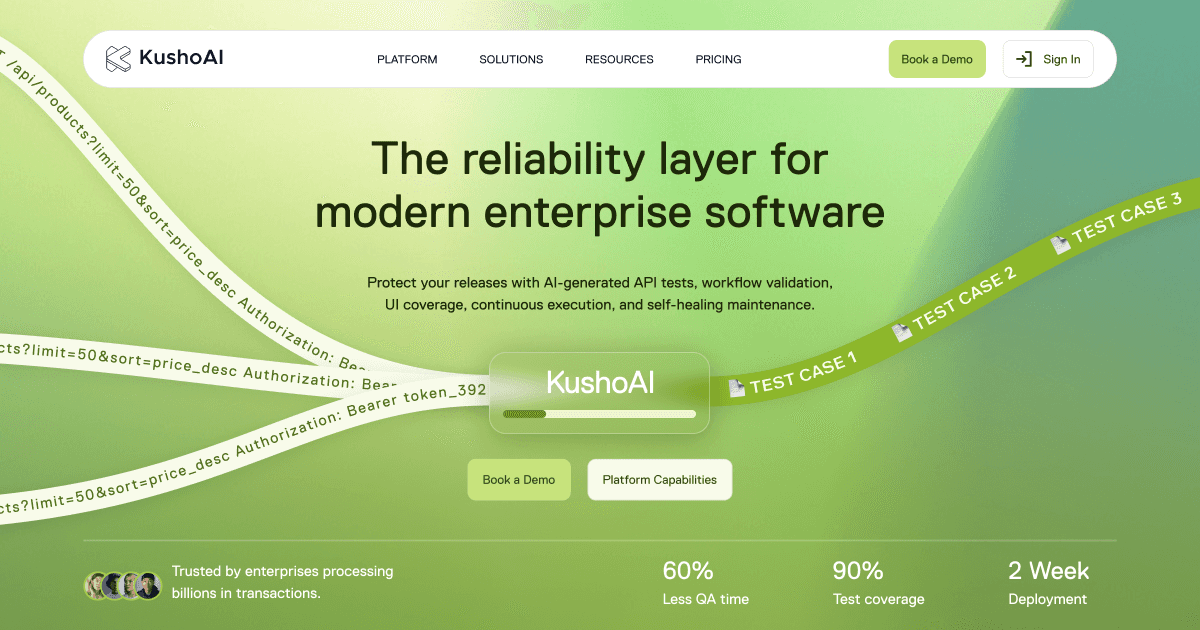
KushoAI Full homepage screenshot

At a glance

Category
Artificial Intelligence
Language
English
Paid-content signal
Paid contentObserved
Registered
2022
Hosting
Amazon.com, Inc.Inferred
HTTPS certificate trusted
PassedObserved
Last updated

Website review

This review may include AI-generated content and is not individually verified. Domain, certificate and other facts come from the observed data on this page.

What is KushoAI?

KushoAI is an AI-native reliability platform for software maintenance, built around autonomous agents that run inside your CI/CD pipeline to handle API testing, self-healing test upkeep, security scanning, and monitoring. Its stated goal is to catch failures and security gaps before they reach production, so teams spend less time fixing and more time building. The platform is organized as a staged adoption path: start with API contract testing, then add continuous security scanning, broaden to end-to-end coverage across services, databases, and UI layers, and finally layer on self-healing infrastructure and release intelligence.

Where it fits in practice

  • Contract testing as the entry point. You point KushoAI at an OpenAPI spec or Postman collection, and it generates a test suite automatically, then checks each change against the contract to catch breaking changes early. This suits teams with well-documented APIs and frequent releases.
  • Security scanning in the pipeline. It scans live APIs for vulnerabilities, misconfigurations, and access-control risks, running automatically in CI rather than as a periodic audit.
  • Coverage beyond endpoints. It validates full workflows across services, databases, and UI layers, aiming at real user journeys instead of isolated endpoint checks.

Who benefits most

Teams with API-heavy architectures and existing CI/CD discipline get the clearest value, because the agents are designed to live in that pipeline. Organizations that already maintain OpenAPI or Postman artifacts can onboard with less setup. Teams without documented API contracts would need to invest in that first.

Trade-offs to weigh

A staged rollout keeps scope manageable, but it also means the full value depends on adopting several layers, not just one. Automated test generation and self-healing reduce manual QA effort, yet generated suites still need review to confirm they test what matters to your business. Security scanning inside CI is continuous, but it complements rather than replaces deeper manual security review.

Next step

If you maintain OpenAPI or Postman specs, start by mapping one high-traffic API to a contract-testing pilot and measure how many breaking changes it catches before release. Compare that against your current QA cycle time to judge whether the staged expansion is worth it. You can review details at KushoAI.

How does KushoAI generate API tests from an OpenAPI spec or Postman collection?

KushoAI generates API tests by reading your existing API definitions—either an OpenAPI spec or a Postman collection—and automatically producing a test suite from them. Rather than requiring you to hand-write cases, you point the tool at the spec or collection, and it derives tests that check each change against that contract. The practical effect is contract validation: when an API change would break the agreed interface, the generated tests catch it before it moves forward, shifting the team from reactive fixes to controlled validation. This is described on KushoAI as the entry point ("Start with KushoAI: API Contract Testing") where most teams begin.

What that means in practice

  • Input: your OpenAPI spec or Postman collection, which already encodes endpoints, parameters, and expected shapes.
  • Output: a generated suite that validates requests and responses against that contract.
  • Where it runs: inside your CI/CD, so breaking changes surface on each change rather than after release.

A concrete scenario

A backend team adds a required field to a POST /orders response and renames a query parameter. If the OpenAPI spec is the source of truth, pointing KushoAI at it regenerates tests that assert the new contract. Any service still calling the old parameter fails in CI, and the mismatch is visible before deployment instead of in production.

Decision criteria

Choose spec-driven generation when your OpenAPI or Postman definitions are current and treated as the contract; the tests are only as good as the definitions they read. If your specs lag behind the real API, refresh them first, or the generated suite will validate a stale contract. For teams already running Postman collections, that path lowers setup effort since no separate spec maintenance is needed.

As a next step, audit whether your spec or collection is the authoritative contract, then run generation against a single high-traffic service to confirm the tests match real behavior before rolling out across the stack.

How does KushoAI's continuous security scanning fit into an existing CI/CD pipeline?

KushoAI's continuous security scanning is designed to run automatically inside your CI pipeline, so API security checks happen on every change rather than in periodic audits. According to the product page, once your APIs are live, KushoAI scans them for vulnerabilities, misconfigurations and access-control risks "based on how they are actually built and secured," and security testing runs automatically as part of CI. The page positions this as step two in an adoption path: start with API contract testing against your OpenAPI spec or Postman collection, then add continuous security scanning as a "force multiplier."

What that means in practice

For a team already running CI, the practical fit is a gate rather than a separate tool: contract tests catch breaking changes before they move forward, and security scans run alongside them on the same pipeline events. A concrete scenario: a backend team merges a change to an endpoint's authentication logic; the pipeline triggers both the contract check and the security scan, and access-control issues surface in the same build that would have caught a schema break. The page's stated outcomes—80% less QA time, 93%+ test coverage, under 30 days payback—come from KushoAI's own customer-base figures across 7M+ test executions, so treat them as vendor-reported rather than independently verified.

Trade-offs to weigh

  • Shift-left value vs. pipeline time: automatic scanning on every run adds build duration; teams with slow CI may want scans scoped to changed services first.
  • Context dependency: the page says scans are based on how APIs are actually built and secured, which suggests results improve with accurate specs and configuration—stale OpenAPI definitions will weaken both contract and security checks.
  • Scope: security scanning is one layer; the page notes API testing alone isn't enough and pairs it with end-to-end workflow coverage across services, databases and UI.

Next step: before adopting, map your current pipeline stages and identify where a contract-test gate and a security-scan stage would sit relative to deploy. If you want a comparison point for CI-native security tooling, look at Snyk or Semgrep; for API contract testing specifically, Schemathesis is worth reviewing alongside KushoAI's offering.

Can KushoAI test complete end-to-end user journeys across APIs, databases, and UI layers?

Yes. KushoAI's platform is described as validating complete workflows across services, databases and UI layers, so critical user journeys are tested end to end rather than as isolated endpoints. The page frames this as its "Comprehensive Coverage" step: API testing alone is treated as insufficient for enterprise-grade assurance, and the scope shifts from individual endpoints to real business flows.

What that means in practice

  • Starting point: teams typically begin with API contract testing, pointing KushoAI at an OpenAPI spec or Postman collection so a test suite is generated automatically and breaking changes are caught against the contract.
  • Layered expansion: once APIs are covered, continuous security scanning runs in the CI pipeline, and coverage extends to cross-service workflows involving databases and the UI.
  • Where it fits: the agents are positioned to live in CI/CD and handle testing, healing and monitoring continuously, so end-to-end checks run as part of the delivery pipeline rather than as a separate manual phase.

Who benefits most

A team shipping a multi-service product with a documented API surface is the natural fit: contract tests give fast, low-effort coverage, and the same platform can then exercise the full journey a customer takes through UI, API and data. The trade-off is that end-to-end coverage depends on how well those layers are reachable and described; a UI-heavy product with little API definition gets less from the contract-first starting point.

How to decide

Ask whether your critical journeys can be expressed as API calls plus data checks, or whether they depend heavily on browser behavior. For the former, end-to-end coverage here is a realistic target; for the latter, confirm UI-layer support against your actual flows before committing. A practical next step is to list your three most business-critical journeys and check each layer they touch against the platform's coverage claims. For pricing and plan limits, see KushoAI.

What does KushoAI's self-healing testing infrastructure do when a test breaks?

KushoAI describes its self-healing testing infrastructure as part of a layered reliability platform, but the page evidence does not spell out the exact mechanics of what happens when a single test breaks. What it does show is the surrounding intent: tests are generated from your API definitions (OpenAPI spec or Postman collection), every change is checked against the contract, and the platform is meant to keep testing running continuously in CI/CD rather than requiring manual repair. In practice, "self-healing" in this context usually means the system detects a broken or outdated test, works out whether the cause is a genuine defect or a change in the API/UI it was written against, and updates the test so it stays valid—then flags real regressions for you. Treat that as the general pattern for self-healing test tools, not a confirmed description of KushoAI's internals.

What to verify before relying on it

  • Failure classification: Ask a demo whether it distinguishes a real bug from a stale test, and how it reports each.
  • Change scope: Confirm whether healing covers API contract changes only, or also UI and database layers, since the page claims end-to-end workflow coverage.
  • Review step: Check whether healed tests need human approval before merging, which matters for audit and compliance.
  • CI fit: Confirm how it plugs into your existing pipeline and what happens when healing fails.

A concrete scenario

A team points KushoAI at their OpenAPI spec, and a developer renames a response field. A contract test breaks. The useful question for that team is whether the tool silently rewrites the assertion to match the new field (hiding a breaking change for downstream consumers) or flags it as a contract violation. That distinction decides whether self-healing saves time or masks risk.

As a next step, bring one recently broken test from your own suite to a demo and ask the team to walk through exactly how KushoAI would handle it. For broader context on API testing approaches, see Postman and OpenAPI Initiative.

How much does KushoAI cost and how quickly can a team see a return on investment?

KushoAI's page does not list specific prices; it points readers to a pricing page and a demo request for actual quotes. What it does state is a headline payback figure of under 30 days, alongside 80% less QA time and 93%+ test coverage, drawn from more than 7 million test executions across its customer base. Treat those numbers as vendor-reported outcomes for existing customers, not a guarantee for your team.

What drives cost and payback

Because the site gives no tiers or per-seat figures, the practical answer depends on your starting point:

  • API contract testing is the entry step: point the tool at your OpenAPI spec or Postman collection and it generates a test suite automatically. Teams with well-maintained specs will see value fastest.
  • CI/CD integration matters for payback. Savings come from catching breaking changes and security issues before production, so the return compounds with release frequency.
  • Scope expands from endpoint tests to full workflows across services, databases and UI layers. Broader coverage usually means more setup and a longer path to measurable savings.

A realistic scenario

A mid-sized team shipping API changes weekly spends hours per release on manual regression checks. If generated contract tests catch breaking changes in CI, the saved QA hours are the main return, and the 30-day figure becomes plausible. A team with unstable specs or infrequent releases should expect a slower payback and should validate with a pilot before committing.

Next step

Request a demo and ask for pricing tied to your API count and CI setup, plus a baseline of your current QA hours per release. Compare that baseline against the vendor's reported reductions to estimate your own payback window. You can also review the vendor's own materials at KushoAI.

Related questions

More questions →
What Is KushoAI's Self-Healing Testing Infrastructure?

KushoAI's self-healing testing infrastructure is a set of autonomous agents that run inside your CI/CD pipeline and continuously handle testing, repair, and monitoring. In practice, "self-healing" means the test suite is maintained by the system rather than by engineers manually updating broken tests after each code change. It is aimed at teams whose API and integration tests break often and consume QA time. The vendor presents outcomes of 80% less QA time, 93%+ test coverage, and a payback period under 30 days, drawn from 7Mn+ test executions across its customer base; treat these as vendor-reported figures to validate in your own environment.

How the self-healing loop works

The mechanism rests on a contract the tests are generated from, so healing has a reference point.

  1. Input: You point KushoAI at your OpenAPI spec or Postman collection. It reads your API definitions and generates a test suite automatically.
  2. Validation: On each change, KushoAI checks the implementation against the contract. Breaking changes are caught before they move forward, shifting the team from reactive fixes to controlled validation.
  3. Healing: Because tests are derived from the definition rather than hand-written, they stay aligned as the API evolves instead of failing on stale assertions.
  4. Continuous operation: The agents live in CI/CD, so testing and monitoring run on every pipeline execution rather than in periodic QA cycles.

A concrete example: a developer renames a response field in an endpoint. A hand-maintained suite would fail on that assertion and someone would file a ticket to fix the test. With contract-based generation, the change is checked against the spec, and the suite reflects the updated contract, so QA effort goes to real regressions rather than test upkeep.

What sits around the healing layer

Self-healing is one stage in a staged platform, and the surrounding stages are what make continuous operation practical:

Stage What it does Why it matters for healing
API Contract Testing Generates tests from OpenAPI/Postman and checks every change against the contract Provides the reference the suite heals toward
Continuous Security Scanning Scans live APIs for vulnerabilities, misconfigurations, and access control risks, running automatically in the CI pipeline Keeps protection continuous rather than periodic
Comprehensive Coverage Validates complete workflows across services, databases, and UI layers, testing critical user journeys end to end Moves testing from single endpoints to real business flows
Self-Healing Testing Infrastructure Autonomous agents maintain and repair tests continuously Removes manual test maintenance
Release Intelligence Aggregates signals to inform release decisions Turns test and security output into release guidance

The vendor describes the sequence as starting with API contract testing, then adding security scanning, enabling full coverage, and activating self-healing.

When it fits and when it doesn't

Self-healing infrastructure pays off most when:

  • Your APIs are defined in OpenAPI or Postman collections, since generation depends on those artifacts.
  • Your pipeline already runs in CI/CD and you want testing embedded there.
  • Test maintenance is a recurring drain, with suites breaking on every schema or field change.
  • You need end-to-end coverage across services, databases, and UI, not just endpoint checks.

It is a weaker fit if your APIs lack machine-readable definitions, if you need only occasional pre-release testing rather than continuous monitoring, or if you cannot grant agents access to your CI/CD pipeline. Pricing and plan details are listed on KushoAI's pricing page; the available material does not state costs or access terms, so confirm those directly before committing.

How to evaluate it

Start with the contract testing stage on one well-defined API and measure two things over a few release cycles: how often tests break for reasons unrelated to real defects, and how much QA time goes to maintenance versus new coverage. If maintenance drops and coverage holds, expand to security scanning and end-to-end workflows. The vendor's headline numbers are a useful benchmark, but your baseline is the number that decides whether the platform earns its place in the pipeline.

How KushoAI Provides Comprehensive Coverage Across the Stack

KushoAI extends testing beyond individual API endpoints by validating complete workflows that span services, databases, and UI layers. According to KushoAI's own platform description, this "Comprehensive Coverage" stage is the third step in its adoption path, positioned after API contract testing and continuous security scanning. The practical effect is that critical user journeys are tested end to end, so a failure in one layer that only surfaces in a downstream service or the UI is caught as part of a real business flow rather than as an isolated endpoint check.

What "comprehensive coverage" means in practice

Most API testing tools verify a single request and response against a contract. KushoAI's stated approach shifts the unit of testing from the endpoint to the workflow: a sequence of calls across multiple services, with database state and UI behavior included in the same validation.

Dimension Endpoint-level testing KushoAI comprehensive coverage (as described)
Unit under test One API request/response A complete user journey across services
Layers touched API only Services, databases, and UI layers
Failure detection Contract breaks on a single endpoint Breaks that appear only mid-flow or downstream
Business relevance Low—technical contract High—mirrors real user behavior

The distinction matters most when a bug is invisible at the endpoint level. For example, an order-creation endpoint may return 200 correctly while a downstream inventory service writes an inconsistent database record, and the UI shows a confirmation that later fails. Endpoint tests pass; the workflow test fails.

How the layers connect

KushoAI's platform page describes the coverage stage as validating "complete workflows across services, databases, and UI layers," with critical user journeys tested end to end. In operational terms, that means a single test case can:

  1. Drive the UI layer to trigger a user action.
  2. Follow the resulting service calls across API boundaries.
  3. Verify database state after the flow completes.

This is the mechanism behind the shift "from individual endpoints to real business flows." It also explains why KushoAI positions comprehensive coverage as a later stage: it builds on the API definitions already ingested during contract testing, so the workflow tests reuse the same API understanding rather than requiring a separate model of the system.

Where it fits in the adoption sequence

KushoAI presents the platform as a staged path, and coverage is step three:

  • Start: API contract testing—point KushoAI at an OpenAPI spec or Postman collection and it generates the test suite automatically.
  • Add: continuous security scanning in the CI pipeline.
  • Enable: comprehensive coverage across services, databases, and UI.
  • Activate: self-healing testing infrastructure.
  • Achieve: release intelligence.

Teams already running contract tests therefore have the prerequisite in place; the coverage stage extends the same test assets into multi-layer flows. Teams starting from scratch should expect to complete the contract-testing step first, since the workflow tests depend on the API definitions established there.

Reported outcomes and how to read them

KushoAI's site cites figures drawn from 7M+ test executions across its customer base: 80% less QA time, 93%+ test coverage, and a payback period under 30 days. These are vendor-reported aggregates, not guarantees for a specific codebase. Treat them as directional signals of what the vendor claims comprehensive coverage delivers, and validate against your own critical journeys—particularly flows that cross service boundaries, since those are where endpoint-only testing tends to miss failures.

Deciding whether this fits your team

Comprehensive coverage is most valuable when:

  • Your critical user journeys span multiple services, so endpoint tests cannot catch mid-flow failures.
  • You already maintain an OpenAPI spec or Postman collection that KushoAI can consume.
  • You want database and UI state included in the same validation as API behavior.

It is less of a fit if your system is a single service with simple request/response behavior, where endpoint-level contract testing already covers the risk. In that case, the earlier stages of KushoAI's path—contract testing and security scanning—address the bulk of the need, and the coverage stage adds less marginal value.

To evaluate it concretely, identify two or three business flows that cross service boundaries and currently lack end-to-end tests; those are the flows where the coverage stage's value will be easiest to verify. KushoAI offers a demo booking and a pricing page for teams that want to confirm fit before committing.

What Is KushoAI and What Does It Do?

KushoAI is an AI-native reliability layer for software maintenance. It runs autonomous agents inside your CI/CD pipeline to generate and run API tests, scan for security issues, validate end-to-end workflows, and support self-healing test infrastructure — so failures and security gaps are caught before production. It fits teams that already define their APIs (for example with an OpenAPI spec or Postman collection) and want continuous, automated validation rather than periodic manual QA.

What KushoAI actually does

KushoAI is organized as a staged platform, and the vendor's own page presents it as a sequence you adopt step by step:

Stage What it does Input / trigger
API Contract Testing Generates a test suite and checks every API change against the contract Your OpenAPI spec or Postman collection
Continuous Security Scanning Scans live APIs for vulnerabilities, misconfigurations, and access control risks; runs in the CI pipeline APIs as actually built and secured
Comprehensive Coverage Validates complete workflows across services, databases, and UI layers Critical user journeys
Self-Healing Testing Infrastructure Keeps test infrastructure running with less manual repair Existing test setup
Release Intelligence Surfaces release-level insight from test activity Accumulated test data

The core mechanism is contract-based: KushoAI reads your API definitions, generates tests from them, and flags breaking changes before they move forward. That shifts the team from reactive fixing to controlled validation.

Who it is for

KushoAI is a reasonable fit if:

  • Your APIs are already described in an OpenAPI spec or Postman collection — this is the entry point for the first stage.
  • You want testing and security checks to run automatically on every change in CI, not as a periodic audit.
  • You need coverage beyond single endpoints, including cross-service and UI workflows.
  • You are willing to adopt the platform incrementally, starting with contract testing and adding capabilities.

It is a weaker fit if you have no machine-readable API definitions, or if you only need one-off manual testing rather than continuous pipeline-integrated checks.

What the vendor claims

KushoAI's site reports, based on 7M+ test executions across its customer base: 80% less QA time, 93%+ test coverage, and a payback period under 30 days. It also states 5,200+ organizations use it. These are vendor-published figures from its customer base, not independently verified benchmarks — treat them as directional and validate against your own stack.

How to evaluate it

  1. Check your prerequisites. Confirm you have an OpenAPI spec or Postman collection that reflects your current API surface. Without it, the contract-testing entry point has nothing to read.
  2. Start with contract testing. Point KushoAI at your spec, let it generate the suite, and observe whether it catches a breaking change you introduce deliberately in a staging branch.
  3. Verify CI integration. Confirm security scanning runs inside your existing pipeline rather than as a separate manual step.
  4. Test coverage claims against your journeys. Pick two or three critical user flows that span services and check whether end-to-end validation covers them.
  5. Review pricing and access. The site links to a pricing page and offers a demo; actual plan details and any login requirements are not specified in the available material, so confirm them directly before committing.

The main thing to watch: the value depends on how completely your APIs are defined and how much of your testing already lives in CI. Teams with mature specs and pipeline discipline will see the staged model fit quickly; teams without them should expect setup work before the first stage delivers anything.

How KushoAI's API Contract Testing Works

KushoAI's API contract testing starts from API definitions you already maintain: you point it at an OpenAPI spec or a Postman collection, and it generates a test suite automatically. From then on, it checks each change against that contract so breaking changes are caught before they move forward. This fits teams that already have a spec or collection and want validation to run continuously in CI/CD rather than through manual regression passes.

What you need before starting

  • An OpenAPI specification or a Postman collection that describes your API.
  • The API definitions kept reasonably current — the contract is the reference KushoAI tests against, so stale definitions weaken the check.
  • A CI/CD pipeline if you want the checks to run on every change rather than on demand.

The workflow, step by step

1. Connect your API definition

Point KushoAI at your OpenAPI spec or Postman collection. Per KushoAI's own description of the entry point, this is where most teams begin: the platform reads your API definitions and uses them as the source of truth.

Expected result: KushoAI has a machine-readable contract to test against, with no hand-written test cases required at this stage.

2. Let the test suite generate

KushoAI generates your test suite automatically from those definitions. Instead of writing endpoint tests by hand, you get a suite derived from the contract itself.

Expected result: A test suite that reflects the endpoints, schemas, and expected behavior declared in your spec or collection.

3. Run checks against every change

As your API changes, KushoAI checks each change against the contract. Breaking changes — responses or behavior that diverge from what the definition promises — are flagged before they progress further.

Expected result: You move from reactive fixing after release to controlled validation before release. The practical signal to watch is contract drift: a change that passes code review but violates the spec should surface here.

4. Put it in your pipeline

KushoAI positions its agents as living in your CI/CD, handling testing, healing, and monitoring continuously. Contract testing is the first layer; security scanning, broader coverage across services, databases, and UI, self-healing test infrastructure, and release intelligence are presented as subsequent layers you can add.

Expected result: Validation runs on every change automatically, not as a periodic manual exercise.

How to verify it's working

  • Introduce a deliberate breaking change (for example, remove or rename a field the spec declares) and confirm the check flags it before merge.
  • Confirm the suite covers the endpoints in your definition rather than a subset.
  • Check that runs are triggered by pipeline events, not only manual starts.

Common sticking points

  • Spec drift: if the OpenAPI file or Postman collection lags behind the real API, tests validate the wrong contract. Treat the definition as a maintained artifact.
  • Coverage expectations: contract testing validates conformance to the definition. It is not the same as end-to-end workflow testing, which KushoAI describes as a separate layer covering services, databases, and UI.
  • Scope of the first step: the entry point is API contract testing specifically; security scanning and the other layers are additions, so plan adoption in that order if you want the documented path.

Where this fits

KushoAI describes itself as a reliability layer for modern software, with agents in CI/CD handling testing, healing, and monitoring. Contract testing is the starting point because it converts an existing spec into automated validation with minimal setup. Teams without a reliable OpenAPI spec or Postman collection should establish one first; teams that have one can begin with contract checks and expand into security scanning and broader coverage as needed. Pricing and plan details are listed on KushoAI's pricing page rather than assumed here.

What KushoAI's Continuous Security Scanning Checks For

KushoAI's continuous security scanning examines your live APIs for vulnerabilities, misconfigurations, and access control risks, using how your APIs are actually built and secured as the basis for its checks. It runs automatically inside your CI pipeline, so security testing happens continuously with each change rather than as a periodic audit. It is designed for teams that already have APIs in production or approaching release and want security validation tied to their delivery workflow.

The Three Check Categories

KushoAI describes its security scanning as covering three areas:

Check category What it targets
Vulnerabilities Weaknesses in the API itself that could be exploited
Misconfigurations Settings or setup that leave the API exposed or improperly secured
Access control risks Problems with who can reach what, based on the API's actual security model

The distinguishing detail is the phrase "based on how they are actually built and secured." The scan is not a generic checklist applied blindly; it works from your API's real definitions and security setup. That matters because a misconfiguration only counts as one relative to intended behavior — the same setting can be correct in one architecture and risky in another.

How It Fits Into the CI Pipeline

Security scanning is the second step in KushoAI's platform sequence, after API contract testing:

  1. Start with API contract testing. You point KushoAI at your OpenAPI spec or Postman collection, and it generates a test suite that checks every change against the contract.
  2. Add continuous security scanning. Once APIs are live, KushoAI scans them automatically as part of the CI pipeline.

The practical consequence of running in CI is timing: findings surface during development and delivery, before code reaches production, rather than in a separate security review cycle. KushoAI frames this as protection becoming "continuous, not periodic."

What It Does Not Replace

The page evidence describes scanning as automated and CI-integrated but does not detail rule sets, severity scoring, remediation guidance, or compliance mappings. If you need those specifics — for example, to satisfy an audit requirement — treat them as questions for a demo rather than assumptions. The scanning also sits alongside, not instead of, the broader coverage step, where KushoAI validates complete workflows across services, databases, and UI layers.

Who This Fits

Continuous security scanning in KushoAI is a reasonable fit if:

  • Your APIs are defined in OpenAPI or Postman, since contract testing is the entry point.
  • You want security checks to run on every pipeline change rather than on a scheduled cadence.
  • You are already using or planning to use KushoAI for API testing and want security in the same workflow.

It is a weaker fit if you need a standalone security product with published rule coverage, or if your APIs lack machine-readable definitions. Pricing and plan details are not specified in the available material; check the pricing page or book a demo for current terms.

Website Overview

An active inbound-mail setup with incomplete authentication may leave the domain more open to impersonation. Provider hosting alone does not close that gap.

Domain and Registration

Transfer-protection status is present, helping reduce the risk of unauthorized domain transfers. The domain has about 3 years of registration history; its current configuration provides more context than age alone. The registrar is NameCheap, Inc., a widely used domain service provider. Registration contact information is publicly available through RDAP. The domain uses the common .ai extension, which is not an independent safety signal.

DNS and Email

The observed email authentication setup is incomplete: DMARC is missing. Nameservers are provided by Cloudflare, indicating managed DNS hosting. MX records point to the Google Workspace email service. No CNAME was found; the observed records resolve directly to addresses. TXT records include verification markers for Google. Such markers may also remain after a service stops being used.

TLS and Certificates

The public key uses EC with 256 bits. The server supplied a complete certificate chain. No organization name is present in the certificate; the available fields are consistent with domain validation. The certificate was issued by Let's Encrypt, commonly associated with automated certificate services. The certificate's total validity is about 89 days, consistent with a short renewal cycle.

HTTP and Browser Security

The response lacks these common security headers: CSP, Referrer-Policy, Permissions-Policy, clickjacking protection. No X-Powered-By header was found, reducing one common source of backend fingerprinting information. No obvious internal addresses or debug information were found in the headers. The Server header contains the custom value Framer/24ab00f. No explicit CDN or WAF marker was found in the response headers.

Technology Stack Analysis

The public page identifies Framer 121674c, Google Analytics, Intercom without precise versions, leaving fewer clues for version-specific scanning.

Search and Social Sharing

The meta description has 161 characters and may be shortened in search results. The Generator tag identifies Framer 121674c, making the publishing system easier to fingerprint. Twitter Card metadata is configured. The title has 7 characters, within a common display range. A viewport declaration is present, providing a basis for mobile layout.

Hosting and Email

DNSCloudflare
HostingAmazon.com, Inc.
EmailGoogle Workspace
Approximate IP geolocation (inferred; a CDN or proxy may differ from the origin server) The Netherlands flagAmsterdam, North Holland, The Netherlands Inferred 31.43.160.6
Registration details

RDAP / WHOIS

RegistrarNameCheap, Inc.
Registered2022-11-03
Expires2028-11-03
Domain statusclient transfer prohibited
Nameserverselaine.ns.cloudflare.com、josh.ns.cloudflare.com
DNSSECunsigned

DNS records

DNS

TypeNameValueTTLPriority
Akusho.ai31.43.160.6300—
Akusho.ai31.43.161.6300—
MXkusho.aiaspmx.l.google.com36001
MXkusho.aialt1.aspmx.l.google.com36005
MXkusho.aialt2.aspmx.l.google.com36005
MXkusho.aialt3.aspmx.l.google.com360010
MXkusho.aialt4.aspmx.l.google.com360010
NSkusho.aielaine.ns.cloudflare.com86400—
NSkusho.aijosh.ns.cloudflare.com86400—
TXTkusho.aiahrefs-site-verification_cb91389739d53f1b3d72baa091fa508cda37028da49a220276df08894ec8d079300—
TXTkusho.aigoogle-site-verification=JYwF-QS9wFKBdiGltmZT3awTluetNFv34lhLEeoxdtM300—
TXTkusho.ailinkedin-site-verification=f00fa091-bea3-41a4-833d-08f77d436fbe300—
TXTkusho.aiv=spf1 include:_spf.google.com -all300—

TLS and certificates

TLS / SSL

AssessmentNormal configuration
Supported protocolsTLSv1.2、TLSv1.3
Negotiated protocolTLSv1.3
Certificate subjectkusho.ai
IssuerLet's Encrypt
Valid until2027-01-12T13:18 · Remaining when checked: 86 days
Verification detailsCertificate trust: Passed · Hostname match: Passed

HTTP response headers

HTTP

HeaderValue
content-typetext/html
cache-controlpublic, max-age=0, must-revalidate
serverFramer/24ab00f
strict-transport-securitymax-age=31536000
x-content-type-optionsnosniff

Identified technologies

Framer 121674cGoogle AnalyticsIntercom

Pages, Search and Sharing

Meta descriptionKushoAI is AI-native infrastructure for software maintenance. Autonomous agents that live in your CI/CD and handle testing, healing, and monitoring continuously.
Canonical URLhttps://kusho.ai/
LanguageEnglish (default)
Twitter Cardsummary_large_image
All bots 1 allowed · 0 disallowed
  • Allow/

User reviews (0)

  • No reviews yet.