
 ramenclub.com
No paid content found
ramenclub.com
No paid content found
Categories: Productivity
Join 400+ bootstrapped SaaS founders for Slack accountability, weekly events, mentors, partner discounts, and support to reach ramen profitability.
 Visit website
 Updated: 2026-09-30 06:56
 Language: English (default)
 Access: Normal
 Profile views 3
 Outbound visits 0
Related questions
More questions →What Is Ramen Club? A Community for Bootstrapped SaaS Founders
Ramen Club is a paid membership community for bootstrapped SaaS founders, built around a Slack group of 400+ members. It combines peer help, weekly events, in-house mentors, and discounts on 500+ tools, with the stated goal of helping founders reach "ramen profitability" and grow beyond it. It suits founders who are building without outside funding and want fast answers, accountability, and a network of people at a similar stage. It is not a course, an accelerator, or an investor introduction service.
What you actually get as a member
The membership is organised around four things: people, events, mentors, and tool savings.
- A Slack community of 400+ founders. The pitch is answers in hours rather than days — you ask a question and get responses from people who have shipped, not from a support queue.
- Weekly events. These include demo days, founder interviews, expert workshops, AMAs, and virtual coworking. Sessions are recorded, so you can catch a replay if you miss one. Past interview guests cited by the site include founders from Fathom Analytics, MentorCruise, and FindyMail.
- In-house mentors. Mentors cover areas such as growth, sales, AI, validation, user research, and legal. The model is "tag a mentor, get feedback" — no scheduling required.
- Tool discounts. Discounts on 500+ tools, with Stripe, AWS, Notion, and Google Cloud named as examples.
- Member introductions. Fortnightly intros to other members, plus a searchable directory, aimed at finding collaborators or simply people at your stage.
Who it is for — and who it is not for
Ramen Club is aimed at founders who are bootstrapping: funding the business from revenue or savings rather than venture capital. The framing throughout is about shipping, accountability, and reaching ramen profitability — the point where revenue covers your basic living costs.
It is likely a good fit if you recognise this situation:
- You are building alone and want a group to think out loud with.
- You want feedback on a decision within hours, not at your next launch.
- You want to learn from founders who have already done the thing you are attempting.
- You would use the tool discounts enough to offset the subscription.
It is probably not the right fit if you are looking for structured curriculum, hands-on implementation work, or investor connections. The value here is the network and the cadence of events, which means it depends on you actually showing up and participating.
Pricing and commitment
The site lists two plans, and states that both include everything described above.
| Plan | Price | Notes |
|---|---|---|
| Monthly | £25/month | Subject to applicable taxes |
A 30-day money-back guarantee applies: if it is not for you, you DM Charlie and get a full refund, with no questions asked. Cancellation is stated as available anytime.
One thing worth separating out: Ramen Space, the coworking space in London, is a separate membership. It starts from £30/day (ex VAT) and is not included in the online community plan. If you are not based in London, this part is irrelevant to you.
How to decide whether to join
Because the guarantee is 30 days and the monthly commitment is low, the practical test is whether the community is active and useful to your specific problem. A reasonable approach:
- Join on the monthly plan rather than committing further out.
- In the first week, ask one real question in Slack and see what comes back — and how fast.
- Attend at least one workshop or demo day, and check whether the recorded library covers your stage.
- Check whether the tool discounts apply to services you already pay for.
- If it is not working, use the 30-day refund window rather than letting the subscription drift.
The main risk is not the price — it is paying for a community you never open. The value scales with participation, so judge it on whether you would actually use it weekly.
What Is SaaS? How Software-as-a-Service Works and When to Use It
SaaS (Software-as-a-Service) is a delivery model in which a vendor hosts an application and customers access it over the internet, typically paying a recurring subscription fee rather than buying a perpetual license. It fits most organizations that want faster deployment, lower upfront cost, and automatic updates — but it is a weaker fit when you need deep customization, strict data residency control, or the ability to run fully offline.
The core SaaS model
In a SaaS arrangement, three things move from the customer to the vendor:
- Infrastructure — servers, storage, and networking are owned and operated by the provider.
- Maintenance — patching, upgrades, and uptime are the provider's responsibility.
- Access — users reach the software through a browser or thin client, usually with per-user or usage-based billing.
You consume the software as a service rather than owning a copy of it. That single shift is what drives most of the benefits and most of the trade-offs below.
SaaS vs. on-premise, self-hosted, IaaS, and PaaS
These models are often confused because they all involve "the cloud." The difference is how much the vendor manages.
| Model | Who manages the app? | Who manages the infrastructure? | Typical customer control |
|---|---|---|---|
| SaaS | Vendor | Vendor | Configuration and data only |
| PaaS | Customer (builds/deploys) | Vendor | App code, runtime settings |
| IaaS | Customer | Customer (on rented VMs) | OS, middleware, app, data |
| On-premise | Customer | Customer (own hardware) | Everything |
| Self-hosted | Customer | Customer (own or rented) | Everything, but you install the vendor's software yourself |
A quick way to place them: with IaaS you rent the raw building blocks; with PaaS you rent a ready workbench to build on; with SaaS you rent the finished product. On-premise and self-hosted mean you run and maintain the software on infrastructure you control.
Main benefits and trade-offs
Benefits
- Lower upfront cost — no hardware purchase or large license fee; spend shifts to an operating expense.
- Faster setup — provisioning is usually measured in hours or days, not procurement cycles.
- Automatic updates — the vendor ships fixes and new features without a customer-side upgrade project.
- Elastic scalability — capacity can often be adjusted up or down as demand changes.
- Anywhere access — a browser and a connection are usually enough, which supports distributed teams.
Trade-offs
- Less data control — your data lives in the vendor's environment, subject to their architecture and regions.
- Limited customization — you generally configure within the vendor's boundaries rather than modifying the core.
- Vendor lock-in — migrating away can be costly if data export and integration are not well supported.
- Ongoing cost — subscriptions never "finish paying off" the way a perpetual license can.
- Dependency on connectivity and uptime — if the service is down or unreachable, work may stop.
Typical use cases and examples
SaaS is the default choice for horizontal needs like email, CRM, project management, and HR. It is also increasingly common as vertical SaaS — software built for one industry's specific workflows and compliance requirements.
Regulated industries are a useful illustration. Trust, corporate, and fund services providers handle sensitive client data and face audit and reporting obligations, so they tend to weigh data control and compliance heavily. Quantios, for example, describes itself as an AI-native SaaS platform for global corporate, trust, and fund services providers, positioned to help them reduce risk, boost efficiency, and scale. That is the vertical-SaaS pattern: the delivery model is standard SaaS, but the feature set and compliance posture are tailored to one sector.
How to evaluate a SaaS option
Use the same criteria regardless of vendor, and get specifics rather than assurances:
- Security — encryption in transit and at rest, access controls, and how incidents are handled.
- Compliance — which standards and regulations the vendor supports, and whether they match your obligations.
- Integration — APIs, prebuilt connectors, and how easily it fits your existing stack.
- Pricing model — per user, per usage, tiered, or a mix; understand what triggers a cost increase.
- Data portability and exit — can you export your data in a usable format, and what happens to it at contract end?
- Service levels — uptime commitments, support channels, and response times.
When SaaS is the right fit — and when it isn't
Choose SaaS when you want speed, predictable operating costs, and low maintenance overhead, and your data can reasonably live in a vendor's environment.
Reconsider when you need deep customization, must keep data strictly on your own infrastructure, operate in low-connectivity settings, or face regulations that rule out third-party hosting. In those cases, self-hosted or on-premise may be the better fit — or a SaaS vendor with strong regional and compliance guarantees.
What Is Life Like Before vs After Joining Ramen Club?
Joining Ramen Club mainly changes who you build alongside, not what you build. Before, you work alone and ship into silence; after, you get a Slack community of 400+ bootstrapped SaaS founders, fortnightly intros, demo days, mentors you can tag, and weekly events. The trade-off is a paid membership (from £25/month, with a 30-day money-back guarantee) and the effort of actually showing up. If you already have a founder network you lean on daily, the difference will be smaller.
Life before Ramen Club
The site frames the "before" state as building alone, and the pattern is familiar to most solo SaaS founders:
- Working alone, talking to no one all day — no one to sanity-check an idea against.
- Not knowing a single other person building SaaS — your friends and family can't relate to the problems you hit.
- Shipping into the void — feedback arrives only on launch day, if at all.
- Second-guessing every decision by yourself — pricing, positioning, whether to keep going.
- Learning from recycled Twitter threads — advice that's been passed around rather than earned.
- Motivation dying when things get hard — no external accountability to keep you shipping.
None of this is a product problem. It's a support-structure problem, which is what the community is positioned to fix.
Life after joining Ramen Club
The "after" column is concrete about what replaces each gap:
| Before | After |
|---|---|
| Working alone all day | 400+ founders in your corner, every day |
| No other SaaS founders in your life | Fortnightly intros & IRL events with founders at your stage |
| Feedback only on launch day | Demo days & Slack feedback in hours |
| Deciding everything alone | Mentors on tap: growth, sales, validation, legal & AI |
| Recycled Twitter advice | Weekly workshops from founders who've actually done it |
| Motivation dies when it gets hard | Accountability that keeps you shipping |
The mechanism behind most of these is the Slack community. You ask a question and get answers in hours rather than days, from people who have shipped. Mentors work the same way — you tag them for feedback on growth, sales, AI, validation or legal questions, with no scheduling required.
Weekly events add a rhythm: demo days, founder interviews, expert workshops and virtual coworking, all recorded so you can catch a replay if you miss one. Fortnightly intros and a searchable member directory handle the "meet people" side, and there's an in-person option if you're London-based.
What actually changes in practice
The shift is less about information and more about loop speed. Instead of sitting on a decision for a week, you post it and get a response the same day. Instead of launching to silence, you run it past demo day first. Instead of losing momentum in a quiet stretch, a recurring event or an intro gives you a reason to keep shipping.
That said, the value depends on participation. A community of 400+ founders only helps if you ask, attend and follow up. Members who lurk get far less out of it than members who post.
Cost and commitment
Both plans include everything above, and the monthly plan is £25/month, subject to applicable taxes. There's a 30-day money-back guarantee — if it's not for you, you DM Charlie and get a full refund, no questions asked. You can cancel anytime.
One thing to separate out: if you're in London, the Ramen Space coworking space is a separate membership, from £30/day (ex VAT). It isn't included in the community plan.
Who sees the biggest difference
The before/after gap is widest if you're a solo bootstrapped founder with no peer group — the "building alone, talking to no one" description matches your week. It's narrower if you already have founders you talk to regularly, or if you're mainly looking for tooling discounts rather than feedback and accountability.
If the "before" list reads like your last month, the 30-day guarantee makes it a low-risk way to test whether the "after" list holds up for you.
How much does Ramen Club cost and is there a guarantee?
Ramen Club's monthly membership is £25/month, subject to applicable taxes, and it comes with a 30-day money-back guarantee plus the ability to cancel anytime. That single plan includes everything the community offers — the 400+ founder Slack, weekly events, mentors and tool discounts — so there's no higher tier to weigh up. The guarantee is what makes it low-risk to test: if it isn't for you within 30 days, you get a full refund, and the site says you just DM Charlie with no questions asked.
What the £25/month covers
Because both plans include everything, the £25 monthly fee is the whole product, not a stripped-back entry level. As a member you get:
- The Slack community — 400+ bootstrapped SaaS founders, positioned around getting answers in hours rather than days.
- Weekly events — demo days, founder interviews, expert workshops, AMAs and virtual coworking. Sessions are recorded, so you can catch a replay if you miss one.
- In-house mentors — growth, sales, AI, validation, user research and legal. The model is "tag a mentor, get feedback" rather than booking a scheduled call.
- Partner discounts — on 500+ tools including Stripe, AWS, Notion and Google Cloud.
- Member intros and directory — fortnightly introductions to other members plus a searchable directory for finding collaborators.
For a solo founder, the tool discounts alone can offset a £25 monthly cost, but that depends entirely on which of those 500+ tools you already pay for. If you use none of them, value has to come from the community and events instead.
The guarantee and cancellation terms
The risk-free terms are stated plainly on the site:
| Term | Detail |
|---|---|
| Trial window | 30 days |
| Refund | Full refund if it's not for you |
| How to claim | DM Charlie |
| Conditions | "No questions asked" per the site |
| Cancellation | Cancel anytime |
Two practical points worth noting. First, the guarantee is described as a 30-day money-back guarantee, so the clock starts at sign-up — if you want to genuinely test it, join when you can actually attend a demo day or workshop inside that window. Second, the refund route is a direct message rather than a self-serve button, which is worth knowing if you prefer automated cancellation.
What isn't included: Ramen Space London
If you're in London, the coworking space, Ramen Space, is a separate membership starting from £30/day (ex VAT). It is not part of the £25/month community plan, so don't factor it into the membership cost unless you specifically want desk space.
Is it worth joining?
The honest answer depends on what you're missing:
- Worth trying if you're building bootstrapped SaaS alone, want feedback on decisions before you ship, and would use at least a few of the discounted tools. The 30-day guarantee means the downside is limited to your time.
- Less compelling if you already have a strong founder network, won't attend live events, and don't use any of the partner tools — in that case the £25/month buys you a Slack you may not open.
The site frames the goal as reaching "ramen profitability" and beyond, and the member quote it leads with — from Che, founder of Chargebackstop — claims it's "the one subscription you'll never cancel." Treat that as marketing rather than a guarantee of fit; the concrete, checkable facts are the £25/month price, the all-inclusive scope, the 30-day full refund and the anytime cancellation.
What Do You Get as a Ramen Club Member?
Ramen Club membership gives you access to a Slack community of 400+ bootstrapped SaaS founders, weekly live events (demo days, founder interviews, expert workshops and virtual coworking), in-house mentors across growth, sales, validation, legal and AI, and discounts on 500+ tools including Stripe, AWS, Notion and Google Cloud. Both plans include everything, and there's a 30-day money-back guarantee with cancel-anytime terms.
The core benefits at a glance
| Benefit | What it actually means |
|---|---|
| 400+ founder Slack community | Ask anything and get real help from people who've shipped, typically in hours rather than days |
| Weekly events | Demo days, expert workshops, AMAs and virtual coworking; all recorded so you can catch the replay |
| In-house mentors | Tag a mentor for feedback on growth, sales, AI, validation or legal — no scheduling required |
| Tool discounts | Savings on 500+ tools, including Stripe, AWS, Notion and Google Cloud |
| Founder matching | Fortnightly intros to other members plus a searchable directory for collaborators and friends |
| Risk-free trial | 30-day money-back guarantee; if it's not for you, DM Charlie and it's refunded, no questions asked |
Community and peer support
The Slack community is the centre of the membership. With 400+ founders active, the pitch is that you get answers in hours, not days — from people who have actually shipped products rather than recycled advice. You can ask anything, and the community also runs fortnightly introductions and a searchable member directory so you can find collaborators or peers at your stage.
Weekly events and recordings
Membership includes weekly events: demo days, founder interviews, expert workshops and virtual coworking. Interviews and AMAs feature founders of companies such as Fathom Analytics, MentorCruise and FindyMail. Every session is recorded, so missing one doesn't mean missing out — you can watch the replay.
Mentors on tap
Rather than booking sessions, you tag an in-house mentor in Slack and get expert feedback. Coverage spans growth, sales, AI, validation and legal. This is positioned as a way to avoid second-guessing decisions alone.
Tool discounts
Members get discounts on 500+ tools, with Stripe, AWS, Notion and Google Cloud named as examples. If you're already paying for several of these, the savings can offset part of the membership cost — though the exact discount per tool isn't specified on the page, so check the individual offers before assuming a specific saving.
Pricing and commitment
Both plans include everything above, and the page lists a monthly price of £25/month, subject to applicable taxes. A 30-day money-back guarantee applies, and you can cancel anytime.
One thing to note: Ramen Space, the London coworking space, is a separate membership starting from £30/day (ex VAT). It is not included in the standard Ramen Club membership.
Who it suits
Ramen Club fits bootstrapped SaaS founders who want fast peer answers, regular accountability and access to mentors without scheduling friction. If you're building alone, shipping into the void and relying on launch-day feedback, the community, demo days and Slack feedback loop are the parts most likely to change how you work. If you mainly want coworking space in London, that's a different membership to price separately.
Website Overview
An established domain and managed infrastructure suggest continuity of operations and may support dependable delivery, although neither guarantees service quality. Page metadata, canonical configuration and social previews work together to provide more consistent search and sharing presentation.
Domain and Registration
Registered in 2002, this domain has about 23 years of history. That suggests continuity, although ownership and purpose may have changed. Transfer-protection status is present, helping reduce the risk of unauthorized domain transfers. The registrar is Cloudflare, Inc., a widely used domain service provider. The domain uses the common .com extension, which is not an independent safety signal.
DNS and Email
Nameservers are provided by Cloudflare, indicating managed DNS hosting. MX records point to the Google Workspace email service. No CNAME was found; the observed records resolve directly to addresses. SPF and DMARC are configured. DKIM status is unknown. TXT records include verification markers for Google. Such markers may also remain after a service stops being used.
TLS and Certificates
The public key uses EC with 256 bits. The server supplied a complete certificate chain. No organization name is present in the certificate; the available fields are consistent with domain validation. The certificate was issued within the Google Trust Services cloud or CDN ecosystem. The certificate's total validity is about 90 days, consistent with a short renewal cycle.
HTTP and Browser Security
CORS permits any origin to read this response. This is common for public resources; sensitive responses need narrower handling. No X-Powered-By header was found, reducing one common source of backend fingerprinting information. All six checked browser-security headers are present. Their effectiveness still depends on the policy values and application behavior. The cf-ray response header indicates a CDN or caching proxy in the delivery path. No obvious internal addresses or debug information were found in the headers.
Technology Stack Analysis
The public page identifies Cloudflare without precise versions, leaving fewer clues for version-specific scanning.
Search and Social Sharing
Twitter Card metadata is configured. JSON-LD includes Organization data, helping describe the organization as an entity. The title has 52 characters, within a common display range. A meta description is present, with 147 characters. The observed directives allow indexing and link following.
 Hosting and Email
 Cloudflare
 Hosting
 Google Workspace
 Location
 unknown
104.26.0.160
Location
Location unknown
104.26.0.160
 Pages, Search and Sharing
| Meta description | Join 400+ bootstrapped SaaS founders for Slack accountability, weekly events, mentors, partner discounts, and support to reach ramen profitability. |
|---|---|
| Canonical URL | https://ramenclub.com/ |
| Language | English (default) |
| Twitter Card | summary_large_image |
Social Sharing Preview
12 fields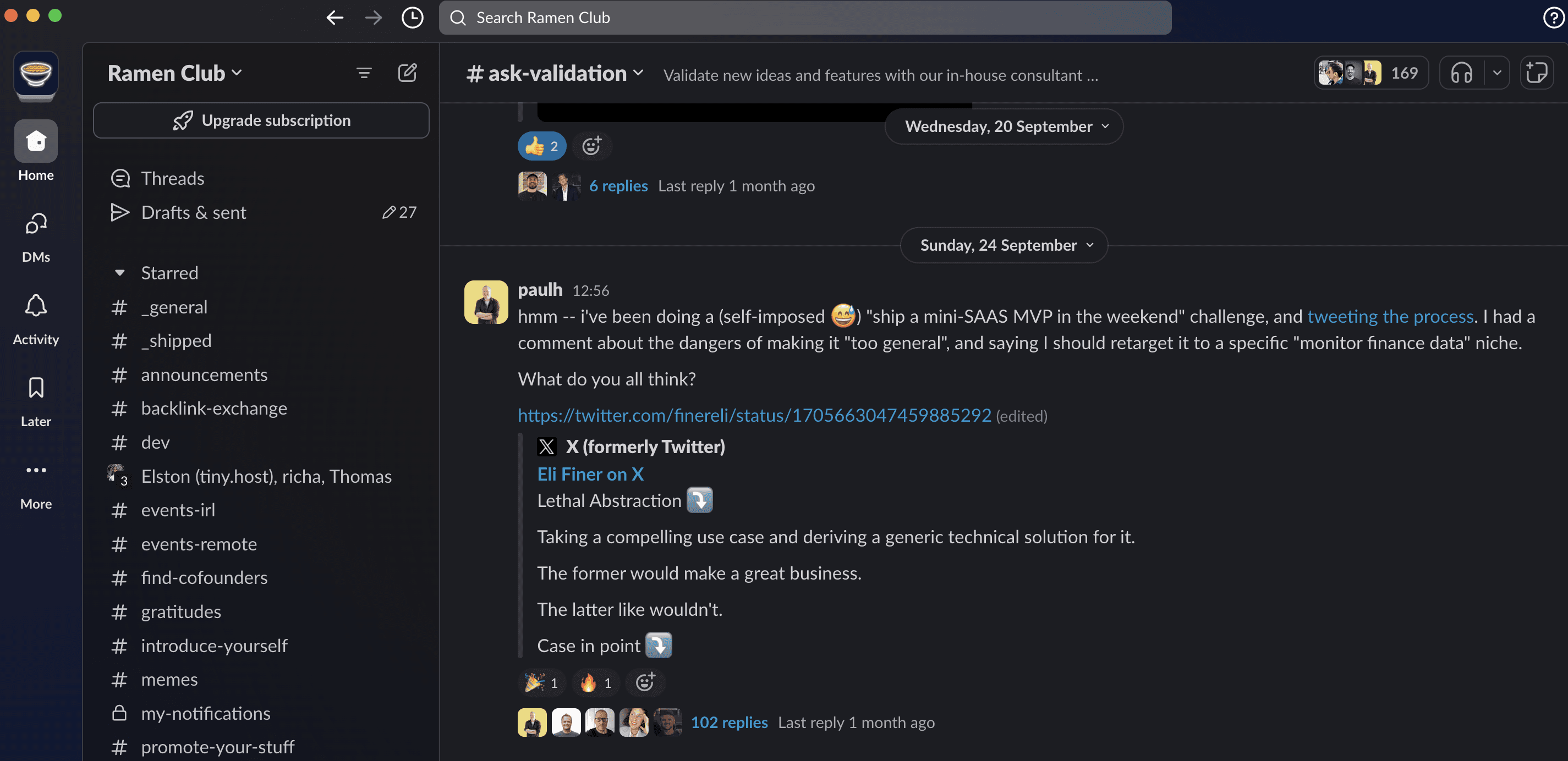

Sharing metadata
| og:url | https://ramenclub.com/ |
|---|---|
| og:type | website |
| og:image | https://ramenclub.com/_astro/nR9zuiHIp3EYtApi6NSw0V8n18.Bq3Xoc8U.png |
| og:title | Ramen Club | Founder Community for Bootstrapped SaaS |
| og:locale | en_GB |
| og:image:alt | Ramen Club founder community discussion in Slack |
| og:site_name | Ramen Club |
| og:description | Join 400+ bootstrapped SaaS founders for Slack accountability, weekly events, mentors, partner discounts, and support to reach ramen profitability. |
| twitter:card | summary_large_image |
| twitter:image | https://ramenclub.com/_astro/nR9zuiHIp3EYtApi6NSw0V8n18.Bq3Xoc8U.png |
| twitter:title | Ramen Club | Founder Community for Bootstrapped SaaS |
| twitter:description | Join 400+ bootstrapped SaaS founders for Slack accountability, weekly events, mentors, partner discounts, and support to reach ramen profitability. |
robots.txt (opens in a new tab)
1 rulesAll bots 1 allowed · 0 disallowed

 All bots

/
No matching rules.
Sitemaps
1 Registration details RDAP / WHOIS
| Registrar | Cloudflare, Inc. |
|---|---|
| Registered | 2002-12-28 |
| Expires | 2027-12-28 |
| Domain status | client transfer prohibited |
| Nameservers | fish.ns.cloudflare.com、woz.ns.cloudflare.com |
| DNSSEC | unsigned |
 DNS records
| Type | Name | Value | TTL | Priority |
|---|---|---|---|---|
| A | ramenclub.com | 104.26.0.160 | 300 | — |
| A | ramenclub.com | 104.26.1.160 | 300 | — |
| A | ramenclub.com | 172.67.68.20 | 300 | — |
| AAAA | ramenclub.com | 2606:4700:20::681a:1a0 | 300 | — |
| AAAA | ramenclub.com | 2606:4700:20::681a:a0 | 300 | — |
| AAAA | ramenclub.com | 2606:4700:20::ac43:4414 | 300 | — |
| MX | ramenclub.com | aspmx.l.google.com | 3600 | 1 |
| MX | ramenclub.com | alt1.aspmx.l.google.com | 3600 | 5 |
| MX | ramenclub.com | alt2.aspmx.l.google.com | 3600 | 5 |
| MX | ramenclub.com | alt3.aspmx.l.google.com | 3600 | 10 |
| MX | ramenclub.com | alt4.aspmx.l.google.com | 3600 | 10 |
| NS | ramenclub.com | fish.ns.cloudflare.com | 86400 | — |
| NS | ramenclub.com | woz.ns.cloudflare.com | 86400 | — |
| TXT | ramenclub.com | google-site-verification=w6eRfY1PzOXwzr1VprFcGSagRCkinR5SJRdwRjhW-bA | 3600 | — |
| TXT | ramenclub.com | v=spf1 include:_spf.google.com ~all | 3600 | — |
| DMARC | _dmarc.ramenclub.com | v=DMARC1; p=none; | 3600 | — |
 TLS and certificates
| Assessment | Normal configuration |
|---|---|
| Supported protocols | TLSv1.2、TLSv1.3 |
| Negotiated protocol | TLSv1.3 |
| Certificate subject | ramenclub.com |
| Issuer | Google Trust Services |
| Valid until | 2026-12-14T08:29 · Remaining when checked: 75 days |
| Verification details | Certificate trust: Passed · Hostname match: Passed |
 HTTP response headers
| Header | Value |
|---|---|
| content-type | text/html; charset=utf-8 |
| cache-control | public, max-age=0, must-revalidate |
| server | cloudflare |
| strict-transport-security | max-age=31536000; includeSubDomains; preload |
| content-security-policy | default-src 'self'; base-uri 'self'; object-src 'none'; frame-ancestors 'self'; img-src 'self' data: https:; font-src 'self' data:; style-src 'self' 'unsafe-inline'; script-src 'self' https://www.googletagmanager.com https://www.google-analytics.com https://googleads.g.doubleclick.net https://www.googleadservices.com https://connect.facebook.net https://cdn.usefathom.com https://ingest.promptwatch.com https://tally.so https://*.tally.so; connect-src 'self' https://members.ramenclub.com https://www.googletagmanager.com https://www.google-analytics.com https://*.google-analytics.com https://analytics.google.com https://region1.analytics.google.com https://stats.g.doubleclick.net https://ad.doubleclick.net https://googleads.g.doubleclick.net https://www.google.com https://cdn.usefathom.com https://api.usefathom.com https://collect.usefathom.com https://ingest.promptwatch.com https://tally.so https://*.tally.so https://eu.i.posthog.com https://eu-assets.i.posthog.com; frame-src https://www.googletagmanager.com https://tally.so https://*.tally.so https://widget.senja.io https://www.youtube.com https://www.youtube-nocookie.com https://airtable.com https://*.airtable.com https://ppp-calculator.tiiny.co; form-action 'self' https://buy.stripe.com https://tally.so https://*.tally.so; upgrade-insecure-requests |
| x-frame-options | SAMEORIGIN |
| x-content-type-options | nosniff |
| referrer-policy | strict-origin-when-cross-origin |
| permissions-policy | camera=(), microphone=(), geolocation=(), payment=() |
| access-control-allow-origin | * |
 Identified technologies
User reviews (0)