
 简体中文
 English

Website review
This review may include AI-generated content and is not individually verified. Domain, certificate and other facts come from the observed data on this page.
What is STAR Voting?
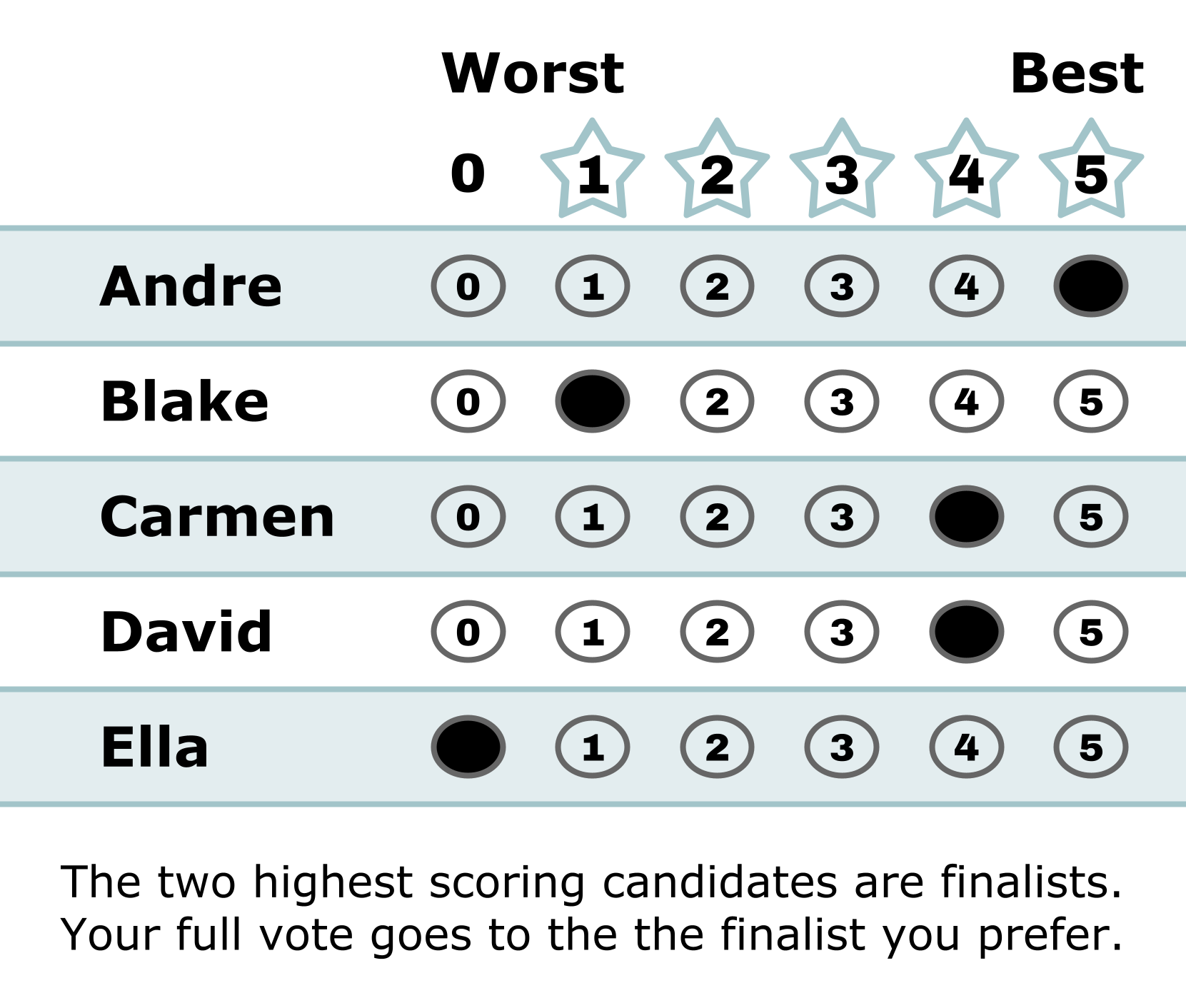
STAR Voting is an electoral method designed to reduce vote-splitting and produce winners who are broadly acceptable to most voters. Its name describes the two-stage process: Score Then Automatic Runoff.
How it works
- Score: Voters rate each candidate from 0 to 5 stars. Giving multiple candidates the same score is allowed, so voters can support a favorite and still show support for others.
- Automatic runoff: The two candidates with the highest total scores become finalists. Every ballot then counts as one vote for whichever of those two finalists the voter scored higher.
- Winner: The finalist preferred on more ballots wins.
Why people choose it
The main appeal is that voters can honestly rank their true favorite first without worrying that doing so helps an unacceptable candidate win. Because the runoff is decided between two finalists using one-person, one-vote, the system tends to elect the candidate preferred by a majority when a clear majority preference exists. It also reduces the incentive for strategic voting: scoring a lesser favorite lower can backfire if that candidate is eliminated before the runoff.
STAR vs. ranked-choice voting
| Feature | STAR Voting | Ranked-Choice Voting |
|---|---|---|
| Ballot type | Scores from 0 to 5 | Rankings |
| First stage | Highest total scores | First-choice counts |
| Final stage | Top-two automatic runoff | Eliminate lowest, transfer votes |
| Equal support | Allowed | Usually not allowed |
| Strategic voting risk | Lower | Can still reward insincere rankings |
Ranked-choice voting eliminates candidates one at a time and transfers votes, which can produce different outcomes depending on elimination order. STAR's two-stage design is simpler to explain in the runoff step, though the scoring round asks voters to think about relative intensity, not just order.
A practical example
Imagine three candidates: A, B and C. A voter loves A, likes B and dislikes C. Under STAR, that voter can give A five stars, B three stars and C zero. If A and C become finalists, the ballot automatically goes to A. If B and C become finalists, it goes to B. The voter never has to guess which choice is "electable" to avoid helping C.
Where to start
If you are evaluating STAR for a student election, club, or local race, try a small mock election with real candidates and a few dozen voters. Compare the STAR result with a simple plurality vote and, if possible, a ranked-choice count. The differences usually show up most clearly when there are three or more competitive candidates.
For the official rules, examples and research, see STAR Voting.
How does STAR Voting work in practice?
STAR Voting asks voters to score each candidate from 0 to 5 stars, then resolves the election in two steps. First, the two candidates with the highest total scores become finalists. Second, an automatic runoff compares those two finalists on the same ballots: your vote goes to whichever finalist you scored higher. The finalist preferred by more voters wins.
In practice, a voter might score a favorite 5, a compromise candidate 4, and a disliked candidate 0. Equal scores are allowed, and leaving candidates blank counts as zero. Because the runoff uses the scores already on the ballot, there is no separate second election or ranking step.
H3 What this means for different voters
- Supporters of a long-shot candidate: They can give their true favorite 5 stars without worrying that it throws the election to a worse candidate, because the runoff still lets them support a viable finalist they scored lower.
- Pragmatic voters: They can score a broadly acceptable candidate highly and a favorite even more highly, rather than choosing between sincerity and strategy.
- Voters who dislike both finalists: They can score both low, but the runoff still sends their vote to the one they scored higher, if they scored them differently.
H3 How it differs from ranked choice voting The site’s own comparison section asks “How is this different from Ranked Choice Voting?” The key practical difference is that STAR uses scores rather than rankings, and its final round is a single head-to-head comparison between the top two scorers. Ranked choice voting typically eliminates candidates round by round and transfers votes according to rankings. STAR’s runoff is simpler to describe: two finalists, one comparison, most votes wins.
For a concrete decision, think about what you want from a ballot. If you want to express intensity of preference and avoid vote-splitting, STAR’s scoring plus runoff is designed for that. If you prefer a system where voters rank candidates and lower-ranked choices transfer as candidates are eliminated, ranked choice voting is the alternative to examine.
A useful next step is to read the official explanation and examples at STAR Voting, then try scoring a past election you know well. Ask whether the two finalists and the runoff winner match the outcome you would consider fair. That exercise shows the trade-off: STAR gives voters more expressive ballots, but it also asks them to understand two rounds of counting rather than one.
How is STAR Voting different from Ranked Choice Voting?
STAR Voting and Ranked Choice Voting (RCV) both aim to reduce vote-splitting and elect broadly acceptable winners, but they ask voters for different things and handle ballots differently. The core distinction: STAR uses scored ballots with a final two-candidate runoff, while RCV uses ranked ballots with elimination rounds.
How each ballot works
- STAR Voting: You score every candidate from 0 to 5 stars. You can give multiple candidates the same score, and you can leave candidates blank (effectively zero). Your favorite can get 5 stars without hurting another acceptable candidate.
- Ranked Choice Voting: You rank candidates in order of preference. You can often rank as many or as few as you like, but you cannot express equal preference or say how much better one candidate is than another.
How each is counted
- STAR: Two rounds. First, all scores are added up, and the two highest-scoring candidates become finalists. Then an automatic runoff compares those two finalists on every ballot: your vote goes to whichever finalist you scored higher.
- RCV: Multiple elimination rounds. If no candidate has a majority of first choices, the last-place candidate is eliminated, and those ballots transfer to the next ranked choice. This repeats until someone has a majority.
Practical differences for voters and results
| Consideration | STAR Voting | Ranked Choice Voting |
|---|---|---|
| Ballot expression | Scores (0–5), equal scores allowed | Rankings, no equal ranks |
| Counting method | Score + top-two runoff | Sequential elimination |
| Strategic voting | Less incentive to exaggerate, because the runoff rewards broad appeal | Can encourage ranking a "lesser evil" first in some scenarios |
| Voter effort | Simple scoring; no need to order everyone | Ranking many candidates can feel tedious |
| Winner profile | Tends to favor consensus candidates who score well broadly | Can elect a candidate who is many voters' backup, depending on transfers |
The trade-off in plain terms
RCV's elimination process can produce a winner who is acceptable to many but rarely the top choice of a majority. STAR's runoff explicitly asks: between the two frontrunners, who does a majority prefer? That majority-preferred framing is central to STAR's pitch. The cost is that scoring is less familiar to voters than ranking, and some people find the two-stage count harder to explain.
A quick reader scenario
Imagine an election with one polarizing favorite and two broadly liked moderates. Under RCV, the polarizing candidate might survive early rounds while moderates split first-choice support. Under STAR, both moderates could receive high scores from each other's supporters, potentially both making the runoff, where the majority-preferred moderate wins.
Next step
If you are comparing systems for a local election, look at how each handles your specific ballot rules and whether voters can score or rank every candidate. STAR Voting's site explains its own method and offers case studies and technical specifications; for RCV, check your local election office's official voter guide. STAR Voting
How can I host an election using STAR Voting?
You can host a STAR election through the site's Host Election section, which offers two paths: a dedicated STAR Voting option and scheduling through BetterVoting. Both are aimed at organizers running a real contest, not just a demonstration.
What the process involves
STAR voting itself is straightforward for voters: they score candidates from 0 to 5 stars, equal scores are allowed, and blanks count as zero. Counting has two stages—the two highest-scoring candidates become finalists, then a one-person-one-vote runoff between them decides the winner, using each ballot's already-expressed preference.
So hosting means setting up the ballot, giving voters clear scoring instructions, and running that two-stage count.
Choosing your hosting route
| Route | Best for | Trade-off |
|---|---|---|
| STAR Voting's own host election tool | Organizers who want the process built around STAR specifically | Fewer general-purpose features than a full election platform |
| BetterVoting scheduling | Groups already familiar with BetterVoting or wanting its broader toolset | You rely on an outside platform, so confirm it matches your rules |
Practical next step
Before launch, decide three things: who can vote, whether your contest is single-winner or multi-winner (the site distinguishes these, and proportional STAR exists for multi-winner races), and how you will audit the result. The site publishes auditing guidance on risk-limiting audits and a cost analysis, which are worth reading if your election needs to withstand scrutiny or a challenge.
For anything formal—a union, a board, a party primary—also check the case studies and technical specifications so you can show voters and candidates exactly how the count works. If you want a lower-stakes trial first, run a practice election with a small group before the real one.
Related reading on the site includes STAR Voting for the main resources, and you can compare alternative methods through FairVote if your group is also weighing ranked choice voting.
What are the main benefits of STAR Voting over the current system?
STAR Voting's main pitch is that it changes the incentives around voting, not just the counting. Instead of picking one candidate and hoping they survive, you score every candidate from 0 to 5 stars, so you can give your honest favorite five stars without helping the candidate you fear most. That is the core benefit: no more vote-splitting and no more "wasted" vote.
How the system produces those benefits
The method is Score Then Automatic Runoff. Voters score candidates 0–5, equal scores are allowed, and blank means zero. The two highest scorers become finalists, then a one-person, one-vote runoff decides between them using the preferences already on your ballot. So you get the expressiveness of scoring plus a majority-style final choice.
What that means in practice
- Vote your conscience, safely. You can rank your true favorite first without throwing support to a lesser evil.
- Majority-preferred winners. The site claims it elects majority-preferred winners whenever possible and prevents vote-splitting.
- Less strategic gaming. The site says strategic voting is not incentivized and honesty is the best strategy.
- A leveler for disenfranchised voters. The site frames it as leveling the playing field and empowering voters who feel ignored.
- Evidence-based claims. The site says the method is vetted and peer-reviewed, topping studies of accuracy and representativeness.
Versus ranked choice voting
The site has a dedicated comparison page, "How is this different from Ranked Choice Voting?" The practical difference for a voter is that STAR lets you express strength of preference with scores, then guarantees the final decision is a simple head-to-head majority. RCV forces a strict ranking and can eliminate your favorite early. If your main frustration is feeling forced to choose between "electable" and "honest," STAR is designed for exactly that.
A concrete scenario
Imagine a voter who loves a minor-party candidate but dreads one major-party candidate. Under the current system, that voter might hold their nose. Under STAR, they give the minor candidate five stars, give the dreaded candidate zero, and score the acceptable major candidate three or four. If the minor candidate makes the runoff, great. If not, the ballot still helps decide between the finalists.
Next step
Read the site's own FAQ and the RCV comparison, then try scoring a past election you know well. If your honest scores would have changed the outcome in a way you find more representative, that is the benefit in concrete terms: STAR Voting.
How can I get involved in the STAR Voting movement?
You can get involved at several levels, from signing up for updates to hosting an election or launching a local initiative. STAR Voting lists a dedicated Get Involved section with entry points for individuals, organizers and institutions.
H3 Practical ways to participate
- Sign up and volunteer. Join the mailing list, volunteer for projects, or attend events listed on the events calendar.
- Use the Activist Toolkit. It is aimed at people who want to organize locally rather than just follow news.
- Start or join a chapter. This suits someone who wants a recurring local group, not a one-off action.
- Host an election. The site offers hosting options, including scheduling with BetterVoting, plus case studies and technical specifications for organizations that want to try STAR in a real contest.
- Support campaigns and legislation. There are templates, endorsements and examples of prior campaigns, such as the British Columbia referendum and LA charter reform.
- Launch an initiative. This is the most demanding route and makes sense if you already have a committed local team and a concrete ballot goal.
H3 Which route fits you
| If you are… | Start with… |
|---|---|
| Curious but not ready to commit | Sign up, read the FAQ and voter guide |
| Willing to give time | Volunteer or attend an event |
| Part of a club, union or local party | Chapter organizing or the Activist Toolkit |
| Running an organization’s internal election | Host Election resources and case studies |
| Focused on policy change | Campaigns, legislation templates or an initiative |
A useful next step is to decide whether your goal is education, demonstration or policy change. If you want to show that STAR works, hosting a low-stakes election is the clearest demonstration. If you want to change rules, chapters and initiative campaigns are the relevant path.
 Cloudflare
 Google Workspace
User reviews (0)