
 简体中文
简体中文 English
Website review
This review may include AI-generated content and is not individually verified. Domain, certificate and other facts come from the observed data on this page.
What is VPlayed?
VPlayed is a ready-to-go, white-label streaming platform for launching and monetizing live and on-demand video. Rather than building an OTT service from scratch, content owners use it to run branded video experiences across web, mobile apps and smart TVs from one place. Its own pages describe it as a SaaP-based (software-as-a-product) platform aimed at broadcasters, distributors and content owners.
What it covers
- OTT streaming — a branded app and web destination for live and on-demand video
- Live streaming and broadcast — live events to global audiences
- Live-to-VOD — record live content and publish it on demand
- Cloud playout — linear streaming and online broadcasting
- Video content management — store, distribute and measure video
- Micro drama platform — short-form, branded video apps
Underlying features include HLS/HTML5 players, monetization tools, white-labeling, DRM and security, marketing tools, real-time analytics, encoding/transcoding and a video CDN. Native app support is listed for Android, iOS, Apple TV, Android TV, Fire TV, Roku TV and Smart TV.
Who it fits
The site's own case studies name a news network, an entertainment app, a yoga school, a fitness platform and a sports broadcaster — so the typical buyer is an organization with existing content and an audience it wants to own directly, not a casual creator. Two claims stand out for that buyer: full branding freedom and keeping 100% of revenue, which matters if you are moving off a marketplace or ad-share platform.
Trade-offs to weigh
A packaged platform gets you live faster and removes infrastructure work, but you are building on someone else's product roadmap and feature set. If your needs are unusual — bespoke recommendation logic, complex rights windows, or deep integration with existing billing and CRM — check how much customization is actually possible before committing. Also confirm what "1000+ features" means for your plan, since broad feature lists often span multiple tiers or add-ons.
Next step: shortlist two or three platforms, then run the same demo script with each: launch one live event, publish one VOD title, set up one paywall, and check the analytics you would actually report on. Compare who owns the apps, the data and the subscriber relationship — that is usually the deciding factor, more than the feature count.
How does VPlayed help content owners monetize their videos?
VPlayed approaches monetization as one part of a ready-made streaming stack rather than a standalone payments tool. Its page groups video monetization alongside HLS/HTML5 playback, white-label streaming, DRM and security, marketing, real-time analytics, encoding/transcoding and video CDN. The practical implication for a content owner is that you can put the same live or on-demand library behind a paywall, subscription, ad-supported or transactional model without stitching together separate vendors for hosting, delivery, apps and billing.
What the platform provides for monetization
- Video monetization features listed as a core capability, aimed at turning viewers into revenue.
- White-label streaming, so the service carries your brand rather than VPlayed's.
- DRM and security, which matter when paid content needs protection from sharing and piracy.
- Real-time analytics, useful for seeing which titles, plans or campaigns actually convert.
- Video marketing tools to promote content and drive sign-ups.
- Distribution across web, mobile apps and smart TVs — Android, iOS, Apple TV, Android TV, Fire TV, Roku and Smart TV — so monetized content reaches viewers on the devices they already use.
- Live and on-demand support, letting you charge for events, linear channels or a permanent library.
VPlayed also frames full-branding freedom and keeping 100% of revenue as part of its pitch. Those are the platform's claims; in practice, "keeping 100% of revenue" usually still involves payment-processor fees and any third-party costs, so treat it as a statement about revenue share rather than zero cost.
Who this suits
A broadcaster, distributor or independent content owner who wants to launch a branded OTT service quickly is the clearest fit. The case-study themes on the page — news networks, entertainment apps, a yoga school, a fitness platform, a sports broadcaster — suggest the platform is aimed at organizations with existing audiences and content, not hobby creators. If you already have a library and an audience but no engineering team to build apps, billing and delivery, this kind of packaged platform shortens the path to revenue.
How to decide
Ask three questions before committing:
- Which monetization models do you need — subscription, transactional, advertising or a mix? Confirm each is supported natively rather than through add-ons.
- How much customization do you need in apps and branding? White-label helps, but deep UX changes may still require development work.
- What are the total costs beyond the platform — payment processing, CDN overages, app store fees and DRM licensing?
A useful next step is to request a demo and walk through one real monetization scenario end to end: a viewer discovers a title, pays, watches on a TV app and appears correctly in your revenue analytics. If that flow works without hidden gaps, the platform is a credible fit. For broader context on the OTT market, VPlayed is the vendor itself, while independent industry coverage can help you benchmark alternatives.
Can VPlayed be used to launch a branded streaming app on smart TVs and mobile devices?
Yes. VPlayed is positioned as a ready-to-go streaming platform for launching branded live and on-demand video services across web, mobile apps and smart TVs. Its page evidence lists Android & iOS alongside Apple TV, Android TV, Fire TV, Roku TV and Smart TV, so a single content operation can be distributed through phone apps and living-room apps rather than treating TV as an afterthought.
What that means in practice
A small content owner — say a regional news network, fitness studio or niche entertainment channel — could use VPlayed as the base layer for:
- Branded mobile apps on Android and iOS
- Smart TV and connected-TV apps across the listed platforms
- Web streaming with HLS/HTML5 playback
- Live streaming and broadcast, plus live-to-VOD recording
- Video content management, encoding/transcoding and a video CDN
- Monetization, DRM/security, marketing tools and real-time analytics
The page also mentions white-label streaming and full-branding freedom, which matters if your app must look like your brand rather than a generic video portal. AI-driven OTT capabilities are presented as part of the viewer experience, though the page evidence does not detail what those capabilities do.
Where the trade-off sits
The main appeal is speed and breadth: one platform covering mobile, TV and web, with monetization and security built in. The main caution is fit. A ready-made platform is strongest when your needs match its packaged products — OTT streaming, live broadcast, micro-drama, cloud playout, live-to-VOD, video CMS. If you need unusual workflows, deep custom integrations or full control of the codebase, a platform like this can become a constraint rather than a shortcut. The page’s customer stories span news, entertainment, yoga, fitness and sports, which suggests it is aimed at content owners and broadcasters rather than teams building streaming infrastructure from scratch.
Next step
Before committing, list your must-have distribution targets and monetization models, then ask VPlayed for a demo using your own content and a TV app mock-up. Confirm two things directly: which smart-TV platforms are supported in your region, and how much branding and revenue control you retain. If you want to compare the wider category first, look at VPlayed alongside established alternatives such as Uscreen for creator-style subscription video or Brightcove for enterprise-grade video infrastructure.
What types of content can be streamed using VPlayed, such as live events or on-demand videos?
VPlayed supports both major streaming formats: live and on-demand. The platform is built for broadcasters, distributors, and content owners who need to deliver video across web, mobile apps, and smart TVs.
Live content
- Live events and broadcasts to global audiences
- Linear streaming and online broadcasting via cloud playout
- Live-to-VOD recording, where live content is captured and turned into on-demand video
On-demand content
- Video content management for storing, distributing, and measuring a library
- Short-form video through a dedicated micro drama platform
- General on-demand streaming across branded apps and devices
Content categories the platform is positioned for
- Broadcast and media
- Entertainment
- Filmmakers and studio distributors
- Religious services
- Education
- Sports
- Fitness
- Enterprise communications
If you are deciding whether VPlayed fits your use case, the practical test is whether you need live and on-demand in one place. A news network streaming breaking coverage and archived reports, a fitness brand running scheduled classes plus a replay library, or a sports broadcaster mixing live matches with highlights all fit that pattern. If you only ever publish pre-recorded files with no live component, a simpler video hosting tool may be enough.
A useful next step is to list your content types, then check which ones need real-time delivery versus a library. For a fuller picture of the platform, see VPlayed.
Is VPlayed suitable for niche streaming services like fitness, education, or religious content?
Yes. VPlayed is explicitly positioned for niche content owners, and its page names fitness, education, sports, religious, entertainment, filmmakers and enterprise as target solution areas. It bundles the pieces a niche service usually needs: branded apps, live and on-demand delivery, monetization, DRM, analytics and distribution across web, mobile and smart TVs.
Where it maps to each niche
- Fitness: live classes plus on-demand libraries, subscription monetization, and apps on mobile and TV. The page cites a Brazil fitness platform as a customer story, though the details behind the reported revenue lift are theirs, not an independent benchmark.
- Education: interactive, engaging teaching formats with access control and analytics on completion and viewing behavior.
- Religious content: scheduled live worship plus an on-demand archive, which suits congregations that want both a weekly live stream and a searchable library.
- Adjacent niches: sports, news, entertainment, micro-drama and enterprise training follow the same pattern.
The real trade-off
The deciding factor is rarely niche fit — it is whether you want a ready-made platform or a custom build.
| Your situation | VPlayed looks like | Alternative |
|---|---|---|
| Small catalogue, small team, fast launch | A faster route than assembling encoders, CDN, apps and billing yourself | A lean setup with a video host plus a membership tool |
| Need branded apps on Roku, Fire TV, Apple TV, Android TV | One vendor covers app surfaces and playback together | Separate app agency plus streaming vendor |
| Complex or unusual workflows | Configure within its feature set | Custom development may fit better |
How to decide
Ask three questions: Which revenue model do you need (subscription, rental, advertising, or a mix)? Which devices must you be on in year one? Does your content need strict DRM or geo-restrictions? If your answers match its listed capabilities, request a demo and test your own content on it. If you need deep custom logic, compare against building on a general video API.
For context on what a niche service typically needs, see Vimeo for hosting and monetization tooling and Roku for the TV app route.
How does VPlayed compare to building a custom streaming platform from scratch?
VPlayed is a buy-and-configure option: it gives you a ready-made streaming stack—video hosting, transcoding, players, monetization, apps, analytics—so you can launch sooner and avoid assembling many vendors. Building from scratch gives you maximum control, but you own the architecture, integrations, security, scaling and ongoing operations.
Where the difference shows up
| Decision area | VPlayed (SaaP-style platform) | Custom build from scratch |
|---|---|---|
| Time to launch | Faster: pre-built modules and branded apps | Slower: design, build, test, integrate |
| Control | Constrained by the product's roadmap and configuration limits | Full control over features, UX, data model |
| Engineering load | Lower: you configure and operate | High: you hire/retain streaming, mobile, DevOps talent |
| Cost pattern | Predictable subscription/licensing, but less room to optimize | Higher upfront and ongoing, but potentially cheaper at very large scale |
| Differentiation | Limited to what the platform exposes | Can be a unique product advantage |
| Risk | Vendor dependency and migration risk | Execution risk, delays, scaling surprises |
Choose VPlayed when you are a content owner, broadcaster, distributor, fitness/education/religious/sports publisher, or media brand that needs live and on-demand video across web, mobile and smart TVs without becoming a streaming engineering company. The page evidence shows this positioning: OTT streaming, live broadcast, cloud playout, live-to-VOD, video CMS, HLS/HTML5 player, monetization, white-label streaming, DRM, marketing, analytics, encoding/transcoding, CDN, plus Android/iOS, Apple TV, Android TV, Fire TV, Roku and Smart TV apps. It also cites case studies across news, entertainment, yoga, fitness and sports, which suggests the target buyer values speed and breadth over deep customization.
Build from scratch when streaming is core to your competitive advantage, you have unusual requirements (custom recommendation logic, proprietary ad tech, complex rights windows, unique data residency), or you already have a strong platform team and want to avoid per-viewer or per-feature vendor economics.
A practical next step: write a one-page decision brief with three columns—must-have features, launch deadline, and internal team capacity. If the deadline is tight and the must-haves map to standard OTT capabilities, shortlist VPlayed and request a demo. If your must-haves include capabilities the product does not expose, price the build honestly, including CDN, DRM, transcoding, app maintenance and 24/7 support.
For broader market context, you can compare approaches with Brightcove, Wowza, Kaltura and Mux.
 Amazon Route 53
 Zoho Mail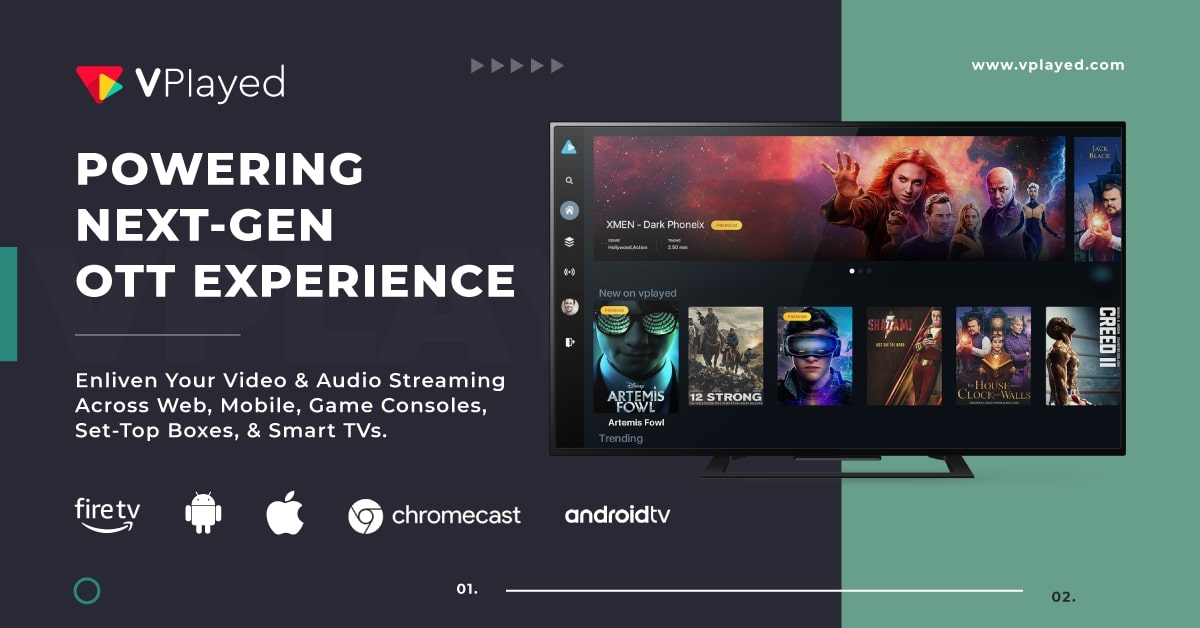

User reviews (0)