Website profiles · Technology insights · Alternatives

w3gpt.ai

Deploy smart contracts, create AI Agents, do more onchain with AI.

No paid content found
Visit website
Profile views 4 Outbound visits 0 Normal
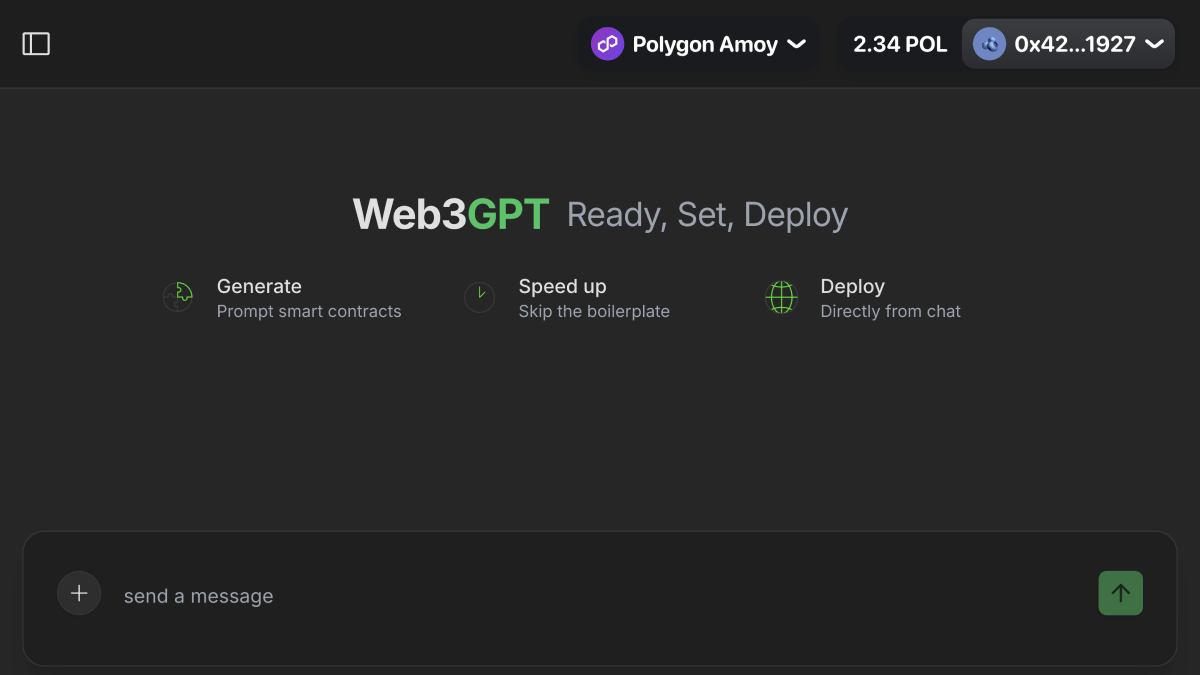
Web3GPT Full homepage screenshot

At a glance

Category
Artificial Intelligence
Language
English
Paid-content signal
No paid content foundObserved
Registered
2023
Hosting
VercelInferred
HTTPS certificate trusted
PassedObserved
Last updated

Website review

This review may include AI-generated content and is not individually verified. Domain, certificate and other facts come from the observed data on this page.

What is Web3GPT?

Web3GPT is a chat-based tool for generating and deploying smart contracts and AI agents onchain. Its pitch is speed: describe what you want in a prompt, and it produces contract code and handles deployment from the chat interface, skipping the usual project scaffolding.

What it actually does

  • Contract generation: turns a plain-language prompt into Solidity-style smart contract code.
  • Direct deployment: pushes a contract to a blockchain from the chat, rather than requiring a separate build-and-deploy pipeline.
  • AI agent creation: supports building onchain AI agents alongside contracts.
  • Boilerplate reduction: the stated goal is to remove setup work so you move from idea to a deployed contract faster.

Who it fits

  • Developers prototyping an idea who want a first working contract without configuring a full toolchain.
  • People already comfortable reading Solidity who want a faster drafting loop.
  • Teams exploring onchain AI agents without committing to a large build.

It fits less well if you need audited, production-grade contracts, tight control over compiler settings, or a formal review process. The tool itself warns that it can make mistakes and that contracts should be reviewed before deployment — treat generated code as a draft, not a finished artifact.

A concrete scenario

You want a simple token or NFT mint contract for a testnet demo. Instead of installing a framework, writing config, and wiring up a deploy script, you describe the contract in chat, read the output, adjust it, and deploy. That saves an afternoon on a throwaway prototype. For anything holding real value, that same shortcut is a liability: you still need a human to check access control, arithmetic, and external calls, and to test on a testnet before mainnet.

How to decide

Use Web3GPT when the cost of a wrong first draft is low and speed matters. Fall back to a conventional development workflow when the contract will custody funds, when you need reproducible builds, or when an auditor will review the code. A reasonable middle path: generate with Web3GPT, then move the code into a standard toolchain for testing and review.

Next step: pick one small contract you already understand well, generate it, and compare the output against what you would have written by hand. That tells you quickly whether the time saved outweighs the review burden. For broader context on the ecosystem, see Ethereum.

How do I deploy a smart contract using Web3GPT?

Web3GPT is a chat-style interface for generating and deploying smart contracts: you describe what you want, it writes the Solidity, and you deploy from the same conversation rather than setting up a local toolchain first. The page's own flow is "Ready, Set, Deploy," with "Generate Prompt," "Skip the boilerplate," and "Deploy Directly from chat" as the stated steps, plus the warning that Web3GPT can make mistakes and contracts should be reviewed before deploying.

A practical deployment sequence

  1. Write the prompt as a specification, not a wish. State the contract type, the functions you need, who may call them, and the network. For example: "An ERC-20 with a fixed supply minted to the deployer, no mint function after construction, and a transfer fee of zero."
  2. Read the generated code before doing anything else. Check the constructor, access control, and any external calls. The tool's own disclaimer points at this step for a reason: generated code is a draft.
  3. Deploy from the chat and confirm the network and the account you are deploying from. Deployment is a real transaction, and on a live network it costs real money.
  4. Verify the contract so others can read the source, then test the deployed functions with small amounts before announcing or integrating anything.

Where it fits and where it doesn't

Web3GPT is most useful for prototypes, testnets, hackathon projects, and learning — cases where boilerplate is the main obstacle. It is a poor fit for contracts holding significant value, upgradeable proxies, or anything handling other people's funds, where you want a formal audit, a local test suite, and a review process. If you are new to Solidity, treat the generated contract as a starting point to study, not as finished work.

Decision criteria

Situation Reasonable approach
Learning, testnet, quick prototype Deploy from Web3GPT and iterate in chat
Small mainnet contract, low value at risk Generate with Web3GPT, then review and test locally before deploying
Funds, upgrades, or third-party users Write and audit with a standard toolchain; use AI only for scaffolding

If you want to understand the contracts it produces, the Solidity documentation at Solidity and the OpenZeppelin library at OpenZeppelin are the references most generated code leans on, and Remix at Remix gives you a browser-based way to test the same contract before it touches a live network.

Can Web3GPT create AI agents for onchain tasks?

Yes — Web3GPT is positioned to create AI agents as well as deploy smart contracts. Its own description lists both capabilities side by side: "Deploy smart contracts, create AI Agents, do more onchain with AI" Web3GPT. The page evidence reinforces the contract side with prompts like "Ready, Set, Deploy," "Generate Prompt smart contracts," "Speed up," and "Skip the boilerplate," and it includes the warning that Web3GPT "can make mistakes" and that contracts should be reviewed before deploying.

What that means in practice

An AI agent for onchain tasks is usually a program that watches a blockchain or external trigger, decides what to do, and then submits a transaction or calls a contract. Web3GPT appears aimed at the creation step: describing an agent in chat and generating the code, prompts, or contract scaffolding it needs. The contract deployment features are the clearest part of the evidence; agent creation is stated in the product description but not detailed in the page excerpt, so treat the exact agent tooling as something to verify inside the app.

A concrete scenario: a small DAO wants an agent that monitors a treasury address and sends a weekly summary, or one that mints a token when a condition is met. Using Web3GPT, a developer could describe the logic in chat, generate the Solidity contract and any offchain agent code, then deploy the contract directly from the chat interface. That removes boilerplate setup, but the generated contract still needs a human review before it touches real funds.

Trade-offs to weigh

  • Speed vs. review burden. "Skip the boilerplate" is genuinely useful for prototypes, but generated contracts can contain errors. Budget time for testing on a testnet and, for anything holding value, a professional audit.
  • Prompt-driven vs. precise control. Chat generation is fast for standard patterns but can be awkward for unusual tokenomics, upgradeability, or gas-sensitive logic.
  • Agent scope. Confirm whether the agent runs offchain, onchain, or both, and how it handles keys and transaction signing — that determines its security model more than the code generation does.

Next step

Before committing, open Web3GPT and try a small, low-stakes agent: describe a task such as "watch this address and emit an event when the balance changes," generate the code, deploy to a testnet, and inspect the result. If you need a broader comparison of AI-assisted smart contract tools, look at Ethereum.org for developer resources and OpenZeppelin for audited contract libraries to pair with generated code.

Is it safe to deploy contracts generated by Web3GPT?

Treat Web3GPT-generated contracts as drafts, not finished products. The site itself warns that it "can make mistakes" and tells you to review contracts before deploying, which is the right posture: the tool speeds up writing and deployment, but the safety of any contract depends on what it actually does and who audits it.

Where the risk actually sits

  • Generated code can be subtly wrong. AI models produce plausible-looking Solidity that compiles but mishandles edge cases: reentrancy, unchecked external calls, integer rounding, access control gaps, or missing slippage and deadline checks.
  • Deployment is irreversible. Once a contract holds funds, a flaw is usually not patchable without migration. Testnets are cheap; mainnet mistakes are not.
  • The prompt drives the output. Vague instructions ("a staking contract") yield generic, unaudited patterns. Precise requirements plus explicit constraints produce something closer to reviewable.
  • Chat interfaces can misstate what was generated. Verify the deployed bytecode and constructor arguments match what you intended.

A practical workflow

  1. Generate on a testnet first, never straight to mainnet.
  2. Read every line, or have someone who writes Solidity do it. Focus on external calls, state changes before/after them, onlyOwner-style gates, and arithmetic.
  3. Run static analysis (Slither, Mythril) and a fuzzing suite (Foundry, Echidna) against your invariants.
  4. Write tests for failure paths, not just the happy path: unauthorized callers, zero addresses, reentrancy attempts, paused states.
  5. For anything holding real value, get an independent audit and consider a bug bounty.

Who this suits

Prototyping, hackathon projects, internal tooling, and learning Solidity benefit most — the boilerplate savings are real and the blast radius is small. Production DeFi, custody of user funds, or anything with upgrade authority warrants a human-written or human-reviewed codebase, with the AI output used only as a starting reference. If you are not able to audit the code yourself, that is the signal to bring in someone who can, or to keep the contract on a testnet.

For comparison, established alternatives with published tooling and documentation include OpenZeppelin for audited contract libraries and ethereum.org for language and security guidance.

Which blockchains and networks does Web3GPT support for deployment?

Web3GPT is described as a tool for deploying smart contracts and creating AI agents "onchain," and its page evidence centers on generating contracts from a chat prompt and deploying them directly from that chat. The evidence provided does not name specific blockchains or networks, so the honest answer is that the supported deployment targets are not specified in the material available here.

What the evidence does show

  • The workflow is prompt-to-contract: you describe what you want, Web3GPT generates Solidity-style smart-contract code, and you can deploy "directly from chat."
  • The tool itself warns that it "can make mistakes" and tells users to "review contracts before deploying." That warning matters more than usual when the deployment target is uncertain, because a contract written for one chain may not behave identically on another.

How to find out for your case

The deployment network is usually chosen at deploy time, not at generation time, so the answer may depend on the wallet or provider you connect. A practical check:

  1. Open Web3GPT and start a contract-generation prompt.
  2. Look at the deploy step for a network selector, chain dropdown, or wallet connection request.
  3. Note which chain your wallet is asked to switch to; that is the network the deployment will use.
  4. If you need a specific chain, confirm it before writing anything complex, since contract code and gas assumptions can differ between EVM-compatible networks and non-EVM ones.

A concrete scenario

Suppose you want a simple NFT minting contract on an EVM-compatible testnet. You could generate the contract in Web3GPT, then check whether the deploy step offers that testnet or asks your wallet to switch to it. If it only offers a different network, you would copy the generated Solidity into a tool that targets your chain, such as Remix for EVM networks, and deploy there after reviewing the code. For general chain and testnet references, Ethereum.org covers the Ethereum ecosystem, while Solidity Docs helps verify language-level correctness before you deploy anywhere.

Decision criterion: if your project must run on a particular chain, treat the network selector as the first thing to verify, not the last. If Web3GPT's available targets match your chain, its chat-to-deploy flow saves setup time; if they don't, use it for drafting and deploy through a tool that explicitly supports your network.

Do I need to know Solidity to use Web3GPT effectively?

No — Solidity knowledge is not a prerequisite for using Web3GPT, but it changes what you can do with it. The site presents itself as a chat-driven tool for generating and deploying smart contracts and AI agents, with an explicit warning to review contracts before deploying. That warning is the crux: you can generate without knowing Solidity, but you cannot safely verify without some ability to read it or someone who can.

What each user gets

Your background What Web3GPT is good for Main risk
No Solidity at all Learning what a contract looks like, prototyping ideas on a testnet, generating simple tokens or agents Deploying code you cannot evaluate; hidden logic, wrong permissions, or irreversible mistakes
Basic Solidity reading ability Fast scaffolding, then editing the generated code yourself before deploying Trusting the model's output without checking edge cases
Experienced developer Skipping boilerplate and iterating quickly on standard patterns Over-reliance on generated code for non-standard or security-critical logic

A practical way to decide

Ask what happens if the contract is wrong. If the answer is "nothing, it's a testnet experiment," prompting alone is fine. If real funds, user assets, or upgrade rights are involved, treat the generated contract as a first draft and get it reviewed. Even a modest amount of Solidity — enough to read function visibility, ownership, and external calls — is the difference between using the tool and being used by it.

Concrete next step

Start on a testnet with a trivial contract, paste the output into a block explorer to see what actually deployed, and compare it against what you asked for. If you want a structured path to reading contracts rather than writing them from scratch, Solidity documentation and Ethereum developer resources cover the fundamentals; OpenZeppelin is useful for seeing what well-audited contract patterns look like.

Related questions

More questions →
What Is Web3 and How Do Smart Contracts and AI Fit In?

Web3 is the term for internet applications that store ownership and logic on a blockchain instead of a company's private servers. Where Web2 platforms keep your account, balance, and content in a database the operator controls, Web3 puts those records in a public ledger that anyone can read and that no single party can quietly rewrite. Smart contracts are the programs that run that logic, and AI tools are increasingly used to write and deploy them. The sections below explain each layer and where the practical risks sit.

Web3 vs. Web2: what actually changes

The difference is not the interface — it is who holds the state.

Dimension Web2 Web3
Where data lives Company servers and databases Public blockchain ledger
Who can change records The platform operator Rules defined in code; no unilateral edits
Account model Email/password issued by the platform Cryptographic key pair you control
Access to logic Private APIs Open contracts anyone can call
Failure mode Platform bans, shutdowns, data loss Contract bugs, lost keys, irreversible transactions

The trade-off is real: Web3 removes a trusted intermediary but replaces it with code you must verify yourself. There is no support line to reverse a bad transaction.

Blockchain and Ethereum's role

A blockchain is a replicated ledger maintained by many independent nodes. Each block of transactions is cryptographically linked to the previous one, so altering history would require redoing the work across the network.

Ethereum matters to Web3 because it added general computation on top of a ledger. Instead of only sending value from A to B, you can deploy a program that holds funds and enforces conditions. That program is a smart contract, and the network of nodes executes it identically for everyone.

How smart contracts work

A smart contract is code deployed to an address on the chain. Once deployed, its functions can be called by anyone, and its state changes are recorded permanently.

A simple mental model: a vending machine. You send input (payment), the machine checks a condition (enough credit, item in stock), and it produces an output (the item, or a refund). No clerk decides — the rule is fixed in advance.

What this enables:

  • Tokens and ownership records that transfer without a custodian
  • Escrow and conditional payments that release only when terms are met
  • Composability — one contract can call another, so building blocks stack

What it does not do: fix mistakes. A deployed contract generally cannot be edited unless the authors deliberately built in an upgrade path, and even then that path is itself a trust assumption.

Where AI fits into onchain work

AI assistants are being applied to the parts of Web3 development that are repetitive or syntax-heavy. Web3GPT, for example, describes itself as letting users "deploy smart contracts, create AI Agents, do more onchain with AI," and its interface emphasizes skipping boilerplate and deploying directly from chat.

In practice, that means a workflow like:

  1. Describe the contract in plain language — for example, a token with a fixed supply and a transfer function.
  2. Generate the Solidity source — the AI produces a first draft, which is the boilerplate-heavy part.
  3. Review the code — read the logic, check supply, permissions, and any external calls.
  4. Deploy from the chat interface — the tool submits the contract to the network.

The value is speed on the scaffolding. The risk is that generated code looks plausible and compiles while still containing a flaw. Web3GPT's own interface carries the warning: "Web3GPT can make mistakes. Review contracts before deploying."

What to check before you deploy

Treat AI-generated contract code as a draft from a fast but unaccountable collaborator.

  • Read every function that moves funds or changes ownership. If you cannot explain what a line does, do not deploy it.
  • Check who has privileged access. Owner-only mint, pause, or withdrawal functions are common and are a central point of failure or abuse.
  • Test on a testnet first. Deploying to a test network costs nothing real and surfaces obvious errors.
  • Confirm the network and parameters before signing. A transaction sent to the wrong chain or with wrong constructor arguments is not reversible.
  • Assume permanence. Unless the contract was written to be upgradeable, the deployed version is the final version.

Choosing whether to use an AI-assisted tool

Use an AI contract tool when you are prototyping, learning, or generating standard patterns and you have the ability to review the output. Skip it, or add a human audit, when the contract will hold other people's funds, when it governs access or payouts, or when you cannot evaluate the code yourself. The tool shortens the distance from idea to deployment; it does not shorten the distance from deployment to consequence.

What Does Game Development Involve for Indie Developers?

Indie game development is the process of taking a game from an initial idea to a released, playable product with a small team or solo — typically covering concept, prototyping, production, and release. It suits developers who can wear multiple hats (design, code, art, audio, marketing) or who can collaborate with others to fill gaps. The practical core is scoping a project small enough to finish, choosing tools that match your skills and target platforms, and iterating based on real feedback rather than assumptions.

The Core Stages of Indie Development

Most indie projects move through four overlapping stages. They are not strictly linear — you will loop back as you learn — but each has a distinct goal.

1. Concept

Define the core loop: what the player does repeatedly, why it is fun, and what makes it distinct. Keep this to a one-page description. The output is a clear pitch you can test against.

2. Prototyping

Build the smallest playable version of the core loop. Use placeholder art and minimal systems. The goal is to answer "is this fun?" before investing in production. If the prototype is not engaging, change the concept rather than polishing it.

3. Production

Turn the validated prototype into a full game: real art, audio, levels, UI, save systems, and content. This is usually the longest stage and where scope discipline matters most.

4. Release

Prepare builds for your target platforms, handle store pages, ratings, and any platform-specific requirements, then ship and support the game with patches.

Choosing an Engine or Framework

The engine decision should follow your skills and target platforms, not trends. A rough guide:

Situation Reasonable choice Why
New to gamedev, want visual tools A general-purpose engine with a scene editor Lets you build without deep engine internals
Strong programmer, want control A code-first framework or low-level library Fewer abstractions, more direct control
Targeting many platforms An engine with built-in export pipelines Reduces per-platform work
Very small 2D scope A lightweight 2D-focused engine or framework Less overhead than a full 3D engine

Match the tool to what you can actually finish with. A powerful engine you do not understand slows you down more than a simple one you do.

Essential Tools for a Small Team

Beyond the engine, indie developers typically rely on a small set of supporting tools:

  • Code editor / IDE — whatever you are productive in; the site's own keywords include editors like Neovim and Vim, which are common among developers who prefer keyboard-driven workflows.
  • Art tools — 2D raster or vector editors, or 3D modeling software depending on your style.
  • Audio tools — for sound effects and music, or sources for licensed assets.
  • Version control — essential even solo. It lets you experiment safely and recover from mistakes.
  • Project tracking — a simple task list or board to keep scope visible.

The exact products matter less than having one tool per job and sticking with it.

Scoping a First Project

The most common reason indie projects fail is scope, not skill. A finishable first project usually:

  • Has one core mechanic, not five.
  • Can be completed in a few months of part-time work.
  • Uses a visual style you can produce consistently.
  • Has a clear end state (a win condition, a final level, a credits screen).

Test scope by asking: can I describe the entire game in one sentence, and can I build a playable version of that sentence this month? If not, cut until you can.

Common Pitfalls

  • Feature creep — adding mechanics mid-production. Freeze the design after prototyping and log new ideas for a sequel.
  • Asset licensing — if you use third-party art, audio, or code, verify the license permits your intended use, including commercial release. CC0 assets are a common starting point, but always confirm the terms yourself.
  • Platform requirements — stores and consoles have technical and content rules. Check them before you are deep into production, not at submission.
  • No feedback loop — building in isolation until launch. Share early builds to catch problems while they are cheap to fix.

Communities, Feedback, and Distribution

Indie development is solo-friendly but not isolation-friendly. Useful entry points:

  • Developer communities and forums — for technical help and design critique.
  • Playtesting groups — for structured feedback on builds.
  • Distribution channels — storefronts and platforms where indie games are commonly published; each has its own submission and revenue terms you should read directly.

Start with one community and one distribution channel, learn their norms, and expand only when you have something to show.

A Practical Starting Path

  1. Write a one-page concept with a single core loop.
  2. Build a placeholder prototype and test whether it is fun.
  3. Pick an engine or framework that fits your skills and platforms.
  4. Set up version control and a simple task list.
  5. Freeze scope, produce the game, and playtest regularly.
  6. Prepare platform requirements early, then release and patch.

The through-line is finishing: a small, complete game teaches more than an ambitious unfinished one.

How Does AI with Frozen Semen Work When Breeding a Connemara Pony?

Artificial insemination (AI) with frozen semen lets you breed a Connemara mare to a stallion that may be standing hundreds or thousands of miles away — or no longer alive. The trade-off is that frozen semen demands much tighter management than natural cover or fresh/chilled semen. In practice, you need a veterinarian experienced in equine reproduction, precise monitoring of the mare's cycle, and realistic expectations about success rates. This article walks through what actually happens, step by step, and helps you judge whether AI is the right route for your breeding plan.

What "AI with frozen semen" actually means

AI is simply placing semen into the mare's reproductive tract by instrument rather than by natural cover. The semen itself comes in three broad forms:

  • Fresh: collected and used within hours.
  • Chilled: extended and shipped, typically used within 24–48 hours.
  • Frozen: processed with cryoprotectants and stored in liquid nitrogen, potentially for years.

Frozen semen is the most logistically flexible and the most biologically demanding. The freezing and thawing process kills a large proportion of sperm cells, and the survivors have a shorter functional lifespan in the mare's tract than fresh sperm. That is the single most important fact to understand before you commit.

The basic steps, in order

1. Confirm the mare is a suitable candidate

Before anything else, a reproductive examination is worthwhile. A vet typically checks:

  • General health and body condition
  • Reproductive tract via ultrasound and/or speculum exam
  • Cervical and uterine status
  • Any history of previous foaling or breeding problems
  • Uterine culture or cytology if infection is suspected

Older mares, mares with a history of endometritis, or mares that have never conceived are all higher-risk. This does not rule them out, but it changes the odds and the level of veterinary input required.

2. Source the frozen semen

Frozen Connemara semen is available from some studs and via semen banks, though the pool is smaller than in warmblood or Thoroughbred breeding. When enquiring, ask for:

  • Stallion registration details and studbook
  • Number of doses available per breeding
  • Post-thaw motility figures (a quality indicator, not a guarantee)
  • Breeding contract terms, including live foal guarantees if offered
  • Shipping and storage arrangements for the liquid nitrogen dewar

If you are breeding for a registered Connemara foal, check the relevant studbook's rules on AI and on frozen semen specifically. Registration bodies differ in what they accept and what documentation they require from the stallion owner.

3. Monitor the mare's cycle closely

This is where frozen semen differs most from natural cover. Because thawed sperm survive only a short time, insemination must happen very close to ovulation — often within a window of roughly 12 to 24 hours before or around ovulation, depending on the protocol your vet uses.

Typical monitoring involves:

  • Teasing with a stallion or a reliable teaser to detect oestrus
  • Ultrasound scanning every 24–48 hours once the mare is in season
  • Tracking follicle size to predict imminent ovulation
  • Possible ovulation induction with a hormone injection to tighten the timing

Some vets also use deep-horn or hysteroscopic insemination, which places a small volume of semen directly at the tip of the uterine horn. This can improve results with low-dose or poor-quality frozen samples, but it requires specialised equipment and skill.

4. Thaw and inseminate

Thawing follows the semen processor's instructions exactly — usually a specific water bath temperature and time. Deviating from the protocol damages sperm. The insemination itself is quick and is performed by the vet.

5. Post-breeding management

Depending on the mare's history, the vet may recommend:

  • Oxytocin treatment to help clear fluid from the uterus
  • Anti-inflammatory medication
  • A post-breeding scan to confirm ovulation and check for fluid

Pregnancy is normally confirmed by ultrasound around 14–16 days after ovulation, with a follow-up check later to monitor the pregnancy.

Why timing is the hard part

With natural cover, sperm can remain viable in the mare for a day or more, so a slightly mistimed breeding still has a chance. With frozen semen, that buffer largely disappears. If you inseminate too early, the sperm are gone before the egg arrives. Too late, and the egg has already aged.

This is why frozen semen breeding is often described as a timing exercise as much as a fertility one. It also explains why success rates vary so widely between mares, cycles, and clinics. Published per-cycle pregnancy rates for frozen semen in horses are generally lower than for fresh or chilled semen, and outcomes depend heavily on mare fertility, semen quality, and the skill of the team managing the cycle.

Practical considerations before you decide

Factor Frozen semen AI Natural cover
Stallion location Anywhere; semen shipped and stored Stallion must be physically available
Timing precision required Very high Moderate
Veterinary involvement Essential, often intensive Often minimal
Cost structure Semen purchase + storage + repeated vet visits Stud fee + transport/boarding
Mare stress Multiple handling and scans Usually less
Flexibility if mare doesn't conceive Can repeat in later cycles with stored doses Depends on stallion access
Suitability for subfertile mares Possible but harder Also harder, but more forgiving on timing

Questions to ask yourself

  • Do I have a vet with equine reproduction experience nearby? Without one, frozen semen AI is impractical.
  • Can I commit to frequent scanning appointments? Cycles can require several visits over a few days.
  • Is the stallion I want only available frozen? If a suitable stallion is available fresh or chilled, that is usually the easier path.
  • What does the studbook require? Confirm AI and frozen semen are accepted and what paperwork is needed.
  • What is my budget for a possibly repeated process? Frozen semen breeding can take more than one cycle.

When AI makes sense — and when it doesn't

AI with frozen semen is a reasonable choice when:

  • The stallion you want is geographically distant, deceased, or in heavy competition
  • You want to preserve genetics from a specific pony
  • Natural cover is impossible for health, safety, or management reasons
  • You have access to good reproductive veterinary care

It is a poor fit when:

  • No experienced equine vet is available
  • The mare has known fertility problems and you want the easiest route
  • You cannot manage the monitoring schedule
  • A suitable stallion is available locally for natural cover or fresh semen

A realistic way to proceed

  1. Have your mare examined and get an honest assessment of her breeding soundness.
  2. Confirm the studbook's rules on AI and frozen semen.
  3. Contact stallion owners or semen banks and request post-thaw quality data and contract terms.
  4. Line up a reproductive vet before you buy semen, not after.
  5. Plan the breeding for a time of year when you can attend appointments and when the vet's schedule allows.
  6. Budget for more than one cycle, and treat the first attempt as a learning cycle rather than a certainty.

Frozen semen AI is a powerful tool for Connemara breeders, but it rewards preparation far more than improvisation. If you have the veterinary support and the patience for precise timing, it opens up stallion choices you could never access otherwise. If you don't, natural cover or fresh semen will usually be the more straightforward route to a foal.

What Are Smart Contracts and How Do They Work?

A smart contract is a program deployed to a blockchain that runs automatically when predefined conditions are met, without a middleman executing the agreement. You interact with it by sending a transaction; the network's nodes execute the code and record the result on-chain. This makes smart contracts useful when you need transparent, tamper-resistant logic that multiple parties can verify — and risky when the code has bugs, since deployed contracts are generally hard or impossible to change.

The core mechanism

A smart contract combines three things: code (the rules), state (data stored on-chain, such as balances or ownership records), and triggers (the transactions or calls that make the code run).

The flow looks like this:

  1. You write the contract in a language such as Solidity and compile it.
  2. You deploy it in a transaction, which assigns it a blockchain address.
  3. Users or other contracts send transactions to that address, calling specific functions.
  4. Nodes execute the function, update the contract's state, and include the result in a block.
  5. The updated state is permanent and visible to anyone.

Because execution happens on every participating node, the result doesn't depend on trusting a single operator. That's the property people usually mean when they say smart contracts are "trustless" — you still trust the code and the network, just not a counterparty.

What smart contracts are used for

Use case What the contract does
Tokens Tracks balances and transfers for fungible or non-fungible assets
DeFi Handles lending, borrowing, swaps, and liquidity pools
NFTs Records ownership and enforces minting or royalty rules
DAOs Manages proposals, voting, and treasury spending
Supply chain Logs custody and status events across parties

In each case the contract replaces a record-keeper or escrow function with code that anyone can inspect and call.

Key limitations and risks

  • Immutability cuts both ways. Once deployed, fixing a bug often requires deploying a new contract and migrating users, which is why upgrade patterns exist but add complexity.
  • Code is the final word. If a function allows an unintended action, an attacker can take it. Bugs in contracts have led to large, well-documented losses.
  • Gas costs. Every operation consumes gas, so inefficient code is expensive to run, and complex logic can become impractical on-chain.
  • Audits matter. Reviewing and testing contracts before deployment is standard practice, not optional.

Web3GPT's own interface carries the warning "Web3GPT can make mistakes. Review contracts before deploying" — a reasonable default for any AI-assisted contract generation.

How to get started

The common path is to write in Solidity, test on a testnet, then deploy to a mainnet only after review.

  1. Write the contract. Solidity is the dominant language for Ethereum-compatible chains.
  2. Test locally or on a testnet. Testnets let you deploy and call functions without spending real funds.
  3. Review the code. Check access control, arithmetic, and external calls before anything goes live.
  4. Deploy. Deployment is itself a transaction, so you need a funded wallet and network access.
  5. Verify and interact. Publishing source code lets others read what the contract does.

AI-assisted tools can reduce the boilerplate. Web3GPT, for example, describes generating and deploying contracts directly from a chat prompt ("Skip the boilerplate," "Deploy Directly from chat"). That speeds up prototyping, but the generated code still needs the same review step as hand-written code — the tool's own disclaimer points to exactly that.

Deciding whether to use one

Smart contracts fit situations where you need shared, verifiable rules and can accept that changes are costly. They fit poorly when the logic changes often, when the data must stay private, or when a normal database and a trusted operator would be simpler and cheaper. If you're prototyping, start on a testnet with a small contract, confirm the behavior, and only then consider deploying something real.

What Is Ethereum and How Can You Track ETH With an AI Crypto Analysis Platform?

Ethereum is a blockchain network whose native asset, ETH, pays for transactions and computational work on that network. You can track ETH in an AI crypto analysis platform by adding it to a portfolio ledger, binding an EVM wallet so on-chain holdings sync automatically, and reading AI-generated market analysis alongside price charts. CryptoMind, the platform described in the source material, supports this workflow: it connects an API key for AI analysis, records trades and transfers in one ledger, and verifies holdings from bound wallets. Its stated output is data analysis, not investment advice, so decisions remain yours.

Ethereum vs. Bitcoin: the core distinction

Both are blockchain networks with a native asset, but they were built for different primary purposes.

Dimension Bitcoin Ethereum
Primary role Peer-to-peer value transfer and store of value General-purpose platform for applications and smart contracts
Native asset BTC ETH
Typical use of the asset Sending value, holding Paying gas fees, staking, interacting with on-chain applications
Supply model Capped issuance No fixed cap; issuance rules have changed over time

The practical takeaway: BTC is usually discussed as "digital money," while ETH is better understood as the fuel and security deposit for a network that runs code. That difference shapes how each behaves in a portfolio and how you might track it.

How to track ETH in CryptoMind

The platform's interface, as described in the source material, exposes several connected surfaces: a ledger, a wallet view, charts, and an AI chat. Here is the workflow they imply.

1. Add ETH to the investment ledger

Use Add Entry and choose the Trade type. The form accepts:

  • Buy or Sell
  • A Symbol field
  • Amount and Currency — ETH is one of the listed currencies (alongside BTC, TON, USDT, USDC, SOL, BNB, XRP, DOGE, ADA, AVAX, MATIC, DOT, LINK, and fiat options including TWD, USD, HKD, JPY, CNY, EUR)
  • Date & time — leave empty to use the current time
  • Category — can be auto-categorized
  • Note

Leaving the amount field empty triggers an automatic lookup. Entries can be edited or deleted later from Entry History.

2. Bind an EVM wallet for on-chain sync

The wallet section supports binding an EVM wallet or a Google account for sign-in. Note that TON sign-in has been retired in this version, so existing users are prompted to rebind. Once a wallet is bound:

  • Transfers into and out of bound wallets are recorded in the ledger daily at market price
  • You can toggle Auto sync daily or trigger Sync now
  • Any synced entry can still be edited or deleted

This matters for ETH specifically because most ETH activity — swaps, staking, bridging — happens on EVM-compatible chains, so a bound EVM wallet captures more of the real position than manual entry alone.

3. Read AI analysis and charts

Connect an API key to enable AI analysis. The chat input accepts questions, and the platform states its default AI output is data analysis, not investment advice. Guest mode allows a few free AI questions per day.

For price context, the chart panel offers timeframes from 1m through 1W with an OFF toggle, and displays O/H/L/C plus volume. ETH appears alongside BTC and stock charts (US and Taiwan, with after-hours delayed data via yfinance).

4. Set up reminders for ETH-relevant events

The calendar supports Once, Weekly, Monthly, and Yearly reminders, and entries surface in the daily brief. The brief is described as covering earnings reports, token unlocks, and macro events — token unlocks are the category most relevant to ETH and other tokens, since large scheduled releases can affect circulating supply.

What the AI will and won't do

The platform is explicit on this point: "Official default AI output is data analysis, not investment advice. Investment decisions are yours." Treat AI responses as a faster way to assemble and interpret market data, not as a recommendation to buy or sell ETH.

A related feature worth knowing: the scorecard scores every ledger trade against the market after 30 and 90 days, and it is visible only to you. If you record a directional view without trading it — using Record a call with Bullish/Bearish and a horizon of 7d, 30d, 90d, 180d, or 365d — the entry price is the latest close and the call locks after 24 hours. This is a way to test your ETH thesis against outcomes rather than memory.

Common sticking points

  • Wallet binding is required for sync. Without a bound EVM wallet, on-chain holdings won't appear automatically; you'd rely on manual entries.
  • TON sign-in no longer works. If you previously signed in that way, you need to bind an EVM wallet or Google account to keep access to the same account.
  • Empty amount fields trigger lookups. Convenient, but it means the recorded figure depends on the platform's price source at that moment.
  • Calls lock after 24 hours. Decide your horizon before recording, since you can't revise afterward.
  • Guest mode is limited. A few free AI questions per day; sustained use requires connecting an API key.

Quick reference

Task Where Key detail
Log an ETH buy/sell Add Entry → Trade ETH is a selectable currency
Sync on-chain ETH Wallet → bind EVM wallet Daily sync at market price
Ask about ETH Chat input Requires API key; guest mode limited
View ETH price Chart panel 1m–1W timeframes, O/H/L/C + volume
Track unlocks/macro Calendar Once/Weekly/Monthly/Yearly, shown in daily brief
Test a thesis Record a call Locks after 24h; scored at 30/90 days

Start by binding an EVM wallet and adding one ETH entry, then ask the AI a specific question about ETH market data. That sequence gives you a working baseline before you expand into calendars and scorecards.

Website Overview

The available information shows a mix of normal operation and configuration gaps. Depending on how the website is used, these gaps may affect secure access or the consistency of its public presentation.

Domain and Registration

Transfer-protection status is present, helping reduce the risk of unauthorized domain transfers. The domain has about 3 years of registration history; its current configuration provides more context than age alone. The registrar is NameCheap, Inc., a widely used domain service provider. Registration contact information is publicly available through RDAP. The domain uses the common .ai extension, which is not an independent safety signal.

DNS and Email

Nameservers are provided by Namecheap, indicating managed DNS hosting. MX records point to the Namecheap Private Email email service. No CNAME was found; the observed records resolve directly to addresses. SPF and DMARC are configured. DKIM status is unknown. TXT records include verification markers for Google. Such markers may also remain after a service stops being used.

TLS and Certificates

The certificate uses an RSA 2048-bit public key, offering broad client compatibility. The server supplied a complete certificate chain. No organization name is present in the certificate; the available fields are consistent with domain validation. The certificate was issued by Let's Encrypt, commonly associated with automated certificate services. The certificate's total validity is about 89 days, consistent with a short renewal cycle.

HTTP and Browser Security

X-Powered-By exposes backend information: Next.js. The response lacks these common security headers: CSP, X-Content-Type-Options, Referrer-Policy, Permissions-Policy, clickjacking protection. No obvious internal addresses or debug information were found in the headers. The Server header contains the custom value Vercel. No explicit CDN or WAF marker was found in the response headers.

Technology Stack Analysis

The public page identifies Next.js, Vercel without precise versions, leaving fewer clues for version-specific scanning.

Search and Social Sharing

No homepage canonical URL was detected. If duplicate URLs exist, consolidation may be less explicit. Twitter Card metadata is configured. The title has 7 characters, within a common display range. A meta description is present, with 66 characters. The observed directives allow indexing and link following.

Hosting and Email

DNSNamecheap
HostingVercel
EmailNamecheap Private Email
Approximate IP geolocation (inferred; a CDN or proxy may differ from the origin server) United States flagWalnut, California, United States Inferred 76.76.21.21

Registration details

RDAP / WHOIS

RegistrarNameCheap, Inc.
Registered2023-06-14
Expires2027-06-14
Domain statusclient transfer prohibited
Nameserversdns1.registrar-servers.com、dns2.registrar-servers.com
DNSSECunsigned

DNS records

DNS

TypeNameValueTTLPriority
Aw3gpt.ai76.76.21.211799—
MXw3gpt.aimx1.privateemail.com180010
MXw3gpt.aimx2.privateemail.com180010
NSw3gpt.aidns1.registrar-servers.com1800—
NSw3gpt.aidns2.registrar-servers.com1800—
TXTw3gpt.ai5c404fd8-d3fd-48b8-af80-6a45beb22e85=d8daa139a074a9edcd2c5c38a62273ebbb7a0c7498573b5910865cfd3e979199300—
TXTw3gpt.aibrevo-code:5b727c8ecc4de8860131808d1123550f300—
TXTw3gpt.aigoogle-site-verification=APC9PaUCuvCFndvt20zycvKJHrTi96cLCiNjTDDYnb0300—
TXTw3gpt.aiopenai-domain-verification=dv-KRtjUMsyGbUaYojSJ3mvdaul300—
TXTw3gpt.aiv=spf1 include:spf.privateemail.com ~all300—
DMARC_dmarc.w3gpt.aiv=DMARC1; p=none; rua=mailto:[email protected]300—

TLS and certificates

TLS / SSL

AssessmentNormal configuration
Supported protocolsTLSv1.2、TLSv1.3
Negotiated protocolTLSv1.3
Certificate subjectw3gpt.ai
IssuerLet's Encrypt
Valid until2027-01-01T09:22 · Remaining when checked: 83 days
Verification detailsCertificate trust: Passed · Hostname match: Passed

HTTP response headers

HTTP

HeaderValue
content-typetext/html; charset=utf-8
cache-controlprivate, no-cache, no-store, max-age=0, must-revalidate
serverVercel
strict-transport-securitymax-age=63072000

Identified technologies

Next.jsVercel

Pages, Search and Sharing

Meta descriptionDeploy smart contracts, create AI Agents, do more onchain with AI.
Canonical URLNot detected
LanguageEnglish (default)
Twitter Cardsummary_large_image
All bots 1 allowed · 3 disallowed
  • Allow/
  • Disallow/api/
  • Disallow/_next/
  • Disallow/private/

User reviews (0)

  • No reviews yet.