
 webstudio.is
 Paid content
Categories: Design & Creativity
Webstudio is an open source website builder that empowers creators to build highly maintainable and fast websites using modern web standards.
 Visit website
 Updated: 2026-09-25 16:42
 Language: English (default)
 Access: Normal
 Profile views 0
 Outbound visits 0
Related questions
More questions →What Are Open-Source UI Element Libraries and How Do They Differ From UI Frameworks?
An open-source UI element library is a collection of individual, ready-made interface pieces—buttons, cards, inputs, toggles, loaders—that you copy into your own project and adapt. A UI framework, by contrast, is a structured system of components, conventions, and often a theming layer that governs how your whole interface is built. The practical difference: an element library gives you a snippet; a framework gives you a way of working. If you need a polished button in ten minutes, reach for the element library. If you're building a 40-screen product with a team, you probably want the framework.
What "open-source UI element library" actually means
The term gets used loosely, so it helps to separate the parts:
- Open-source: the code is publicly available, and the license tells you what you may do with it—copy, modify, redistribute, or use commercially.
- UI element: a single, self-contained piece of interface, usually small enough to read in one sitting. A button with hover states, a pricing card, a search field.
- Library: a browsable, searchable collection of those elements, typically contributed by many different people.
On a site like Uiverse, elements are shared by a community and written in plain CSS or Tailwind. You find one you like, copy the markup and styles, paste them into your project, and adjust colors, spacing, and text to fit. There's no package to install and no build step required—which is exactly the appeal, and also the source of most of the confusion.
Element library vs. UI framework: the core differences
| Dimension | Open-source UI element library | UI framework / design system |
|---|---|---|
| Unit of reuse | A single snippet you copy | A component you import or call |
| Installation | None; paste into your code | Package install, config, sometimes a provider |
| Consistency | Depends on you; each element may look different | Enforced by shared tokens and APIs |
| Theming | Manual edits per element | Central theme/config file |
| Updates | You own the copy; no upstream updates | Version bumps bring fixes and changes |
| Accessibility | Varies per contributor; must be checked | Usually tested and documented |
| Best for | Prototypes, landing pages, small sites, one-off needs | Multi-page apps, teams, long-lived products |
| Learning curve | Low—read the CSS | Higher—learn the API and conventions |
The table isn't a verdict. It's a map of trade-offs. Element libraries win on speed and freedom; frameworks win on consistency and maintenance.
Licensing and attribution: what to check before you paste
This is where people get into trouble, and it's worth slowing down for.
- Find the license. Every element or collection should state one. Common open-source licenses include MIT, Apache-2.0, and BSD. Some projects use copyleft licenses like GPL, which can impose obligations if you redistribute your code.
- Understand what the license permits. MIT and Apache-2.0 are permissive: you can typically use the code in commercial and closed-source projects. Copyleft licenses may require you to release derivative source under the same terms.
- Check attribution requirements. Permissive licenses usually require you to keep the copyright notice and license text somewhere in your project. That's a real obligation, not a formality.
- Look for per-element terms. On community sites, the site's overall terms and the individual contributor's stated wishes may differ. If a contributor asks for credit, honor it.
- When in doubt, ask or avoid. If a snippet has no license at all, you don't have clear permission to reuse it. Treat "no license" as "not open source," even if the code is publicly visible.
This article is general information, not legal advice. For commercial products with real exposure, have someone qualified review the licenses you're relying on.
How to use a community element in your project: a practical workflow
Here's a repeatable process that avoids most of the usual mess.
1. Start from a real need, not a browsing session
Decide what you need first—"a compact primary button with a loading state"—then search. Browsing aimlessly produces a pile of pretty snippets that don't fit together.
2. Copy the smallest version that works
Take the markup and the styles. Strip anything you don't need: demo wrappers, extra animations, decorative layers. Less code means fewer surprises.
3. Convert it to your conventions
If your project uses design tokens or CSS variables, replace hard-coded values:
/* Before: hard-coded */
.button { background: #4f46e5; border-radius: 8px; }

/* After: token-based */
.button { background: var(--color-primary); border-radius: var(--radius-md); }
This one step is what keeps a copied element from looking like a foreign object in your UI.
4. Check accessibility before you ship
Community elements vary widely here. Verify at minimum:
- Keyboard focus is visible and the element is reachable by Tab.
- Color contrast meets WCAG AA (4.5:1 for normal text).
- Interactive elements use semantic HTML (
<button>, not a clickable<div>). - Form inputs have associated labels.
- Motion respects
prefers-reduced-motion.
5. Test in context
Paste it into a real page with real content. Long labels, small screens, and dark mode break more copied elements than anything else.
6. Note where it came from
Keep a short comment or an internal credits file: source, license, date. Future you—and your legal reviewer—will be grateful.
Where element libraries genuinely shine
- Prototypes and demos: you need something clickable today, not a design system.
- Landing pages and marketing sites: a handful of distinctive elements, each custom.
- Filling gaps: your framework lacks one specific component, and you don't want to build it from scratch.
- Learning: reading well-made CSS is one of the fastest ways to improve.
- Small projects: a personal site doesn't need a theming architecture.
Where they fall short
- Consistency at scale: ten elements from ten contributors rarely look like one product.
- Maintenance: you own every copy. When your design changes, you edit each one.
- Accessibility debt: you inherit whatever the contributor did or didn't do.
- No upstream fixes: a bug fixed in the original won't reach your copy.
- Integration friction: different naming conventions, different units, different assumptions about resets.
When to choose which
Choose an element library when the scope is small, the timeline is short, or you need a few distinctive pieces rather than a whole system.
Choose a framework or design system when multiple people build multiple screens over months, when consistency is a product requirement, or when accessibility and theming need to be guaranteed rather than checked.
A hybrid works well for many teams: adopt a framework for the structural components—forms, navigation, layout—and borrow individual elements for the places where you want personality. Just route every borrowed element through the same token and accessibility checks, so it lands as part of your system rather than beside it.
The short version: open-source UI element libraries are a fast, flexible way to get good-looking interface pieces into a project. They are not a substitute for a design system, and the license and accessibility details are the part worth reading carefully.
Cybersecurity Basics: What It Protects and How to Apply It to Your Website
Cybersecurity is the practice of keeping your data, accounts, and services from being accessed, stolen, altered, or knocked offline by someone who shouldn't have them. For a personal site or small online presence, that reduces to a short list of concrete jobs: protect your login credentials, keep your software current, serve traffic over HTTPS, and lock down the domain and DNS layer that everything else depends on. You don't need an enterprise security team to cover the basics — but you do need to treat your registrar account and your hosting account as the two most valuable things you own, because whoever controls those controls the site.
What cybersecurity actually protects
It helps to separate the assets from the threats, because most small-site incidents come from a handful of causes.
| Asset | What can go wrong | Primary protection |
|---|---|---|
| Accounts (registrar, hosting, email, CMS admin) | Credential theft, password reuse, session hijacking | Unique passwords + multi-factor authentication (MFA) |
| Data in transit | Eavesdropping, tampering, browser warnings | HTTPS/TLS certificate |
| Software (CMS, plugins, themes) | Malware, backdoors, defacement | Timely updates, minimal plugins |
| Domain and DNS records | Unauthorized transfer, DNS hijacking, spoofed email | Registrar account protection, registrar lock, DNSSEC |
| Availability | DDoS, resource exhaustion | Hosting/CDN/WAF layer |
The pattern: each asset has one or two controls that remove most of the risk. You don't need all of them on day one, but skipping the account and domain layers is the mistake that's hardest to undo.
The threat categories a small site actually faces
- Credential theft — reused or weak passwords, or credentials leaked from another breached service. This is the most common way small sites fall.
- Phishing — fake login pages or "your domain is expiring" emails designed to capture your registrar or hosting password.
- Malware and backdoors — usually arriving through an outdated CMS, plugin, or theme.
- DDoS — flooding a site until it's unreachable; often handled by your host or a CDN rather than by you.
- Misconfiguration — an open admin panel, directory listing, or default credentials left in place.
Notice that four of the five are about access, not exotic exploits. That's why the basics work.
Core protections to apply first
Use strong, unique passwords and a password manager
Every account tied to your site — registrar, host, CMS, email — should have a different password. A password manager makes this practical. The goal is that one leaked password can't be replayed anywhere else.
Turn on multi-factor authentication
MFA is the single highest-value control for your registrar and hosting accounts. Even if a password is stolen, an attacker without the second factor can't log in. Prefer an authenticator app or hardware key over SMS where the service supports it.
Serve everything over HTTPS
An HTTPS/TLS certificate encrypts traffic between visitors and your site and prevents browser "not secure" warnings. Most hosts and registrars offer a free certificate; the important part is that it's installed and that HTTP redirects to HTTPS.
Update promptly and keep the surface small
Apply CMS, plugin, and theme updates as they're released, and delete anything you're not using. Fewer components means fewer places for a known vulnerability to sit unpatched.
Apply least privilege
Give each person (and each integration) only the access they need. Don't run your site day-to-day from an administrator account, and don't hand out admin rights for tasks that don't require them.
Secure the domain and DNS layer
This layer is easy to overlook and expensive to lose, because a hijacked domain can point anywhere.
- Protect the registrar account with a unique password and MFA. Your registrar account is the root of control over the domain.
- Enable the registrar lock (often called a transfer lock or clientTransferProhibited) so the domain can't be moved without your action.
- Keep registrant contact email secure — that inbox is often the recovery path for the domain.
- Enable DNSSEC where your registrar and DNS provider support it, so responses can be cryptographically validated and spoofing is harder.
- Watch for unauthorized DNS changes — if records you didn't touch appear, treat it as a compromise.
Porkbun is an ICANN-accredited domain registrar, which means it operates under ICANN's registrar rules — relevant here because those rules govern transfers, locks, and registrant contact requirements. Its site lists Stripe among its payment platforms. Beyond that, check your specific registrar's and DNS provider's current feature set for lock and DNSSEC support, since availability varies.
Warning signs and first steps if something looks wrong
Watch for: unexpected DNS records, visitors reporting malware warnings, unexplained admin accounts, a sudden traffic drop, or emails about transfers you didn't request.
If you suspect a compromise:
- Change passwords on registrar, hosting, and CMS accounts, starting with the registrar.
- Revoke active sessions and reset MFA where possible.
- Check DNS records against what you expect and revert unauthorized changes.
- Restore from a known-good backup if files were altered.
- Re-scan and update the software before reopening the site.
Containment first, then recovery — don't try to clean a live, still-compromised site.
What to outsource vs. manage yourself
| Decide based on | Manage yourself | Outsource |
|---|---|---|
| Site size | Small static or low-traffic site | Growing or high-traffic site |
| Risk tolerance | Low-stakes personal project | Anything handling user data or payments |
| Time | You can patch and monitor regularly | You can't commit to ongoing upkeep |
| Threats | Basic credential and update hygiene | DDoS, WAF, and 24/7 monitoring needs |
Hosting-level security, CDN, and WAF are usually worth outsourcing because they require scale and constant attention. Account hygiene, MFA, updates, and domain/DNS protection are things you should keep in your own hands regardless of size — they're cheap to do and costly to skip.
What Does an IDX Website Actually Do for a Real Estate Agent?
An IDX website pulls live listings from your local MLS and displays them on your own domain, so visitors can search homes without leaving your site. That single capability changes what a website does for your business: instead of a static brochure that describes who you are, it becomes a working search tool that captures leads at the moment they're actively looking. A built-in CRM then takes those inquiries and turns them into an ongoing contact record rather than a message buried in your inbox.
The Core Difference: Brochure Site vs. IDX Site
A generic agent website typically has a homepage, an "About Me" page, a few testimonials, and a contact form. Visitors read, maybe click "Contact," and leave. There's little reason to return.
An IDX-enabled site adds a searchable listing database. Visitors filter by price, bedrooms, neighborhood, or property type, save favorites, and come back to check for new matches. The practical difference shows up in behavior:
| Brochure site | IDX-enabled site | |
|---|---|---|
| Primary visitor action | Reading about you | Searching homes |
| Reason to return | Rare | New listings, saved searches |
| Lead trigger | "I want to talk to an agent" | "I want info on this specific home" |
| Typical inquiry | General, low urgency | Property-specific, higher intent |
| Follow-up context | Almost none | Which listings they viewed and saved |
Neither type is useless. But if your goal is capturing buyers who are in the market right now, the search experience is what keeps them on your domain instead of sending them to a national portal where you're one of many agents competing for the same click.
What "IDX" Actually Means in Plain Terms
IDX stands for Internet Data Exchange. It's a reciprocal arrangement among MLS participants: brokers agree to let their listings appear on each other's websites in exchange for the same courtesy. Your MLS governs the rules — what data can display, how often it refreshes, how listings must be attributed, and which fields can be shown.
For you as an agent, the practical takeaway is:
- The feed comes from your MLS, not from the website provider. The provider builds the display; the MLS supplies the data.
- Coverage depends on your MLS. If you belong to one MLS, you typically get that MLS's listings. If you belong to several, you may need multiple feeds.
- Rules vary by region. Some MLSs require specific disclaimers, refresh intervals, or restrictions on certain fields.
This is why "does it have IDX?" is the wrong first question. The better question is "does it support my MLS, and what does the display look like?"
How the CRM Connects the Dots
A listing search without follow-up is just a nicer brochure. The CRM is what closes the loop.
Here's the flow in a well-integrated setup:
- A visitor searches listings and clicks "Request a showing" or "Ask a question" on a specific property.
- The inquiry lands in the CRM with the property address attached, not just a name and email.
- The agent sees what the lead was looking at, which makes the first reply specific instead of generic.
- The lead enters a follow-up sequence — new listings matching their criteria, price-change alerts, or a simple check-in.
- Over time, the contact record accumulates: saved searches, past inquiries, showing history.
The alternative — leads arriving as raw emails — means you're reconstructing context from memory and hoping you remember to follow up. Most agents don't, not because they're careless, but because there's no system prompting them.
What to Expect During Setup
Setup is usually more about approvals than technical work. A realistic sequence:
1. Choose a domain
Use your name or brand (for example, yourname.com). Many providers include a free domain with a paid plan; confirm whether it renews free or at standard rate after year one.
2. Select a template and connect your branding
Logo, colors, headshot, service areas, and a short bio. This is the part you control fully.
3. Submit your MLS IDX approval
This is the step that catches people off guard. Your MLS must approve you as a participant authorized to display IDX data. You'll typically need your license number and MLS credentials. Approval can take anywhere from a day to a couple of weeks depending on the MLS.
4. Verify the feed and listing display
Once approved, confirm that listings actually appear, that search filters work, and that required disclaimers show. Check a handful of known addresses to make sure the data is current.
5. Set up lead capture and CRM routing
Decide where inquiries go, who gets notified, and what the first automated response says. Test it yourself with a fake inquiry before going live.
6. Publish and review on mobile
Most real estate searches happen on phones. Check the search flow on your own device before announcing the site.
Limitations Worth Knowing Before You Commit
IDX is powerful but not unlimited. Ask a provider these questions directly:
- Which MLSs do you support? Get a specific answer for your MLS, not a general "we support many."
- How often does the feed refresh? Some MLSs mandate near-real-time; others allow delays.
- Can I display sold and pending data? Rules differ, and sold data is often restricted.
- What happens if I switch brokers or MLSs? Can the feed be transferred or re-approved?
- Is the CRM included or an add-on? Some providers bundle it; others charge separately.
- What are the limits on contacts or emails? A CRM that caps out at 500 contacts may not fit a growing database.
- Who owns the lead data if I leave? Export rights matter more than most agents realize until it's too late.
Pricing structures in this category commonly start in the range of a few tens of dollars per month for a basic plan, with higher tiers adding features like advanced CRM, additional MLS feeds, or expanded marketing tools. Confirm current pricing and what each tier includes directly with the provider, since plan contents change.
A Reasonable Way to Decide
Ask yourself three questions:
- Do buyers in my market search online before contacting an agent? In most markets, yes — which means a searchable site meets them where they already are.
- Do I have a follow-up system I actually use? If not, the CRM half of an IDX site is arguably more valuable than the listings half.
- Is my MLS supported? Without this, nothing else matters.
If the answer to all three is yes, an IDX site with integrated CRM is a reasonable infrastructure investment. If your MLS isn't supported, or you won't use the follow-up tools, a simpler site plus a standalone CRM may serve you better.
The honest framing: an IDX website doesn't generate leads by itself, and no provider can promise rankings or sales. What it does is give interested visitors a reason to stay on your domain and give you a structured way to follow up when they raise their hand. Whether that translates into business depends on how consistently you work the leads it captures.
Website Overview
Page metadata, canonical configuration and social previews work together to provide more consistent search and sharing presentation.
Domain and Registration
The domain has about 4 years of registration history; its current configuration provides more context than age alone. Registration contact information is publicly available through RDAP. The domain uses the common .is extension, which is not an independent safety signal.
DNS and Email
The lowest TTL is 30 seconds, supporting rapid record changes at the cost of more frequent lookups. Nameservers are provided by Cloudflare, indicating managed DNS hosting. MX records point to the Google Workspace email service. No CNAME was found; the observed records resolve directly to addresses. SPF and DMARC are configured. DKIM status is unknown.
TLS and Certificates
The public key uses EC with 256 bits. The server supplied a complete certificate chain. No organization name is present in the certificate; the available fields are consistent with domain validation. The certificate was issued by Let's Encrypt, commonly associated with automated certificate services. The certificate's total validity is about 89 days, consistent with a short renewal cycle.
HTTP and Browser Security
X-Powered-By exposes backend information: Webstudio Cloud. The response lacks these common security headers: Permissions-Policy. The cf-ray response header indicates a CDN or caching proxy in the delivery path. No obvious internal addresses or debug information were found in the headers. The Server header identifies cloudflare without an exact version.
Technology Stack Analysis
The public page identifies Remix, Cloudflare without precise versions, leaving fewer clues for version-specific scanning.
Search and Social Sharing
Twitter Card metadata is configured. The title has 48 characters, within a common display range. A meta description is present, with 141 characters. The observed directives allow indexing and link following. No Generator meta tag is publicly exposed.
 Hosting and Email
 Cloudflare
 Hosting
 Google Workspace
 Location
 unknown
104.26.12.107
Location
Location unknown
104.26.12.107
 Pages, Search and Sharing
| Meta description | Webstudio is an open source website builder that empowers creators to build highly maintainable and fast websites using modern web standards. |
|---|---|
| Canonical URL | https://webstudio.is |
| Language | English (default) |
| Twitter Card | summary_large_image |
Social Sharing Preview
7 fields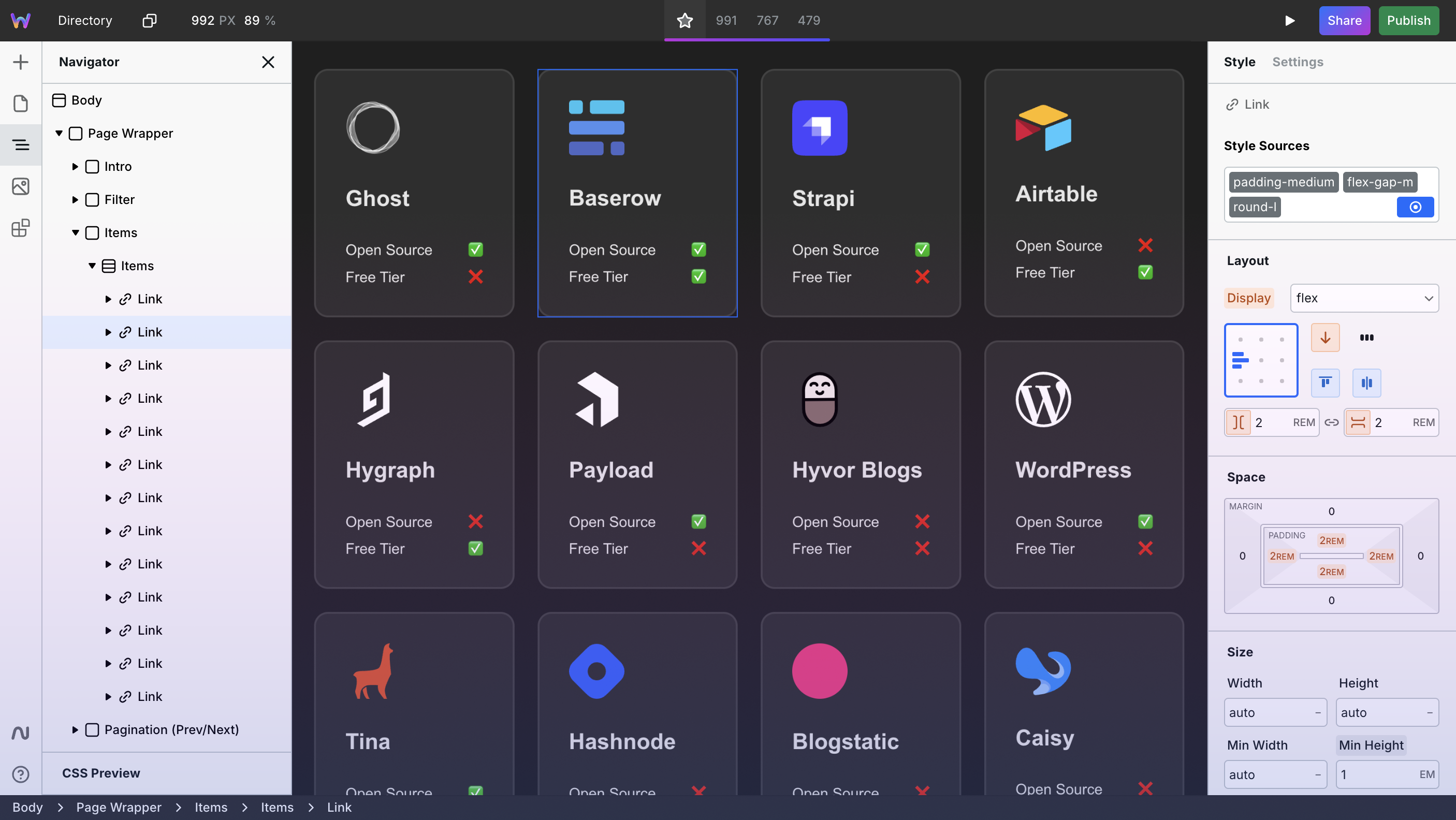
Sharing metadata
| og:url | https://webstudio.is/ |
|---|---|
| og:type | website |
| og:image | https://webstudio.is/cgi/image/visual-builder_6p7VS5-OlwHXPek83iJwo.png?format=raw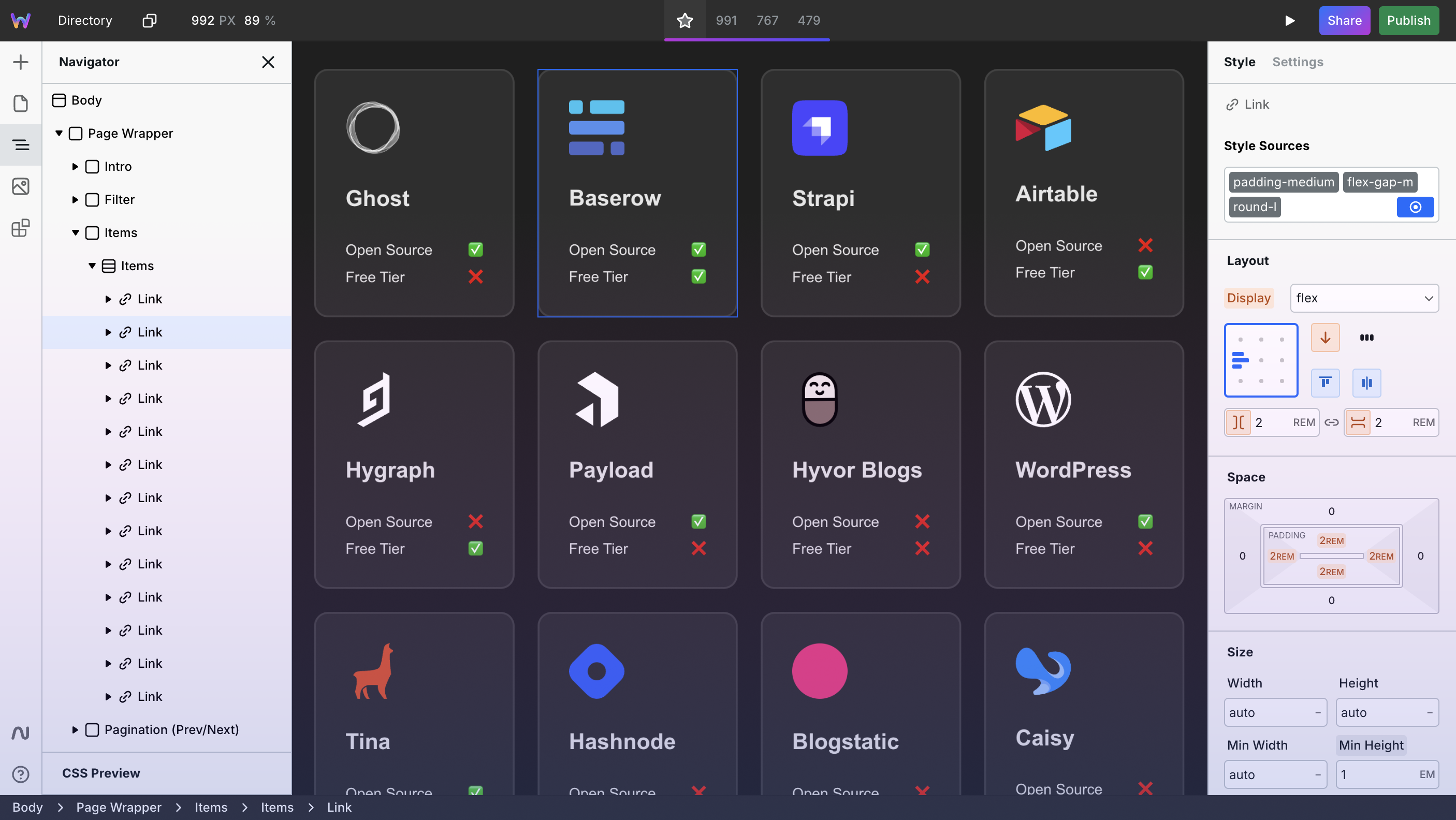 |
| og:title | Webstudio — Advanced Open Source Website Builder |
| og:site_name | Webstudio |
| og:description | Webstudio is an open source website builder that empowers creators to build highly maintainable and fast websites using modern web standards. |
| twitter:card | summary_large_image |
robots.txt (opens in a new tab)
1 rulesAll bots 0 allowed · 1 disallowed

 All bots

/api/
No matching rules.
Sitemaps
1 Registration details RDAP / WHOIS
| Registrar | Unknown |
|---|---|
| Registered | 2022-01-26 |
| Expires | Unknown |
| Domain status | active |
| Nameservers | cosmin.ns.cloudflare.com、sandra.ns.cloudflare.com |
| DNSSEC | unsigned |
 DNS records
| Type | Name | Value | TTL | Priority |
|---|---|---|---|---|
| A | webstudio.is | 104.26.12.107 | 222 | — |
| A | webstudio.is | 104.26.13.107 | 222 | — |
| A | webstudio.is | 172.67.75.51 | 222 | — |
| AAAA | webstudio.is | 2606:4700:20::681a:c6b | 300 | — |
| AAAA | webstudio.is | 2606:4700:20::681a:d6b | 300 | — |
| AAAA | webstudio.is | 2606:4700:20::ac43:4b33 | 300 | — |
| MX | webstudio.is | aspmx.l.google.com | 300 | 1 |
| MX | webstudio.is | alt1.aspmx.l.google.com | 300 | 5 |
| MX | webstudio.is | alt2.aspmx.l.google.com | 300 | 5 |
| MX | webstudio.is | aspmx2.googlemail.com | 300 | 10 |
| MX | webstudio.is | aspmx3.googlemail.com | 300 | 10 |
| NS | webstudio.is | cosmin.ns.cloudflare.com | 86400 | — |
| NS | webstudio.is | sandra.ns.cloudflare.com | 86400 | — |
| TXT | webstudio.is | ahrefs-site-verification_102edba958cbe2fcd824c8c172552dbc37eb62a0041400565a9f948f43f2d5c4 | 30 | — |
| TXT | webstudio.is | cname.vercel-dns.com | 30 | — |
| TXT | webstudio.is | google-site-verification=1Fso7rf0LnexC1rm9vy0T3AHQxADXJewcNEPcPDcDb8 | 30 | — |
| TXT | webstudio.is | google-site-verification=uDwR3iGutTQcjpN8sl-ISjRnmAuL9H54sxKCP4hbJ9Y | 30 | — |
| TXT | webstudio.is | v=DMARC1; p=reject; rua=mailto:[email protected]; pct=100; adkim=s; aspf=s | 30 | — |
| TXT | webstudio.is | v=spf1 include:spf.mailjet.com include:_spf.google.com -all | 30 | — |
| DMARC | _dmarc.webstudio.is | v=DMARC1; p=none; rua=mailto:[email protected] | 300 | — |
 TLS and certificates
| Assessment | Normal configuration |
|---|---|
| Supported protocols | TLSv1.2、TLSv1.3 |
| Negotiated protocol | TLSv1.3 |
| Certificate subject | webstudio.is |
| Issuer | Let's Encrypt |
| Valid until | 2026-12-22T09:11 · Remaining when checked: 87 days |
| Verification details | Certificate trust: Passed · Hostname match: Passed |
 HTTP response headers
| Header | Value |
|---|---|
| content-type | text/html |
| cache-control | public, max-age=0, must-revalidate |
| server | cloudflare |
| strict-transport-security | max-age=63072000; includeSubDomains; preload |
| content-security-policy | frame-ancestors 'self' |
| x-frame-options | SAMEORIGIN |
| x-content-type-options | nosniff |
| referrer-policy | strict-origin-when-cross-origin |
 Identified technologies
User reviews (0)