Website profiles · Technology insights · Alternatives

writinghooks.com

Practice writing attention-grabbing hooks by studying proven examples, reverse-engineering their patterns, and creating your own versions with reusable templates and AI-powered feedback

Paid content
Visit website
Profile views 8 Outbound visits 3 Normal
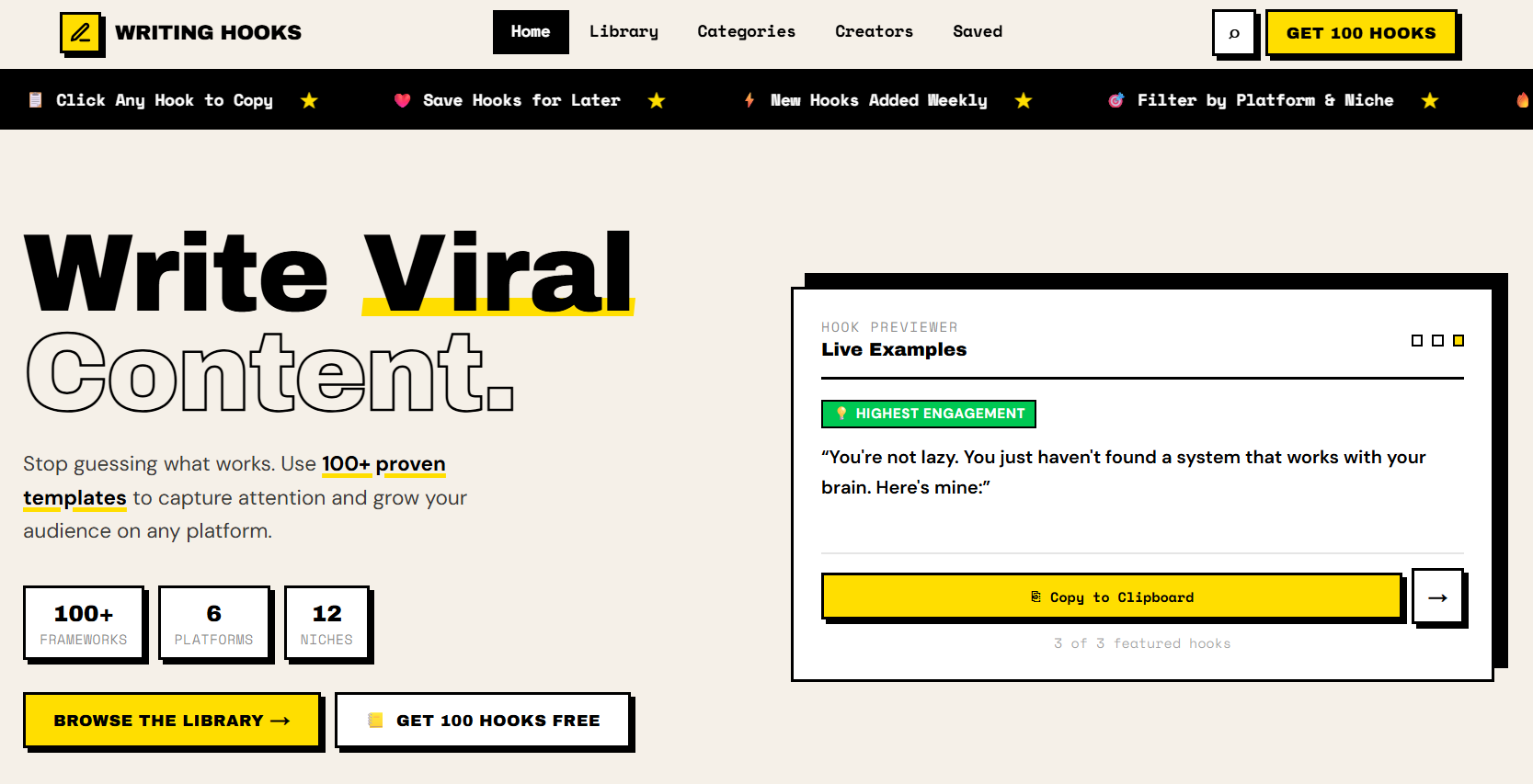
Writing Hooks Full homepage screenshot

At a glance

Category
Artificial Intelligence
Language
English
Paid-content signal
Paid contentObserved
Registered
2026
Hosting
VercelInferred
HTTPS certificate trusted
PassedObserved
Last updated

Website review

This review may include AI-generated content and is not individually verified. Domain, certificate and other facts come from the observed data on this page.

What is Writing Hooks?

Writing Hooks is an interactive practice tool for learning to write attention-grabbing opening lines. Rather than just reading advice about hooks, you work with proven examples: study them, reverse-engineer the pattern behind them, then write your own versions using reusable templates with AI-powered feedback. The site's framing is "Make them stop scrolling," which tells you the intended audience: creators, copywriters, and marketers writing for feeds where the first line decides whether anything else gets read.

What you actually do there

  • The Hook Library — a collection of examples to study rather than just skim.
  • Writing Challenges — structured practice, so you're producing hooks instead of only consuming them.
  • Anatomy of a Viral Hook — breakdowns that show why a given opening works.
  • The Creator Wall — a place to see what other people are writing.
  • AI Prompts for Hooks — prompt-based help for generating and refining options.

The core loop is study → deconstruct → imitate → get feedback. That's a meaningfully different activity from reading a copywriting blog post, and it's the main reason to consider this over general writing resources.

Who gets the most out of it

If you already publish — short-form video scripts, newsletters, LinkedIn posts, ad copy, YouTube titles and intros — the value is repetition. You arrive with real material you need to ship, run it through the pattern exercises, and leave with several candidate openings. If you're a beginner with no publishing habit, the challenges still work as drills, but you'll get more from them once you have something real to apply them to.

Trade-offs to weigh

  • Pattern-based practice builds speed and instinct, but hooks that follow recognizable formulas can read as formulaic. The tool teaches the shape; you still supply the specific, surprising detail that makes a hook land.
  • AI feedback is useful for volume and quick iteration, but it tends to reward familiar structures. Treat its suggestions as a first pass, not a verdict.
  • Templates are a starting point. The strongest hooks usually break the template in one deliberate way.

The site lists a "Buy Now" path, so some or all of it is paid — check the current terms on the site before committing, since I can't confirm what's free versus gated.

A practical next step

Pick one piece you're publishing this week. Write its opening line, then rewrite it five times using five different patterns from the library. Compare them side by side and ask which one a distracted reader would stop for — that single exercise tells you quickly whether this kind of drilling fits how you work. For broader craft context alongside it, Copyblogger covers headline and opening principles, and Ann Handley writes well on voice and keeping readers engaged past the first line.

How can I practice writing hooks on this site?

Practice on Writing Hooks happens in three connected steps: study a hook, take it apart, then write your own.

How the practice loop works

  • The Hook Library gives you proven examples to read before you write anything. This is the study phase — you're collecting patterns, not producing yet.
  • Anatomy of a Viral Hook is where you reverse-engineer why an example works. This is the step most people skip, and it's the one that transfers: naming the mechanism (a curiosity gap, a specific number, a contrarian claim) is what lets you reproduce it deliberately.
  • Writing Challenges push you to produce your own versions rather than copy. This is the reps stage.
  • AI Prompts for Hooks and the built-in editor give you feedback and reusable templates, so you can iterate on a weak attempt instead of starting over.
  • The Creator Wall shows what other people wrote, which is useful for calibrating what "good" looks like beyond the curated library.

The page's own framing — "Make them stop scrolling" — tells you the target: the first line's only job is to earn the next one.

A concrete way to use it

Pick one hook from the library that genuinely stopped you. Write down its structure in plain words ("states a mistake, then implies most people make it"). Then write three of your own using that same structure about your own topic, and put the best one through the editor or an AI prompt for feedback. Repeat with a different pattern the next day. Ten patterns practiced this way will do more for you than reading a hundred examples.

A decision criterion

If you're a creator, copywriter, or founder writing posts and emails yourself, the reverse-engineering step is the highest-value part — it builds a reusable mental library. If you already write confidently and just want faster output, the templates and feedback loop will save you more time than the challenges.

Next step

Choose one pattern you use often — a question hook, a number hook, a "most people get this wrong" hook — and write five versions of it for a single piece of content. Then compare them side by side and keep the one you'd actually click.

For deeper grounding in the underlying craft, Copyblogger covers headline and opening-line technique, and Copyhackers focuses on conversion-oriented copy if your hooks are selling something.

What hook patterns and frameworks are available in the Hook Library?

The Hook Library is where you study proven hook patterns rather than guess at them. According to the site, it works in three stages: read examples, reverse-engineer the pattern behind each one, then write your own version using a reusable template. It also lists Writing Challenges and an "Anatomy of a Viral Hook" section, so the library is meant to be practiced against, not just browsed.

What you can expect to get out of it

  • Named, reusable patterns. Instead of one-off lines, you work with structures you can refill with your own topic.
  • Reverse-engineering practice. Taking a strong example apart is what makes the pattern transferable to a different niche.
  • Templates for your own drafts. The library feeds directly into writing, so study time turns into output.
  • Feedback on your attempts. The site describes AI-powered feedback, which is the part that tells you whether your version actually lands.
  • Challenges as a forcing function. Useful if you read examples passively and never ship anything.

A concrete way to use it

Pick one pattern, write three versions for a single piece you already need to publish — a newsletter subject line, a short-video opening, a landing-page headline — and compare which one you would actually click. Repeat with a second pattern the next day. Two patterns you can execute under pressure beat twenty you only recognise.

Choosing between this and alternatives

If your need is… Better fit
Structured practice with templates and feedback Writing Hooks Writing Hooks
Broad copywriting and marketing fundamentals Copyblogger
Headline-specific testing and scoring CoSchedule
Short-form video hook inspiration TikTok (study your own niche's top posts)

Trade-off to weigh: pattern libraries speed up your first draft but can make everything sound alike. Use the library to get unstuck, then rewrite the opening in your own voice before publishing.

Next step: open the Hook Library, choose one pattern, and rewrite the first line of a piece you have already published to see whether the new version is genuinely stronger.

How does the AI-powered feedback help improve my hooks?

AI-powered feedback on Writing Hooks works as a fast review layer on top of the practice the site already builds in: you study examples, reverse-engineer their patterns, write your own version, and then get a critique instead of guessing whether it landed.

What that feedback is useful for

  • Spotting weak openings. Most weak hooks fail in the first few words. A critique that reacts to your draft can flag when you open with throat-clearing ("In today's world…") rather than tension, a number, or a specific claim.
  • Checking pattern fit. The site is organized around proven hook patterns and templates. Feedback is most valuable when it tells you whether your draft actually follows the pattern you chose, or drifts into a generic sentence that just sounds like one.
  • Cutting length. Hooks usually improve when trimmed. An automated pass is good at surfacing words that add nothing, which is tedious to catch on your own draft.
  • Testing variants. Because you can iterate quickly, you can write three or four versions of the same hook and compare the critiques rather than committing to your first attempt.

Where it helps least

AI feedback tends to be better at structure, clarity and pattern-matching than at whether a hook is true to your voice or appropriate for a specific audience. It also can't tell you if a claim is accurate or if a bold hook overpromises what your content delivers. Treat it as a first-pass editor, not a final judge.

A practical way to use it

  1. Pick one pattern from the library and write a hook for a real piece you're publishing.
  2. Submit it and note only the one or two criticisms you agree with.
  3. Rewrite once, then compare the two versions side by side yourself before deciding.
  4. Keep a personal file of hooks that performed well; that record will eventually beat any automated critique.

If you want a human second opinion on the final version, a writing community such as Reddit's r/copywriting can give you audience-specific reactions that feedback tools can't.

Can I use Writing Hooks to write hooks for social media or marketing content?

Yes. Writing Hooks is built around exactly that use case: short, attention-grabbing opening lines for social posts, ads, emails and other marketing content. The page frames the goal as "Make them stop scrolling," and its core sections support hook writing directly rather than general long-form drafting.

What you can actually do there

  • The Hook Library — study proven examples to see what patterns successful hooks follow.
  • Writing Challenges — practice producing your own hooks instead of only reading them.
  • Anatomy of a Viral Hook — break down why a hook works, which is the reverse-engineering step.
  • AI Prompts for Hooks — generate or refine options with AI assistance.
  • The Creator Wall — a community-facing area, useful if you want to see how other creators approach the same problem.

Where it fits and where it doesn't

Your task Good fit? Why
Social captions, Reels/TikTok openers, X/LinkedIn first lines Yes The whole tool is scoped to the first line that earns attention
Ad headlines, email subject lines, landing-page openers Yes Same skill: pattern recognition plus fast variation
Practicing and improving your hook instincts over time Yes Challenges and pattern breakdowns are built for repetition
Writing the full post, article, script or sales page No It stops at the hook; you'd draft the body elsewhere
SEO keyword research or publishing/scheduling No Not what the page covers

A practical way to use it

Take one real piece of content you need to publish this week. Pull three hooks from the library that resemble your topic, write down the pattern each one uses (curiosity gap, contrarian claim, specific number, direct callout), then write five of your own on that same pattern for your actual post. Run the weakest two through the AI prompts to see what changes. You end up with tested options for real work rather than abstract practice.

Decision criterion

Choose it if your bottleneck is the opening line — you can write the rest but your posts get scrolled past. Skip it if you need an all-in-one writing or scheduling tool, or if you already have a hook process that performs well.

For broader copywriting and marketing craft alongside it, Copyblogger and Copyhackers cover the surrounding skills.

Is Writing Hooks free to use, and what does the paid version include?

Writing Hooks is not positioned as a free tool: the site includes a "Buy Now →" link, which suggests paid access, but the page evidence provided does not specify a free tier or list what a paid plan includes. Treat any claim about a free version or exact paid features as unconfirmed until you check the site directly.

What the page does show

  • Hook Library — a collection of examples to study.
  • Writing Challenges — practice exercises.
  • Anatomy of a Viral Hook — breakdowns of why hooks work.
  • The Creator Wall — likely a showcase of user or creator hooks.
  • AI Prompts for Hooks — prompts for generating or refining hooks.

How to decide If you mainly want to browse examples, a free trial or sample library would be enough. If you want structured practice, reusable templates and AI feedback, that is the kind of feature set usually reserved for a paid tier — but confirm it on the site rather than assuming.

Practical next step: open Writing Hooks and look for a pricing or plans page. Compare the free limits (number of hooks, feedback, templates) against the paid tier, and check whether payment is one-time or recurring before buying.

Related questions

More questions →
How to Practice Writing Hooks That Stop the Scroll Using Proven Patterns

To write hooks that stop the scroll, don't start from a blank page. Start from a proven example: find a hook that worked, reverse-engineer the pattern underneath it, then draft your own version using a reusable template and revise it against feedback. Writing Hooks (writinghooks.com) is built around exactly this loop — a Hook Library of examples, Writing Challenges to practice, an "Anatomy of a Viral Hook" breakdown, and AI Prompts for Hooks to get feedback. This guide walks through that loop step by step, plus how to diagnose a weak hook and fix it.

Step 1: Reverse-engineer a hook you already know works

Before you write anything, study one example closely. The goal isn't to copy the line — it's to extract the structure so you can reuse it with your own topic.

Take a hook you've seen stop your own scroll, and answer:

  • What is the first word or phrase? Hooks usually front-load the tension, the number, or the surprising claim.
  • What promise or gap does it open? A good hook makes you need the next line to close a loop.
  • What's the pattern? Strip the topic away and name the skeleton — e.g. "Most people do X. Here's what actually works." or "I did X for Y days. Here's what happened."

The "Anatomy of a Viral Hook" section on Writing Hooks is designed for this kind of teardown, and the Hook Library gives you a bank of examples to pull from when you don't have one in mind.

Expected result: you end up with a one-line pattern you can fill with any topic, not a single copied hook.

Step 2: Draft with a reusable template

Once you have the pattern, turn it into a template with blanks. This is what makes practice repeatable instead of random.

For example, if your pattern is "Most people do X. Here's what actually works," your template becomes:

Most people [common approach]. Here's what actually [better outcome].

Then draft 3–5 versions against your actual topic. Keep them short — the first line has to earn the second.

Writing Hooks provides reusable templates for this stage, so you're filling proven structures rather than inventing a format from scratch each time.

Step 3: Practice under a constraint, not in the abstract

Free-writing hooks rarely improves them. Practice works better when you add a limit — a format, a platform, or a time box.

Writing Challenges on the site are built for this: you practice a specific pattern rather than "writing hooks" in general. If you're doing it on your own, set a constraint such as:

  • Write 10 hooks for one piece of content in 10 minutes.
  • Write the same hook five different ways using five different patterns.
  • Write hooks for three different formats (a short video, a newsletter subject line, a post caption) from the same idea.

Why this matters: constraints force you to feel which patterns fit which formats, which is the skill that transfers to real work.

Step 4: Get feedback and revise

A first draft hook is rarely the one that stops the scroll. The revision step is where most of the improvement happens.

Use AI Prompts for Hooks on Writing Hooks to get feedback on your drafts, or run this check yourself:

Question If the answer is no
Does the first 3–5 words carry tension or curiosity? Move the interesting part to the front
Is there a clear promise or open loop? Add the payoff or the question
Is it specific (number, name, outcome)? Replace vague words with concrete ones
Would it work with the topic removed? It's probably too generic — sharpen it

Diagnosing a weak hook: if a hook feels flat, it's usually because the tension is buried in the middle, the promise is vague, or it sounds like everything else in the feed. Fix the position first, then the specificity.

Step 5: Apply the same frameworks across formats

The patterns transfer, but the execution changes by platform. A hook that works as a video opener may need to be compressed for a subject line or expanded for a caption. The Creator Wall on Writing Hooks shows how other creators apply hooks in practice, which is useful for seeing the same pattern in different formats.

When adapting, keep the pattern and change the delivery:

  • Short video: the first spoken or on-screen words are the hook.
  • Newsletter subject line: the hook is the whole line — no room for setup.
  • Post caption: the first line before the "more" cutoff is the hook.

A realistic practice loop

  1. Pick one example from the Hook Library.
  2. Reverse-engineer its pattern using the Anatomy of a Viral Hook breakdown.
  3. Fill a reusable template with your own topic — draft 3–5 versions.
  4. Run a Writing Challenge to practice the pattern under a constraint.
  5. Get AI-powered feedback and revise the weakest line.
  6. Adapt the strongest version to a second format.

Repeat with a new pattern. The point isn't to memorize hooks — it's to build a mental library of patterns you can reach for on demand, so the next hook you write starts from structure instead of a blank page.

How to Write Hooks That Stop the Scroll: Practice with Proven Patterns

The fastest way to write hooks that stop the scroll is to stop inventing from scratch and start reverse-engineering. Writing Hooks (writinghooks.com) is built around exactly that loop: study proven examples in a hook library, break them into patterns, draft your own versions with reusable templates, and get AI-powered feedback on each attempt. This approach works if you already publish content and want a repeatable way to improve your opening lines — it is a practice tool, not a one-click generator. If you only need a single headline and never plan to write again, a template list alone will do.

Why practicing beats collecting

Most people collect hook formulas and never use them. The gap is repetition with feedback. Writing Hooks structures that gap into four activities, each with a different job:

Activity What it does When to use it
The Hook Library Shows proven examples you can study When you need raw material to learn from
Anatomy of a Viral Hook Breaks an example into its working parts When you want to understand why a hook works
Writing Challenges Gives you a constrained prompt to draft against When you need reps, not theory
AI Prompts for Hooks Generates feedback on your attempt When you want a second opinion before publishing

The site also includes The Creator Wall, which surfaces what other creators are producing — useful for calibrating your own attempts against real output rather than abstract advice.

Step 1: Reverse-engineer before you write

Open The Hook Library and pick three hooks that made you stop. For each one, answer:

  • What is the first word or phrase doing? (Usually creating a gap, a stake, or a surprise.)
  • What promise or tension does the second clause introduce?
  • What would you have expected instead — and how does the hook break that expectation?

Then move to Anatomy of a Viral Hook and compare your breakdown against the site's. The goal is not to memorize the example but to name the pattern, so you can reproduce the structure with your own topic.

Step 2: Draft against a constraint, not a blank page

Blank pages produce generic hooks. Writing Challenges removes the blank page by giving you a specific prompt or format to write into. Treat each challenge as a rep:

  1. Read the challenge constraint.
  2. Write 5–10 hook variations without editing.
  3. Pick the two that create the strongest gap between what the reader expects and what you deliver.

Constraints are the point. A hook written to a tight brief is easier to evaluate than one written in open space, because you can see whether it met the brief.

Step 3: Get feedback and revise

Use AI Prompts for Hooks to review your drafts. A useful feedback loop asks specific questions rather than "is this good?" — for example, whether the hook creates curiosity, whether the promise is clear, and whether the first three words carry weight. Revise based on what you can verify: if the feedback says the stake is unclear, rewrite the stake, don't just reword the sentence.

Step 4: Build a repeatable routine

Consistency matters more than any single hook. A workable routine:

  • Daily (10 min): one challenge, five drafts, no editing.
  • Weekly (20 min): reverse-engineer three hooks from the library and label their patterns.
  • Before publishing: run your chosen hook through the feedback prompt and revise once.

Track which patterns you use most. Over time you will notice which structures fit your voice and format — short-form video hooks behave differently from newsletter subject lines, and the library lets you compare across formats.

Common sticking points

  • Copying instead of adapting. A hook that worked for someone else's audience may not fit yours. Extract the structure, swap the specifics.
  • Editing while drafting. It kills volume. Draft first, select second.
  • Skipping the "why." If you can't explain why a hook works, you can't reproduce it reliably.
  • Treating feedback as verdict. AI feedback is a prompt to revise, not a final score.

What to check before committing

Writing Hooks offers a purchase path (a "Buy Now" link on the site), so some features may sit behind payment. The site does not publish pricing details in the material available here, so check the buy page directly for current terms before assuming what is free. If you want to test the loop first, start with the free-facing activities — the library, the anatomy breakdown, and the challenges — and see whether the practice format fits how you actually work.

What Is the Creator Economy? How Independent Creators Make a Living

The creator economy is the ecosystem of independent people who publish content and earn from it directly, rather than as employees of a media company. It includes YouTubers, newsletter writers, podcasters, streamers, course sellers, illustrators, and niche experts who build an audience and monetize it. You count as part of it if you publish under your own name or brand and capture some of the value yourself. You don't need a huge following to participate—you need a repeatable way to reach people and at least one way to get paid.

Who counts as a creator

The label is broader than "influencer." The defining trait is that you own the relationship with your audience and the output.

  • Publishers: YouTubers, bloggers, newsletter writers, podcasters
  • Performers and streamers: live video, gaming, music, comedy
  • Educators: course creators, coaches, tutors, technical writers
  • Artists and makers: illustrators, designers, photographers, craft sellers
  • Service providers with an audience: freelancers and consultants who publish to attract clients

A useful test: if a platform disappeared tomorrow, could you still reach your audience? If yes, you're operating as a creator business. If no, you're renting distribution.

The main ways creators earn

Most sustainable creators stack several of these rather than relying on one.

Revenue stream How it works Best when
Ads and platform payouts Platforms share ad or subscription revenue based on views/watch time You have high, consistent traffic
Sponsorships and brand deals A brand pays for a mention, integration, or dedicated piece Your audience matches a brand's customer
Subscriptions Readers/viewers pay monthly for access or extra content You publish reliably and offer ongoing value
Digital products Courses, templates, ebooks, presets, memberships You can package repeatable expertise
Services Freelance work, consulting, coaching You want fast revenue and direct client contact
Affiliate and commerce Commission on products you recommend or sell Your recommendations are trusted

The mix matters more than any single line. Ads reward scale; products and services reward trust and specificity. A small, engaged audience often earns more from products and services than a large passive one earns from ads.

How platforms and tools shape the work

Platforms decide how your work gets discovered and how you get paid. That cuts both ways.

  • Distribution: Recommendation feeds can push a single piece to millions, but they can also bury you without warning. Algorithms reward watch time, saves, and shares—not effort.
  • Monetization: Each platform sets its own payout rules, thresholds, and revenue splits. These change, so treat any single payout as unstable.
  • Tools: Writing tools, schedulers, email platforms, and payment processors lower the cost of publishing and selling. For example, Writing Hooks is built around practicing attention-grabbing hooks—studying proven examples, reverse-engineering their patterns, and writing your own with reusable templates and feedback. Its library, challenges, and hook breakdowns reflect a core creator-economy skill: earning the first few seconds of attention. The site lists a "Buy Now" option, so assume paid access rather than a free tool unless you check the page.

The practical takeaway: use platforms for reach, but don't let them be your only channel.

Why audience ownership matters

Direct relationships—email lists, communities, your own site—are the difference between a hobby and a business.

  • You control the channel. No algorithm change or account suspension erases your list.
  • You can sell directly. Email and community convert to products and services far better than a public feed.
  • You can negotiate. Brands pay more when you can prove a direct, engaged audience.

A common pattern: use social platforms as the top of the funnel, then move interested people to a channel you own. The hook gets the click; the owned channel keeps the customer.

Common misconceptions and realistic expectations

  • "You need a million followers." You don't. A few thousand true fans who buy can outperform a large passive audience.
  • "It's passive income." Most income streams require ongoing publishing, support, and iteration. Products sell because you keep showing up.
  • "One viral post changes everything." Virality brings attention, not income. Converting that attention takes an offer and a follow-up path.
  • "Everyone makes a full-time living." Many creators earn part-time or supplementary income. Full-time income usually follows years of consistent output and a diversified revenue mix.
  • "The platform will pay me." Platform payouts are one stream, often the smallest. Treat them as a bonus, not a plan.

How to start, in order

  1. Pick one topic and one primary format. Narrow beats broad when you're unknown.
  2. Publish on a schedule you can sustain. Consistency teaches the algorithm and your audience what to expect.
  3. Practice the hook. The first line or first three seconds decide whether anything else gets seen.
  4. Start an owned channel early. Collect emails from day one.
  5. Add one revenue stream, then another. Begin with services or a small product, then layer subscriptions or sponsorships as your audience grows.
  6. Track what converts. Views are vanity; clicks, replies, and sales tell you what's working.

If you want to build the skill that sits at the front of all of this—getting someone to stop scrolling—practicing hooks with proven patterns is a reasonable place to start, and tools like Writing Hooks are designed for exactly that.

What Makes a Viral Hook? Anatomy and Patterns of Attention-Grabbing Hooks

A viral hook works because it creates an unresolved gap between what the reader knows and what they want to know, then closes that gap fast enough to earn the next second of attention. The pattern matters more than the wording: most hooks that stop the scroll do one of a few recognizable jobs — call out a specific reader, promise a concrete payoff, or open a loop the brain wants closed. You can learn these patterns by reverse-engineering examples, then practicing your own versions against them.

The anatomy of a viral hook

Writing Hooks frames this as "Anatomy of a Viral Hook" — the idea that a hook has identifiable parts you can name, copy, and swap. In practice, most attention-grabbing hooks combine three elements:

  • A specific target or situation. "If you write landing pages…" or "When your video dies at 0:03…" beats "For creators." Specificity signals this is for me and filters out everyone else.
  • A tension or gap. A question, a contradiction, a number that doesn't add up, or a claim that sounds wrong. The gap is what makes scrolling feel more expensive than reading.
  • A reason to keep going. An implied payoff — a method, a result, a reveal — that the rest of the content actually delivers.

A hook that has tension but no payoff trains readers to distrust you. A hook with payoff but no tension gets skipped. The viral ones hold both at once.

Why the gap does the work

Attention is a cost-benefit decision made in under a second. A hook that names a problem the reader already feels ("your hooks fall flat") and implies a fix creates a small debt: I should know this. That debt is the engine. The stronger and more personal the debt, the harder it is to scroll past.

Common viral hook patterns

These are the recurring shapes you'll see across short-form video, newsletters, and landing pages. Treat them as templates, not scripts.

Pattern What it does Example shape
Callout Names the exact reader "If you're a [role] who [struggle]…"
Contrarian Challenges a belief "Everything you know about [topic] is backwards."
Open loop Starts a story mid-tension "I almost deleted this. Then it hit 2M views."
Specific number Promises a bounded payoff "3 hooks that doubled my watch time."
Mistake Names a costly error "The hook mistake killing your first 3 seconds."
Before/after Shows a transformation "This hook got 200 views. Here's the rewrite."

The pattern is the skeleton. Your topic, audience, and voice are the flesh — which is why copying a viral hook word-for-word usually fails while copying its structure often works.

How to apply a pattern to your own content

  1. Pick the pattern that matches your goal. Want saves and shares? Use a specific number or before/after. Want comments? Use contrarian or callout.
  2. Fill it with a real, specific detail. Replace every vague noun with the actual thing: the real metric, the real mistake, the real audience.
  3. Cut everything before the tension. If your first sentence is setup, delete it. The hook is the first sentence.
  4. Write the payoff before you publish. If you can't state what the reader gets, the hook is promising something you don't have.
  5. Test more than one version. Write 3–5 hooks for the same piece and compare which one you'd stop for.

Writing Hooks supports this loop directly: its Hook Library gives you proven examples to study, Writing Challenges push you to produce your own, and AI-powered feedback plus reusable templates let you iterate instead of guessing. The "Creator Wall" and "AI Prompts for Hooks" sections extend the same practice into a community and prompt-driven workflow.

Mistakes that make hooks fall flat

  • Vagueness. "Grow your audience" targets no one. Name the reader and the outcome.
  • Burying the tension. If the interesting part is in sentence three, sentence one is dead weight.
  • Overpromising. A hook the content can't cash destroys trust and kills retention on the next post too.
  • Pattern without substance. A contrarian claim with nothing behind it reads as clickbait.
  • No practice loop. Reading hooks doesn't build the skill; writing and revising them does.

Where to practice

If you want a structured way to build the skill rather than just read about it, Writing Hooks is built around exactly that: study proven examples, reverse-engineer their patterns, write your own versions with reusable templates, and get AI feedback on each attempt. The site lists a "Buy Now" option at writinghooks.com/buy — check that page for current access and pricing details, since the available material doesn't specify them.

The short version: a viral hook is a specific promise wrapped in tension, delivered in the first line. Learn the patterns, fill them with real detail, and practice until writing them is fast.

How to Write Content Hooks That Stop the Scroll: Study Patterns and Practice

To write content hooks that stop the scroll, work in four moves: study proven examples, reverse-engineer the pattern behind each one, rebuild it with a reusable template for your own topic, then practice in volume and iterate on feedback. This works for short-form video, newsletters, and social posts where the first line carries the whole burden of earning attention. It assumes you already know your topic and audience; the bottleneck is the opening, not the idea.

What a hook actually has to do

A hook is not a summary. It is a trade: you promise the reader something worth their next few seconds, and you create just enough tension that they can't resolve it without continuing. Writing Hooks frames this as "make them stop scrolling" — the hook's only job is to interrupt an automatic behavior.

Three things have to be present in the first few seconds:

  • A promise — a specific payoff the reader can picture.
  • Tension — an open loop, conflict, or gap between what they know and what you're implying.
  • Self-interest — a clear reason this matters to them, not to you.

If any one is missing, the hook reads as either vague ("Let's talk about productivity"), flat ("Here are some tips"), or self-centered ("I've been thinking a lot lately").

The common hook patterns worth studying

Most scroll-stopping hooks reuse a small set of patterns. Learn to name them and you can generate options on demand instead of waiting for inspiration.

Pattern What it does Example shape
Suspense / open loop Starts a story or claim and delays the resolution "I almost deleted this whole project — then one line changed it."
Conflict / contrast Puts two opposing things side by side "Everyone says post more. My best month came from posting less."
Counter-intuitive claim Breaks an assumption the reader holds "Your hook isn't too weak. It's too long."
Specific payoff Names a concrete, measurable result "This one sentence doubled my reply rate."
Direct callout Names the exact person who should care "If your posts get views but no clicks, read this."

The pattern matters more than the wording. Once you can label which pattern a hook uses, you can swap in your own topic and keep the structure.

Anatomy of a viral hook: reverse-engineer it

Take any hook you admire and pull it apart in this order. The Writing Hooks site treats this as "Anatomy of a Viral Hook" — the goal is to see the machinery, not just feel the effect.

  1. First words. What is the very first noun or verb? Strong hooks front-load a concrete subject, not throat-clearing.
  2. The promise. Write down, in one sentence, what the reader expects to get.
  3. The tension. What question is left open? What does the reader not yet know?
  4. The stake. Why does it matter to the reader specifically?
  5. The length. Count the words. Most effective hooks are shorter than you think.

Do this for five hooks in your niche. You'll usually find they share two or three patterns from the table above — that's your template set.

Turn patterns into reusable templates

A template is a pattern with blanks. Build one per pattern you want to use, then fill it for your topic.

Suspense:    "I [did unexpected thing] — and [surprising result]."
Contrast:    "Everyone [common advice]. I [opposite] and [outcome]."
Counter:     "You don't have a [problem] problem. You have a [real cause] problem."
Payoff:      "This [small thing] [specific measurable result]."
Callout:     "If you [specific situation], this is for you."

For each piece of content, fill the same template three to five times. You are not looking for the perfect hook on the first try — you are generating options so you can pick the strongest. Writing Hooks supports this with a hook library, writing challenges, and AI prompts for hooks, so you can practice against examples rather than a blank page.

Practice loop: study, write, get feedback, repeat

Improvement comes from volume plus correction, not from reading about hooks.

  1. Study — pick one pattern and find three real examples.
  2. Write — produce five hooks for your next piece using that pattern only.
  3. Test — pick the one that best balances promise, tension, and self-interest.
  4. Get feedback — use the site's AI-powered feedback or a peer to flag vagueness and length.
  5. Repeat — rotate to a new pattern next session so you build range.

Writing Challenges on the site exist for exactly this: short, constrained reps that force you to apply a pattern instead of defaulting to your usual opening.

Why hooks fail: a diagnostic checklist

When a hook doesn't stop the scroll, the cause is usually one of these:

  • Too generic. "Here's how to grow" could be about anything. Name the specific person, number, or situation.
  • Vague promise. The reader can't picture the payoff. Replace abstractions with concrete outcomes.
  • Slow start. The real hook is in sentence two. Move it to the front.
  • No tension. Everything is resolved in the first line, so there's no reason to continue.
  • Wrong audience. It's interesting to you, not to the person scrolling.
  • Overlength. If it takes more than a breath to read, cut it.

Run your draft against this list before publishing. Most weak hooks fail on the first two.

When to use this approach

This method fits creators, copywriters, and anyone writing for feeds where attention is the scarce resource — short video, social posts, email subject lines, newsletter openers. It's less useful for long-form where the title and structure carry more weight than a single opening line. If you're just starting, pick two patterns, build two templates, and run the practice loop for a week before expanding your set.

Website Overview

Several search or sharing settings need attention. Together they may make snippets, preview images or preferred URLs less consistent across platforms. An active inbound-mail setup with incomplete authentication may leave the domain more open to impersonation. Provider hosting alone does not close that gap.

Domain and Registration

The domain was registered less than a year ago and has limited historical evidence to assess. Transfer-protection status is present, helping reduce the risk of unauthorized domain transfers. The registrar is NameCheap, Inc., a widely used domain service provider. The domain uses the common .com extension, which is not an independent safety signal.

DNS and Email

The observed email authentication setup is incomplete: DMARC is missing. Nameservers are provided by Namecheap, indicating managed DNS hosting. MX records point to the registrar-servers.com email service. No CNAME was found; the observed records resolve directly to addresses. TXT records include verification markers for Google. Such markers may also remain after a service stops being used.

TLS and Certificates

The certificate uses an RSA 2048-bit public key, offering broad client compatibility. The server supplied a complete certificate chain. No organization name is present in the certificate; the available fields are consistent with domain validation. The certificate was issued by Let's Encrypt, commonly associated with automated certificate services. The certificate's total validity is about 89 days, consistent with a short renewal cycle.

HTTP and Browser Security

X-Powered-By exposes backend information: Next.js. The response lacks these common security headers: CSP, X-Content-Type-Options, Referrer-Policy, Permissions-Policy, clickjacking protection. No obvious internal addresses or debug information were found in the headers. The Server header contains the custom value Vercel. No explicit CDN or WAF marker was found in the response headers.

Technology Stack Analysis

The public page identifies Next.js, Google Analytics, Vercel without precise versions, leaving fewer clues for version-specific scanning.

Search and Social Sharing

The title has 101 characters and may be truncated in search results. The meta description has 185 characters and may be shortened in search results. Open Graph is partially configured; og:type is missing. Twitter Card metadata is configured. JSON-LD includes Organization data, helping describe the organization as an entity.

Hosting and Email

DNSNamecheap
HostingVercel
Emailregistrar-servers.com
Approximate IP geolocation (inferred; a CDN or proxy may differ from the origin server) United States flagUnited States Inferred 216.150.1.1

Registration details

RDAP / WHOIS

RegistrarNameCheap, Inc.
Registered2026-03-16
Expires2027-03-16
Domain statusclient transfer prohibited
Nameserversdns1.registrar-servers.com、dns2.registrar-servers.com
DNSSECunsigned

DNS records

DNS

TypeNameValueTTLPriority
Awritinghooks.com216.150.1.11799—
MXwritinghooks.comeforward1.registrar-servers.com180010
MXwritinghooks.comeforward2.registrar-servers.com180010
MXwritinghooks.comeforward3.registrar-servers.com180010
MXwritinghooks.comeforward4.registrar-servers.com180015
MXwritinghooks.comeforward5.registrar-servers.com180020
NSwritinghooks.comdns1.registrar-servers.com1800—
NSwritinghooks.comdns2.registrar-servers.com1800—
TXTwritinghooks.comgbober-verify-a2ea31f71c1f818dc0fb5575eec5371f1799—
TXTwritinghooks.comgoogle-site-verification=CkHmkOV2pS3O0C8Lh8sK6i5MvJSviOXwsLtqfJasMV41799—
TXTwritinghooks.comv=spf1 include:spf.efwd.registrar-servers.com ~all1799—

TLS and certificates

TLS / SSL

AssessmentNormal configuration
Supported protocolsTLSv1.2、TLSv1.3
Negotiated protocolTLSv1.3
Certificate subjectwritinghooks.com
IssuerLet's Encrypt
Valid until2026-12-28T00:31 · Remaining when checked: 87 days
Verification detailsCertificate trust: Passed · Hostname match: Passed

HTTP response headers

HTTP

HeaderValue
content-typetext/html; charset=utf-8
cache-controlprivate, no-cache, no-store, max-age=0, must-revalidate
serverVercel
strict-transport-securitymax-age=63072000

Identified technologies

Next.jsGoogle AnalyticsVercel

Pages, Search and Sharing

Meta descriptionPractice writing attention-grabbing hooks by studying proven examples, reverse-engineering their patterns, and creating your own versions with reusable templates and AI-powered feedback
Canonical URLhttps://writinghooks.com
LanguageEnglish (default)
Twitter Cardsummary_large_image
All bots 1 allowed · 2 disallowed
  • Allow/
  • Disallow/api/
  • Disallow/_next/

User reviews (0)

  • No reviews yet.