
 3v4l.org
No paid content found
3v4l.org
No paid content found
Categories: Other
Run your php code online; get statistics, vld output and compare output from all versions.
 Visit website
 Updated: 2026-09-29 02:29
 Language: English (default)
 Access: Normal
 Profile views 0
 Outbound visits 0
Related questions
More questions →What Is Marketing Performance and How Do You Measure It?
Marketing performance is the measurable outcome of marketing activity against the goals and budget you set for it. You measure it by comparing what you planned to spend and do with what you actually spent and did, then judging the results. In an enterprise setting, that means tracking three things continuously: budget utilization, plan vs. actual spend, and campaign or channel results — with reporting that arrives fast enough to change decisions. This applies to any organization running hierarchical campaigns, multiple channels, or partner programs where spend and activity are spread across teams.
The three questions performance tracking has to answer
Q:chi frames enterprise marketing performance around three questions a CMO needs to answer:
- What activity is my team planning, and what will they need to spend?
- What are they doing right now, and what are they spending?
- What have they done already, and what have they spent?
Each question maps to a different time horizon — forward plan, live execution, and historical result. Performance measurement breaks down when you can only answer one of them. A team that reports last quarter's spend accurately but can't see current commitments is measuring history, not performance.
Core metrics to track
| Metric | What it tells you | Why it matters |
|---|---|---|
| Budget utilization | Share of allocated budget actually used | Low utilization signals underspend and wasted planning cycles |
| Plan vs. actual spend | Variance between planned and real spend | Reveals where forecasts drift and where money is stuck |
| Campaign results | Outcomes of specific campaigns against their goals | Connects spend to activity, not just totals |
| Reporting timeliness | How fast results reach decision-makers | Late reporting turns measurement into an audit, not a control |
| Partner program performance | Incentives, MDF, rebates, and SPIFs against budgets | Shows whether channel spend produces auditable results |
The first two are the ones most often missing in enterprise marketing operations. Campaign results are usually tracked somewhere; real-time budget position often isn't.
How real-time planning and spend control change the picture
Traditional budget control works in cycles — plan annually, spend, reconcile at period end. That model lets underspend accumulate silently and makes it hard to respond to change mid-quarter.
Real-time planning and spend control means budgets are visible and adjustable as activity happens. Q:chi describes this as planning and controlling marketing budgets with agility in real time, specifically to prevent underspend and respond to change. The practical difference:
- Cycle-based control: you discover underspend after the period closes, when the money can no longer be redeployed.
- Real-time control: you see the gap while there's still time to shift budget toward activity that will use it.
For performance measurement, this matters because a budget that's 60% used at 90% through the period isn't a result — it's a signal that needs acting on. Real-time visibility is what makes that signal actionable.
Where workflow automation and integrations fit
Performance data is only as good as the process that produces it. When approvals, activity requests, and payments run through manual handoffs, reporting lags and errors accumulate.
Q:chi's marketing operations automation covers running hierarchical campaigns aligned with corporate strategy, automating workflows, analyzing results, and hitting reporting deadlines through integrations. The mechanism is straightforward: if approvals and spend requests are captured in the same system that holds the budget, then reporting is a byproduct of normal work rather than a separate collection exercise.
For channel programs specifically, the same logic applies to incentives, MDF, rebates, and SPIFs — running them against budgets with streamlined activity requests, approvals, and payments, plus auditable proof of performance. Proof of performance is the piece that turns a payment record into a performance record.
Setting up performance tracking: a practical sequence
- Define the plan structure first. Hierarchical campaigns that align with corporate strategy give you the levels at which you'll later compare plan to actual. Without this, reporting has nothing to roll up to.
- Attach budgets to that structure. Each campaign or program node needs an allocated amount before you can measure utilization.
- Capture spend at the point of commitment, not payment. Approvals and activity requests are earlier signals than invoices.
- Automate the approval and request workflow. This is what keeps the data current without a manual reporting cycle.
- Report on plan vs. actual at a fixed cadence, and review variance. The cadence should be short enough that variance is still correctable.
- Extend the same tracking to partner programs if you run them — incentives, MDF, rebates, and SPIFs against their own budgets.
Steps 3 and 4 are where most setups fail. If spend is only recorded when it's paid, your performance view is always weeks behind reality.
Common pitfalls that distort performance visibility
- Siloed data. Budgets in one system, campaign activity in another, partner programs in a third. Each produces a partial answer to a different one of the three questions.
- Delayed reporting. If results arrive after the period closes, you're measuring outcomes you can no longer influence.
- Underspend treated as savings. Unused budget usually means planned activity didn't happen, not that the team was efficient.
- No proof of performance for partner spend. Without auditable evidence that an activity occurred, partner program spend can't be assessed against results.
- Tracking results without tracking plan. Campaign outcomes without the original plan and budget give you numbers with no baseline to judge them against.
What to take away
Marketing performance in an enterprise context is the continuous comparison of planned activity and spend against actual activity and spend, plus the results those activities produced. Measure it with budget utilization, plan vs. actual variance, campaign and channel results, and reporting timeliness. Improve it by making budgets visible in real time, capturing spend at commitment rather than payment, and automating the workflows that generate the data. The test of a working setup is simple: can you answer what your team is planning, doing, and has done — each with its spend — without waiting for a reporting cycle to close?
What Is PHP and What Is It Used For?
PHP is a server-side scripting language used mainly to build dynamic websites and web applications. When a visitor requests a PHP page, the web server runs the PHP code first, then sends the resulting HTML to the browser. You would use PHP when a page needs to change based on user input, stored data, or a database — for example, a login form, a product listing, or a contact form that saves messages. You don't need PHP for a purely static site.
How PHP actually runs
PHP is not executed by the browser. It runs on the web server, which means visitors never see your PHP source code — only the output it produces.
A typical request works like this:
- The browser requests a URL such as
example.com/greet.php. - The web server (commonly Apache) recognizes the
.phpextension and hands the file to the PHP interpreter. - PHP executes the code, which may read a database, check a session, or process form data.
- PHP outputs HTML (or JSON, or an image), and the server sends that output back to the browser.
This is the key difference from JavaScript: JavaScript runs in the browser after the page arrives, while PHP runs on the server before the page is sent.
Common things PHP is used for
- Generating dynamic pages — inserting different content depending on the user, the time, or the URL.
- Handling form submissions — receiving data from an HTML form, validating it, and responding.
- Connecting to databases — reading and writing records in MariaDB or MySQL, which is how most PHP applications store users, posts, and orders.
- Managing sessions and cookies — keeping a user logged in across multiple pages.
- Building APIs — returning JSON so a front-end or mobile app can fetch data.
- Content management systems — WordPress, a widely used CMS, is written in PHP.
A minimal PHP example
<?php
$name = "World";
echo "Hello, " . $name . "!";
?>
When the server runs this, the browser receives only:
Hello, World!
The <?php ... ?> tags mark where PHP code begins and ends. echo sends output to the page. Variables start with $. You can mix PHP blocks with regular HTML in the same file, which is why PHP is convenient for templating.
How PHP fits with Apache and MariaDB
PHP rarely works alone. In a typical stack:
| Component | Role |
|---|---|
| Apache | Web server that receives requests and passes .php files to PHP |
| PHP | Executes application logic and produces output |
| MariaDB / MySQL | Stores the data the PHP code reads and writes |
This combination is often called a LAMP-style stack (Linux, Apache, MySQL/MariaDB, PHP), with variations across operating systems.
Getting started locally with XAMPP
To run PHP on your own machine without configuring each piece separately, you can use an integrated package. XAMPP is one option: according to Apache Friends, it is "a completely free, easy to install Apache distribution containing MariaDB, PHP, and Perl," and it is described as a popular PHP development environment.
The general setup path:
- Download the XAMPP installer for your operating system (Windows, Linux, or OS X versions are listed on the site).
- Run the installer and start the Apache and MySQL/MariaDB modules from the control panel.
- Place your
.phpfiles in the web root directory (commonlyhtdocs). - Open a browser and visit
localhostfollowed by your file path, such aslocalhost/greet.php. - Verify it worked: if you see "Hello, World!" instead of the raw code, PHP is executing correctly.
Common snags: if the browser shows the PHP source code as plain text, the file likely isn't being processed by PHP — check the file extension and that Apache is running. If the page won't load at all, confirm the server is started and the port isn't already in use.
Where PHP is used today
PHP remains widely deployed because it is easy to host, has extensive documentation, and powers a large share of existing websites and CMS platforms. It is a practical choice when you want to build server-rendered web pages, work with an existing PHP codebase, or use a PHP-based CMS. If your goal is a purely static site or a browser-only interface, PHP may be unnecessary.
To decide whether to learn it: choose PHP if you want to build or maintain dynamic, database-driven websites and value a large hosting ecosystem. If you only need client-side interactivity, JavaScript alone may cover your needs.
What Is Britannica Online and How Do You Use It for Research?
Britannica Online is the web version of the Encyclopaedia Britannica: a general-reference platform with fact-checked articles, biographies, videos, and images written or reviewed by named experts. It works best as a starting point for research—use it to build background and vocabulary on a topic, then follow its citations and "Further Reading" links to primary and scholarly sources. Some content is free to read; other features sit behind a Britannica Premium subscription, so expect a mix of open and gated material rather than assuming everything is either free or paid.
What Britannica Online actually contains
The site describes itself as a fact-checked online encyclopedia with hundreds of thousands of objective articles, biographies, videos, and images from experts. In practice that means several content types you can use differently:
- Encyclopedia articles — overviews of people, places, events, concepts, and disciplines.
- Biographies — profiles of notable figures, useful for quick factual grounding.
- Videos and images — media that can clarify a concept or give you a visual reference point.
- Dictionary and thesaurus entries — short definitions and word relationships, handy for pinning down terminology before you search deeper.
Because it is a general encyclopedia, its strength is breadth and reliability of overview, not depth on narrow research questions. Treat it as orientation, not as your final source.
Free access vs. Britannica Premium
Britannica mixes open pages with subscription-gated ones. The site surfaces SUBSCRIBE and Subscribe to Britannica Premium links in its navigation, login box, and page footers, which signals that a meaningful portion of the experience is tied to a paid membership.
What this means for you:
- You can generally read many articles and use basic search without paying.
- Premium membership is the mechanism the site uses to unlock additional content and features.
- The exact boundary between free and premium content isn't fixed per article, so check whether a specific page is gated before you plan your research around it.
If you hit a paywall on a page you need, note the citation and look for the same information in a library database or an open scholarly source.
How to use it for research
1. Start with search, then narrow by topic
Enter your topic in the search bar. If results are too broad, browse by subject area to see how the encyclopedia organizes the field—this often reveals sub-topics and related terms you hadn't considered. Expected result: a shortlist of relevant articles and a clearer map of the topic.
2. Read for orientation, not citation
Use the opening sections to get definitions, key dates, and the main debates. Write down unfamiliar terms and names as you go—these become your next search queries in more specialized sources.
3. Check authorship and review
Britannica articles are attributed to contributors and reviewed by editors. Look for the author byline and any listed credentials. An article with a named expert and an editorial review is a stronger background source than an unattributed page.
4. Check the update date
Reference topics change—especially science, technology, politics, and law. Find the "last updated" or publication date and judge whether the information is current enough for your question. For fast-moving fields, an older article may still be useful for history but not for current facts.
5. Follow the citations and further reading
This is the highest-value step. Britannica articles typically point to external sources. Use those references to reach primary documents, scholarly articles, and books. Your final paper should cite those deeper sources, with Britannica credited only as background.
6. Verify anything you'll rely on
Cross-check key facts against at least one independent source. Encyclopedias are reliable for consensus overviews, but a single reference work shouldn't be your only support for a contested or high-stakes claim.
Evaluating a Britannica article: quick checklist
| Check | What to look for | Why it matters |
|---|---|---|
| Authorship | Named contributor with relevant expertise | Signals subject-matter reliability |
| Editorial review | Editor or review credit | Indicates fact-checking |
| Update date | Recent "last updated" for current topics | Prevents using outdated facts |
| Citations | References and further reading | Gives you a path to deeper sources |
| Scope | Overview vs. narrow detail | Tells you if it's the right tool for the question |
| Access | Free page or premium-gated | Affects whether you can use it now |
Common pitfalls
- Citing an encyclopedia as a primary source. Use it for background, then cite the sources it points to.
- Assuming everything is free. Subscription prompts appear throughout the site, so verify access before building a plan around a specific page.
- Ignoring the date. A well-written article can still be out of date for your question.
- Stopping at the overview. The real research value is in the references, not the summary.
When Britannica is the right tool—and when it isn't
Use it when you need a reliable, citable overview, a quick biography, or a way to learn the vocabulary of an unfamiliar field before diving into databases.
Skip it when you need original data, cutting-edge findings, or deep specialist analysis. For those, go straight to scholarly databases, journals, and primary documents—using Britannica only to frame your search terms.
What Is a Game Console and How Is It Different From PC or Handheld Gaming?
A game console is a closed, dedicated device built primarily to play video games on a TV or monitor. You buy the box once, plug it into a display, and play games made for that specific platform. That single definition separates it from a PC (open hardware, many non-gaming uses, upgradeable parts) and from a handheld (same idea as a console, but with a built-in screen and battery). The right choice depends on which games you want, whether you need portability, and how you prefer to pay over time.
The three categories, side by side
| Home console | PC | Handheld | |
|---|---|---|---|
| Primary display | TV or monitor you already own | Monitor (or TV) | Built-in screen |
| Hardware | Fixed for the generation | Upgradeable part by part | Fixed, small, battery-powered |
| Software source | One closed store per platform | Multiple storefronts and launchers | One closed store per platform |
| Portability | None (stays in one room) | Limited (laptop) or none (desktop) | Full |
| Typical strength | Convenience, exclusives, local multiplayer on a couch | Flexibility, mods, backward compatibility, multitasking | Playing anywhere, short sessions |
| Typical trade-off | Less control over performance and sales | More setup, drivers, and cost spread across parts | Smaller screen, weaker hardware, battery life |
The key mechanical difference is closed vs. open. A console's hardware and operating system are controlled by one company, so every game released for it is tested against one known configuration. A PC has millions of possible configurations, which is why settings menus, drivers, and troubleshooting exist. Neither is better in the abstract — they solve different problems.
Home console vs. handheld: what actually changes
Both are closed platforms, so the real question is where you play.
- Home console: best when you want a big screen, a controller in hand, and local multiplayer with people in the same room. It assumes a fixed setup — a TV, a power outlet, a shelf.
- Handheld: best when your play time is fragmented — commutes, lunch breaks, travel. You trade screen size and raw performance for the ability to play anywhere. Many modern handhelds can also output to a TV, which blurs the line, but the battery and thermal limits still shape what games can do on them.
If most of your gaming happens in one room with a TV, a home console fits. If it happens in gaps between other things, a handheld fits. If you want both, that's usually two devices, not one compromise.
Console vs. PC: the differences that affect your decision
- Exclusives. Each console platform holds games you can't legally play elsewhere. PC has its own exclusives and, over time, receives ports of many console titles — but not all, and often later.
- Performance and upgrades. A console's performance is fixed until the next model. On PC you can upgrade a GPU, add storage, or raise settings as hardware improves. If you dislike being locked to one performance level for years, that matters.
- Peripherals and input. Consoles ship with a standard controller and are designed around it. PC supports controllers, keyboard and mouse, wheels, flight sticks, and more, but you may need to configure them per game.
- How you spend. Consoles concentrate cost into one purchase plus a subscription for online play on some platforms. PC spreads cost across parts and offers many storefronts with frequent discounts. Neither is automatically cheaper — it depends on what you buy and when.
Retro consoles: a different set of rules
Older consoles are still consoles, but the practical concerns change:
- Compatibility. Cartridges and discs degrade, and regional lockouts exist on many systems. A working console doesn't guarantee working software.
- Display. Old consoles were designed for CRT televisions. On a modern flat panel they may look soft or lag without an upscaler or adapter.
- Collection vs. play. Some people collect original hardware and boxes; others just want to play the games and use emulation or official re-releases. These are different hobbies with different costs.
- Maintenance. Capacitors, disc drives, and controller membranes wear out. Expect some repair or replacement over time.
If your goal is to play old games rather than own the original hardware, check whether the titles you want have official modern ports before committing to a retro setup.
How to choose
Work through these in order:
- List the games you actually want to play. Exclusives usually decide the platform faster than any spec sheet.
- Decide if portability is required. If yes, a handheld is the starting point; if no, a home console or PC.
- Decide how much you value flexibility. Want to upgrade, mod, and use one machine for work and play? PC. Want to sit down and just play? Console.
- Check the ongoing costs. Online subscriptions, extra controllers, storage expansions, and game prices vary by platform.
- For retro interest, separate collecting from playing. Choose original hardware if ownership matters to you; choose ports or emulation if access to the games matters more.
A console is the simplest path to playing games on a TV with minimal setup. A PC is the most flexible. A handheld is the most portable. Most people who can't decide are really choosing between convenience and flexibility — pick the one whose trade-off you'd rather live with.
Website Overview
An established domain and managed infrastructure suggest continuity of operations and may support dependable delivery, although neither guarantees service quality.
Domain and Registration
Registered in 2012, this domain has about 14 years of history. That suggests continuity, although ownership and purpose may have changed. Transfer-protection status is present, helping reduce the risk of unauthorized domain transfers. The domain uses the common .org extension, which is not an independent safety signal.
DNS and Email
Nameservers are provided by transip.net, indicating managed DNS hosting. MX records point to the Proton Mail email service. CAA records restrict which certificate authorities are authorized to issue certificates. No CNAME was found; the observed records resolve directly to addresses. SPF and DMARC are configured. DKIM status is unknown.
TLS and Certificates
The public key uses EC with 256 bits. The server supplied a complete certificate chain. No organization name is present in the certificate; the available fields are consistent with domain validation. The certificate was issued by Let's Encrypt, commonly associated with automated certificate services. The certificate's total validity is about 89 days, consistent with a short renewal cycle.
HTTP and Browser Security
The response lacks these common security headers: clickjacking protection. No X-Powered-By header was found, reducing one common source of backend fingerprinting information. No obvious internal addresses or debug information were found in the headers. The Server header identifies nginx without an exact version. No explicit CDN or WAF marker was found in the response headers.
Technology Stack Analysis
The public page identifies nginx without precise versions, leaving fewer clues for version-specific scanning.
Search and Social Sharing
No homepage canonical URL was detected. If duplicate URLs exist, consolidation may be less explicit. Twitter Card metadata is configured. The title has 50 characters, within a common display range. A meta description is present, with 90 characters. The observed directives allow indexing and link following.
 Hosting and Email
 Hosting
 Hetzner Online GmbH
 Proton Mail
 Location
 Falkenstein, Saxony, Germany
 Pages, Search and Sharing
| Meta description | Run your php code online; get statistics, vld output and compare output from all versions. |
|---|---|
| Canonical URL | Not detected |
| Language | English (default) |
| Twitter Card | summary |
Social Sharing Preview
6 fields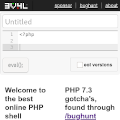
Sharing metadata
| og:url | https://3v4l.org/ |
|---|---|
| og:type | article |
| og:image | https://3v4l.org/s/site_thumb.png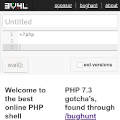 |
| og:title | 3v4l.org - online PHP shell with 500+ PHP versions |
| og:description | Visit 3v4l.org: an online shell that allows you to run your code on my server |
| twitter:card | summary |
robots.txt (opens in a new tab)
2 rulesAll bots 0 allowed · 2 disallowed

 All bots

/new/search/
No matching rules.
Sitemaps
1 Registration details RDAP / WHOIS
| Registrar | Key-Systems GmbH |
|---|---|
| Registered | 2012-04-17 |
| Expires | 2027-04-17 |
| Domain status | client transfer prohibited |
| Nameservers | ns0.transip.net、ns1.transip.nl、ns2.transip.eu |
| DNSSEC | unsigned |
 DNS records
| Type | Name | Value | TTL | Priority |
|---|---|---|---|---|
| A | 3v4l.org | 88.99.124.196 | 28800 | — |
| AAAA | 3v4l.org | 2a01:4f8:c012:6763::1 | 28800 | — |
| MX | 3v4l.org | mail.protonmail.ch | 28800 | 10 |
| MX | 3v4l.org | mailsec.protonmail.ch | 28800 | 20 |
| NS | 3v4l.org | ns0.transip.net | 86400 | — |
| NS | 3v4l.org | ns1.transip.nl | 86400 | — |
| NS | 3v4l.org | ns2.transip.eu | 86400 | — |
| TXT | 3v4l.org | protonmail-verification=cda6e4d593bdccc28e0f970a821fa104cc17a865 | 28800 | — |
| TXT | 3v4l.org | v=spf1 include:_spf.protonmail.ch -all | 28800 | — |
| CAA | 3v4l.org | 0 issue "letsencrypt.org" | 28800 | — |
| DMARC | _dmarc.3v4l.org | v=DMARC1; p=quarantine | 28800 | — |
 TLS and certificates
| Assessment | Normal configuration |
|---|---|
| Supported protocols | TLSv1.2、TLSv1.3 |
| Negotiated protocol | TLSv1.3 |
| Certificate subject | www.3v4l.org |
| Issuer | Let's Encrypt |
| Valid until | 2026-11-05T21:56 · Remaining when checked: 37 days |
| Verification details | Certificate trust: Passed · Hostname match: Passed |
 HTTP response headers
| Header | Value |
|---|---|
| content-type | text/html; charset=UTF-8 |
| cache-control | public, max-age=45 |
| server | nginx |
| strict-transport-security | max-age=31536000; includeSubDomains; preload |
| content-security-policy | default-src 'none'; script-src 'self' 'unsafe-eval' cdn.jsdelivr.net blob:; manifest-src 'self'; worker-src 'self' cdn.jsdelivr.net blob:; connect-src 'self' data: https://cdn.jsdelivr.net/; base-uri 'self'; form-action 'self'; img-src 'self' data:; style-src 'self' 'unsafe-inline'; |
| x-content-type-options | nosniff |
| referrer-policy | origin-when-cross-origin |
| permissions-policy | fullscreen=(), geolocation=() |
 Identified technologies
User reviews (0)