
 简体中文
简体中文 English
hackerwars.io
Hacker Wars is an online hacking simulation game. Play as a hacker seeking fame and money. Fight and compete against other hackers. Join now for free.
At a glance
- Category
- Games & Board Games
- Language
- English
- Paid-content signal
- No paid content foundObserved
- Registered
- 2019
- Hosting
- CloudflareInferred
- HTTPS certificate trusted
- PassedObserved
- Last updated
Related questions
More questions →What Is a Browser Game and How Does It Work?
A browser game is a video game you play directly in a web browser — no download, no installation, no launcher. You open a URL, log in, and play. That makes browser games the lowest-friction way to start a game: they run on almost any device with a modern browser and an internet connection, and progress is stored on the game's servers rather than on your machine. The trade-off is that you depend on that server staying online, and the game's visual and mechanical depth is usually lighter than a native client. Kapilands, a long-running business simulation by upjers, is a useful example: you register, log in, and build a company entirely inside the browser.
How a browser game actually runs
The core mechanism is client–server separation:
- The client is your browser. The game sends HTML, CSS, JavaScript, and images. Your browser renders them and sends your actions back.
- The game state lives on the server. Your factories, money, inventory, and market orders are stored remotely. Closing the tab doesn't lose progress — it just stops you from acting until you return.
- Sessions define play. You log in, act, and log out. Many browser games are designed around short, repeated sessions rather than long continuous play.
This is why browser games often feel like management tools: you check in, make decisions, queue up production, and come back later.
What you need to play
- A device with a current browser (desktop or mobile)
- An internet connection
- An account on the game's site
Nothing else. There is no install step, which is the defining advantage over downloadable or mobile titles.
Common genres
Browser games cluster into a few recognizable types:
| Genre | What you do | Typical session |
|---|---|---|
| Business simulation | Build production, trade, set prices | Check in, adjust, return |
| Strategy / MMO | Build armies or cities, compete or ally | Longer, event-driven |
| Idle / incremental | Progress accrues over time | Very short, frequent |
| Puzzle / casual | Short self-contained rounds | Minutes |
Business simulations are a natural fit for the browser because their gameplay loop — produce, trade, optimize — works well in short sessions and doesn't require fast reflexes or high-end graphics.
How free browser games make money
"Free to play" describes access, not necessarily the absence of spending. Common models:
- Optional purchases — cosmetic items, convenience features, or acceleration
- Advertising — banners or rewarded ads
- Premium tiers or subscriptions — extra features or capacity
The important distinction for a new player: a game can be free to start and still offer paid options. Whether a specific game charges, and for what, depends on that game — check its own pages rather than assuming.
The typical gameplay loop
Most account-based browser games follow the same shape:
- Register an account on the game's site.
- Log in to a server or realm.
- Act — build, produce, trade, or fight.
- Wait or return — many actions resolve over time.
- Progress — your account state persists between sessions.
Kapilands illustrates this pattern directly. Its entry page shows a login with two realms, a password-recovery link, and a registration form that asks for a head office country, gender, and date of birth, plus agreement to the terms and privacy policy. The page states "Play for free!" and offers registration for players without an account. Once inside, the described gameplay is: build more than 40 different production facilities, trade with other players, determine your product quality, and optimize prices — either through strategic partnerships or open competition.
Advantages and limits vs. downloadable or mobile games
Advantages
- No install, no storage cost, no update downloads
- Works across devices with a browser
- Easy to try and easy to abandon
- Progress is server-side, so it follows your account
Limits
- Requires a live connection and a running server
- Usually lighter graphics and simpler mechanics
- Long-term availability depends on the operator — a shut-down server means a lost game
- Performance is bounded by the browser
For a business simulation specifically, these limits matter less: the genre rewards planning and patience more than rendering power.
Where Kapilands fits
Kapilands is a browser-based business simulation developed by upjers. According to its own site, it was once selected "MMO of the Year" and is now positioned as a retro title for fans of business games. Its stated features — 40+ production facilities, player-to-player trade, quality control, and price optimization — are the classic business-simulation loop, and its dynamic market is driven by supply and demand, just as in real trade.
If you want to understand browser games through one concrete example, Kapilands is a clean one: register in the browser, log in to a realm, and manage a company across sessions without ever installing anything.
Website Overview
An established domain and managed infrastructure suggest continuity of operations and may support dependable delivery, although neither guarantees service quality. Several search or sharing settings need attention. Together they may make snippets, preview images or preferred URLs less consistent across platforms.
Domain and Registration
Registered in 2019, this domain has about 7 years of history. That suggests continuity, although ownership and purpose may have changed. Transfer-protection status is present, helping reduce the risk of unauthorized domain transfers. The registrar is Cloudflare, Inc, a widely used domain service provider. The domain uses the common .io extension, which is not an independent safety signal.
DNS and Email
Nameservers are provided by Cloudflare, indicating managed DNS hosting. MX records point to the Google Workspace email service. DNSSEC is enabled, allowing validating resolvers to authenticate signed DNS data. No CNAME was found; the observed records resolve directly to addresses. SPF and DMARC are configured. DKIM status is unknown.
TLS and Certificates
The public key uses EC with 256 bits. The server supplied a complete certificate chain. No organization name is present in the certificate; the available fields are consistent with domain validation. The certificate was issued within the Google Trust Services cloud or CDN ecosystem. The certificate's total validity is about 90 days, consistent with a short renewal cycle.
HTTP and Browser Security
The response lacks these common security headers: HSTS, CSP, X-Content-Type-Options, Referrer-Policy, Permissions-Policy. No X-Powered-By header was found, reducing one common source of backend fingerprinting information. The cf-ray response header indicates a CDN or caching proxy in the delivery path. No obvious internal addresses or debug information were found in the headers. The Server header identifies cloudflare without an exact version.
Technology Stack Analysis
The public page identifies jQuery, Cloudflare without precise versions, leaving fewer clues for version-specific scanning.
Search and Social Sharing
No homepage canonical URL was detected. If duplicate URLs exist, consolidation may be less explicit. Open Graph is partially configured; og:type is missing. The title has 11 characters, within a common display range. A meta description is present, with 150 characters. The observed directives allow indexing and link following.
Hosting and Email
 Cloudflare
 Google Workspace
Registration details
| Registrar | Cloudflare, Inc |
|---|---|
| Registered | 2019-10-02 |
| Expires | 2027-10-02 |
| Domain status | clientTransferProhibited https://icann.org/epp#clientTransferProhibited |
| Nameservers | henry.ns.cloudflare.com、sandy.ns.cloudflare.com |
| DNSSEC | signed |
DNS records
| Type | Name | Value | TTL | Priority |
|---|---|---|---|---|
| A | hackerwars.io | 104.21.87.242 | 300 | — |
| A | hackerwars.io | 172.67.148.201 | 300 | — |
| AAAA | hackerwars.io | 2606:4700:3033::6815:57f2 | 300 | — |
| AAAA | hackerwars.io | 2606:4700:3037::ac43:94c9 | 300 | — |
| MX | hackerwars.io | aspmx.l.google.com | 300 | 1 |
| MX | hackerwars.io | alt1.aspmx.l.google.com | 300 | 5 |
| MX | hackerwars.io | alt2.aspmx.l.google.com | 300 | 5 |
| MX | hackerwars.io | alt3.aspmx.l.google.com | 300 | 10 |
| MX | hackerwars.io | alt4.aspmx.l.google.com | 300 | 10 |
| NS | hackerwars.io | henry.ns.cloudflare.com | 86400 | — |
| NS | hackerwars.io | sandy.ns.cloudflare.com | 86400 | — |
| TXT | hackerwars.io | v=spf1 include:_spf.google.com ip4:185.242.112.58 ~all | 300 | — |
| DS | hackerwars.io | 2371 13 2 37621842bdcc89b10f54933b9480be079c6c91b928bb39745c23158c6f8bbd84 | 3600 | — |
| DMARC | _dmarc.hackerwars.io | v=DMARC1; p=none; rua=mailto:[email protected] | 300 | — |
TLS and certificates
HTTP response headers
| Header | Value |
|---|---|
| content-type | text/html; charset=UTF-8 |
| cache-control | no-store, no-cache, must-revalidate |
| server | cloudflare |
| x-frame-options | DENY |
| set-cookie | Redacted |
Identified technologies
Pages, Search and Sharing
| Meta description | Hacker Wars is an online hacking simulation game. Play as a hacker seeking fame and money. Fight and compete against other hackers. Join now for free. |
|---|---|
| Canonical URL | Not detected |
| Language | English (default) |
| Twitter Card | Not detected |
Social Sharing Preview
5 fields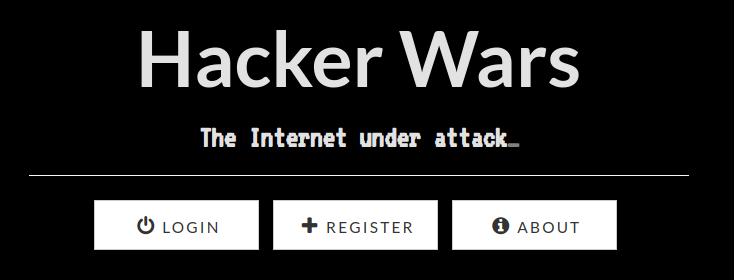
robots.txt (opens in a new tab)
1 rulesAll bots 0 allowed · 1 disallowed
- Disallow
/reset
No matching rules.
User reviews (0)