
 nesslabs.com
 Paid content
Categories: Productivity
Want to achieve more without sacrificing your mental health? Say hello to mindful productivity.
 Visit website
 Updated: 2026-09-27 21:29
 Language: English (default)
 Access: Normal
 Profile views 9
 Outbound visits 1
Related questions
More questions →What the Ness Labs Learning Community and Online Courses Are Like
Ness Labs runs a paid learning community and online courses built around one promise: achieve more without sacrificing your mental health. The community brings together thousands of members running "tiny experiments," while the courses teach you to develop an experimental mindset and design your own mindful productivity system. If you want structured learning plus peers to compare notes with, this is the part of Ness Labs aimed at you. If you only want free reading, the newsletter and article library cover that separately.
What the learning community is
The community is described as a learning community with thousands of members who run tiny experiments together. The shared goal is achieving more without sacrificing mental health — the same framing used across the site.
What that means in practice, based on the site's own language:
- A shared method, not just a chat room. Members run "tiny experiments," so the community is organized around trying small changes and reflecting on results rather than passive discussion.
- A knowledge-worker audience. Ness Labs is positioned as a "mindful productivity school for knowledge workers," so expect peers dealing with focus, decision-making, and creative project work.
- A curiosity-first tone. The site calls itself "a playground for curiosity" — a place to experiment with ideas, explore creative projects, make better decisions, and reflect on progress.
The site does not publish a member count beyond "thousands," nor does it list community platform details, meeting cadence, or moderation rules in the material available here. Treat those as open questions to confirm before joining.
What the online courses cover
The courses have two stated outcomes:
- Develop your experimental mindset — the site's core idea is that "all you need is an experimental mindset," and the courses are where that gets taught systematically.
- Design your very own mindful productivity system — not a template you copy, but a personal system you build.
That second point matters. The framing throughout is "build a laboratory for your mind" and become "the scientist of your own life." So the courses are less about adopting a fixed productivity method and more about learning to test and adjust your own.
The site does not list individual course titles, lesson counts, durations, or prices in the available material. Pricing signals show Stripe as a payment platform, which indicates paid checkout exists somewhere on the site, but no specific price is stated here — check the course pages directly.
Community vs. courses: which fits
| Learning community | Online courses | |
|---|---|---|
| Primary purpose | Run tiny experiments alongside other members | Learn the experimental mindset and build your productivity system |
| Format | Ongoing membership with thousands of members | Structured course material |
| Best if you want | Peer accountability and shared practice | A guided path to designing your own system |
| Stated outcome | Achieve more without sacrificing mental health | Develop an experimental mindset; design a mindful productivity system |
They are complementary rather than competing: the courses supply the method, the community supplies the practice and the people.
Free options before you commit
If you are not ready to pay, two free entry points exist:
- The newsletter — one weekly email with simple tools to become "the scientist of your own life." Subscribers also get the first chapter of Tiny Experiments as a bonus.
- The article library — hundreds of free articles on curiosity, creativity, and mindful productivity.
These are a reasonable way to test whether the site's approach fits how you think before moving to the community or courses.
Related reading on Ness Labs
The book Tiny Experiments: How to Live Freely in a Goal-Obsessed World is written by a neuroscientist, entrepreneur, and creator of the Ness Labs newsletter, and covers rethinking goals, creativity, and life itself. If the courses appeal to you but you want the ideas in long form first, the book is the natural starting point.
What to verify before joining
Because the available material does not specify these, confirm directly on the site:
- Current price of community membership and each course
- Whether community access is included with a course purchase or billed separately
- Time commitment and any live-session schedule
- Refund terms
The consistent thread across everything Ness Labs offers — newsletter, articles, community, courses, and book — is the same: work mindfully rather than more, and treat your own life as something to experiment with.
What Is Tiny Experiments, the Book by the Creator of Ness Labs?
Tiny Experiments is a book by the neuroscientist, entrepreneur, and creator of the Ness Labs newsletter, described on the Ness Labs site as "a transformative guide to rethinking your approach to goals, creativity, and life itself." Its subtitle is How to Live Freely in a Goal-Obsessed World. It is the book-length extension of the same experimental mindset that Ness Labs is built around: instead of chasing goals at any cost, you treat your life as a laboratory and run small experiments.
What the book is about
According to the description on nesslabs.com, the book is a guide to rethinking three things:
- Goals — how you set and relate to them
- Creativity — how you explore ideas and projects
- Life itself — how you live day to day
The framing is a direct contrast to what the subtitle calls a "goal-obsessed world." Rather than assuming more effort and more goals are always better, the book argues for an experimental approach: try small things, observe what happens, and adjust.
How it connects to Ness Labs
The book is not a separate project from Ness Labs — it grows out of the same philosophy. The Ness Labs homepage states the core idea plainly: "Want to achieve more without sacrificing your mental health? All you need is an experimental mindset."
That mindset shows up across everything Ness Labs offers:
| Ness Labs offering | What it is |
|---|---|
| Newsletter | One weekly email with simple tools to become "the scientist of your own life" |
| Article library | Hundreds of free articles on curiosity, creativity, and mindful productivity |
| Learning community | Thousands of members running tiny experiments |
| Online courses | Programs to develop an experimental mindset and design your own mindful productivity system |
| The book | Tiny Experiments, the long-form treatment of the same ideas |
The site describes Ness Labs as "a playground for curiosity – a place where you can learn how to experiment with ideas, explore creative projects, make better decisions, and reflect on your progress." The book takes that same promise and develops it at book length.
The idea behind "tiny experiments"
The name is the method. Instead of committing to a large, all-or-nothing goal, you run small, bounded experiments — the kind the Ness Labs community is described as running — and use what you learn to decide what to do next. This is what the site means by building "a laboratory for your mind," and it is the same logic behind the newsletter's promise to help you become "the scientist of your own life."
The connection to mindful productivity is direct: the goal is to "achieve more without sacrificing your mental health," not to work more. The site's own summary of the philosophy is "Don't work more. Work mindfully."
Who it's for
Based on how Ness Labs describes itself and its audience, the book is aimed at knowledge workers and anyone who feels stuck in goal-driven overwork. The site's testimonials point at the same reader:
- Steph Smith: "The consistency and thoughtfulness of Ness Labs inspire me to question the ordinary and iterate towards being a better version of myself."
- Kelly Miller: "This was the resource I didn't know I needed – so badly. Bite-sized but in-depth insights into my brain. Ness Labs has changed the way I approach work."
If that description of the newsletter and community resonates, the book is the same material in a longer, more structured form.
How to get it
The Ness Labs site links to the book under "Order the Book," alongside a "Learn More" link for details. The site also offers a bonus: subscribing to the Ness Labs newsletter gets you the first chapter of Tiny Experiments, plus one weekly email. If you want to sample the ideas before buying, that is the lowest-commitment route — and it mirrors the book's own advice to start small.
What Is Ness Labs and What Does It Offer?
Ness Labs is a mindful productivity school and learning community for knowledge workers. Its stated goal is to help you "achieve more without sacrificing your mental health," and the method it teaches is an experimental mindset: treat your habits, projects, and decisions as small experiments rather than fixed obligations. It's a reasonable fit if you want structured, reflective self-improvement content rather than pure output-maximization advice.
The core idea
The site frames itself as "a playground for curiosity" — a place to experiment with ideas, explore creative projects, make better decisions, and reflect on progress. The name plays on the suffix "-ness" (as in awareness, mindfulness, consciousness), and the tagline "Build a laboratory for your mind" captures the approach: you are the scientist of your own life, running small tests instead of adopting one-size-fits-all productivity systems.
The positioning is explicitly against "work more." The site's own framing is "Don't work more. Work mindfully."
What Ness Labs actually offers
| Offering | What it is | How you access it |
|---|---|---|
| Educational articles | One article per week on curiosity, creativity, and mindful productivity | Newsletter subscription |
| Article library | Hundreds of free articles | Browse on the site |
| Learning community | A community of members running "tiny experiments" | Join the community |
| Online courses | Courses to develop an experimental mindset and design your own mindful productivity system | Enroll via the courses page |
| Book | Tiny Experiments: How to Live Freely in a Goal-Obsessed World | Order separately |
The newsletter
The newsletter is the main entry point: one weekly email with "simple tools to become the scientist of your own life." Subscribers also receive the first chapter of Tiny Experiments as a bonus. If you only want to sample the thinking before committing to anything else, this is the lowest-effort way in.
The free article library
The site describes a library of hundreds of free articles, which you can browse without subscribing. This is useful if you want to judge the writing style and depth before joining the community or paying for a course.
The community and courses
The learning community is described as having thousands of members running tiny experiments. The online courses are the paid, structured layer: they're aimed at developing an experimental mindset and designing a personal mindful productivity system. The site lists Stripe as its payment platform, so courses are a commercial product rather than a free resource — but the page doesn't state specific prices, so check the course pages for current cost and terms.
The book
Tiny Experiments is written by a neuroscientist, entrepreneur, and the creator of the Ness Labs newsletter. It's described as a guide to rethinking goals, creativity, and life itself, and it's sold separately from the site's other offerings.
Who it's for
Ness Labs suits knowledge workers who:
- Want to improve how they work without treating burnout as a badge of honor
- Prefer small, testable changes over sweeping productivity overhauls
- Enjoy reflective, research-informed writing rather than tactical hacks
- Want a community of people doing similar experiments
It's less suited to someone looking for a rigid, prescriptive system or purely technical tooling advice — the emphasis is on mindset and reflection, not software workflows.
How to evaluate it for yourself
- Subscribe to the newsletter and read a few weekly articles. Expected result: a sense of whether the tone and topics match what you want.
- Browse the free article library for a topic you already care about. Expected result: a concrete sample of depth, not just marketing copy.
- If the free material lands, look at the community and course pages for current details on access and cost.
- If you prefer a book-length treatment, order Tiny Experiments instead of or before joining.
The main caveat: the site's own page doesn't publish pricing for the community or courses, so treat those as things to verify on the relevant pages rather than assume are free. The newsletter and article library, by contrast, are presented as free entry points.
What Do You Get From the Ness Labs Newsletter and Free Article Library?
Subscribing to the Ness Labs newsletter gets you one weekly email with simple tools for becoming "the scientist of your own life," plus the first chapter of Tiny Experiments as a signup bonus. Separately, the site's free article library is open to browse without subscribing and holds hundreds of articles on curiosity, creativity, and mindful productivity. Both are free entry points into Ness Labs, which describes itself as a "playground for curiosity" and a "laboratory for your mind."
What the newsletter delivers
The core offer is deliberately small: one email per week, not a daily digest. According to the site, each issue contains "simple tools to become the scientist of your own life," framed around three recurring themes:
- Curiosity — treating ideas as things to experiment with rather than accept or reject
- Creativity — exploring creative projects
- Mindful productivity — achieving more without sacrificing mental health
The stated purpose is to help you "experiment with ideas, explore creative projects, make better decisions, and reflect on your progress." The framing matters: the newsletter positions itself as a set of tools for self-directed experimentation, not as news or commentary.
The signup bonus
New subscribers receive the first chapter of Tiny Experiments: How to Live Freely in a Goal-Obsessed World, described as a book by a neuroscientist, entrepreneur, and the creator of the Ness Labs newsletter. If you want a sample of the underlying philosophy before committing attention to a weekly email, the first chapter serves that purpose.
What the free article library contains
The library is described as containing hundreds of free articles, published at roughly one per week. It covers the same territory as the newsletter — curiosity, creativity, and mindful productivity — and is browsable directly on the site without going through the email list.
This makes the library the better starting point if you want to evaluate the writing style or find material on a specific topic before handing over an email address.
Newsletter vs. article library: which to use
| Newsletter | Free article library | |
|---|---|---|
| Format | One weekly email | Hundreds of articles on-site |
| Access | Requires subscribing | Open to browse |
| Best for | Ongoing, paced input and tools | Topical reading and evaluating fit |
| Bonus | First chapter of Tiny Experiments | — |
Choose the newsletter if you want a steady weekly nudge and the book chapter. Choose the library if you'd rather read on your own schedule or check whether the content matches how you think before subscribing.
Where this fits in the broader Ness Labs offering
The newsletter and library are the free layer. Ness Labs also runs a learning community with thousands of members "running tiny experiments," and sells online courses for developing an experimental mindset and designing a personal mindful productivity system. Payment on the site runs through Stripe, though the site's own materials don't state prices for the courses or community — check the course pages directly for current terms.
The through-line across all of it is the same idea, captured in the site's own framing: don't work more, work mindfully, and build "a laboratory for your mind." The name itself points at this — "-ness" means "state of being," as in awareness, mindfulness, consciousness.
How to decide
If your goal is simply to see whether the "mindful productivity" approach fits how you work, start with the free article library — no commitment, and hundreds of pieces to sample. If it resonates, subscribe to get the weekly tool plus the Tiny Experiments first chapter, and only then consider whether the community or courses are worth paying for. Testimonials on the site, such as those from Steph Smith and Kelly Miller, emphasize consistency and depth in bite-sized form — useful signals, but ones you can verify yourself against the free library first.
What Is Mindful Productivity, According to Ness Labs?
Mindful productivity, as Ness Labs frames it, is the practice of achieving more without sacrificing your mental health. Instead of optimizing for maximum output, it asks you to treat your own mind as a laboratory: run small experiments, reflect on the results, and design a personal system that fits how you actually think and feel. This approach suits knowledge workers who find conventional productivity advice leaves them busier but not better.
The Core Idea: Don't Work More, Work Mindfully
Ness Labs states its position directly: "Don't work more. Work mindfully." The goal isn't to squeeze more tasks into a day, but to work with awareness of your own state — your energy, attention, and wellbeing.
The name itself carries the philosophy. As the site explains, "-ness" is a suffix meaning "state of being," as in awareness, mindfulness, consciousness. Ness Labs positions itself as "a playground for curiosity" — a place to experiment with ideas, explore creative projects, make better decisions, and reflect on progress.
How It Differs from Traditional Productivity
| Dimension | Conventional productivity | Mindful productivity (Ness Labs) |
|---|---|---|
| Primary aim | Maximize output and efficiency | Achieve more without sacrificing mental health |
| Method | Follow established systems and hacks | Run personal experiments and reflect |
| Stance toward goals | Goal-driven, often over-optimized | Experimental, curiosity-led |
| Unit of improvement | The workflow | The whole person — mind included |
The contrast is deliberate. Where mainstream productivity culture tends to treat the person as a machine to be tuned, Ness Labs treats the mind as something to be studied and understood.
The Mechanism: An Experimental Mindset
The central tool is what Ness Labs calls an experimental mindset — becoming "the scientist of your own life." Rather than adopting someone else's system wholesale, you:
- Form a small hypothesis about how you work best (a "tiny experiment").
- Try it in your actual work.
- Observe the results, including how it affected your mental state.
- Reflect and adjust, building a personal productivity system over time.
This is why the site describes itself as building "a laboratory for your mind." The output isn't a fixed method — it's your own calibrated approach.
What Ness Labs Offers Around This Idea
- Educational articles — one weekly email on curiosity, creativity, and mindful productivity, plus a library of hundreds of free articles.
- A learning community — thousands of members running tiny experiments together.
- Online courses — for developing an experimental mindset and designing your own mindful productivity system.
- A book — Tiny Experiments: How to Live Freely in a Goal-Obsessed World, described as a guide to rethinking goals, creativity, and life, written by a neuroscientist and the creator of the Ness Labs newsletter.
The newsletter is free to join and includes the first chapter of Tiny Experiments as a bonus. Note that the site lists Stripe as a payment platform, which indicates paid offerings exist (such as courses), though specific prices aren't stated in the available material.
Who This Is For
Mindful productivity as Ness Labs defines it is aimed at knowledge workers who want to "think better, work smarter, live happier" — and who suspect that working harder isn't the answer. If you've tried standard productivity systems and found them effective on paper but draining in practice, the experimental approach offers a different starting point: begin with your own mind, not someone else's template.
Website Overview
Identifiable technologies and additional version or configuration signals make the service easier to fingerprint, which may help targeted scanners narrow their checks. An established domain and managed infrastructure suggest continuity of operations and may support dependable delivery, although neither guarantees service quality.
Domain and Registration
Registered in 2017, this domain has about 8 years of history. That suggests continuity, although ownership and purpose may have changed. Transfer-protection status is present, helping reduce the risk of unauthorized domain transfers. The domain uses the common .com extension, which is not an independent safety signal.
DNS and Email
The lowest TTL is 60 seconds, supporting rapid record changes at the cost of more frequent lookups. Nameservers are provided by dreamhost.com, indicating managed DNS hosting. MX records point to the Google Workspace email service. No CNAME was found; the observed records resolve directly to addresses. SPF and DMARC are configured. DKIM status is unknown.
TLS and Certificates
The certificate uses an RSA 2048-bit public key, offering broad client compatibility. The server supplied a complete certificate chain. No organization name is present in the certificate; the available fields are consistent with domain validation. The certificate was issued by Let's Encrypt, commonly associated with automated certificate services. The certificate's total validity is about 89 days, consistent with a short renewal cycle.
HTTP and Browser Security
The response lacks these common security headers: Permissions-Policy. No X-Powered-By header was found, reducing one common source of backend fingerprinting information. No obvious internal addresses or debug information were found in the headers. The Server header identifies nginx without an exact version. No explicit CDN or WAF marker was found in the response headers.
Technology Stack Analysis
The public page identifies WordPress 7.1.2, jQuery, Stripe, nginx, with exact versions exposed for 1 technologies. These details can narrow vulnerability checks, although exposure alone is not a vulnerability.
Search and Social Sharing
The Generator tag identifies WordPress 7.1.2, making the publishing system easier to fingerprint. Twitter Card metadata is configured. JSON-LD includes Organization data, helping describe the organization as an entity. The title has 61 characters, within a common display range. A meta description is present, with 95 characters.
 Hosting and Email
 Hosting
 Google Workspace
 Location
 Hillsboro, Oregon, United States
 Pages, Search and Sharing
| Meta description | Want to achieve more without sacrificing your mental health? Say hello to mindful productivity. |
|---|---|
| Canonical URL | https://nesslabs.com/ |
| Language | English (default) |
| Twitter Card | summary_large_image |
Social Sharing Preview
15 fields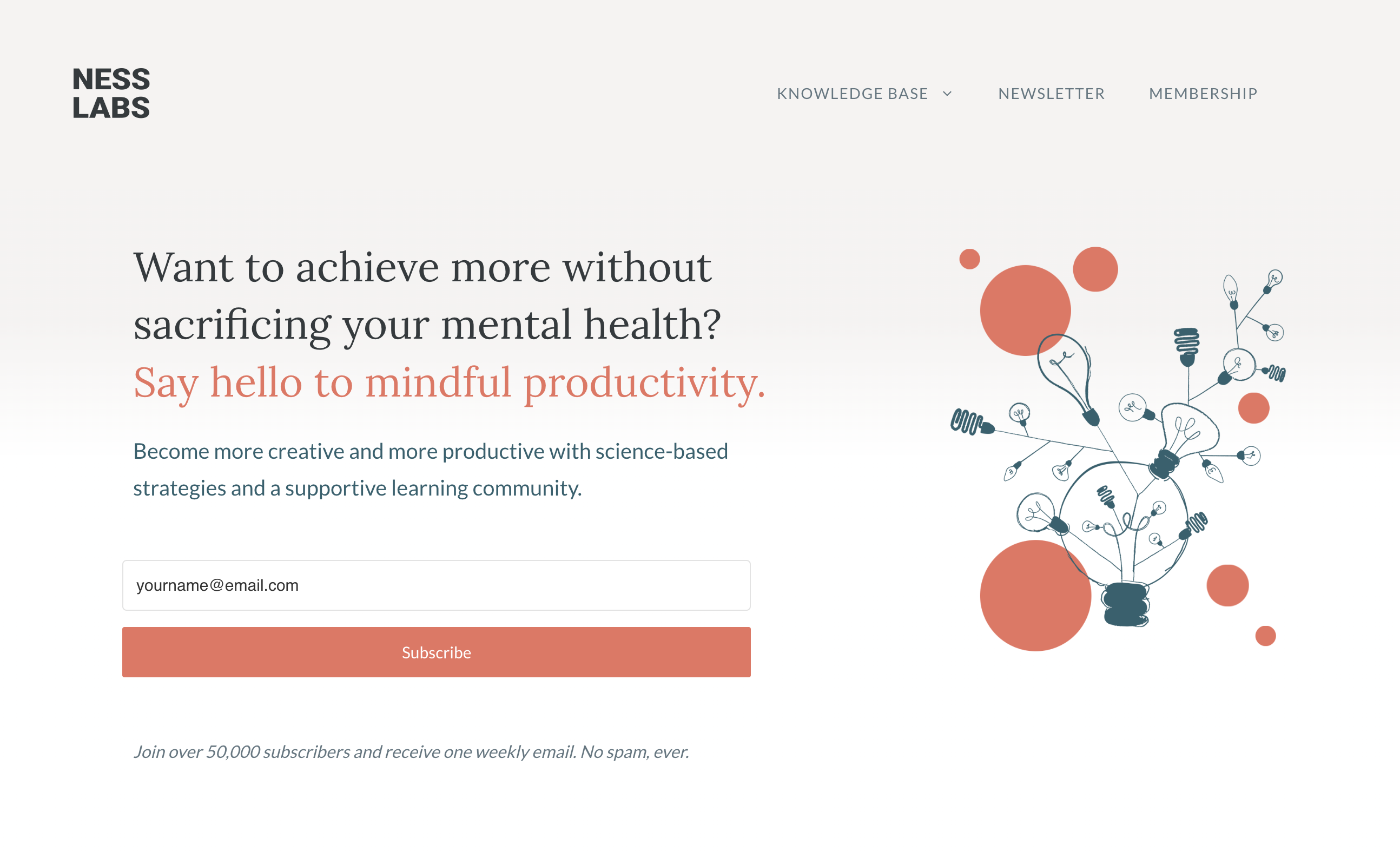

Sharing metadata
| og:url | https://nesslabs.com/ |
|---|---|
| og:type | website |
| og:image | https://nesslabs.com/wp-content/uploads/2022/10/home-page-screenshot-banner.png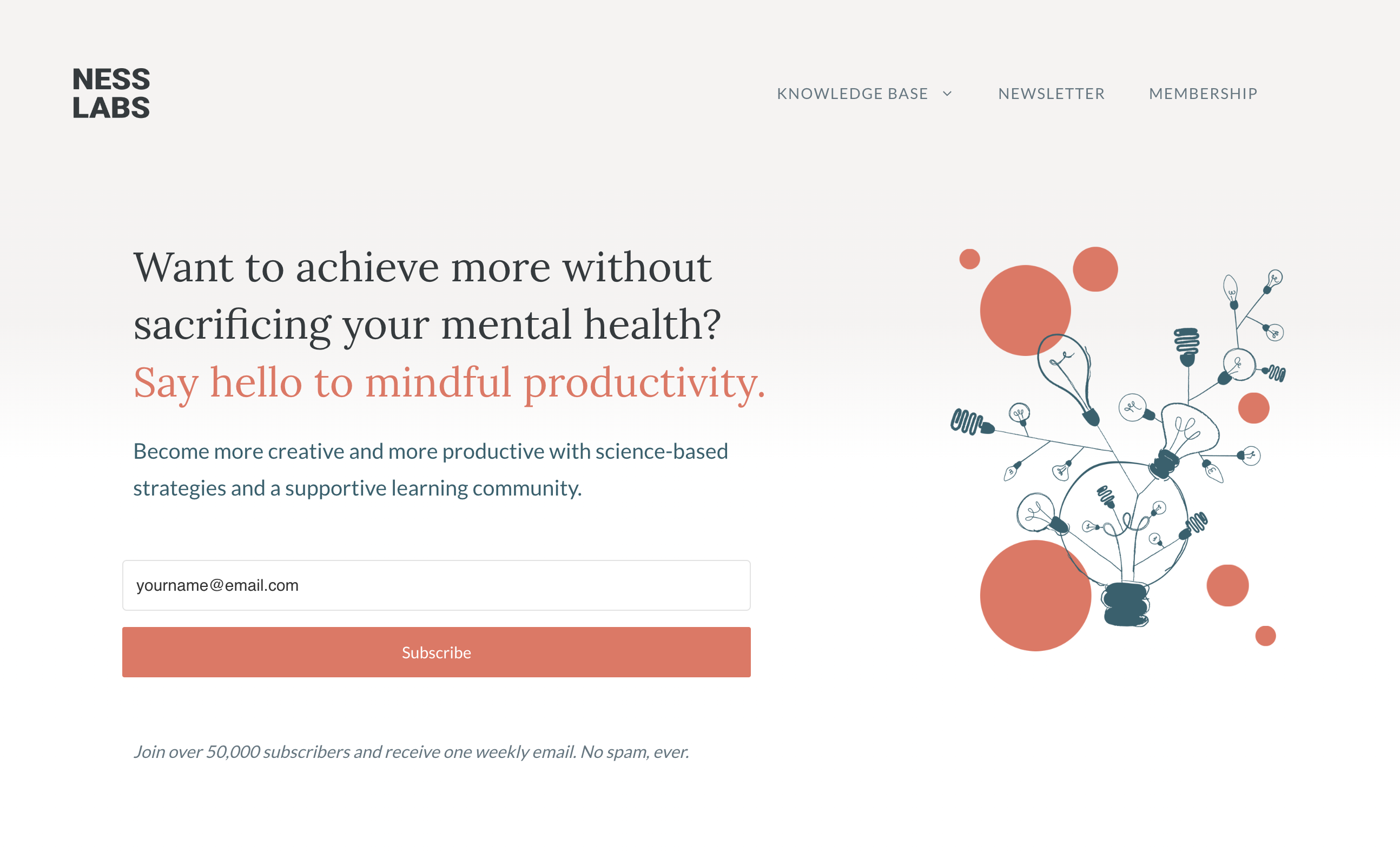 |
| og:title | Ness Labs - The Learning Community for Knowledge Workers |
| og:locale | en_US |
| og:site_name | Ness Labs |
| og:image:type | image/png |
| og:description | Want to achieve more without sacrificing your mental health? Say hello to mindful productivity. |
| og:image:width | 2588 |
| og:image:height | 1586 |
| twitter:card | summary_large_image |
| twitter:site | @ness_labs |
| twitter:image | https://nesslabs.com/wp-content/uploads/2022/10/home-page-screenshot-banner.png |
| twitter:title | Ness Labs - The Learning Community for Knowledge Workers |
| twitter:description | Want to achieve more without sacrificing your mental health? Say hello to mindful productivity. |
robots.txt (opens in a new tab)
0 rulesAll bots 0 allowed · 0 disallowed

 All bots
No matching rules.
Sitemaps
1 Registration details RDAP / WHOIS
| Registrar | DreamHost, LLC |
|---|---|
| Registered | 2017-11-03 |
| Expires | 2026-11-03 |
| Domain status | client transfer prohibited |
| Nameservers | ns1.dreamhost.com、ns2.dreamhost.com、ns3.dreamhost.com |
| DNSSEC | unsigned |
 DNS records
| Type | Name | Value | TTL | Priority |
|---|---|---|---|---|
| A | nesslabs.com | 69.163.153.169 | 60 | — |
| MX | nesslabs.com | aspmx.l.google.com | 60 | 1 |
| MX | nesslabs.com | alt1.aspmx.l.google.com | 60 | 5 |
| MX | nesslabs.com | alt2.aspmx.l.google.com | 60 | 5 |
| MX | nesslabs.com | alt3.aspmx.l.google.com | 60 | 10 |
| MX | nesslabs.com | alt4.aspmx.l.google.com | 60 | 10 |
| NS | nesslabs.com | ns1.dreamhost.com | 14400 | — |
| NS | nesslabs.com | ns2.dreamhost.com | 14400 | — |
| NS | nesslabs.com | ns3.dreamhost.com | 14400 | — |
| TXT | nesslabs.com | google-site-verification=kpphaueoKhqi3KsDR4LBL11fu0rLFqFqbjJYwfarKjA | 60 | — |
| TXT | nesslabs.com | v=spf1 mx include:_spf.google.com ~all | 60 | — |
| DMARC | _dmarc.nesslabs.com | v=DMARC1; p=none | 60 | — |
 TLS and certificates
| Assessment | Normal configuration |
|---|---|
| Supported protocols | TLSv1.2、TLSv1.3 |
| Negotiated protocol | TLSv1.3 |
| Certificate subject | www.nesslabs.com |
| Issuer | Let's Encrypt |
| Valid until | 2026-12-14T15:36 · Remaining when checked: 77 days |
| Verification details | Certificate trust: Passed · Hostname match: Passed |
 HTTP response headers
| Header | Value |
|---|---|
| content-type | text/html; charset=UTF-8 |
| cache-control | max-age=0 |
| server | nginx |
| strict-transport-security | max-age=31536000; |
| content-security-policy | default-src * 'unsafe-inline' 'unsafe-eval' data: blob:; |
| x-frame-options | SAMEORIGIN |
| x-content-type-options | nosniff |
| referrer-policy | no-referrer-when-downgrade |
 Identified technologies
Recent Updates
- Website images
- Screenshots
- Network details
- Website Technologies
- Pages and Search Information
- HTTP Response Information
- TLS and certificates
- DNS Information
- Domain Registration
- Website profile
- Website Description
- Website Name
- Website profile
- Website Description
- Website Name
User reviews (0)