
 简体中文
 English

Website review
This review may include AI-generated content and is not individually verified. Domain, certificate and other facts come from the observed data on this page.
What is SimpliHere?
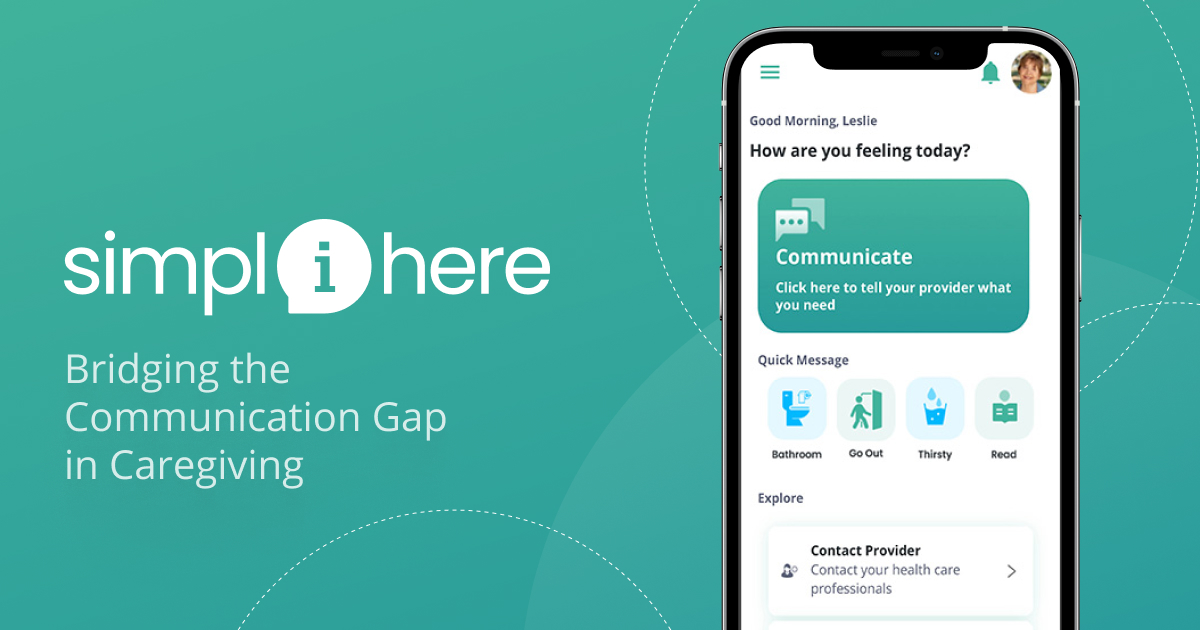
SimpliHere is a mobile app for caregiving when a neurological condition affects speech or mobility. It centers on a one-touch communication menu, so a patient who has limited speech or hand movement can signal needs and wants without typing or speaking, and a task-management layer that lets a primary caregiver track daily tasks and patient requests while other family members and caregivers view those interactions. The site describes it as HIPAA-ready and aimed at both families and organizations.
Who it fits
- Families coordinating care at home, where one person carries most of the load and others need visibility.
- Professional caregivers — home health aides, assisted living or nursing home staff, healthcare providers — who need to stay in the same loop as the family.
- Caregivers who want the news, resources and peer communities the app bundles alongside its core tools, rather than a bare communication board.
How the pieces relate
| Need | SimpliHere's approach |
|---|---|
| Patient can't speak or gesture easily | One-touch menu to convey needs and wants |
| Tasks scattered across texts and calls | Shared task tracking with a primary caregiver managing and others viewing |
| Multiple people involved in care | A connected "care circle" spanning family and professionals |
| Sensitive health information | HIPAA-ready data protection described across plans |
Practical trade-offs
The one-touch menu is only as good as its preset options: it suits recurring, predictable needs better than nuanced conversation, so it complements rather than replaces speech therapy tools or a dedicated AAC device. Shared visibility is the real value — it reduces the "who already did this?" problem — but it depends on everyone actually opening the app, which is a habit issue more than a software one.
Next step
If you're comparing options, list the five or six messages the person most often needs to send, then check whether a one-touch menu covers them. For a facility, agency or clinic, the site directs enterprise enquiries to [email protected]. For background on the conditions involved, the Alzheimer's Association and American Parkinson Disease Association cover disease context and caregiver guidance.
How does SimpliHere help patients with speech loss or mobility limitations communicate?
SimpliHere is built around a one-touch communication menu. The idea is that a patient who has lost speech, or who has limited hand and arm mobility, does not have to type, dictate, or navigate deep menus to be understood. They tap a prepared item to signal a need or want, and the caregiver sees it. That is the core of the product's answer to the communication gap.
Who it fits
- A family caring at home for someone with a neurological condition affecting speech and movement, where one primary caregiver coordinates and relatives want visibility without constant phone calls.
- A patient who can still make a deliberate selection on a screen, even if speech is unreliable.
- Professional caregivers — home health aides, assisted living or nursing home staff, clinicians — who need to stay in the same loop as the family.
What sits around the communication feature
| Element | What it does |
|---|---|
| One-touch communication | Patient conveys needs and wants to caregivers without speaking |
| Task management | Primary caregiver tracks daily tasks and patient or family requests; other family members and caregivers can view the interactions |
| Care circle | Keeps relatives and paid caregivers updated in one place |
| News, resources, communities | Support for the caregiver's own load and self-care |
| Security posture | Described as HIPAA-ready, applied across the plans |
Practical analysis
The strongest design choice here is separating expression from coordination. Speech-loss tools often stop at the button press; the harder problem is that the message must reach whoever is actually on shift, and that requests do not get lost between people. Pairing the communication menu with shared task tracking addresses that second half. The trade-off is setup effort: someone has to configure the patient's menu items and the task list before the system pays off, and a menu only helps if the options match what the patient actually wants to say. Start by listing the ten requests that come up most days, then build outward.
A useful next step is to watch the video tour on SimpliHere with the patient present, and check whether the interaction style suits their remaining abilities. For organisations rather than individuals, the site directs enquiries to its enterprise contact.
Can family members and professional caregivers coordinate tasks through SimpliHere?
Yes. SimpliHere is built around a shared "circle of care," so family members and professional caregivers can view and manage the same tasks and patient requests rather than coordinating through separate texts and calls.
How coordination works
- A Primary Caregiver manages daily tasks and patient requests through a simple tracking system.
- Other family members and caregivers can view those interactions, so everyone sees the same status.
- The app is designed for home health aides, assisted living or nursing home staff, healthcare providers and families to stay connected.
- Patients with speech loss or mobility limitations use a one-touch communication menu to convey needs and wants, which then feeds into that shared task flow.
- The company describes the solution as HIPAA-ready, which matters when professional caregivers are part of the circle.
Where the trade-off sits
The value is transparency: fewer repeated questions, less chance a request is dropped, and professional caregivers arriving already knowing what has been done. The limitation is that coordination only works if the people involved actually use the app — a family member who prefers phone calls, or an agency with its own scheduling system, can become the weak link. Someone still has to own setup and keep the task list current.
A practical scenario
An adult child lives two hours away, a sibling visits on weekends, and a home health aide comes three mornings a week. The parent can no longer speak clearly. With SimpliHere, the parent taps a request, the primary caregiver assigns or completes it, and the aide sees the history before the next visit. That is the coordination benefit in concrete terms.
Next step
Decide who will be the Primary Caregiver and confirm that your agency or facility is willing to have staff use a family-managed app. For household-level use, the individual plan is described as personal use only, while facilities, agencies and clinics are directed to enterprise-level services. If you are an agency, contact SimpliHere through the details on SimpliHere before assuming the individual plan covers your staff.
Is SimpliHere HIPAA-compliant for protecting caregiving information?
SimpliHere describes itself as a “HIPAA-ready” solution built with HIPAA-ready security standards, and says all subscription plans include HIPAA-ready data protection. That is the company's own characterization in its page content — it is not the same as an independent certification or a legal determination of compliance.
What "HIPAA-ready" does and doesn't tell you
- What it signals: the product was designed with HIPAA requirements in mind, which matters because caregiving communications can involve protected health information (names, diagnoses, medication needs, requests tied to a patient's condition).
- What it doesn't settle: HIPAA compliance is shared. A vendor can build safeguards, but your own obligations depend on who you are. A family member coordinating care is generally not a HIPAA "covered entity." A home health agency, assisted living facility, nursing home, or clinic almost certainly is, and would need a Business Associate Agreement (BAA) in place before using the tool with patient data.
- The gap to close: the page does not state that a BAA is offered or signed. If you are a provider or organization, that is the first thing to confirm directly.
Who should care most
| User | Practical concern |
|---|---|
| Individual family caregiver | Mainly wants privacy from outsiders; HIPAA itself may not legally bind you |
| Home health aide or agency | Needs a BAA and clarity on what data is stored, where, and for how long |
| Assisted living / nursing facility | Needs BAA plus internal policy alignment and staff training |
| Healthcare clinic | Needs BAA plus review against existing EHR and privacy workflows |
A useful next step
If you are evaluating SimpliHere for an organization, email the contact listed on the site and ask three concrete questions: (1) Will you sign a BAA? (2) Where is data stored and encrypted, and at what points? (3) What is the retention and deletion policy for patient communications? For personal family use, the more practical question is simply whether you are comfortable with the information you and your loved one share through the app.
For general context on HIPAA and business associates, the U.S. Department of Health and Human Services publishes guidance at HHS.gov.
How much does SimpliHere cost for individual users versus caregiving organizations?
SimpliHere separates individual and organizational pricing.
Individual users: $4.99/month or $49.99/year. This plan is for personal use only — the page states it is not for people affiliated with a caregiving facility, agency or healthcare clinic. It includes unlimited communications, instant availability and 24/7 free support.
Caregiving organizations: Custom pricing. Facilities, agencies and healthcare clinics are directed to contact SimpliHere for enterprise-level services rather than buying the individual plan.
| User type | Pricing model | Who it covers |
|---|---|---|
| Individual | $4.99/month or $49.99/year | Personal use, not tied to a facility, agency or clinic |
| Enterprise | Custom quote | Caregiving facilities, agencies and healthcare clinics |
For a family caregiver managing a relative's daily needs at home, the individual plan is the straightforward option. If you are a home health aide, assisted-living staff member or clinic employee coordinating care through your employer, the enterprise route is the intended path — the individual plan explicitly excludes you.
Next step: Organizations should contact SimpliHere directly (the page lists [email protected]) to request enterprise pricing, since custom quotes depend on factors such as staff and patient numbers that the site does not publish.
How do I get started with SimpliHere for my family or caregiving facility?
Start by deciding which side of SimpliHere you need: the self-serve Individual plan for a family, or an Enterprise arrangement for a facility, agency or clinic. The page separates these two paths clearly, and the right one depends on whether you are coordinating care for your own household or managing staff and patients across an organization.
For families
The Individual plan is described as being for personal use, not for anyone affiliated with a caregiving facility, agency or healthcare clinic. It is available instantly, includes an unlimited number of communications and 24/7 free support, and comes with HIPAA-ready data protection. You choose between monthly and yearly billing.
A practical first step is to set up the patient's one-touch communication menu, since the page presents this as the core feature for people with speech loss and mobility limitations. From there, invite the rest of your care circle so the task-tracking and updates flow to everyone at once rather than through repeated phone calls.
For facilities and providers
Enterprise is the route for caregiving facilities, agencies and healthcare clinics. Pricing is listed as custom, and the page directs interested organizations to contact [email protected]. If you are evaluating this for a facility, ask about onboarding for aides and clinical staff, how patient accounts are structured, and how the HIPAA-ready protections map onto your existing compliance obligations.
What you get either way
| Area | What the page describes |
|---|---|
| Communication | One-touch menu for patients with speech loss or mobility limits |
| Task management | Primary caregivers track daily tasks and requests; other family and caregivers can view them |
| Professional connection | Home health aides, assisted living or nursing home staff, providers and families stay connected |
| Extra content | News, resources and communities aimed at caregiving demands and self-care |
| Security | HIPAA-ready data protection on all plans |
A useful decision criterion: if your care circle is a family with no institutional affiliation, start with the Individual plan and invite members as you go. If you are coordinating paid staff, multiple patients or clinical oversight, go straight to the Enterprise conversation, because the Individual plan is explicitly not intended for that setting.
As a next step, watch the video tour mentioned on the page before you invite anyone else. Seeing the actual communication and task screens will tell you quickly whether the one-touch menu fits your patient's current abilities, which matters more than any feature list when speech and mobility are already limited.
 Google Workspace

User reviews (0)